Introduction
Industrial facilities, data centers, healthcare campuses, and utility substations depend on switchboards as the nerve center of their electrical systems. According to CBRE's 2025 industry report, data center supply increased 36% year-over-year to 9,432 MW, driving unprecedented demand for power distribution infrastructure. With vacancy rates hitting record lows of 1.4%, even a single week of project delay can stall construction timelines, trigger penalty clauses, or push commissioning dates back by months.
That supply pressure makes manufacturer selection a higher-stakes decision than it used to be. The wrong choice can mean extended lead times, federal compliance failures, or dangerous downtime. This guide covers the top industrial switchboard manufacturers, the criteria used to evaluate them, and what procurement and engineering teams should prioritize when sourcing UL 891-certified switchgear for mission-critical applications.
Key Takeaways
- Industrial switchboards distribute and control low-voltage power across multiple circuits—they are code-required infrastructure in commercial, industrial, and utility environments
- Top manufacturers differentiate on UL 891 certification, in-house engineering capability, lead time reliability, and custom configuration capability
- DEI Power, Schneider Electric, Eaton Corporation, Siemens AG, and ABB Ltd. each serve distinct buyer profiles
- BABA-compliant projects benefit from domestic manufacturers—global OEMs typically run 35–62 week lead times
- Lead time, compliance requirements, and amperage range should drive your shortlist before you request a quote
What Are Industrial Switchboards?
An industrial switchboard is a dead-front, metal-enclosed assembly that receives power from a utility or transformer and distributes it safely across multiple branch circuits. Unlike panelboards (limited to 1,200A maximum and wall-mounted) or switchgear (medium-voltage equipment up to 38kV), switchboards handle 400A to 6,000A at voltages up to 600V for low-voltage applications.
UL 891 governs dead-front low-voltage switchboards in the US, with product category code WEVZ. The standard covers ratings up to 4,000A at 480V (600V for designs under 2,000A) and short-circuit current ratings from 5,000 to 200,000 rms symmetrical amperes.
Core switchboard types buyers encounter:
- Service entrance switchboards receive power directly from utilities
- Distribution switchboards distribute power to downstream circuits
- Metering switchboards integrate revenue-grade metering for billing accuracy
These configurations deploy across industrial plants, commercial buildings, data centers, and utility substations— where an unplanned outage can halt operations entirely. For buyers in these environments, certifications, lead times, and customization capability are the deciding factors between manufacturers.
Top Industrial Switchboard Manufacturers
Selection criteria prioritize UL certification status, domestic manufacturing capability, customization capacity, industry track record, and documented lead time performance—not brand size alone.
DEI Power
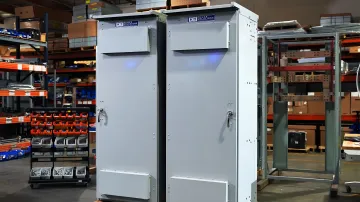
DEI Power operates from a 50,000 sq. ft. facility in Ontario, California, with over 10 years of experience building UL 891-certified low-voltage switchboards for commercial, industrial, utility, and data center applications. As an approved Siemens OEM, they offer vertically integrated manufacturing—design, fabrication, and assembly happen in-house without third-party dependencies.
What sets DEI Power apart:
- Fastest lead times: custom builds ship in 4–6 weeks; in-stock units deliver in 3–5 business days
- Builds switchgear to jobsite-specific voltage (120/240V to 600V), layout, and configuration requirements
- 100% USA manufacturing meets Build America, Buy America (BABA) domestic content requirements for federally funded projects
- No freight charges — all orders ship free with 3–5 business day delivery nationwide
- In-house engineering team provides specification review, CAD layouts, and compliance documentation to reduce RFIs and field change orders
| Certifications & Standards | UL 891 certified low-voltage switchboards; Approved Siemens OEM; BABA-compliant USA manufacturing |
|---|---|
| Voltage & Scope | Low-voltage switchboards (400A–4,000A, up to 600V); NEMA 1 and NEMA 3R enclosures for indoor/outdoor use |
| Key Differentiator | 4–6 week custom builds with free nationwide shipping and included engineering support |
Schneider Electric
Schneider Electric, headquartered in France with extensive US operations, manufactures low-voltage distribution equipment under the Square D brand. Their switchboard portfolio covers data centers, healthcare facilities, and industrial plants, with a focus on energy monitoring and connected infrastructure.
Schneider's strengths:
- Broad product range from standard LV switchboards (QED-2, Speed-D) to integrated energy management systems
- Strong compliance with NEC/NFPA 70 and UL standards, with SCCR up to 200 kA
- Advanced digital monitoring via EcoStruxure Power Monitoring Expert platform, supporting ISO 50001 compliance and real-time power quality analytics
Their scale can translate to longer lead times for custom configurations compared to domestic specialty manufacturers.
| Certifications & Standards | UL listed; IEC compliant; global regulatory approvals across key markets |
|---|---|
| Voltage & Scope | Low- and medium-voltage; horizontal bus rated 1,200A to 5,000A; broad commercial, industrial, and data center coverage |
| Key Differentiator | Integrated energy management and IoT-ready monitoring via EcoStruxure platform |
Eaton Corporation
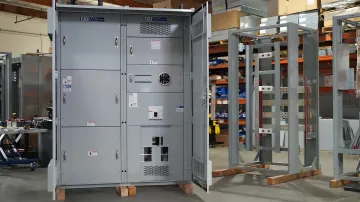
Eaton is a US-headquartered power management company that has manufactured low-voltage switchboards for decades. Their Pow-R-Line product family covers fault tolerance, advanced metering, and ease of maintenance across healthcare, commercial, and industrial segments.
Eaton's differentiators:
- Modular design (Pow-R-Line C and Xpert lines) for easy component replacement and maintenance access
- Sustainability-focused construction aligned with LEED metering certifications
- Broad US service network with 16 satellite locations for lifecycle support
- Amperage ratings from 400A to 6,000A with interrupting ratings up to 200 kAIC
Eaton is the stronger fit for projects where long-term lifecycle support takes priority over rapid custom builds.
| Certifications & Standards | UL 891 listed; NEMA compliant; meets NFPA 70 (NEC) requirements |
|---|---|
| Voltage & Scope | Low-voltage switchboards; commercial buildings, healthcare, and industrial facilities |
| Key Differentiator | Modular, maintenance-friendly design with broad US service network for lifecycle support |
Siemens AG
Siemens manufactures low-voltage switchboards (SB1, SB2, SB3 series) at their North American facility in Fort Worth, TX. Their products deliver modular scalability and IoT integration for industrial, utility, and commercial applications.
Siemens' differentiators:
- Digital integration—connectivity with SCADA and building automation systems via Desigo CC platform using BACnet and Modbus protocols
- Scalable modular architecture with bus ratings up to 6,000A and front-connected designs enabling wall-mounted installation
- Strong component quality backed by decades of R&D; WL breakers available in UL 489 and UL 1066 configurations
Large enterprise buyers benefit from Siemens' global ecosystem. Smaller or time-sensitive projects may face longer lead times through standard ordering channels.
| Certifications & Standards | UL listed; ANSI/IEEE compliant; meets international IEC standards |
|---|---|
| Voltage & Scope | Low- and medium-voltage; industrial plants, utilities, data centers, commercial infrastructure |
| Key Differentiator | Modular scalability and IoT/SCADA integration for smart grid and automation environments |
ABB Ltd.
ABB is a Switzerland-headquartered global technology company with substantial US operations (Houston, TX facility for ReliaGear production). Their low-voltage switchboard offerings are built around energy efficiency, intelligent protection systems, and sustainable design principles.
ABB's differentiators:
- Intelligent arc-fault protection and fault isolation capabilities via Emax 2 air circuit breakers with adaptive protection and cloud connectivity
- Energy optimization algorithms supporting Load Shedding, Power Controller, and Interface Protection functions
- ReliaGear SB series rated up to 6,000A with SCCR up to 200 kA
- Commitment to eco-design with published Environmental Product Declarations (EPDs)
ABB works best for large-scale industrial or utility buyers where energy optimization and global service infrastructure are primary requirements.
| Certifications & Standards | UL listed; IEC 61439 compliant; global certifications across key regulatory markets |
|---|---|
| Voltage & Scope | Low- and medium-voltage; power generation, utilities, large industrial facilities |
| Key Differentiator | Intelligent protection systems and energy optimization algorithms; strong sustainability credentials |
How We Chose the Best Industrial Switchboard Manufacturers
Many buyers default to selecting the largest brand name, which often leads to mismatches between project needs and manufacturer capability. A $200,000 switchboard from a global OEM with a 35-62 week lead time can derail a data center build faster than a specification error.
Five practical criteria anchor this evaluation:
- UL 891 certification (non-negotiable for US code compliance)
- Domestic manufacturing and fulfillment capability
- Customization and engineering support
- Documented lead time performance
- Total cost of procurement (including field change orders, shipping, and commissioning delays)
Tying Evaluation Factors to Business Outcomes
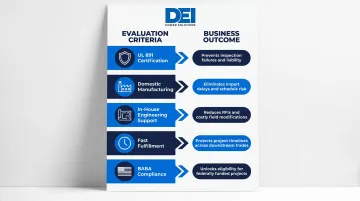
Each factor ties directly to a business outcome on your project:
- UL 891 certification — Protects against inspection failures and liability. All switchboards must carry the WEVZ product category code; verify listings in UL Product iQ before procurement.
- Domestic manufacturing — Cuts schedule risk. CBRE reports record-low 1.4% data center vacancy with 5,994.4 MW under construction—every project competes for the same equipment queue. US-based manufacturers bypass import delays entirely.
- In-house engineering support — Lowers RFI cycles, change orders, and field adjustments. Manufacturers who provide CAD layouts, specification reviews, and compliance documentation before shipment eliminate costly on-site modifications.
- Fast fulfillment — Protects project timelines in healthcare, data center, and industrial construction, where electrical delays cascade across all downstream trades.
- BABA compliance — Unlocks eligibility for federally funded infrastructure and utility projects. The Build America, Buy America Act requires manufactured products to contain more than 55% domestic component cost for federal financial assistance projects obligated after May 14, 2022.
Common Selection Mistakes
- Choosing a manufacturer based on catalog breadth rather than lead time reality
- Overlooking the cost of engineering gaps that result in field modifications
- Failing to verify whether the manufacturer is a true OEM or a reseller—a gap that costs quality control, warranty coverage, and delivery reliability
Conclusion
Selecting the right industrial switchboard manufacturer comes down to fit, not name recognition. The manufacturer whose certification status, lead times, and engineering support match your project's requirements will protect your budget and schedule far better than a familiar brand that can't deliver.
That fit looks different depending on the project: a fast-turn custom build for a data center, BABA-compliant equipment for a utility substation, or lifecycle service support for a healthcare facility. Assess schedule risk and engineering support needs early in procurement — before a spec is finalized and lead times are already locked in.
For contractors, engineers, and facility teams that need UL 891-certified, USA-manufactured switchboards with fast lead times and custom configuration support, DEI Power offers a direct path to procurement. Contact their team at sales@deipower.com or (866) 773-8050 to discuss your project requirements.
Frequently Asked Questions
What are the different types of switchboards?
The three main types are service entrance switchboards (receive power from utility), distribution switchboards (distribute to downstream circuits), and metering switchboards (integrate revenue-grade metering). Industrial applications typically use dead-front, metal-enclosed designs per UL 891.
Are industrial switchboards expensive?
Pricing varies based on amperage rating, section count, overcurrent device type (MCCB vs. ICCB vs. ACB), and customization level. Upfront cost should be weighed against lead time, change order risk, and total installed cost—a $50,000 switchboard delayed by 8 weeks can cost more than a $75,000 unit delivered in 4 weeks.
What is the life expectancy of a switchboard?
Well-maintained UL 891 low-voltage switchboards typically have a useful service life of 25-40 years, depending on load conditions, maintenance history, and environmental factors. Component-level refurbishment can extend service life, but aging breakers and busbars eventually require replacement to maintain safety and code compliance.
Which switchboard breakers are most durable?
Molded case circuit breakers (MCCBs) and insulated case circuit breakers (ICCBs) are the most common options in industrial switchboards. Durability depends on interrupting capacity, operating environment, and load cycle ratings—ICCBs also carry short-time withstand (Icw) ratings that support selective coordination.
Who makes UL 891 switchboards?
Key US manufacturers of UL 891-certified switchboards include DEI Power (with in-house California manufacturing and BABA compliance), as well as larger OEMs like Eaton, Siemens, Schneider Electric, and ABB. UL 891 applies specifically to dead-front low-voltage switchboards—verify WEVZ category listing in UL Product iQ before procurement.