Introduction
A NEMA 12 enclosure subjected to hose-directed washdowns fails prematurely — because NEMA 4 was required. A NEMA 1 unit installed in a moisture-laden industrial environment accelerates corrosion and increases arc flash risk. These aren't edge cases. Misapplied enclosure ratings cause code violations and field corrections that ripple through project schedules and budgets.
For engineers, contractors, and facility teams specifying enclosures in power distribution environments, understanding how NEMA types map to IP equivalents — and where that mapping breaks down — is a practical requirement. The cross-reference runs one direction: NEMA ratings meet or exceed IP minimums, but an IP rating alone cannot satisfy NEMA requirements.
This guide covers the structural differences between both systems, how testing protocols diverge, and the specification pitfalls that affect switchgear, panelboards, and distribution equipment reliability.
Key Takeaways
- NEMA ratings (NEMA 250) cover ingress plus corrosion, ice, and hazardous locations; IP ratings (IEC 60529) address only solid/liquid ingress
- No direct 1:1 conversion exists—NEMA typically meets or exceeds IP equivalents, but not vice versa
- Key industrial types: NEMA 1 (IP10), 3R (IP14), 4 (IP66), 4X (IP66 + corrosion), 12 (IP52)
- Look for UL-listed enclosures—third-party certification provides stronger assurance than manufacturer self-declaration
- Match ratings to actual site conditions using engineering judgment—cross-reference tables are a starting point, not a final answer
What NEMA Enclosure Ratings Represent and Where IP Fits In
NEMA 250: The North American Standard
ANSI/NEMA 250-2020, approved December 8, 2020, defines enclosure protection for electrical equipment rated 1,000 V maximum. Developed by the National Electrical Manufacturers Association, the standard classifies how well enclosures protect personnel from contact with live parts and shield internal components from environmental threats.
NEMA ratings evaluate protection against:
- Solid particle and liquid ingress
- Corrosion and rust
- External ice formation
- Oil and coolant exposure
- Hazardous atmospheres in classified locations
IEC 60529: The International Framework
IEC 60529 Ed. 2.2 b:2013, published by the International Electrotechnical Commission, establishes the IP (Ingress Protection) rating system used globally. The standard applies to enclosures for equipment up to 72.5 kV and focuses on solid particle and liquid ingress protection only.
The IP code uses two digits:
- First digit (0-6): Protection against solid objects and dust
- Second digit (0-9K): Protection against water ingress
Scope Difference: Why the Two Systems Don't Map Cleanly
IP ratings cover ingress only. NEMA ratings govern construction quality, environmental durability, and hazardous location performance — a broader scope that IP testing doesn't replicate. An IP66 enclosure protects against powerful water jets, but IEC 60529 does not test for corrosion resistance, gasket aging, ice formation, or oil exposure — all factors NEMA 250 addresses.
The result is a one-directional cross-reference: a NEMA 4X enclosure meets IP66 requirements, but an IP66 enclosure does not satisfy NEMA 4X specifications.
NEMA Ratings Are Not Sequential
That one-directional relationship becomes clearer once you understand how NEMA types are structured. Unlike intuitive numbering systems, NEMA types don't increase in protection as numbers rise. NEMA 12 provides less water protection than NEMA 4, yet covers circulating dust that NEMA 4 doesn't specifically address. Letter suffixes like "X" denote additional properties — corrosion resistance, in most cases — rather than a higher overall protection tier.
NEMA Enclosure Types and Their IP Equivalents Explained
NEMA-to-IP Cross-Reference Table
| NEMA Type | IP Equivalent | Key Protection | Typical Use |
|---|---|---|---|
| 1 | IP10 | Personnel contact, falling dirt | Indoor electrical rooms |
| 2 | IP11 | Dripping water, falling dirt | Indoor condensation areas |
| 3 | IP54 | Rain, sleet, windblown dust, ice | Outdoor utility enclosures |
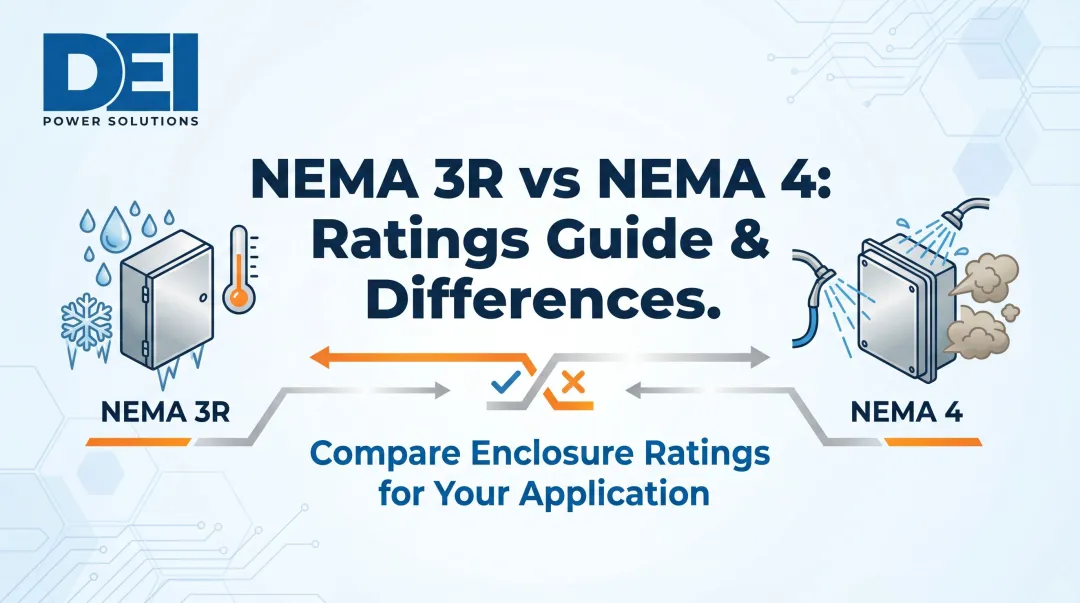
| 3R | IP14 | Rain, sleet, ice (no dust protection) | Outdoor metering, pad-mounted gear |
| 4 | IP66 | Hose-directed water, dust, ice | Industrial washdown areas |
| 4X | IP66 | NEMA 4 + corrosion resistance | Coastal, chemical, food processing |
| 12/12K | IP52 | Circulating dust, dripping liquids | Manufacturing control panels |
| 13 | IP54 | Dust, spraying water, oil, coolants | Machine tool environments |
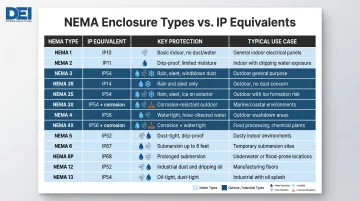
Source: Mersen NEMA Ratings Cross-Reference
Critical note: This table shows minimum IP equivalents that NEMA types meet or exceed. It cannot be used in reverse—specifying IP66 does not guarantee NEMA 4 compliance.
The following breakdown covers each NEMA type in detail — what it protects against, where it's used, and where it falls short.
Indoor NEMA Types
NEMA 1 (IP10/IP20 approximate) The baseline indoor enclosure protects against incidental personnel contact with live parts and falling dirt. It offers no liquid protection, making it suitable only for dry, climate-controlled environments — office electrical rooms, clean control rooms, and similar low-exposure spaces.
NEMA 2 (IP11) Adds limited protection against dripping water or light splashing beyond NEMA 1. Suited for environments with condensation risk such as laundry facilities or cooling areas. Rarely specified in power distribution applications.
NEMA 12 and 12K (IP52) The standard industrial indoor enclosure protects against circulating dust, lint, fibers, and dripping or light splashing of non-corrosive liquids. Widely deployed in manufacturing plants and industrial control panels that don't require full washdown capability. Does not protect against hose-directed water or corrosive atmospheres.
Outdoor and Industrial NEMA Types
NEMA 3 and 3R (IP54/IP14 approximate) Both ratings handle rain, sleet, snow, and external ice formation — but they diverge on one critical point: NEMA 3 protects against windblown dust (IP54); NEMA 3R omits dust protection entirely (IP14).
NEMA 3R is sufficient for most outdoor utility and metering applications where airborne particulate isn't a concern. DEI Power's NEMA 3R switchboards are rain-tested in-house to confirm long-term durability in exterior installations.
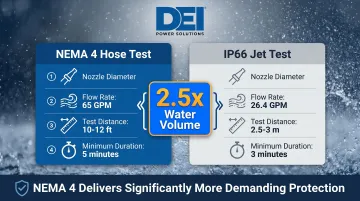
NEMA 4 (IP66 approximate) The workhorse of industrial outdoor enclosures. Rated for hose-directed water, splashing water, windblown dust, and ice formation. The NEMA 4 hose test is significantly more demanding than IP66:
NEMA 4 Hose Test Parameters:
- Nozzle diameter: 1 inch (25.4 mm)
- Flow rate: 65 gallons per minute (GPM)
- Distance: 10-12 feet from enclosure
- Duration: 5 minutes minimum
IP66 Jet Test Parameters:
- Nozzle diameter: 12.5 mm
- Flow rate: 100 liters/minute (~26.4 GPM)
- Distance: 2.5-3 meters
- Duration: 3 minutes minimum
NEMA 4 delivers nearly 2.5 times the water volume at greater distance — showing why IP equivalents understate NEMA 4's actual protection.
NEMA 4X (IP66 approximate) Identical to NEMA 4 in ingress protection but adds corrosion resistance requirements. Critical for coastal installations, chemical processing, food and beverage facilities, and wastewater treatment plants. The shared IP66 equivalent between NEMA 4 and 4X reveals IP rating limitations—IP66 does not address corrosion at all.
Key Structural Differences Between NEMA and IP Rating Systems
Protections NEMA Includes That IP Does Not
| Protection Category | NEMA Types | Addressed by IP? |
|---|---|---|
| Corrosion resistance | 3X, 3RX, 4X, 6P | No |
| Ice formation functionality | 3, 3R, 4, 6 | No |
| Oil and coolant resistance | 12, 13 | No |
| Hazardous location classification | 7, 8, 9 | No |
| Gasket aging and UV resistance | Outdoor types | No |
The NEMA FAQ explicitly states: "It is not possible to state that an IP degree rating is equivalent to a NEMA Type designation" because NEMA addresses icing, corrosion, and construction details IP ratings ignore.
IP Ratings Are Not Cumulative
A critical and often-misunderstood characteristic: water protection ratings above IPX6 are not cumulative. A device rated IPX7 (temporary immersion) is not automatically compliant with IPX5 or IPX6 (water jets) unless separately tested and marked as IPX5/IPX7.
DEKRA Testing confirms: "IP ratings are not cumulative—an IP67 device is not automatically protected against jets (IPX5/6) without testing." This means an enclosure designed to withstand submersion may fail under direct spray conditions.
Self-Certification vs. Third-Party Verification
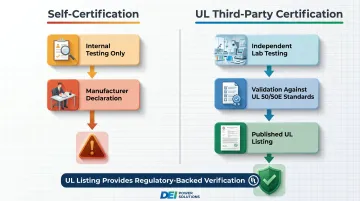
Beyond how ratings are structured, how they're verified matters just as much. Both NEMA and IP ratings permit manufacturer self-certification. The NEMA FAQ (Q5) states: "A manufacturer can choose to self-certify that the product meets the enclosure requirements of NEMA 250 or to seek independent, third-party certification."
This creates a meaningful reliability gap:
- Manufacturers test internally and declare compliance without external review
- Independent labs (such as UL) validate performance against the same standard before any rating is published
For mission-critical power distribution, third-party certification is the standard. A UL listing gives engineers and procurement teams documented proof of performance — not just a manufacturer's claim on a spec sheet.
How Enclosure Ratings Are Tested and Certified
NEMA 250 and IEC 60529 Test Methods
Both standards define specific test procedures, but parameters often differ. The NEMA 4 versus IP66 water test comparison above illustrates this gap—similar intent, different execution, non-equivalent results.
Dust tests also differ in airflow duration, particulate size, and pressure differential requirements between systems. An enclosure passing IEC 60529 IP5X (dust-protected) testing may not satisfy NEMA 12 requirements, which include longer exposure periods and different test chamber conditions.
UL Certification and NEC Compliance
UL 50 and UL 50E cover enclosure construction (structural integrity) and environmental considerations (rain, dust, corrosion testing) respectively. These standards form the foundation for UL Type ratings applied to North American enclosures.
UL 891 establishes requirements for switchboards rated 1,000 V or less. This standard references UL 50/50E for enclosure specifications and is the basis for switchboard listing.
NEC Requirements:
- NEC 110.3(B): Equipment must be listed, labeled, and installed per manufacturer instructions
- NEC Article 408: Switchboards, switchgear, and panelboards shall be listed (references UL 891)
- NEC 110.28: IP ratings are not a substitute for Enclosure Type ratings in U.S. installations
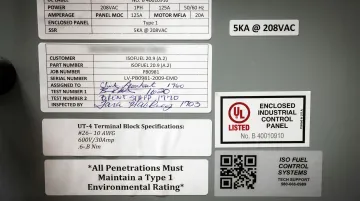
DEI Power's UL 891-certified switchboards undergo independent testing that verifies the complete assembly—enclosure, internal components, and construction—against established safety and performance standards. Code-compliant installations require this certification, and authorities having jurisdiction (AHJs) enforce it.
The UL NRTL Distinction
UL LLC operates as an OSHA-recognized Nationally Recognized Testing Laboratory (NRTL) under 29 CFR 1910.7. This recognition authorizes UL to perform independent safety certification for electrical products. Unlike self-certified NEMA ratings, UL listing provides third-party verification backed by regulatory oversight and standardized testing protocols.
Common Misconceptions and Specification Pitfalls
Misconception 1: Cross-Reference Tables Work Both Ways
The most dangerous assumption: treating NEMA-to-IP tables as bidirectional equivalents. Mersen's cross-reference document warns: "The table should not be used to convert 'from IP Rating to NEMA.'"
The reality: A NEMA 4X enclosure meets IP66 requirements. An IP66 enclosure does not meet NEMA 4X specifications because IP66 testing excludes:
- Corrosion resistance evaluation
- Ice formation functionality
- Gasket aging under UV exposure
- The more demanding NEMA 250 hose test parameters
Specifying IP66 for a coastal switchgear installation misses the corrosion protection NEMA 4X provides, leading to premature failure.
Misconception 2: Under-Specifying Based on Environment
Using NEMA 12 (indoor industrial) in environments requiring NEMA 4 or 4X is a common error. This occurs when:
- Switchgear receives partial outdoor exposure during construction
- Industrial facilities perform periodic washdown cleaning
- Condensation or moisture-laden atmospheres exist near equipment
The consequence: accelerated corrosion, insulation breakdown, and increased arc flash risk from moisture ingress into energized components. Confirming actual site exposure conditions before procurement — not after — is the only reliable way to avoid this failure mode.
Misconception 3: Higher Numbers Mean Better Protection
NEMA ratings don't follow linear progression. Consider:
- NEMA 13 protects against oil and coolant spray but is limited to indoor use
- NEMA 4 handles hose-directed water and outdoor conditions but doesn't address oil/coolant
- NEMA 6 provides submersion protection but adds unnecessary cost/weight when NEMA 4 is sufficient
Specifying NEMA 6 or 6P (submersible) for applications needing only NEMA 4 adds expense, installation complexity, and weight without functional benefit. Select the rating that matches documented site conditions. A higher number on the nameplate does not improve performance in an application the lower-rated enclosure already handles.
Conclusion
NEMA enclosure ratings and IP equivalents are complementary classification systems with important non-overlapping coverage. NEMA 250 addresses environmental factors—corrosion, ice formation, oil resistance—that IEC 60529 does not evaluate. IP ratings provide internationally recognized ingress protection standards but cannot substitute for NEMA requirements in NEC-governed installations.
Selecting the right rating requires understanding what each system covers and what it omits. For power distribution and switchgear environments, environmental mismatches compromise safety, reliability, and code compliance. Cross-reference tables show minimum equivalents, not bidirectional substitutes.
Those cross-references only hold when the equipment behind them is independently verified. Third-party certification through UL listing confirms that ratings are legitimate and that the assembly meets NEC requirements — not just the enclosure, but components and construction together. DEI Power's UL 891-certified switchboards undergo complete assembly testing to that standard. For projects where uptime matters and code compliance is mandatory, independently certified equipment with clear documentation is the starting requirement, not an optional upgrade.
Frequently Asked Questions
What is the difference between NEMA and IP?
NEMA ratings (NEMA 250) are a North American standard covering ingress protection plus corrosion, ice formation, and hazardous location requirements. IP ratings (IEC 60529) are international and address only solid particle and liquid ingress. The systems are comparable but not directly equivalent—NEMA provides broader environmental protection than IP.
What IP rating is NEMA 1?
NEMA 1 corresponds approximately to IP10 or IP20, offering protection only against personnel contact and falling dirt with no liquid protection. It is designed for dry, clean indoor use only — electrical rooms and climate-controlled control panel areas.
What is the NEMA equivalent to IP65?
IP65 is approximately equivalent to NEMA 4, both requiring dust-tight construction and protection against water jets. However, NEMA 4 adds ice formation resistance that IP65 does not test, and NEMA 4X further includes corrosion resistance not covered by IP65.
Can NEMA 1 be used outside?
No. NEMA 1 is rated for indoor use only and provides no protection against rain, moisture, dust ingress, or any liquid. Outdoor installations require minimum NEMA 3R, with NEMA 4 or higher recommended based on site conditions.
Is UL Type 1 the same as NEMA 1?
UL Type 1 enclosures are defined under UL 50 and align closely with NEMA 1 requirements. The distinction: UL Type designations require independent testing and certification by Underwriters Laboratories, whereas NEMA ratings can be self-certified by manufacturers without third-party validation.
Is IP65 suitable for heavy rain?
IP65 protects against low-pressure water jets from any direction and generally handles rain. However, it is not rated for hose-directed or high-pressure water. For sustained outdoor exposure including heavy rain or washdown, IP66 (NEMA 4 equivalent) or higher is recommended.