Getting the choice right means understanding where each type belongs in a power system — not just what voltage class it carries.
Key Takeaways
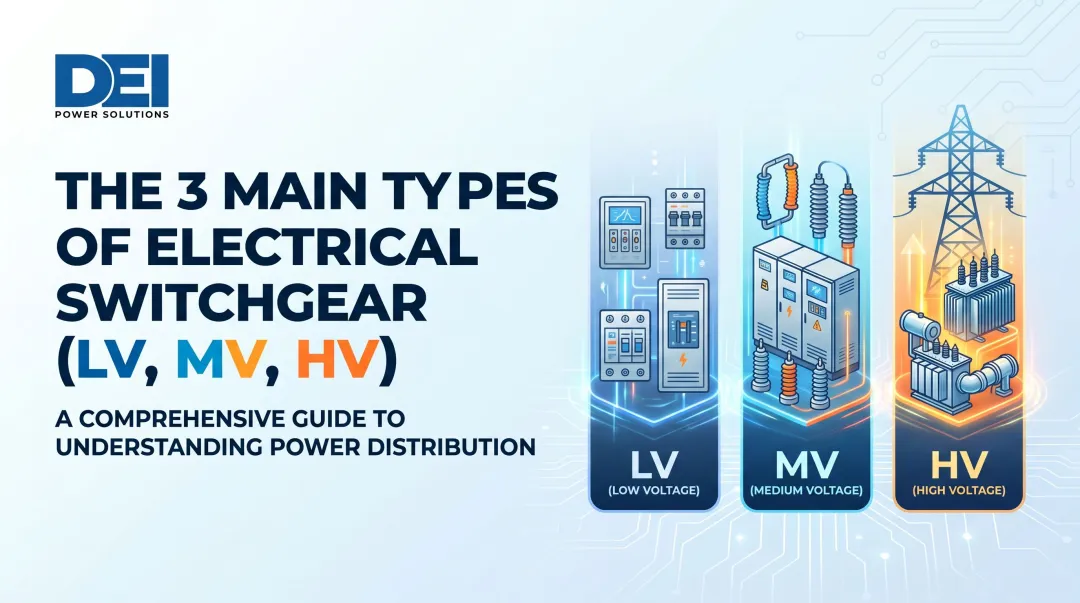
- LV switchgear operates up to 1,000V (per NEC 2014 / ANSI C84.1) and handles final power distribution inside facilities
- MV switchgear operates between 1kV and 35kV (some standards extend to 69kV) for utility-level distribution and large industrial feeds
- LV equipment is faster to procure, easier to install, and has broader contractor support
- MV switchgear carries higher arc flash risk, longer lead times, and requires more complex installation
- Both types frequently coexist in a single facility — they're complementary, not competing
Low Voltage vs. Medium Voltage Switchgear: Quick Comparison
Here's how the two categories compare across the factors that matter most for project planning and equipment selection.
| Category | Low Voltage | Medium Voltage |
|---|---|---|
| Voltage Range | Up to 1,000V (ANSI C84.1 / NEC 2014) | 1kV to 35kV; some standards to 69kV |
| Typical Applications | Building distribution, data centers, hospitals, manufacturing floors | Utility substations, campus feeds, industrial plants, large incoming service |
| Governing Standards | UL 891, UL 1558, IEEE C37.20.1 | IEEE C37.20.2 (metal-clad), C37.20.3 (metal-enclosed), C37.74 (pad-mounted) |
| Equipment Cost | Lower; standardized components | Higher; specialized construction and testing |
| Lead Times | Shorter; broader contractor availability | Pre-COVID: 12–16 weeks; post-pandemic: 26–32 weeks |
| Arc Flash Risk | Lower in most configurations | Significantly higher; arc-resistant ratings often required |
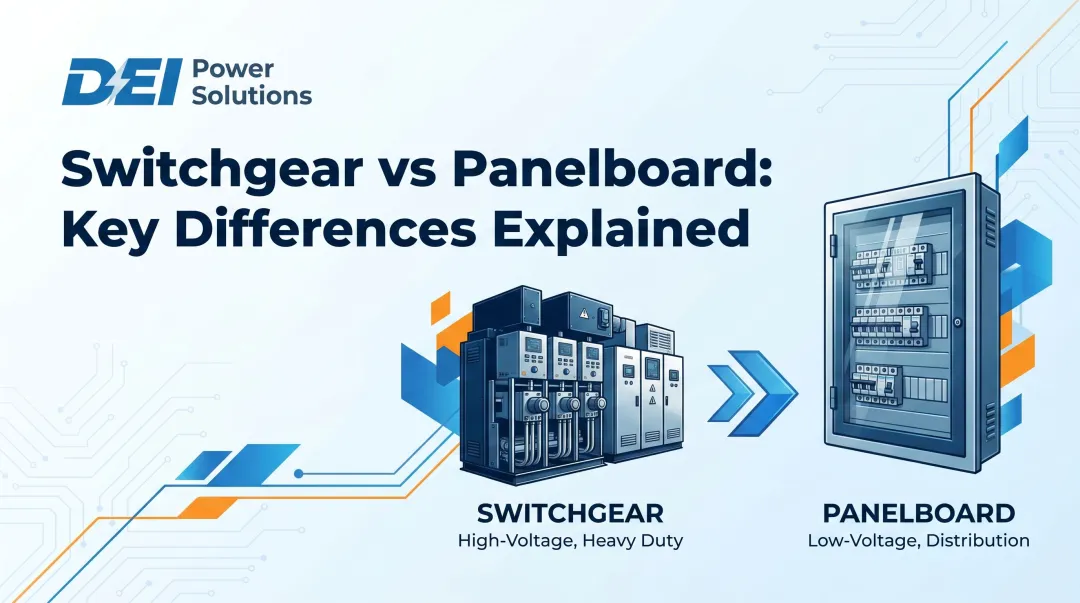
| Physical Footprint | More compact | Larger; requires dedicated space and safety clearances |
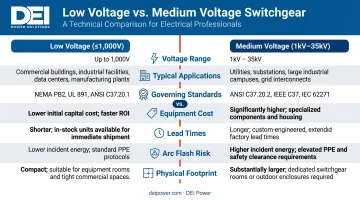
The sections below break down each category in detail — starting with how voltage range and application type drive the initial selection decision.
What Is Low Voltage Switchgear?
Low voltage switchgear is a metal-enclosed assembly of circuit protection devices — circuit breakers, fuses, disconnect switches, and protective relays — designed to control, protect, and distribute power at voltages up to 1,000V AC (per IEEE C37.20.1 and ANSI C84.1). It's the last active switching stage before power reaches individual loads inside a facility.
How the Components Work Together
Each element has a specific job:
- Circuit breakers interrupt fault current before it damages downstream equipment
- Protective relays detect abnormal conditions and trigger the appropriate response
- Disconnect switches allow safe isolation of sections for maintenance without de-energizing the full assembly
- Metal enclosure provides physical protection and contains fault energy
Draw-out breaker configurations add another practical advantage: breakers can be moved into test or disconnect positions and withdrawn for service without removing load cables. In facilities where unplanned downtime carries real operational cost, that serviceability matters.
Standards and Naming Conventions
The terminology in this space creates genuine confusion in the market. Here's what the standards actually cover:
- UL 1558 — Metal-enclosed low-voltage power circuit breaker switchgear assemblies; more stringent construction requirements, including compartmentalization barriers and 30-cycle withstand testing
- UL 891 — Switchboards rated 1,000V or less; typically used for commercial and industrial distribution with 3-cycle withstand testing
- IEEE C37.20.1 — Metal-enclosed LV power circuit breaker switchgear, 1,000V AC and below, 3,200V DC and below
The practical distinction: UL 1558 switchgear is specified for critical infrastructure — healthcare, data centers, airports, industrial facilities — where fault interrupting performance and compartmentalization are non-negotiable. UL 891 switchboards cover a wider range of commercial and industrial distribution applications where those requirements are less demanding.
Where LV Switchgear Gets Deployed
Primary environments include:
- Commercial office buildings and campuses
- Hyperscale and enterprise data centers
- Healthcare facilities (imaging equipment loads, critical distribution)
- Manufacturing and industrial plants
- Utility endpoint distribution
- Telecommunications and edge compute infrastructure
Even in facilities with a medium voltage incoming service, LV switchgear still plays a central role — it handles all distribution downstream of the step-down transformer. The North America LV switchgear market is projected to grow from $12.98 billion in 2025 to $17.02 billion by 2030 — a figure that reflects how foundational this equipment is across virtually every built environment.
DEI Power manufactures UL 891-certified switchgear assemblies from 400A to 4000A, built with certified Siemens components at their Ontario, California facility. Custom configurations across standard voltage options — 208Y/120V, 480V, 480Y/277V, and others — ship with full submittals and compliance documentation.
What Is Medium Voltage Switchgear?
Medium voltage switchgear covers equipment rated between 1kV and 35kV (some standards extend to 69kV), used where power must travel at higher voltages to reduce transmission losses over distance or serve large load concentrations before stepping down to LV. Utilities controlled 44.9% of global MV switchgear spending in 2025, reflecting how dominant this segment is in grid-scale and large infrastructure applications.
MV Switchgear Types
Three primary configurations, each governed by a distinct IEEE standard:
- Metal-clad (IEEE C37.20.2) — Fully compartmentalized with draw-out breakers; air at ambient pressure as primary insulation medium; rated 5kV–38kV; highest construction standard for industrial and utility use
- Metal-enclosed interrupter (IEEE C37.20.3) — Less compartmentalization than metal-clad; rated above 1kV up to 48.3kV; common in commercial and industrial applications
- Pad-mounted/vault (IEEE C37.74) — Designed for outdoor or underground utility distribution up to 38kV; used in campus feeds and utility last-mile distribution
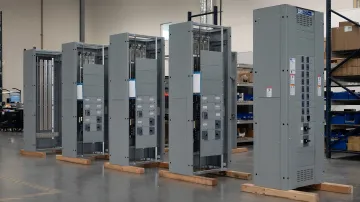
Insulation Medium Options
The insulation medium affects footprint, maintenance frequency, and environmental risk:
- Air-insulated (AIS) — Most common; held 43.1% of the MV switchgear market in 2025; no special handling, but larger physical footprint
- Gas-insulated with SF6 (GIS) — Compact and high-performance, but SF6 carries a global warming potential roughly 23,000–25,000 times higher than CO₂, and California's CARB regulations began phasing it out in 2025
- Vacuum interrupters with clean air — Emerging alternative to SF6; combines vacuum arc suppression with non-hazardous insulating medium
Safety Considerations
MV systems introduce hazards that require purpose-built protocols:
- Arc flash incident energy is substantially higher than most LV configurations — project-specific calculations under IEEE 1584-2018 and NFPA 70E are required before any work near energized MV equipment
- IEEE C37.20.7 governs arc-resistant switchgear testing up to 52kV; arc-resistant enclosures are standard specification on many MV projects
- Remote racking procedures and specialized PPE are required for breaker operations
These safety requirements tie directly to the equipment's electrical ratings. Continuous current ratings run from 1,200A to 4,000A, with interrupting ratings reaching up to 63kAIC symmetrical. Engineers must confirm both against project-specific fault current calculations before finalizing equipment selection.
Where MV Switchgear Gets Deployed
- Utility substations and transmission infrastructure
- Large industrial plants and processing facilities
- Multi-building campuses with centralized distribution
- Hospitals with large incoming service feeds
- Data centers with utility-scale power requirements
The global MV switchgear market is projected at $43.47 billion in 2026, reaching $55.08 billion by 2031 — growth driven by aging grid upgrades, industrial capacity expansion, and the infrastructure demands of large-scale solar and storage projects.
Key Differences That Drive the Decision
System Position Determines the Choice
The decision between LV and MV switchgear is determined by where in the power system the equipment needs to sit — not by preference or budget alone.
- MV switchgear belongs at the service entrance or distribution backbone when the utility delivers power above 1kV
- LV switchgear belongs at the distribution end, serving loads inside buildings or downstream of a step-down transformer
If the utility feed exceeds 1kV, MV equipment handles it first. After the transformer, LV takes over.
Cost and Project Complexity
That system position difference drives real cost and schedule consequences. No single published benchmark separates per-unit costs cleanly, but the complexity drivers are well understood:
| Factor | LV Switchgear | MV Switchgear |
|---|---|---|
| Equipment Cost | Lower; standardized construction | Higher; compartmentalization, arc-resistant testing |
| Lead Times | Faster; broader supply chain | Post-pandemic: 26–32 weeks for MV equipment |
| Installation Labor | Wider pool of certified contractors | Requires specialized MV-rated crews |
| Commissioning | Established UL-based compliance pathway | More rigorous; arc flash studies, protective relay coordination |
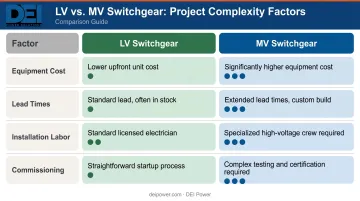
DEI Power's in-stock LV assemblies ship in 3–5 business days nationwide. Custom-configured units typically complete in 4–6 weeks. That gap versus 26–32 weeks for MV procurement can delay energization by months on projects where power distribution is on the critical path.
Standards and Safety Gap
Beyond procurement timelines, the compliance requirements between LV and MV diverge significantly — and that gap affects everything from contractor selection to commissioning scope:
- LV switchgear under UL 891 or UL 1558 follows well-established construction and testing requirements accessible to most certified electrical contractors
- MV switchgear requires compliance with IEEE C37.20.2 or C37.20.3 construction standards, arc-resistant testing per IEEE C37.20.7, and project-specific arc flash analysis under IEEE 1584-2018 before any maintenance activity
The 600V–1,000V Overlap Zone
Engineers specifying equipment in the 600V–1,000V band face a standards boundary that creates real specification risk. Before NEC 2014, most standards treated 600V as the LV ceiling. ANSI C84.1 and NEC 2014 now define LV as 1,000V or below, and IEEE C37.20.1 covers metal-enclosed LV switchgear up to 1,000V AC.
Don't rely on voltage class labels alone in this range. Verify the equipment standard, listed rated maximum voltage, interrupting rating, and applicable code edition before selecting a UL 891 switchboard versus UL 1558 switchgear in this zone. Over-engineering a 600V distribution circuit as MV creates unnecessary cost; under-specifying a 900V industrial feed creates compliance and safety exposure.
When to Choose Each Type
Specify MV switchgear when:
- The incoming utility service exceeds 1kV
- Distributing power across a large campus or industrial complex
- Load density requires voltage levels above LV limits
- The project involves a utility substation or grid-interconnect point
Specify LV switchgear when:
- Incoming power has already been stepped down by a transformer
- Handling building-level or floor-level distribution
- Adding modular capacity to an existing LV distribution system
- Project timelines require faster procurement and installation
Conclusion
LV and MV switchgear serve different positions in the same power system — the choice comes down to where your equipment operates, what voltage the utility delivers, and what the load requires.
For engineers and contractors specifying the LV distribution layer, getting it right upfront eliminates the change orders, code reviews, and schedule delays that come from under- or over-specified equipment.
DEI Power's UL 891-certified switchgear is available in standard configurations from 400A to 4000A and custom-built to project-specific voltage, layout, and jobsite requirements. Submittals and compliance documentation are included with every order, and engineering support is available from spec to installation.
Reach the team at (866) 773-8050 or sales@deipower.com.
Frequently Asked Questions
What is the difference between low voltage and medium voltage switchgear?
LV switchgear distributes power up to 1,000V inside facilities — the final stage before loads. MV switchgear operates between 1kV and 35kV for utility-level distribution or large industrial feeds. Both types commonly coexist in a single facility, with MV handling the incoming service and LV handling building distribution downstream of a transformer.
What is medium voltage switchgear?
MV switchgear is metal-enclosed equipment rated 1kV to 35kV under most standards, used for utility distribution, large industrial plant feeds, and campus-level power delivery. It steps down to LV via transformers before power reaches building loads.
What voltage is considered low voltage in switchgear?
ANSI C84.1 and NEC 2014 define LV as 1,000V or less. Older product standards like UL 891 and legacy ANSI/IEEE references used 600V as the ceiling. The applicable standard for your specific project — not a general label — determines which definition governs equipment selection.
Can low voltage and medium voltage switchgear be used in the same facility?
Yes — this is standard practice. MV switchgear handles the incoming utility service, a step-down transformer reduces the voltage, and LV switchgear then distributes power throughout the building. Most large commercial, industrial, and healthcare facilities are configured this way.
What standards apply to low voltage switchgear?
The primary standards are UL 1558 (metal-enclosed LV power circuit breaker switchgear), UL 891 (switchboards rated 1,000V or less), and IEEE C37.20.1 (metal-enclosed LV switchgear up to 1,000V AC). Each defines construction, testing, and performance requirements for code-compliant installations.
Which type of switchgear costs more — low voltage or medium voltage?
MV switchgear costs more across the board — higher equipment prices, lead times of 26–32 weeks post-pandemic, specialized labor, and more rigorous commissioning. LV switchgear offers faster procurement, broader contractor availability, and a simpler compliance pathway.