
This guide covers the full picture: how reliability is defined and measured, what causes distribution failures, proven improvement strategies, and how equipment selection — particularly switchgear — shapes long-term uptime.
Key Takeaways
- SAIDI, SAIFI, and CAIDI are the standard reliability benchmarks — MED exclusions can skew comparisons significantly
- Most distribution failures fall into three categories: weather exposure, equipment degradation, and design gaps
- Reliability must be built in at every phase — from design and equipment selection through commissioning and maintenance
- Specifying UL 891-certified, properly rated switchgear is one of the highest-leverage decisions you can make at the design stage
- Condition-based maintenance and real-time monitoring protect uptime once the system is running
Understanding Power Distribution Reliability and How It's Measured
Power distribution reliability means delivering power consistently, without unplanned interruptions, over a defined period. That's distinct from power quality — which covers voltage sags, harmonics, and waveform distortions. Both matter, but they require different solutions. Reliability specifically is measured using standardized indices defined in IEEE Std 1366-2022, which establishes consistent terminology and promotes uniform reporting across utilities and facility teams. These indices allow meaningful benchmarking, provided the same measurement basis is applied consistently.
Reliability Indices: SAIDI, SAIFI, CAIDI, and MAIFI
The EIA's 2024 reliability table reports the following U.S. averages using the IEEE method:
| Metric | Definition | With MEDs | Without MEDs |
|---|---|---|---|
| SAIDI | Average total outage minutes per customer/year | 662.6 min | 131.6 min |
| SAIFI | Average outage events per customer/year | 1.531 | 1.065 |
| CAIDI | Average minutes per outage event (SAIDI ÷ SAIFI) | 432.7 min | 123.6 min |
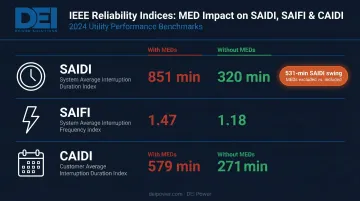
The 531-minute swing in SAIDI — depending on whether Major Event Days are included — shows why the MED basis must always be stated when benchmarking. A facility comparing itself to "the national average" without knowing which figure applies may be understating or overstating its actual performance gap.
MAIFI (Momentary Average Interruption Frequency Index) tracks sub-5-minute interruptions. These brief events don't show up in SAIDI or SAIFI, but they can trip drives, controls, and digital equipment. For industrial plants, data centers, and healthcare facilities, even a momentary voltage loss can disrupt processes — so MAIFI deserves equal attention alongside the longer-duration indices.
Common Causes of Power Distribution Failures
Most failures aren't random. They trace back to predictable categories:
Weather and environmental exposure
- Approximately 83% of reported major U.S. outages from 2000–2021 were weather-related, per DOE
- Storm exposure, humidity cycling, and contamination accelerate insulation and contact degradation
Equipment degradation
- Aging breakers, corroded contacts, and worn switching mechanisms are leading silent failure drivers
- Rising contact resistance at terminations and busbars generates localized heat that cascades before any visible symptom appears
- IEEE 1015 identifies micro-ohm contact resistance measurement as a standard diagnostic for low-voltage circuit breakers — a test most facilities skip between scheduled maintenance cycles
Design-related vulnerabilities
- Inadequate protection coordination, undersized equipment, and no redundancy built into the system
- Radial distribution systems are especially exposed: one failed link takes down the entire downstream path, with no alternate supply route
- Increasing load complexity — more power-electronic equipment, decentralized generation, denser digital infrastructure — amplifies these vulnerabilities in modern facilities
Each of these categories is addressable. The next sections cover the design strategies, maintenance practices, and equipment choices that reduce exposure across all three.
How to Improve Power Distribution Reliability: Key Strategies
Reliability improvements don't work as isolated fixes. They have to be built into every phase — design, commissioning, operations, and ongoing maintenance — to hold up under real-world conditions.
System Design and Protection Coordination
A well-designed system starts by defining clear boundaries, interfaces, and operating conditions before anything gets built. The most practical design principle here is selective protection coordination: when a fault occurs on one circuit, only the nearest upstream breaker trips. Everything else stays live.
Pre-engineered or validated reference designs that incorporate selective coordination reduce the guesswork. Skipping coordination studies at the design stage is one of the most common ways facilities end up with protection schemes that look compliant on paper but cause cascading trips under real fault conditions.
Infrastructure Hardening
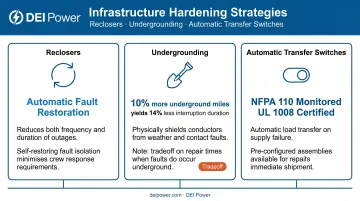
Three proven upgrades that directly reduce SAIDI and SAIFI:
- Reclosers — installed at strategic feeder locations, they automatically restore power after transient faults, cutting both interruption frequency and duration
- Undergrounding — DOE's 2024 undergrounding guide shows a 10% increase in underground line miles correlates with a 14% reduction in annual interruption duration; the tradeoff is that underground repair times can be 5–46% longer than overhead during major storm events, so selective application matters
- Automatic Transfer Switches (ATS) — monitored per NFPA 110 and certified under UL 1008, ATS units transfer load to emergency or standby power when normal supply fails; reliability gains depend on the backup source, transfer controls, coordination, and maintenance all being properly configured together
Smart Grid and Monitoring Technology
Real-time monitoring gives facility teams visibility into hidden risk before an outage occurs. DOE's Smart Grid Investment Grant study confirmed that automated feeder switching, reclosing, and outage detection deliver measurable reductions in both SAIFI and SAIDI. At the facility level, the practical toolkit includes:
- Advanced power meters and thermal sensors for detecting thermal anomalies and load imbalances
- Fault detection systems that can isolate affected segments quickly, containing the impact of any single failure
- Automated switching devices that restore normal operation without requiring manual crew response
Backup Power and Power Conditioning
For loads where any interruption is unacceptable — healthcare, data centers, industrial processes — backup and conditioning systems form a second line of defense:
- UPS systems bridge the gap during transfer to backup sources
- Generators provide sustained backup capacity
- Solid-state transfer switches offer faster transfer times than mechanical ATS
- Power conditioning systems address power quality issues that affect sensitive downstream equipment
These systems don't replace upstream reliability improvements. They protect critical loads during the window between a supply failure and full restoration — making equipment selection, transfer speed, and coordination just as important as the backup source itself.
Choosing the Right Switchgear for Reliable Power Distribution
Switchgear is the primary protection, isolation, and control point for the entire downstream distribution network. A poorly specified or non-compliant switchboard creates risk that's expensive to fix once the equipment is in place.
Key Specification Criteria
When specifying low-voltage switchboards, the non-negotiables are:
- UL 891 certification — the common North American standard for dead-front switchboards rated 600V or less; UL's General Coverage program allows approved manufacturers to apply the UL Mark under defined design and quality-control requirements
- Voltage and ampacity match — equipment must be rated for the actual application, not specified to the nearest standard catalog option
- Interrupting capacity — switchboards must be rated for the available fault current at the installation point; NEC 408.6 requires short-circuit current rating marking on switchboards and panelboards
- Configuration flexibility — the ability to match the facility's specific load layout and accommodate future growth without field modifications
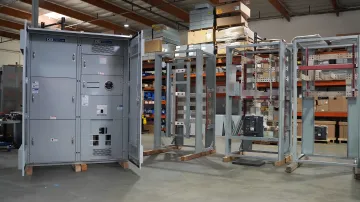
DEI Power's UL 891-certified switchboard line covers 400A to 4000A across seven standard voltage configurations — 120/240V through 480Y/277V — with both NEMA 1 (indoor) and NEMA 3R (outdoor) enclosures. DEI Power builds each unit with genuine Siemens components as an approved Siemens OEM, providing component traceability and manufacturing consistency that directly supports long-term reliability.
Lead Times and Sourcing Risk
Switchgear delivery delays are a real schedule risk — one that often doesn't surface until a project is already behind. When gear doesn't arrive on time, projects stall, workarounds get improvised, and field substitutions create configuration problems for the commissioning crew.
DEI Power keeps inventory on hand at its 50,000 sq. ft. Ontario, California facility, with in-stock units shipping in 3–5 business days. Custom-configured switchboards are typically completed in 4–6 weeks. Compared to the 16-week lead times common elsewhere, that difference has a direct impact on project schedules.
Documentation as a Reliability Control
Certifications, wiring diagrams, and configuration specs function as reliability controls, not just procurement paperwork. Every crew that commissions, inspects, or services the equipment depends on accurate documentation to understand how the system is designed to perform. DEI Power provides submittal documentation with each unit, supporting inspection and commissioning processes from delivery through long-term maintenance.
Building a Proactive Maintenance and Monitoring Plan
Time-based maintenance — servicing equipment on fixed intervals regardless of actual condition — misses the degradation that happens between scheduled visits. A condition-based approach uses monitoring data to detect problems early and schedule intervention before failure occurs.
Core Maintenance Practices
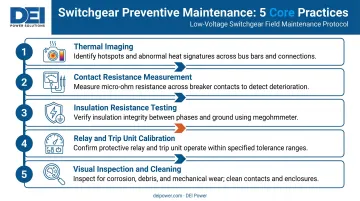
These five practices address the most common recurring failure modes in power distribution systems:
- Thermal imaging locates hot spots at terminations, contacts, and busbars before resistance-driven heat causes damage (NFPA 70B includes this in its electrical preventive maintenance framework)
- Contact resistance measurement: micro-ohm testing per IEEE 1015 detects degraded connections that visual inspection won't catch
- Insulation resistance testing tracks condition on aging assets and provides early warning of breakdown
- Relay and trip unit calibration confirms protective devices will operate as designed under fault conditions
- Visual inspection and cleaning removes contamination from contact surfaces and terminations before it accelerates degradation
ANSI/NETA MTS defines maintenance-testing acceptance criteria for electrical equipment — a standardized framework that keeps results consistent whether your own crew or an outside contractor performs the work.
Reliability-Centered Maintenance (RCM)
Running all five practices on every asset isn't realistic when outage windows and staffing are limited. RCM resolves that by prioritizing tasks based on consequence and detectability — directing resources where failure has the highest impact and where early warning is actually achievable.
A 2019 IEEE study on data center power distribution found that preventive and predictive maintenance models improve maintenance efficiency — reinforcing the shift from reactive servicing to condition-based programs. DOE data puts the urgency in perspective: reactive maintenance has historically accounted for more than 55% of average maintenance programs in U.S. facilities, meaning most teams spend the majority of their resources responding to failures rather than preventing them.
Frequently Asked Questions
What are power distribution reliability solutions?
Power distribution reliability solutions are the combination of equipment, design practices, monitoring tools, and maintenance strategies used to minimize outage frequency and duration. This includes certified switchgear, selective protection coordination, smart fault detection systems, redundancy design, and condition-based maintenance programs.
How can I improve power distribution reliability?
Start with a well-designed distribution system using properly specified, code-compliant equipment. Add real-time monitoring and fault detection to catch developing problems early. A condition-based maintenance schedule (thermal imaging, contact resistance testing, insulation testing) addresses degradation before it becomes a failure.
What are SAIDI and SAIFI?
SAIDI measures average total outage minutes per customer per year; SAIFI measures average outage events per customer per year — both standardized under IEEE 1366-2022. Always confirm whether a published benchmark includes or excludes Major Event Days, since the 2024 U.S. SAIDI differs by 531 minutes depending on that distinction.
What are the types of power distribution systems?
The two primary types are radial systems (single supply path, simpler but no redundancy) and networked or looped systems (multiple supply paths, more resilient but more complex and costly). Most commercial and industrial facilities use radial systems with protective devices sized to limit the scope of any single outage.
What is the difference between power quality and power reliability?
Reliability refers to whether power is available at all — absence of outages. Power quality refers to the characteristics of that power: voltage stability, frequency consistency, absence of harmonics or transients. Both affect operations, but they're measured differently and require different corrective strategies.
How does switchgear design affect power distribution reliability?
Switchgear is the primary protection and isolation point in a distribution system. Properly rated, UL 891-certified equipment with selective coordination isolates faults without cascading to the rest of the network. Poorly specified or non-compliant gear introduces hidden safety and uptime risk that's expensive to correct once installed.