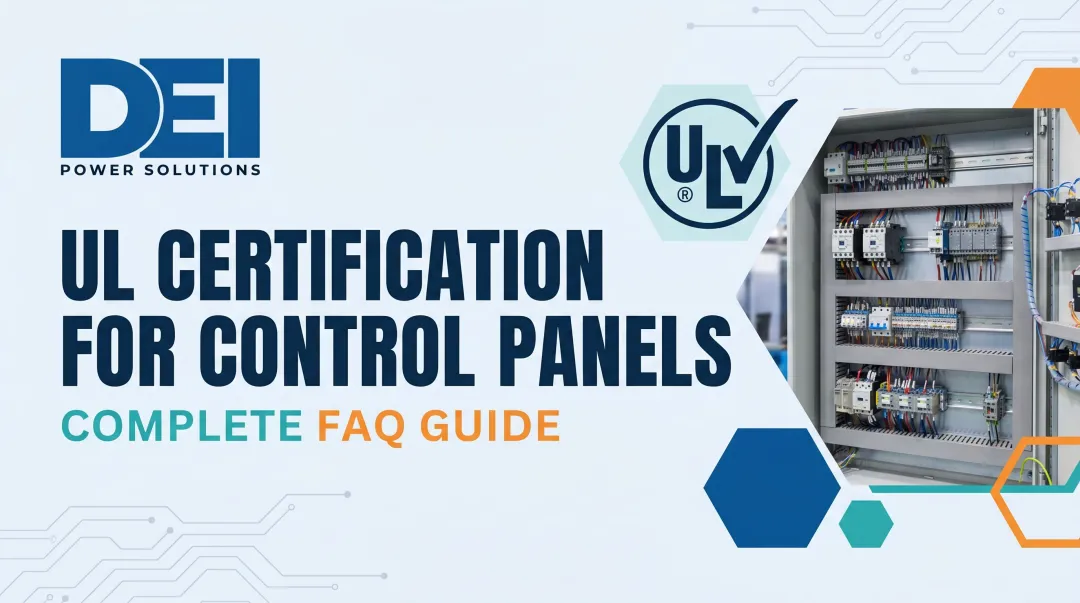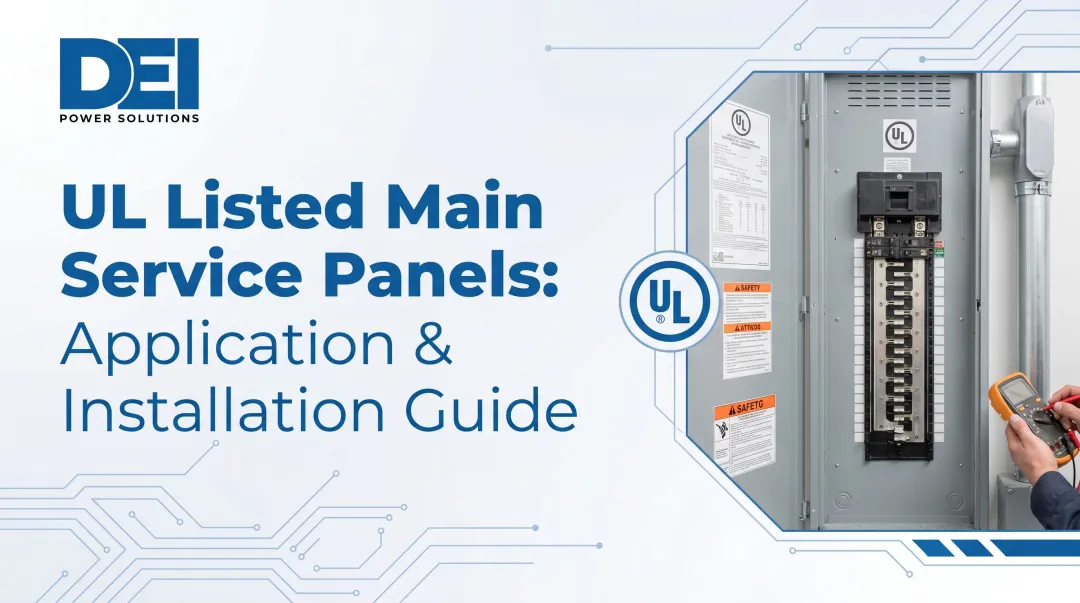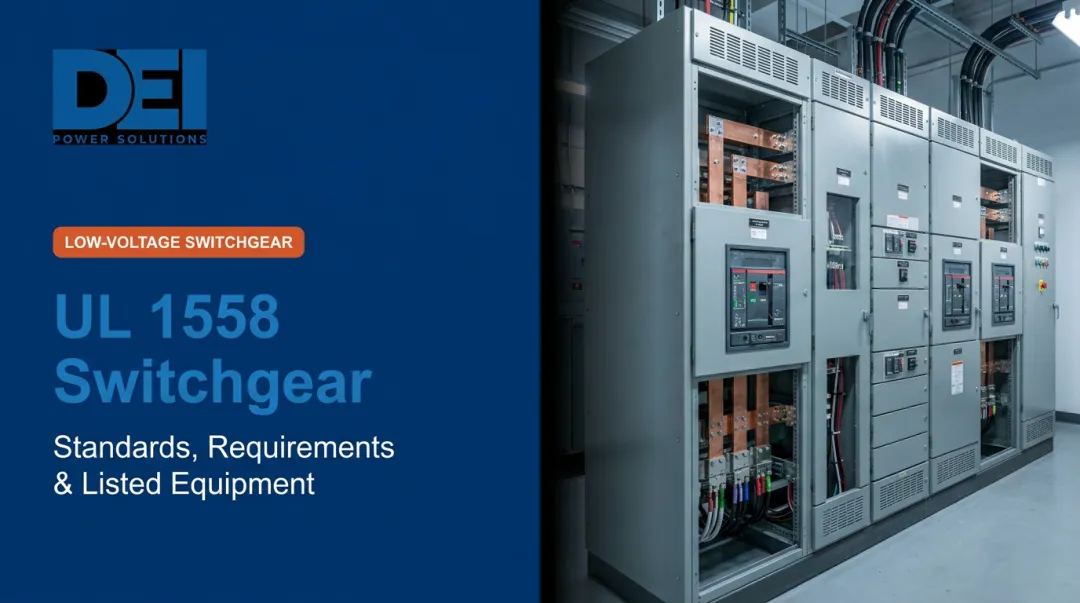
This guide breaks down what UL 67 actually requires: the construction rules, electrical ratings, required markings, and the NEC provisions that make listing practically mandatory on commercial work. It also covers where UL 67 ends and UL 891 begins, which is a boundary that causes real specification errors on larger projects.
Key Takeaways
- UL 67 is the UL safety standard for panelboards rated up to 1,000V, covering design, construction, component requirements, performance testing, and markings
- NEC Article 408 makes listing effectively mandatory for commercial and industrial panelboard installations, enforced by local AHJs
- Required markings include SCCR, voltage rating, current rating, NEMA enclosure type, and service equipment suitability where applicable
- Field fault current labeling (NEC 408.6) is frequently missed during inspections on commercial projects outside one- and two-family dwellings
- UL 891 switchboards apply when projects exceed panelboard capacity, including high-amperage services and mission-critical distribution
What Is UL 67 and What Does It Cover?
UL 67, currently in its 13th edition (published May 2018, with the most recent revision and ANSI approval in August 2025), is the Underwriters Laboratories safety standard for panelboards. It establishes minimum requirements for design, construction, testing, and marking of panelboards used in commercial and industrial buildings in accordance with NFPA 70 (the NEC).
The NEC/UL Definition of a Panelboard
A panelboard is a single panel or group of panel units assembled as a single panel, including buses and automatic overcurrent devices, with or without switches, placed in or against a wall or partition and accessible only from the front. That "accessible only from the front" requirement is what distinguishes a panelboard from other distribution equipment.
The term load center causes confusion here. NEC and UL draw no formal distinction between a load center and a panelboard. Both fall under UL 67. Load center is a commercial term used by manufacturers to describe smaller, cost-optimized units for residential and light commercial use—not a separate listing category.
What UL 67 Covers
The standard's scope includes:
- Enclosure and cabinet construction (fire, shock, and mechanical hazard prevention)
- Panelboard bus structure and internal layout
- Required component certifications (UL 489-listed molded-case circuit breakers are specifically required)
- Performance testing for short-circuit and overcurrent conditions
- All required product markings
UL 67 excludes equipment designed solely for automatic or non-automatic transfer of load connections, portable power distribution equipment, and certain RV converter/inverter distribution equipment.
Listing: Voluntary Standard, Mandatory Practice
UL listing is voluntary for manufacturers, but NEC Article 408 governs panelboard installations and most commercial and industrial projects require listed equipment. Local AHJs enforce this routinely.
"Listed" in code context means the equipment appears in a list published by a nationally recognized testing laboratory (NRTL) that periodically inspects production and confirms compliance. UL listing is the most common form of this in North America.
Core Construction and Safety Requirements Under UL 67
Service Barriers (2017 Update, Clause 5.4)
The 2017 update to UL 67 addressed a direct personnel hazard in service equipment panelboards. Clause 5.4 now requires that panelboards marked "Suitable for use as service equipment" be constructed so that no uninsulated live part on the line side is exposed to inadvertent contact when the service disconnect is in the off position.
This applies specifically when someone is servicing field-connected load terminals, neutral terminals, branch-circuit grounding terminals, or neutral disconnect links.
Metal barriers satisfying this requirement must meet minimum thickness standards:
- 0.032 in. — uncoated steel
- 0.034 in. — galvanized steel
- 0.050 in. — aluminum
Barriers must also be removable without requiring contact with bare live parts or risking damage to insulation.
AC Conductor Routing Through Metal Walls (Clause 10.1.11)
All conductors of an AC circuit—including the neutral—passing through a magnetic metal wall or partition must run through the same opening. This prevents inductive heating that can result from splitting conductors of the same circuit across separate openings in ferromagnetic material.
Clause 10.1.12 permits individual openings in two specific cases:
- Openings are connected by slots cut in the metal wall
- Conductors pass through individual openings in an insulating block over a sufficiently large wall opening, with no metal bracket crossing between conductors
Environmental Ratings and NEMA Enclosure Types
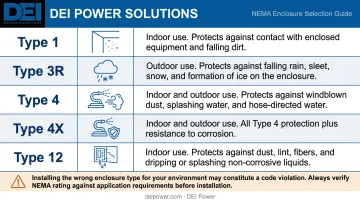
The NEMA enclosure type marked on a panelboard tells installers exactly which environmental conditions the enclosure is rated for. Installing the wrong type — a Type 1 indoor panel in a wet location, for example — creates both a safety hazard and a code violation.
| NEMA Type | Rated For |
|---|---|
| Type 1 | Indoor; protection from falling dirt |
| Type 3R | Indoor/outdoor; rain, sleet, snow, external ice |
| Type 4 | Type 3R + windblown dust, splashing water, hose-directed water |
| Type 4X | Type 4 + corrosion resistance |
| Type 12 | Indoor; dust, lint, dripping noncorrosive liquids |
Component Compatibility
Component selection is tightly controlled under UL 67. Only field-installed units specifically identified as compatible in the panelboard's markings or instructions may be used. Substituting non-listed or unverified components — even UL-listed breakers from a different manufacturer — can void the listing and create a code violation.
One limited exception applies:
- UL-Classified breakers rated 15–60A may be used in panelboards rated 225A or smaller, provided the breakers are marked for that specific use
UL 67 Electrical Ratings Explained
Voltage Rating
Panelboards are marked for specific voltage systems: 120/240V single-phase, 208Y/120V three-phase four-wire, 480Y/277V three-phase four-wire, and others. A single-phase three-wire panelboard cannot be used on a three-phase four-wire delta system. NEC Section 408.36(C) prohibits delta breakers in panelboards — the backfeed hazard is real and well-documented.
Current Rating
The marked current rating represents the maximum continuous current through the main terminals. Unless the assembly is specifically marked for 100% continuous operation, NEC 210.20(A) requires overcurrent devices (OCPDs) to be loaded to no more than 80% of their rating for continuous loads. In practice, a 100A-rated device can only carry 80A continuously under standard conditions.
Note that main bus and neutral bar ampacities may differ. If unequal, both must be marked on the panelboard.
Short-Circuit Current Rating (SCCR)
Every UL 67 panelboard must carry an SCCR in rms symmetrical amperes. This rating confirms two things:
- The OCPDs can safely interrupt fault current at that level
- The bus structure can withstand the magnetic forces generated during a fault
NEC Sections 110.10 and 408.6 require that the installed SCCR equal or exceed the available fault current at the point of supply. The lowest interrupting rating of any installed device limits the panel's effective SCCR. A single underrated breaker pulls the entire assembly's rating down to match.
Fully-Rated vs. Series-Rated Systems
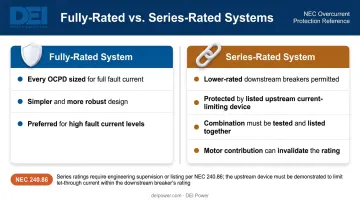
- Fully-rated: Every OCPD is sized for the full available fault current. Simpler, more robust, and the right call when fault current levels are high.
- Series-rated: Lower-rated downstream breakers are protected by a listed upstream current-limiting device per NEC 240.86. The combination must be tested and listed together, and the panel must carry the series rating label. Motor contribution to fault current can invalidate a series rating if not specifically accounted for in the listed combination.
NEC Compliance and UL 67: What Installers Need to Know
Dead-Front Construction (NEC 408.38)
NEC 408.38 requires panelboards to be mounted in cabinets, cutout boxes, or identified enclosures and to be dead-front—meaning no live parts are exposed to a person on the operating side. The exception allows non-dead-front designs only where panels are accessible exclusively to qualified persons, in which case the panel must be marked accordingly.
Service Equipment Requirements
Panelboards marked "Suitable for use as service equipment" must include:
- A listed service disconnecting means
- A neutral bonding provision
- A grounding electrode conductor connection point
- Ground-fault protection for each service disconnect rated 1,000A or more on solidly grounded wye services exceeding 150V to ground, per NEC 230.95
The Field Fault Current Marking Requirement (NEC 408.6)
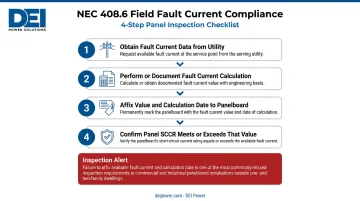
Outside one- and two-family dwellings, NEC 408.6 requires panelboards to be field-marked with the available fault current and the date of the calculation at the point of supply. This is one of the most commonly overlooked requirements during inspections — and inspectors are increasingly enforcing it. The contractor's obligation is to:
- Obtain available fault current data from the utility
- Perform or document a fault current calculation
- Affix the value and calculation date directly to the panelboard
- Confirm the panel's SCCR meets or exceeds that value
How to Verify UL 67 Listing on a Panelboard
Reading the UL Listing Mark
The UL Listing Mark on a compliant panelboard includes four elements:
- The UL symbol (UL in a circle)
- The word Listed (or Certified on newer marks)
- The product name (e.g., "Panelboard" or "Enclosed Panelboard")
- An issue/serial number or alphanumeric control number
The mark must appear on the product itself—not just the packaging. Additional phrases like "Suitable for Use as Service Equipment" appear in the product name where applicable.
Using UL Product iQ for Verification
Visual inspection only goes so far. If a label looks modified, equipment comes from an unfamiliar supplier, or listing status is in question, the UL Product iQ database is the go-to verification tool.
AHJs, engineers, and installers can search by:
- Manufacturer name
- Product name
- Category control number (CCN)
- File number
Each search returns current listing status and the guide information for that product category.
Required Markings Summary
Every UL 67-listed panelboard must carry these markings:
| Marking | What It Communicates |
|---|---|
| SCCR (rms symmetrical amperes) | Maximum fault current the panel can safely handle |
| Voltage rating | Specific voltage system(s) for which the panel is listed |
| Current/ampere rating | Maximum continuous current through main terminals |
| NEMA enclosure type | Environmental conditions the enclosure is rated for |
| Copper/aluminum wire suitability | Which conductor materials are permitted at terminals |
| Conductor temperature rating | Maximum temperature rating for field-connected conductors |
| Service equipment suitability | Whether panel is listed for use as service entrance equipment |
| Manufacturer identification | Includes manufacturer name and factory code |
Look for these markings on the inside of the door or on a nameplate inside the enclosure — not on the outer surface or packaging.
UL 67 vs. UL 891: Choosing the Right Standard for Your Project
Scope Differences
UL 67 covers wall-mounted panelboards rated 1,000V or less, used for branch circuit and feeder distribution in commercial and light industrial facilities. The physical form factor—mounted in or against a wall, accessible from the front only—defines the boundary as much as the ampere rating.
UL 891 covers dead-front switchboards also rated up to 1,000V, but designed as floor-standing lineups with larger bus structures, more complex internal architectures, and the capacity to consolidate multiple large feeders, metering, and utility interface points in a single assembly.
When to Step Up to UL 891
The decision to move from a panelboard to a switchboard is driven by project requirements, not a single ampere threshold. Common triggers include:
- Service ampacity that exceeds what wall-mounted panelboards can practically handle
- Projects requiring utility metering integration at the service entrance
- High-demand distribution where SCCR requirements exceed panelboard ratings
- Selective coordination requirements for healthcare or mission-critical facilities
- The need for a floor-standing lineup with side or rear access for maintenance
Specifying a panelboard where a switchboard is required creates both safety and code compliance risks. The equipment physically cannot accommodate the load, and the UL 67 listing doesn't apply.
DEI Power's UL 891 Switchboard Line
When a project moves beyond UL 67 panelboard territory, DEI Power manufactures UL 891-certified low-voltage switchboards from its 50,000 sq. ft. facility in Ontario, California. As an approved Siemens OEM, DEI Power builds each unit with genuine Siemens components.
Standard configurations include:
- Ampere ratings: 400A to 4,000A
- Voltage configurations: 208Y/120V, 480Y/277V, and others
- Enclosures: NEMA 1 and NEMA 3R
- Compliance: BABA-compliant for federally funded projects
- Lead times: In-stock units ship in 3–5 business days; custom builds deliver in 4–6 weeks
DEI Power's engineering team supports the specification process from early design through submittal documentation — useful when a mid-project scope change means switching from a panelboard spec to a switchboard.
Frequently Asked Questions
What is UL 67 standard for panelboards?
UL 67 is the Underwriters Laboratories safety standard (currently Edition 13) for panelboards rated up to 1,000V. It establishes minimum requirements for design, construction, component certifications, performance testing, and product markings for commercial and industrial power distribution equipment.
Is UL 67 listing required by code?
UL listing is technically voluntary for manufacturers but effectively required in practice. NEC Article 408 governs panelboard installations, and most jurisdictions mandate listed equipment—enforced by local AHJs during inspections.
What is the difference between UL 67 and UL 891?
UL 67 covers wall-mounted panelboards (1,000V or less) for branch circuit distribution in commercial and light industrial settings. UL 891 covers floor-standing dead-front switchboards at the same voltage rating, but designed for larger service entrance applications—with higher ampacity, more complex architectures, and utility interface capability.
What circuit breakers are required in a UL 67 panelboard?
UL 67 requires UL 489-listed molded-case circuit breakers for overcurrent protection. Only field-installed units specifically identified as compatible in the panelboard's markings or instructions may be used—substituting unlisted or incompatible devices can void the listing.
How do I verify a panelboard is UL 67 listed?
Check the product itself for the UL Listing Mark, which includes the UL symbol, the word "Listed" or "Certified," the product name, and a control number. Cross-reference listing status using the UL Product iQ database at productiq.ulprospector.com.
What changed with the 2017 UL 67 update?
Three key changes took effect January 1, 2017:
- Service barriers: New requirements prevent inadvertent contact with energized line-side parts when the service disconnect is off
- AC conductor routing: New rules for routing through magnetic metal walls to prevent inductive heating
- Cord-connected provisions: New requirements for inlet/outlet provisions, including portable generator interconnection