
Introduction
Commercial electrical demand is surging across the United States. According to the U.S. Energy Information Administration, commercial sector retail electricity sales grew 2.9% in 2025—the fastest of any sector—driven primarily by data centers and computing infrastructure. In fact, computing alone accounted for 8% of commercial electricity consumption in 2024 and is projected to reach 20% by 2050, surpassing lighting, space cooling, and ventilation. This escalating demand, coupled with EV fleet charging infrastructure, HVAC upgrades, and electrification mandates, means 400 amp service is no longer a luxury—it's a baseline requirement for most commercial facilities.
That growing load requirement comes with a real price tag—and it varies widely. The cost to upgrade to 400 amp commercial service depends on facility type, existing infrastructure condition, utility requirements, and equipment specifications. Unlike residential upgrades, commercial projects involve three-phase power, utility coordination, and commercial-grade switchgear built to NEC standards. This guide covers realistic pricing ranges, full cost components, and the key drivers that contractors, engineers, and facility teams need to plan and budget with confidence.
Key Takeaways
- Typical commercial 400 amp service upgrade: $15,000–$100,000+, depending on complexity (compared to the residential $8,000–$12,000 range)
- Three-phase service, utility transformer coordination, and UL-certified switchgear selection drive the majority of project costs
- Site conditions — existing infrastructure, utility requirements, and local code — determine where your project lands in that range
- Specifying UL-certified, code-compliant switchgear from the start reduces change orders, field rework, and schedule risk
How Much Does It Cost to Upgrade to 400 Amp Service for a Commercial Building?
Commercial 400 amp service upgrades are a different category entirely from residential work. They require three-phase power, utility transformer coordination, commercial-grade switchgear, permitting under NEC commercial codes, and often significant infrastructure changes. This is why commercial costs far exceed the $8,000–$12,000 range typically cited for residential 400 amp upgrades.
Two Common Cost Mistakes:
- Using residential pricing benchmarks leads to severe budget shortfalls on commercial projects
- Selecting undersized or non-UL-certified gear results in failed inspections and costly field corrections
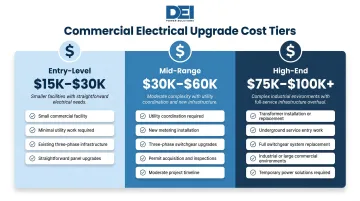
Commercial Cost Tiers
Based on industry data from commercial electrical contractors, here are realistic commercial upgrade ranges:
Entry-Level ($15,000–$30,000)
- Small commercial facility with adequate existing infrastructure
- Minimal utility coordination required
- Straightforward panel upgrade with existing three-phase service
- Covers: commercial-grade panel equipment, installation labor, permit fees, basic utility coordination
Mid-Range ($30,000–$60,000)
- Standard commercial upgrade with utility coordination
- New metering and three-phase switchgear installation
- Permit and inspection fees
- Moderate labor and timeline
- Covers: commercial-grade switchboard, metering equipment, utility connection fees, full permitting
High-End ($25,000–$100,000+)
- Complex upgrade requiring utility transformer work
- Underground service installation or relocation
- Full switchgear replacement in demanding environments (data centers, healthcare, manufacturing)
- Extended project timeline with possible temporary power
- Covers: transformer upgrades, underground trenching, industrial-grade switchgear, specialized labor
Those ranges reflect different project scopes. Here's what typically moves the number up or down:
What's Typically Included:
- Main service entrance equipment and metering
- Switchboard or distribution panel
- Labor and installation
- Permit fees and utility coordination
- Basic inspection costs
What's Typically Excluded:
- Full building rewiring
- Panel relocation or structural modifications
- Extended facility shutdowns
- Contingency for unforeseen conditions (budget 15–20% additional)
Critical Note: A professional load calculation and site assessment is the only reliable way to get an accurate project-specific quote. Use these ranges to set initial expectations — then verify with a licensed commercial electrician before committing to a project budget.
Key Factors That Affect the Cost of a 400 Amp Commercial Service Upgrade
Commercial 400 amp upgrade pricing depends on technical, site-specific, and operational factors. Understanding these helps facility teams evaluate quotes accurately and avoid budget surprises.
Existing Infrastructure Condition and Service Type
Single-Phase to Three-Phase Conversion: Facilities upgrading from lower-amperage single-phase service to three-phase 400 amp service face substantially higher costs than those already on three-phase power. According to industrial electrical contractors, three-phase conversions add $10,000–$30,000 to commercial upgrade projects.
When utility infrastructure must be extended to provide three-phase power:
- Standard installation (infrastructure nearby): $10,000–$20,000
- Extended infrastructure (lines must be relocated): $30,000–$60,000
- Complex installations (long underground runs): $100,000+ is common
Infrastructure Condition: The condition of existing service entrance equipment, metering, wiring, and grounding directly affects cost. Deteriorated or non-compliant infrastructure often requires full replacement rather than upgrade, widening the project scope. Aged equipment that doesn't meet current NEC standards must be replaced entirely, not added to.
That infrastructure reality extends to the utility side as well—what the contractor can't control often drives the biggest cost variables.
Utility Coordination and Transformer Requirements
Transformer Upgrades: Commercial service upgrades often require the utility company to upgrade the transformer serving the building. This adds significant cost and time—neither of which contractors control. U.S. power transformer lead times reached 128 weeks average (nearly 2.5 years) as of Q2 2025, with some specialized orders extending to 4 years. Transformer prices have increased 77–95% since 2019 due to supply constraints and material costs.
Underground vs. Overhead Service: Service type dramatically impacts installation costs:
- Commercial underground trenching: $50–$150 per linear foot
- Urban areas: $20–$40 per foot (higher in congested metro areas)
- Rocky soil conditions: add 50% to trenching costs
- NEC requires 18-inch depth with conduit or 24 inches for direct burial
Costs include PVC conduit ($1–$3/ft), copper wire ($1.50–$5/ft), and labor for excavation, conduit installation, and site restoration.
Equipment Specification and Switchgear Selection
Commercial-Grade Switchgear: The switchboard or switchgear distributing the 400 amp service is a major equipment cost. Commercial facilities require UL 891-listed, code-compliant switchgear rated for correct voltage, fault current, and load configuration. Improperly rated equipment fails inspections and triggers change orders that quickly erode the project budget.
DEI Power manufactures UL 891-certified switchboards built with Siemens components to custom voltage, layout, and load specifications — shipped from their Ontario, California facility, typically within 1–5 business days on in-stock configurations.
Lead Time Impact: Equipment lead times directly affect total project cost. Long lead times on non-standard gear force contractors into expensive temporary power arrangements or project delays, both of which add substantial costs. In-house manufactured equipment with shorter lead times (like DEI Power's typical 1–5 business day shipping) reduces this risk significantly.
Permitting, Inspections, and Code Compliance
Commercial Permit Costs: Commercial electrical permits are more complex and expensive than residential permits. Industry data shows $2,000–$8,000 for commercial permits, though jurisdictions vary significantly:
- Washington, D.C.: $390–$650 per discipline based on building size
- Hammond, IN: $50 base + 1.75% of contract value for projects $500–$15,000
NEC Commercial Code Requirements: NEC 2023 compliance adds components beyond basic service upgrades:
- Arc flash labeling (110.16): Required on all service equipment likely to be examined while energized
- GFCI protection (210.8(B)): Required for commercial receptacles in 15 specified locations including bathrooms, kitchens, rooftops, and areas within 6 feet of sinks
- Grounding and bonding (Article 250): Two or more grounding electrodes required, with specific routing and connection standards
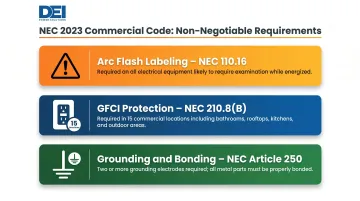
These compliance requirements add material and labor costs but are non-negotiable for passing inspection.
Cost Breakdown: What Does a 400 Amp Commercial Upgrade Actually Include?
The total project cost extends well beyond the panel price. Commercial buyers must budget for every scope component.
Equipment Costs (One-Time)
Based on commercial contractor data:
| Component | Cost Range |
|---|---|
| Main service entrance equipment | $2,000–$15,000 |
| Commercial-grade circuit breakers | $50–$500 each |
| Copper service conductors | $5–$25 per foot |
| Conduit and fittings | $10–$50 per foot |
| Metering equipment | Included in service entrance range |
| Grounding components | $500–$2,000 |
Panel-only upgrade: $8,000–$25,000. Full service replacement with infrastructure work: $25,000–$100,000+.
Installation and Labor Costs (One-Time)
Commercial electrical labor rates exceed residential rates:
- Journeyman electrician: $75–$125 per hour
- Master electrician: $100–$150 per hour
- Overtime/off-hours premium: 1.5x–2x standard rates (common for minimizing operational disruption)
Most commercial 400 amp upgrades require 2–4 electricians over multiple days. Hour estimates by complexity:
- 40–80 labor hours for straightforward projects
- 80–160+ hours for complex installations with infrastructure work
Total labor cost range: $3,000–$24,000 depending on project complexity and timeline.
Permitting, Utility Coordination, and Inspection Fees (One-Time)
These costs are separate from contractor quotes and vary significantly by jurisdiction:
- Commercial electrical permits: $2,000–$8,000
- Utility application/connection fees: $500–$3,000
- Inspection costs: $300–$1,000
- Utility transformer upgrade (if required): $10,000–$60,000+
Total permitting and utility costs: $2,800–$72,000 (wide range due to transformer requirements).
Ongoing Maintenance and Operational Costs (Recurring)
Commercial switchgear requires periodic inspection and testing:
- Electrical maintenance (office buildings): $0.18–$0.35 per sq ft annually
- High-tech/lab facilities: $0.60–$1.10 per sq ft annually
- Healthcare facilities: $0.80–$1.40 per sq ft annually
- Infrared thermography (preventive): $0.02–$0.04 per sq ft annually ($1,000–$5,500 per survey)
NETA (InterNational Electrical Testing Association) recommends switchgear testing every 12–72 months based on reliability requirements and equipment condition — a useful benchmark when forecasting your annual maintenance budget.
Budget vs. Premium: What's the Real Difference in a Commercial 400 Amp Service?
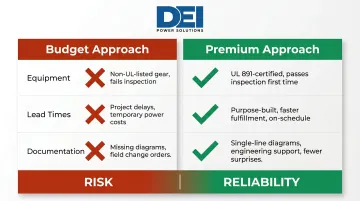
In commercial service upgrades, the difference between budget and premium approaches isn't just price—it's risk, compliance, and long-term reliability.
How Budget and Premium Approaches Compare
| Factor | Budget Approach | Premium Approach |
|---|---|---|
| Equipment | Non-UL-listed or improperly rated gear that fails inspection or requires replacement | UL 891-certified, application-matched equipment that meets fault current and voltage requirements—passes inspection the first time |
| Lead Times | Off-the-shelf gear causes project delays, requiring expensive temporary power and extended timelines | Purpose-built equipment with faster fulfillment keeps projects on schedule |
| Documentation | Bids lack single-line diagrams, configuration docs, or engineering review—leading to field adjustments and change orders | Specification reviews, application guidance, and responsive engineering support reduce field surprises |
Long-Term Value for Critical Facilities
These differences compound quickly in facilities where downtime carries a direct price tag. For data centers, healthcare, and manufacturing environments, a properly specified upgrade pays for itself well before the first failure event.
Consider the math: a budget approach that saves $5,000 upfront but triggers three days of downtime at $10,000/day produces a $25,000 net loss. Spending appropriately from the start costs less. DEI Power's UL 891-certified switchboards and rapid fulfillment—most orders ship within 1–5 business days—are designed specifically to keep that math from going sideways.
How to Estimate the Right Budget for Your Commercial 400 Amp Upgrade
A realistic budget for a commercial 400 amp upgrade accounts for full project scope—not just equipment cost—and builds in room for the unforeseen conditions that show up on nearly every commercial electrical job.
Key Inputs for Building a Realistic Budget
1. Conduct a Professional Load Calculation Confirm 400 amps is the right service size for current and projected demand. Undersizing means doing the project twice; oversizing wastes capital.
2. Assess Existing Infrastructure Identify what must be replaced versus what can remain. A professional assessment reveals hidden costs before they become field surprises.
3. Get Utility Company Input Early Understand transformer requirements, connection fees, and lead times. Utility coordination delays are a top cause of project overruns.
4. Request Itemized Quotes from Qualified Contractors Not lump-sum estimates. Itemized quotes reveal where money goes and make it easier to identify value engineering opportunities. Add 15–20% contingency for unforeseen conditions—this isn't padding, it's realism.
Why Switchgear Specification Affects Your Budget More Than Most Line Items
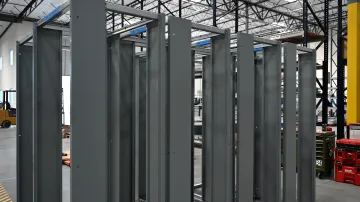
Of all the inputs above, switchgear specification has the highest potential to generate costly change orders if it's wrong. Working with a manufacturer like DEI Power—which offers custom-configured, UL 891-certified switchboards with clear documentation and faster lead times—helps contractors avoid the field adjustments that push commercial projects over budget.
DEI Power provides:
- Pre-sales engineering consultation to confirm correct specifications
- Single-line diagrams and configuration documentation
- Custom builds to match voltage, layout, and jobsite requirements
- In-house manufacturing for faster fulfillment from their Ontario, California facility
- Free shipping with 3–5 business day delivery nationwide
Most Common Budgeting Mistakes
- Focusing only on panel price without accounting for utility coordination and installation labor
- Using residential cost benchmarks for commercial projects (typically off by 2–5x)
- Over-specifying or under-specifying amperage without a load calculation
- Choosing the lowest bid without verifying code compliance and equipment certification
- Omitting contingency budget for unforeseen site conditions
Conclusion
Commercial 400 amp service upgrade costs vary significantly based on infrastructure condition, utility requirements, equipment specification, and facility complexity. Generic residential estimates are not a reliable starting point — commercial projects vary too widely to use a single benchmark. Projects range from $15,000 for straightforward upgrades at small facilities to $100,000+ for complex installations requiring transformer work, underground service, or full switchgear replacement.
The right budget covers the full scope with properly rated, code-compliant equipment and a realistic contingency. Shortcuts in equipment quality or contractor selection almost always cost more through rework, delays, and compliance failures.
For commercial facilities where uptime is critical, investing in UL 891-certified switchgear with clear documentation, in-house engineering support, and fast lead times — like what DEI Power provides — reduces schedule risk and field surprises that budget alternatives rarely account for.
Frequently Asked Questions
How much does it cost to upgrade to 400 amp service for a commercial building?
Commercial 400 amp service upgrades range from $15,000 to $100,000+, much higher than residential upgrades due to three-phase power requirements, utility coordination, and commercial-grade equipment. The exact cost depends on existing infrastructure condition, utility transformer requirements, and project complexity.
What is required to upgrade to 400 amp commercial service?
A commercial 400 amp upgrade requires a professional load calculation, utility coordination (potentially including transformer upgrades), UL 891-certified switchgear and metering equipment, permits under NEC commercial codes, and a licensed commercial electrician. Three-phase power infrastructure is typically required.
Is upgrading to 400 amp service worth it for a commercial property?
For facilities near capacity or planning expansion, the upgrade is usually essential — avoiding downtime costs and enabling operational continuity outweigh the upfront investment. Facilities with high computing, EV charging, or HVAC loads benefit most.
Can I upgrade to 400 amp service without rewiring the building?
Often, yes — the service entrance and distribution equipment can be upgraded without rewiring the entire building. A professional site inspection determines whether existing branch circuits meet NEC ampacity and code compliance requirements before work begins.
What size wire do I need for a 400 amp commercial service?
Common configurations use 600 kcmil copper or 900 kcmil aluminum for single runs, or parallel conductor sets for longer distances. Final sizing depends on voltage, conduit fill, and run length — a licensed engineer must specify conductors per NEC Table 310.15(B)(16).
Why are 400 amp panels so expensive?
Commercial 400 amp equipment must meet UL 891 listing requirements with higher fault current ratings and more complex engineering than residential panels. Supply chain constraints on high-amperage switchgear — including transformer lead times that can exceed two years — push costs further.