Introduction
Over-specifying enclosures is one of the most common budget mistakes in commercial and industrial power distribution. When engineers or contractors default to NEMA 12 or NEMA 4 where NEMA 1 fully meets code requirements, they add unnecessary material costs, longer lead times, and manufacturing complexity — with no functional benefit. NEMA 1 is frequently dismissed as "basic" protection, but that label misses the point in controlled indoor environments where it performs exactly as required.
This article clarifies what NEMA 1 switchgear actually delivers, identifies the environments where it performs optimally, and explains why correct enclosure selection can reduce project costs and procurement delays — without sacrificing compliance.
Key Takeaways
- Designed for clean, dry indoor spaces, NEMA 1 guards against accidental contact and falling dirt
- It's the most cost-effective compliant enclosure option for indoor commercial, industrial, and utility power distribution
- Meets NEC Article 110, OSHA 1910.303, and UL 891 requirements for indoor service
- Misapplication in moisture, dust, or outdoor environments creates equipment failure risk and code violations
- Specifying NEMA 1 correctly cuts unnecessary equipment costs without sacrificing code compliance
What Is NEMA 1 Switchgear?
NEMA 1 is a Type 1 general-purpose enclosure rating established by the National Electrical Manufacturers Association. Per ANSI/NEMA 250-2020, Type 1 enclosures are "constructed for indoor use to provide a degree of protection to personnel against access to hazardous parts and to provide a degree of protection of the equipment inside the enclosure against ingress of solid foreign objects (falling dirt)." NEMA 1 enclosures are explicitly not dust-tight, provide no protection against water, and include no corrosion-resistant features.
How NEMA 1 Applies to Switchgear
When applied to switchgear and switchboards, NEMA 1 refers to the enclosure housing the internal electrical components—buses, overcurrent protection devices, and switching equipment. It does not define the electrical performance ratings of those components.
NEC Article 100 requires switchgear to be "completely enclosed on all sides and top with sheet metal (except for ventilating openings and inspection windows)" with access provided by doors or removable covers. NEMA 1 switchgear meets this definition, making it well-suited for controlled indoor settings like electrical rooms, utility substations, and commercial mechanical spaces.
Where NEMA 1 Switchgear Is Deployed
NEMA 1 switchgear is most commonly specified for:
- Commercial buildings and office campuses
- Data centers and colocation facilities
- Healthcare facilities
- Clean indoor electrical rooms in industrial plants
- Indoor utility substations with climate control
- Service entrance equipment in controlled environments
DEI Power manufactures NEMA 1 switchgear from 400A to 4000A, UL 891 certified and built for the dry, controlled indoor environments where these applications operate.
Key Advantages of NEMA 1 Switchgear
The advantages below reflect measurable operational and financial outcomes, not abstract technical features.
Cost Efficiency Without Over-Engineering
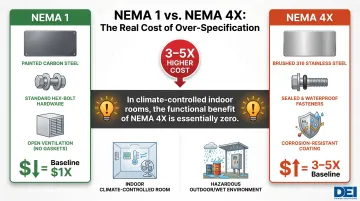
NEMA 1 is the lowest-cost compliant enclosure option for indoor switchgear. It eliminates the material and manufacturing expense of gaskets, sealed hardware, and corrosion-resistant coatings required by NEMA 12 or NEMA 4 ratings.
Why this matters:
- A 316 stainless steel enclosure (typical for NEMA 4X) costs 3-5x more than painted carbon steel (typical for NEMA 1). In climate-controlled electrical rooms, the functional benefit of stainless steel is essentially zero.
- Over-specification on enclosure ratings is a documented source of avoidable cost increases. Contractors selecting higher-rated enclosures for indoor installations pay premiums for gaskets, sealed fasteners, and specialized fabrication that provide no performance advantage.
- Copper prices have risen 26-30% year-on-year, making properly matched enclosure specifications even more critical for project budget control.
Operational impact:
- KPIs affected: Project materials cost, procurement lead time, total cost of ownership, change order frequency
- When this matters most: Large commercial construction, data center builds, healthcare facility upgrades, and industrial electrical room installations where budget discipline is essential
DEI Power's NEMA 1 switchgear is built with genuine Siemens components and UL 891 certification, providing code-compliant performance at the lowest necessary enclosure rating for indoor environments.
Code Compliance and Personnel Safety in Indoor Settings
NEMA 1 switchgear is engineered to meet NEC working clearance requirements and UL construction standards for indoor power distribution. The fully enclosed sheet metal construction with door or cover access ensures live buses, breakers, and wiring remain inaccessible during normal operation, reducing arc flash exposure risk and satisfying OSHA and NEC safety mandates.
Why this matters:
- 147 occupational fatalities occurred from electrical causes in 2023, matching the 10-year annual average. Of these, 24 (17%) occurred in industrial premises. OSHA 29 CFR 1910.303 requires guarding of all live parts at 50 volts or more.
- UL 891 listing provides documented, auditable proof of code conformance, reducing liability risk for contractors and facility operators. DEI Power's UL 891-certified NEMA 1 switchgear provides this compliance documentation at the point of installation.
- Non-compliant or unrated enclosures trigger inspection failures, rework requirements, and insurance complications.
For projects under AHJ scrutiny — healthcare facilities, mission-critical installations, and large commercial or utility builds — this documentation isn't optional. Code compliance rate, inspection pass rate, and liability exposure are the KPIs at stake.
Simplified Maintenance and Long-Term Operational Reliability
NEMA 1 enclosures allow straightforward indoor access. Doors and removable covers let maintenance personnel inspect, service, and replace internal components without the complex sealing or hardware removal that higher-rated enclosures require.
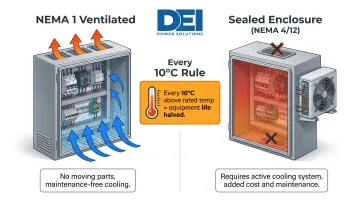
The open ventilation design also supports passive heat dissipation. Per Bud Industries, the 10-degree rule states that every 10°C increase above rated temperature halves equipment life. NEMA 1 ventilated enclosures use natural convection: heated air exits through top vents while cooler air enters below, providing maintenance-free cooling with no moving parts. Sealed enclosures (NEMA 4, 12) block airflow entirely and often require active cooling systems with added purchase cost, energy consumption, and maintenance burden.
Why this matters:
- The 2023 edition of NFPA 70B converted from recommended practice to mandatory standard. Base maintenance intervals for switchgear in good condition are 12 months. NEMA 1 enclosures with accessible doors facilitate these inspections without gasket management or complex re-sealing procedures.
- In climate-controlled commercial and industrial settings, complex enclosure sealing adds unnecessary time to routine maintenance. NEMA 1's accessible design keeps scheduled maintenance efficient and reduces technician labor hours.
- Simplified access means faster fault isolation and restoration, directly supporting operational continuity in facilities where power interruptions are costly.
The KPIs this directly affects: mean time to repair (MTTR), scheduled maintenance labor hours, system uptime, and technician efficiency. These gains matter most in data centers, healthcare facilities, and large commercial campuses where multiple electrical rooms are managed by small facility teams.
When NEMA 1 Switchgear Is Not the Right Fit
NEMA 1 is strictly an indoor rating. Environments with moisture, condensation, oil mist, significant airborne dust, or outdoor exposure require at minimum NEMA 12 (dust and dripping water protection) or NEMA 3R/4 for outdoor or wet locations. Using NEMA 1 in these environments creates a code violation and puts equipment at risk of damage.
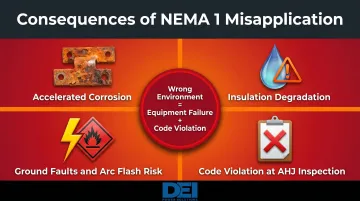
Misapplying NEMA 1 in the wrong environment can cause:
- Accelerated corrosion of internal buses and connections
- Insulation degradation from moisture ingress
- Increased risk of ground faults and arc flash events
- Code violation findings during AHJ inspection
Manufacturing floors with coolant splash, outdoor substations, and facilities near coastal or industrial corrosive atmospheres all need a higher-rated enclosure — and that decision should happen before procurement, not after. Re-specifying mid-project due to wrong NEMA selection is one of the most common drivers of rework and schedule delays. The Construction Industry Institute estimates rework at 2-20% of total project costs, averaging 12%.
How to Get the Most Value from NEMA 1 Switchgear
Getting value from NEMA 1 switchgear comes down to three practical steps: matching the enclosure to the right environment, specifying the correct internal components, and working with a manufacturer who can configure both together.
1. Verify the installation environment before specifying.
Confirm the space is climate-controlled, dry, and not subject to airborne contaminants. NEMA 1 performs reliably when the environment matches its design intent. Involve engineering review early to avoid costly mid-project corrections.
2. Pair NEMA 1 enclosure selection with correct internal component specifications.
Internal specs must align with the enclosure rating and project load requirements:
- UL-listed circuit breakers per UL 489 (molded-case) or UL 1066 (power circuit breakers)
- Properly rated buses and accurate ampacity configurations
- Enclosure rating and internal equipment matched to meet code standards
3. Work with a manufacturer that offers in-house engineering support and custom configuration.
This prevents mismatches between enclosure rating, internal build, and project-specific layout or voltage requirements — and reduces change orders once work is underway. DEI Power builds custom NEMA 1 switchgear to your project specs, with in-house engineering guidance and UL 891-certified assemblies from 400A to 4000A across multiple voltage configurations (120/240V, 208Y/120V, 480V, 480Y/277V).
Conclusion
NEMA 1 switchgear delivers strongest value when correctly specified for clean, controlled indoor environments—where it provides proven personnel safety, code compliance, cost efficiency, and maintenance accessibility without the cost of unnecessary protection features.
Where things go wrong is specifying NEMA 1 without confirming the installation environment actually qualifies—no contaminants, no moisture exposure, no outdoor access. Verifying enclosure type against those conditions before procurement is what keeps projects moving and avoids field-level corrections that are difficult to reverse once equipment is delivered and installed.
Frequently Asked Questions
What is the meaning of NEMA 1?
NEMA 1 is a general-purpose indoor enclosure rating established by the National Electrical Manufacturers Association, designed to protect electrical equipment from accidental personnel contact and light falling debris in clean, dry indoor environments. It is not dust-tight and provides no protection against water or corrosive agents.
What is NEMA 1 vs NEMA 2?
NEMA 2 adds drip-proof protection against limited falling liquids compared to NEMA 1's basic contact and debris protection. NEMA 2 is appropriate for areas where minor condensation or dripping water may occur, such as cooling rooms or laundries, while NEMA 1 is suited for clean, dry indoor spaces.
What is a type 1 breaker?
A "Type 1" reference in switchgear context typically refers to the NEMA Type 1 enclosure housing the breaker assembly, a general-purpose indoor cabinet. The breakers inside are separately rated (such as UL 489 molded-case or UL 1066 power circuit breakers), and the enclosure type governs environmental protection, not breaker electrical performance.
Is NEMA 1 switchgear suitable for outdoor installations?
No. NEMA 1 is rated for indoor use only and should not be installed outdoors or in environments exposed to rain, humidity, or direct weather. Outdoor or wet-location switchgear requires a minimum of NEMA 3R, and more demanding environments require NEMA 4 or higher.
What standards apply to NEMA 1 switchgear construction?
NEMA 1 switchgear construction is governed by NEMA enclosure standards, NEC Article 100 definitions, and UL certifications such as UL 891 for low-voltage switchboards — covering construction, testing, and compliance for indoor power distribution equipment.
When should I upgrade from NEMA 1 to a higher-rated enclosure for my switchgear?
Upgrade when the installation environment involves dust, moisture, dripping water, oil mist, or any outdoor exposure. NEMA 12 is the typical step up for industrial indoor environments with dust or oil seepage, while NEMA 3R or NEMA 4 should be selected for outdoor or wet-location applications.