
In environments where uptime is non-negotiable, an undersized or misconfigured MDP creates downstream failures, costly rework, and project delays. Engineers, contractors, and facility teams who understand what an MDP actually does — and how its components interact — make better equipment decisions and avoid expensive surprises during construction and commissioning.
This guide covers what an MDP is, how its components work, how power flows through it, and where it fits across commercial and industrial applications.
Key Takeaways
- An MDP receives incoming power from a utility or transformer and distributes it to all downstream circuits throughout a facility
- The main circuit breaker serves as the overcurrent protective device and master disconnect
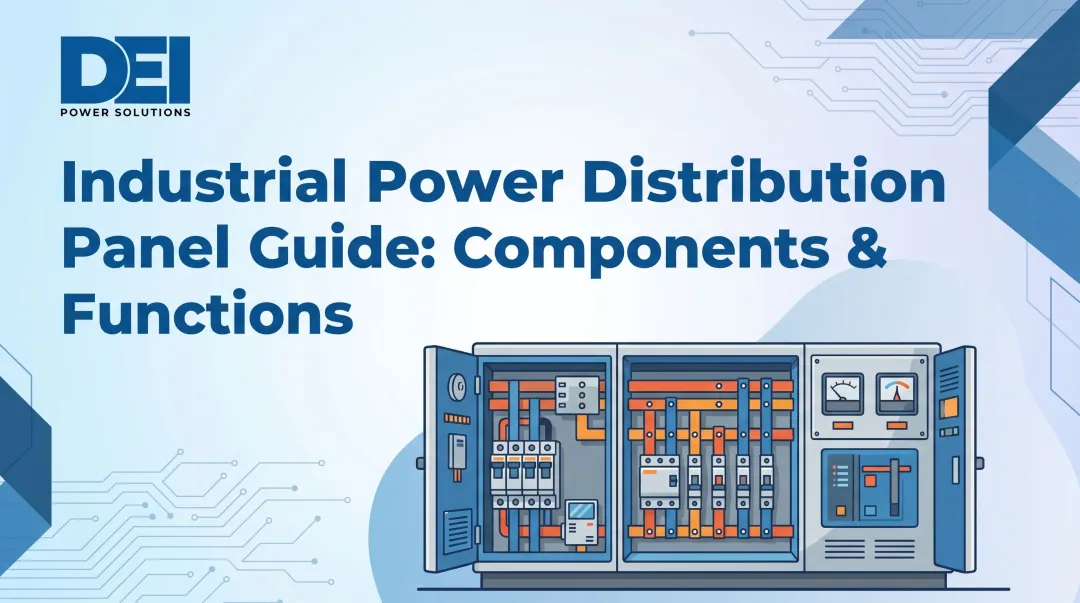
- Internal components include the main breaker, busbars, branch circuit breakers, neutral bar, and grounding bar, all housed in a NEMA-rated enclosure
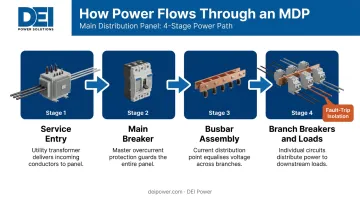
- Power flows: service entry → main breaker → busbars → branch breakers → loads or subpanels
- Common applications span commercial buildings, industrial plants, data centers, healthcare facilities, and utility infrastructure
What Is a Main Distribution Panel?
A main distribution panel is the primary switchgear assembly at the head of a facility's electrical distribution system. It receives high-amperage power from the utility feed or step-down transformer and divides it into manageable, protected branch circuits distributed throughout the building or site.
Terminology and Standards
The MDP goes by several names — main panel, distribution board, breaker panel, switchboard — depending on the application and region. The terminology matters because it reflects a real equipment distinction:
- Switchboards (UL 891): Large, free-standing assemblies for commercial and industrial MDPs; according to Eaton, switchboards can accommodate up to 6,000A bussing
- Panelboards (UL 67): Wall-mounted, cabinet-enclosed assemblies typically limited to 1,200A incoming current
- "Distribution board": A generic term without a separate NEC Article 100 definition — use it conversationally, not as a standards category
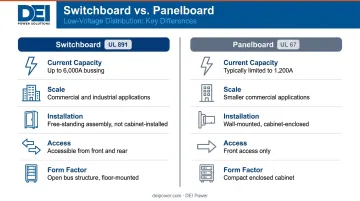
Per IAEI's breakdown of NEC Article 100, a switchboard is a larger panel or assembly generally accessible from front and rear and not intended for cabinet installation — the defining characteristic that separates it from a panelboard at commercial and industrial scale.
What an MDP Is Not
Getting clear on these distinctions also means knowing what an MDP is not.
An MDP is not a subpanel. A subpanel (or secondary distribution panel) receives pre-distributed power from the MDP and serves a specific zone, floor, or system. The MDP is the upstream source that everything else depends on. Confusing the two leads to misspecified equipment and compliance problems.
Key Components of a Main Distribution Panel
Main Circuit Breaker
The main breaker is the master overcurrent protective device at the top of the panel. It connects directly to the incoming service conductors, controls all power entering the panel, and trips automatically under overload or short-circuit conditions.
It also serves as the single-point shutoff during maintenance or emergencies, a critical capability in any facility where safe isolation of the entire electrical system is required.
Busbars
Busbars are rigid copper or aluminum conductors that run vertically through the panel, distributing incoming current to every branch breaker position. Busbar ampacity determines the MDP's total current capacity.
DEI Power's UL 891-certified switchboards, built with genuine Siemens components, are available across the following ampacity ratings:
400A · 600A · 800A · 1000A · 1200A · 1600A · 2000A · 2500A · 3000A · 4000A
Busbar integrity and connection quality directly affect heat buildup, voltage drop, and long-term panel reliability. Material selection and torque specifications matter as much as the ampacity rating itself.
Branch Circuit Breakers
Individual overcurrent devices mount along the busbar, each protecting a specific downstream circuit. When current exceeds the breaker's rated threshold (20A, 30A, or 60A), a bimetal or magnetic mechanism trips the breaker open within milliseconds, isolating the fault before damage propagates.
Selective protection prevents a single fault from shutting down an entire facility. Breakers are sized to match both the load they serve and the wire gauge of the branch circuit.
Neutral Bar and Grounding Bar
These two components handle return current and safety grounding:
- Neutral bar: Collects returning current from all circuits back to the source neutral conductor
- Grounding bar: Connects all equipment grounding conductors to a common ground point
In the MDP (service entrance panel), the neutral and ground bars are bonded together per NEC Article 250. In downstream subpanels, they are kept separate. This bonding point (the main bonding jumper) is critical for both electrical safety and NEC compliance. Getting this wrong in a subpanel creates parallel neutral paths and shock hazards.
Enclosure and Dead-Front Design
The panel is housed in a steel enclosure with a dead-front cover that blocks access to live conductors. Enclosure selection is environment-specific:
| NEMA Type | Environment | Protection |
|---|---|---|
| Type 1 | Indoor | Falling dirt, access to hazardous parts |
| Type 3R | Indoor/Outdoor | Rain, sleet, snow; exterior ice |
| Type 4 | Indoor/Outdoor | Windblown dust, splashing and hose-directed water |
| Type 12 | Indoor only | Circulating dust, dripping noncorrosive liquids |
DEI Power's switchboards are available in NEMA 1 (indoor) and NEMA 3R (outdoor) configurations across the full 400A–4000A range, with each NEMA 3R unit rain-tested in-house before shipment.
How Does a Main Distribution Panel Work?
An MDP receives a single high-amperage feed and systematically distributes it across multiple protected circuits. Each stage involves a specific component performing a defined function.
Service Entry and Connection
Incoming service conductors from the utility transformer — or on-site generator or transfer switch — connect to the line-side terminals of the main circuit breaker. At this point, the panel receives the full facility service voltage: typically 120/240V single-phase for smaller setups, or 480Y/277V three-phase for commercial and industrial applications.
No protective device exists above the main breaker on the building side. That makes the main breaker's integrity and rating the first and most critical line of defense.
In main lug only (MLO) configurations, there is no main breaker in the panel itself. Overcurrent protection exists upstream in a separate disconnect or switchboard section. This is common in large facilities where multiple MDPs are fed from a single upstream switchgear lineup.
Overcurrent Protection and Distribution
Once power passes through the main breaker, it flows onto the busbar assembly — the point where a single incoming feed becomes many potential circuits. From there:
- Each branch breaker monitors its assigned circuit continuously
- When current exceeds the trip rating, a thermal or magnetic mechanism opens the breaker within milliseconds
- The fault is isolated to that circuit only, leaving the rest of the facility unaffected
This selective coordination — where the device nearest the fault clears it without tripping upstream devices — is a design outcome based on breaker settings and time-current curves. In healthcare, data center, and industrial environments, zone-selective interlocking (ZSI) can further improve coordination by allowing downstream breakers to signal upstream devices to delay their response while the downstream device clears the fault.
Grounding and Fault Current Path
The overcurrent protection described above only works reliably when there is a low-impedance path for fault current to return. That path is the grounding system.
Under normal operation, ground conductors carry no current. During a ground fault, fault current travels through the grounding path back to the panel's neutral-ground bond — creating the low-impedance return path that allows the breaker to detect and clear the fault quickly.
Without a proper grounding path, fault current may travel through unintended conductors — or through personnel. NEC Article 250 governs bonding and grounding with the same specificity as overcurrent protection precisely because a failed ground path can turn a clearable fault into a lethal one.
Where Main Distribution Panels Are Used
Commercial Buildings and Campuses
In office buildings, retail centers, hospitals, and educational campuses, the MDP receives the utility service at the main electrical room and feeds downstream panelboards serving individual floors, wings, or building systems — HVAC, lighting, elevators, and server rooms.
These MDPs are sized for total connected load plus a growth margin. Configurations frequently include metering and surge protection to support building automation and energy management systems.
Industrial Plants and Data Centers
Manufacturing facilities, processing plants, and data centers operate MDPs at higher ampacity levels — often configured as free-standing low-voltage switchboards rather than wall-mounted panelboards. The operating conditions are more demanding: continuous heavy loads, frequent switching cycles, and zero tolerance for unplanned downtime.
The scale of this use case is significant. According to the IEA, global data center electricity consumption reached 415 TWh in 2024 and may more than double to around 945 TWh by 2030. That trajectory drives demand for high-capacity, precisely specified MDP equipment.
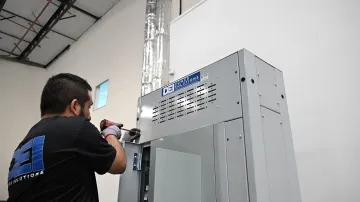
In these environments, NEC compliance, UL certification, fault current rating (AIC), and custom configuration are required without exception — deviations create compliance exposure and field failures. DEI Power supplies switchgear to hyperscale and enterprise data centers, as well as industrial plants and utility substations, with ampacity options from 400A to 4000A and BABA-compliant manufacturing for federally funded projects.
Utility Infrastructure
For utility substations and infrastructure-level distribution, MDPs operate at the top of the ampacity range — 2000A through 4000A — and must meet utility-specific specifications. Equipment at this scale is specified per project, with custom bus ratings, breaker types, and enclosure configurations matched to the incoming service and downstream load profile.
Where an MDP sits in the distribution hierarchy directly determines its specification criteria. Ampacity rating, AIC rating, voltage class, and enclosure type must all align with the incoming service — mismatches at this level don't get caught until the equipment is on-site.
Conclusion
The main distribution panel is the architectural center of any facility's power system. Every downstream circuit, subpanel, and connected load depends on it being correctly specified, configured, and protected. Understanding its components and operating logic directly informs smarter equipment selection and fewer problems during commissioning.
Teams that approach MDP specification strategically — accounting for ampacity, fault current rating, enclosure type, and code compliance during specification — reduce change orders and keep projects moving. For commercial and industrial projects where UL certification, custom configuration, and reliable delivery all matter, working with a manufacturer like DEI Power — a UL 891-certified switchgear builder operating out of Ontario, California — means the MDP is configured to the project's actual specs, not adjusted after the fact.
Frequently Asked Questions
What is the function of the main distribution panel?
The MDP receives incoming power from the utility or transformer and distributes it to all branch circuits throughout a facility. Its main breaker provides overcurrent protection and master disconnect capability, while individual branch breakers protect each downstream circuit from overload, fault, and fire risk.
What is the difference between a distribution panel and a main panel?
The main panel (MDP) is the first point of power entry in a building, containing the master disconnect with a direct utility connection. A distribution panel or subpanel is a downstream assembly fed by the MDP, serving a specific area or floor without its own utility connection. The terms are often used interchangeably in practice.
What is the difference between a main distribution panel and a switchboard?
Both serve the MDP function, but a switchboard (governed by UL 891) is a larger, free-standing assembly capable of handling up to 6,000A and more complex configurations than a wall-mounted panelboard (UL 67, typically limited to 1,200A). Switchboards are the standard choice for commercial, industrial, and utility applications. DEI Power manufactures UL 891-certified switchboards from 400A to 4,000A for exactly these use cases.
What is the difference between a main distribution panel and a subpanel?
The MDP connects directly to the utility service and contains the main overcurrent disconnect. A subpanel is a secondary distribution point fed from the MDP to serve a specific building zone, carrying only a portion of the facility load. Unlike the MDP, subpanels do not bond the neutral and ground conductors.
What does it cost to replace a distribution panel?
Commercial and industrial panel replacements typically range from several thousand to tens of thousands of dollars, depending on ampacity, voltage class, and configuration complexity. Engineering, permitting, coordination studies, and planned downtime add to equipment cost. Contact a licensed electrical contractor or procurement specialist to assess the full project scope.