Introduction
Aging electrical infrastructure puts plant engineers, contractors, and facility managers in a difficult position: most project budgets get locked in before the full scope of a switchgear replacement is understood. The scale of the problem is significant. According to the U.S. Department of Energy, the U.S. power grid is well past its prime:
- 60% of circuit breakers are 30 years of age or older
- 70% of power transformers are 25 years or older
- 70% of transmission lines are 25 years or older
That aging equipment contributes to roughly $80 billion in annual costs from power interruptions to U.S. electricity consumers.
Switchgear replacement costs vary dramatically based on voltage class, amperage rating, installation complexity, downtime requirements, and whether to fully replace or modernize. A 400-amp low-voltage panel replacement may cost $15,000–$30,000, while a multi-section medium-voltage installation can exceed $750,000 in total project costs.
This guide breaks down price ranges by switchgear type, all cost components (visible and hidden), key pricing drivers, and how to estimate the right project budget — so you can plan without expensive surprises.
Key Takeaways
- Replacement costs range from $15,000–$30,000 for 400A low-voltage panels to $250,000–$750,000+ for complex medium-voltage installations
- Cost is driven by voltage class, amperage rating, labor, downtime requirements, permitting, and cable or infrastructure replacement
- Modernization (direct breaker replacement) can save 40%+ compared to full gear replacement when enclosures and bus remain structurally sound
- Hidden costs — unplanned downtime, cable replacement, asbestos remediation — push budgets 30–50% beyond initial estimates
How Much Does Electrical Switchgear Replacement Cost?
There is no fixed price for switchgear replacement — costs shift based on voltage class, amperage rating, number of sections, site conditions, and whether ancillary infrastructure (cables, pads, trays) must also be replaced. In practice, projects frequently run 20–35% over initial estimates once site conditions, outage coordination, and ancillary work enter the picture.
Low-Voltage Switchgear Replacement (Entry-Level)
Low-voltage switchgear (up to 600V) serves commercial buildings, light industrial facilities, and panel-level replacements.
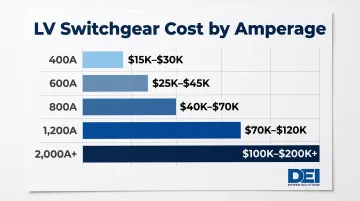
Typical cost ranges by amperage:
- 400A: $15,000–$30,000
- 600A: $25,000–$45,000
- 800A: $40,000–$70,000
- 1,200A: $70,000–$120,000
- 2,000A+: $100,000–$200,000+
What's included: New switchboard assembly, standard circuit breakers, basic installation labor, commissioning, and testing.
Best for: Commercial buildings, small industrial facilities, tenant build-outs, and facilities requiring straightforward power distribution.
DEI Power manufactures UL 891-certified switchboards in these amperage ranges from their Ontario, California facility, with most in-stock units shipping within 3–5 business days — significantly faster than the 12–30 week lead times typical of distribution panelboards from overseas suppliers.
Mid-Range Switchgear Replacement (Standard Industrial/Commercial)
Mid-tier replacements involve larger low-voltage or smaller medium-voltage systems (up to ~15kV) for manufacturing plants, data centers, or utility substations.
Typical project costs: Equipment-only costs for a 15kV, 1200A, 5-breaker metal-enclosed MV switchgear cabinet start around $90,000. Complete replacement projects including installation typically range $150,000–$400,000.
What's included: Engineered switchgear sections, specialized labor, longer outage windows, utility coordination, protective relaying, and commissioning.
Best for: Industrial plants, healthcare facilities, enterprise data centers, and facilities with continuous operation requirements.
Multi-section configurations with metering, protection relays, and bus tie arrangements add substantial cost beyond single-section replacements.
High-End / Large-Scale Replacement (Complex or High-Voltage)
Complex medium-voltage or large-scale replacements (15kV–38kV and above) serve mission-critical facilities requiring custom-engineered assemblies.
Typical project costs: $250,000–$750,000+ for complete installations, with individual circuit breaker units alone costing:
- 69 kV: $71,494
- 138 kV: $92,542
- 230 kV: $154,918
- 345 kV: $428,637
Scope typically includes:
- Custom-engineered assemblies and ancillary infrastructure replacement
- Extended outage coordination and arc flash analysis
- Comprehensive factory acceptance testing (FAT)
- Field commissioning and protective relay coordination studies
Best for: Utility substations, hyperscale data centers, large industrial processing facilities, and applications where power continuity is non-negotiable.
According to MISO's 2024 Transmission Cost Estimation Guide, these costs reflect complete installation including foundations, testing, and commissioning.
Key Factors That Affect the Cost of Replacing Switchgear
Pricing is shaped by technical specifications, site conditions, operational constraints, and procurement decisions — understanding each factor prevents budget overruns.
Voltage Class and Amperage Rating
Low-voltage (LV) and medium-voltage (MV) switchgear occupy entirely different price tiers. Within each class, amperage rating directly multiplies material and labor costs:
- 400A vs. 4,000A bus: A 400A low-voltage switchboard costs $15,000–$30,000, while a 4,000A unit costs $100,000–$200,000+ in equipment alone
- Fault current ratings: Higher available fault current requires more robust interrupting capacity, driving equipment costs up significantly
- Voltage steps: Moving from 600V to 15kV equipment can triple or quadruple the equipment cost, even at the same amperage
For low-voltage projects specifically, DEI Power manufactures UL 891-certified switchboards from 400A to 4,000A using Siemens components — covering the full LV amperage range where equipment selection directly impacts both cost and long-term serviceability.
Number of Sections and Configuration Complexity
A multi-section lineup with metering, protection relays, bus tie arrangements, and motor control centers is exponentially more expensive than a single-section switchboard replacement.
Cost multipliers by configuration:
- Single-section switchboard: baseline equipment cost
- Multi-section lineup (3–5 sections): 2–3× baseline cost
- Custom builds (non-standard voltage, unusual bus arrangements): higher cost plus extended lead time for submittal approval and field verification
Custom configurations requiring detailed submittal approval, coordination studies, and field verification add both time and expense. Working with a manufacturer that handles engineering review in-house — before production begins — can compress that timeline significantly.
Downtime and Outage Window Requirements
The impact of planned downtime is often the largest hidden cost in switchgear replacement projects.
Industrial downtime costs: According to ABB research of 3,600 industry decision-makers, 83% report unplanned downtime costs a minimum of $10,000 per hour, while 76% estimate costs up to $500,000 per hour. For data centers, average outage costs reach $740,357 per incident.
Downtime mitigation adds cost:
- Hot-tie configurations: $30,000–$75,000
- Temporary power solutions: $15,000–$50,000
- Extended staging and phased installation: 25–40% labor cost increase
- Weekend/off-hours work: 1.5–2× standard labor rates
Facilities that cannot tolerate long outages require detailed staging plans that significantly increase project cost but prevent major production losses.
Site and Infrastructure Conditions
Existing site conditions dramatically expand scope and cost:
Common hidden costs:
- Conduit relocation: $30,000–$100,000
- Cable replacement/splicing: $50,000–$200,000
- Structural modifications: $40,000–$150,000
- Fire suppression/HVAC updates: $25,000–$75,000
- Seismic bracing upgrades: $15,000–$50,000
- Rigging for confined or elevated locations: variable, often $10,000–$40,000+
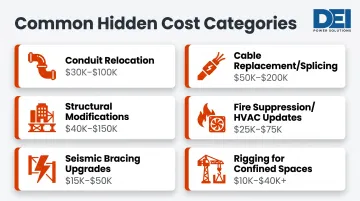
Older facilities frequently require ancillary work that never appears in the initial budget: new cable trays, structural pads for heavier equipment, wall modifications for larger footprints, and floor loading assessments.
Lead Times and Supply Chain Factors
Standard switchgear from overseas suppliers currently carries lead times of 40–80 weeks for medium-voltage units (up from 24–34 weeks pre-COVID), according to Gaston Electrical's Q4 2024 market data. Distribution panelboards now require 12–30 weeks versus 2–10 weeks previously.
Schedule delays translate to cost:
- Project carrying costs accumulate monthly
- Temporary power expenses extend
- Labor crews wait for equipment delivery
- Production schedules face continued uncertainty
In-house manufacturing from domestic suppliers — like DEI Power's UL 891-certified switchboards built and assembled in Ontario, California — can reduce lead times to 4–6 weeks for custom builds and 3–5 business days for in-stock units. Shorter lead times translate directly into lower project carrying costs and reduced temporary power expenses.
Full Cost Breakdown: What You're Actually Paying For
The purchase price of the switchgear unit is only one part of the total project cost — typically representing less than half of the final invoice for complex replacements.
Equipment Purchase (One-Time)
- Switchboard assembly and enclosure
- Circuit breakers and disconnect switches
- Bus work and connections
- Protective relays and metering
- Control wiring and auxiliary devices
Equipment costs vary by manufacturer, specification, and customization level. UL-listed equipment with genuine OEM components (such as Siemens breakers in DEI Power switchboards) costs more upfront but reduces field rework and compliance risk.
Installation and Labor (One-Time)
Installation represents 40–60% of total project cost for standard replacements.
Labor cost components:
- Electrical labor hours: $75–$150/hour (journeymen and foremen)
- Rigging and handling: $10,000–$40,000 for large sections
- Crane or forklift rental: $2,000–$8,000
- Seismic anchoring: $5,000–$20,000
- Cable termination: $50–$200 per termination point
Benchmark installation costs:
- Retrofit labor: $50,000–$150,000
- Complete replacement labor: $250,000–$750,000
Labor costs vary significantly by region and union vs. non-union rates. Metropolitan areas typically see 20–40% higher labor rates than rural locations.
Engineering, Permitting, and Commissioning (One-Time)
Most project budgets allocate too little for professional services — these line items alone can reach $173,000 on a complex replacement.
Typical cost ranges:
- Arc flash analysis: $3,000–$10,000
- Single-line diagram updates: $2,000–$5,000
- AHJ permit fees: $2,000–$8,000 (industrial)
- Design engineering services: $25,000–$75,000
- Factory acceptance testing (FAT): $5,000–$15,000
- Field commissioning: $10,000–$40,000
- Protective relay coordination studies: $8,000–$20,000
These costs represent 15–25% of total project cost and are essential for safe, compliant operation. Manufacturers that provide engineering support and submittal documentation during the quoting process — as DEI Power does — help reduce change orders and field adjustments before work begins.
Downtime and Lost Production (One-Time but High-Impact)
Distinguish between planned outage costs (manageable with proper staging) and forced outages from equipment failure (which can dwarf the entire replacement project budget).
Cost per hour of downtime by sector:
- Manufacturing/industrial: $10,000–$500,000+
- Data centers: $8,851 per minute ($530,000+ per hour)
- Healthcare: $450,000–$474,000 per hour
- Mid-to-large enterprises: 91% report $300,000+ per hour
A well-planned 8-hour outage window in a facility with $50,000/hour downtime costs adds $400,000 to the true project cost. In many cases, that single line item exceeds the combined cost of equipment and installation.
Ongoing Maintenance and Parts (Recurring)
Post-replacement recurring costs include:
- Annual inspections: $2,000–$8,000
- Biennial comprehensive testing: $5,000–$15,000
- Insulation resistance, contact resistance, trip timing tests
- Lubrication and mechanical maintenance
- Spare parts inventory
According to NFPA 70B 2023 standards, visual inspections are required every 12 months for most equipment, with comprehensive servicing every 36–60 months depending on condition and criticality.
Replacing aging gear eliminates the significant cost of sourcing obsolete aftermarket parts at premium prices — often 3–5× the cost of current production parts.
Full Replacement vs. Switchgear Modernization: Cost Comparison
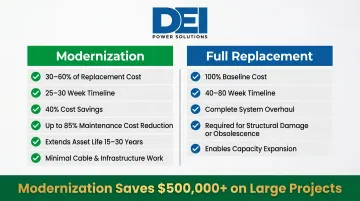
Modernization can cost 30–60% less than full replacement — and for facilities where the switchgear enclosure and bus remain structurally sound, it's often the smarter financial decision. The key is knowing which path fits your situation.
What Modernization Includes and Costs
Modernization swaps only the breaker mechanism for a modern equivalent, leaving the existing enclosure and bus intact. According to ABB's analysis, this approach delivers 40% cost savings over full replacement, up to 80% fewer CO₂ emissions, equipment cost reductions of up to 33%, and maintenance cost reductions of up to 85%.
Additional benefits:
- Extends asset life by 15–30 years
- Reduces project timeline from 60 weeks to 25–30 weeks
- Eliminates need for extensive cable and infrastructure work
- Minimizes downtime compared to full replacement
- Avoids costs of structural modifications
Typical modernization costs: 30–60% of complete replacement cost, saving $500,000+ in equipment and installation expenses on large projects.
When Full Replacement Is the Right Call
Modernization has limits. Full replacement becomes necessary — rather than optional — under these conditions:
Technical obsolescence:
- Gear beyond useful life (typically 25–35 years for circuit breakers)
- Unable to meet increased fault current ratings
- Incompatible with modern protection and control systems
- No viable direct-replacement breakers available
Physical condition:
- Structural damage to enclosure or bus
- Corrosion compromising electrical integrity
- Presence of asbestos in arc chutes (pre-1977 equipment requires hazardous material remediation)
- Inadequate physical space for load growth
Operational requirements:
- Need to reconfigure lineup for increased capacity
- Addition of metering, monitoring, or control systems
- Compliance with updated codes requiring full system replacement
- Integration with facility-wide automation systems
If two or more conditions from these categories apply to your equipment, a full replacement assessment will typically confirm the better ROI — even at the higher upfront cost.
How to Estimate the Right Budget for Your Project
The right budget isn't the lowest number — it's the accurate number, built from real project inputs, not catalog prices alone.
Start with a Full Scope Assessment
Budget accuracy starts with a site walk, review of existing single-line diagrams, and assessment of ancillary infrastructure.
Key factors to evaluate during that assessment:
- Age and condition of existing gear
- Cable condition and routing
- Outage tolerance and production schedules
- Current and future load requirements
- Compliance requirements (NEC, NFPA 70E, local AHJ)
- Available physical space and access constraints
- Structural capacity for new equipment weight
Working with a manufacturer who reviews specifications upfront — verifying compliance requirements and system compatibility before production begins — reduces the risk of change orders and field adjustments that inflate final project cost. DEI Power, for example, provides in-house engineering support and detailed configuration documentation as part of the quoting process.
Account for the Full Cost Stack, Not Just Equipment
Complete cost stack:
- Equipment purchase: 35–50% of total
- Installation labor: 30–45% of total
- Engineering/permits: 10–20% of total
- Downtime staging/mitigation: Variable (can exceed equipment cost)
- Contingency: 10–20% of subtotal
Contingency guidelines:
- New construction, good documentation: 10–15%
- Aging infrastructure, limited documentation: 15–20%
- Facilities older than 30 years: 20–25%
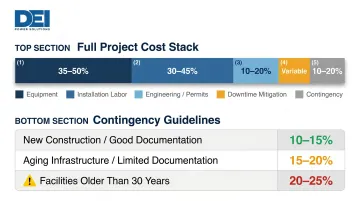
Projects in older facilities should carry higher contingency given the likelihood of discovering hidden conditions during demolition and installation.
Get Quotes That Reflect Your Actual Specifications
Once your cost stack is mapped, accurate quotes depend on the same specificity — catalog prices don't reflect your actual site conditions.
Information required for accurate quotes:
- Voltage and frequency requirements
- Amperage rating and fault current capacity
- Number of sections and breaker positions
- Bus configuration and arrangement
- Enclosure type (indoor/outdoor, NEMA rating)
- Jobsite requirements (access, rigging, staging)
- Delivery schedule and project timeline
- Submittal and documentation requirements
Lead time is part of the cost equation — faster delivery from domestic manufacturers reduces project carrying costs and schedule risk. DEI Power's 4–6 week lead times for custom builds, plus immediate availability of in-stock units, help contractors maintain schedule certainty. That's a meaningful advantage over the extended delays currently affecting overseas suppliers.
Frequently Asked Questions
How do you calculate electrical estimating costs for a switchgear replacement project?
Accurate estimation starts with a full scope takeoff — equipment specs, labor hours, permitting, engineering, outage coordination, and a 10–20% contingency factor. Avoid pricing from catalog sheets alone; site conditions almost always add cost not captured in equipment-only pricing.
What is the typical maintenance cost for electrical switchgear?
Annual maintenance costs vary by gear type, size, and age but typically range $2,000–$8,000 for routine inspections and $5,000–$15,000 for comprehensive biennial testing. Aging switchgear maintenance costs escalate as parts become harder to source and failure risk increases.
How often is switchgear maintenance required?
NFPA 70B and manufacturer guidelines generally recommend annual visual inspections for critical switchgear, with comprehensive electrical and mechanical testing every 1–3 years depending on load, environment, and equipment age. High-criticality installations may require more frequent testing.
What is the purpose of medium voltage switchgear?
Medium voltage switchgear (typically 1kV–38kV) controls, protects, and isolates electrical equipment in industrial plants, substations, and large commercial facilities. Medium voltage switchgear (typically 1kV–38kV) controls, protects, and isolates electrical equipment in industrial plants, substations, and large commercial facilities. It serves as the primary distribution and protection point between the utility feed and downstream loads. Note: DEI Power specializes in low-voltage switchgear (≤1kV, 400A–4000A); for medium-voltage applications, consult a specialist in that voltage class.
How much does it cost to build an electrical substation?
Distribution-level substations can cost up to $5 million and take 12–18 months to build. Transmission-level substations cost significantly more, with circuit breakers alone ranging from $71,494 (69kV) to $1.65 million (765kV) per unit, according to MISO's 2024 cost guide. Switchgear represents one of the largest single line items in substation budgets.
Ready to plan your switchgear replacement project? DEI Power manufactures UL 891-certified low-voltage switchboards (400A–4000A) with fast domestic lead times from their Ontario, California facility and comprehensive engineering support. Contact our team at (866) 773-8050 or sales@deipower.com for specification review and accurate project pricing.