Key Takeaways
- Indoor switchgear is enclosed switching and protection equipment installed inside a building or dedicated switch room
- Key advantages: metal enclosure safety, environmental protection, easier maintenance access, and longer service life
- Main drawbacks: higher upfront cost, dedicated space requirements, and poor viability above 66 kV
- Best suited for commercial buildings, data centers, healthcare, industrial plants, and utility substations
- Configuration choice (metal-enclosed, metal-clad, or GIS) matters as much as the indoor vs. outdoor decision
What Is Indoor Switchgear?
Indoor switchgear is a combination of electrical disconnect switches, circuit breakers, fuses, protective relays, and measurement devices assembled within a grounded metal enclosure and installed inside a building or dedicated switch room. Its purpose is to control, protect, and distribute electrical power safely and reliably.
Voltage classifications follow IEEE standards:
| Voltage Class | Range | IEEE Standard |
|---|---|---|
| Low-Voltage (LV) | Up to 1,000 Vac | IEEE C37.20.1 |
| Medium-Voltage (MV) | 4.76 kV to 38 kV (48.3 kV in 2022 edition) | IEEE C37.20.2 |
| High-Voltage (HV) | Above 38 kV | IEEE C37.20.3 |
Indoor switchgear is typically applied in:
- Commercial and light industrial facilities running low-voltage distribution (up to 1 kV)
- Large industrial plants, substations, and campuses requiring medium-voltage systems (3–36 kV)
- High-voltage applications using gas-insulated switchgear (GIS), where SF6 insulation enables compact indoor installation
Indoor switchgear is an infrastructure decision with long-term operational consequences. Its placement, configuration, and certifications (such as UL 891 for low-voltage switchboards) directly affect system safety, uptime, and code compliance over the facility's life.
Key Pros of Indoor Switchgear
These five advantages reflect what engineers, contractors, and facility teams consistently encounter when indoor switchgear is properly specified and installed.
Enhanced Safety Through Metal Enclosure Construction
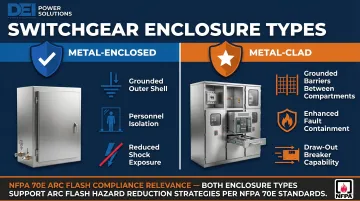
Indoor switchgear is housed in grounded metal enclosures (metal-enclosed or metal-clad), which physically isolate live components from personnel. This reduces shock, electrocution, and arc flash exposure risk in ways that open or exposed outdoor systems cannot match.
Why this matters in practice:
In industrial plants, data centers, and healthcare facilities where non-electrical staff may be present near electrical rooms, enclosed switchgear reduces liability and supports arc flash safety compliance under NFPA 70E requirements. Metal-clad designs add grounded metal barriers between compartments for additional fault containment.
ESFI data reports 1,654 workplace electrical fatalities between 2011-2024, with arc flash accounting for 2% of all electrical fatalities. NFPA reports 147 electrical deaths in 2023, with 5 from arc flash exposure.
Environments that benefit most:
Healthcare, commercial buildings, and industrial settings where personnel safety is a regulatory or operational priority make this advantage particularly high-impact.
Protection from Environmental Contaminants
Indoor switchgear is shielded from the elements that degrade outdoor equipment fastest: moisture, dust, corrosive gases, temperature cycling, UV exposure, and wind-borne debris. This protection directly translates to fewer failures and longer component life.
Real-world outcomes:
- Fewer insulation failures from moisture ingress or condensation
- Less corrosion on contacts and busbars in coastal or chemical environments
- Reduced likelihood of tracking or arc-over due to contaminated surfaces
Manufacturing facilities with airborne particulates and coastal sites with salt-air exposure see the most direct benefit — both are environments where insulation aging and contact degradation accelerate rapidly under IEEE and IEC-documented stress mechanisms.
NEMA enclosure types for indoor applications:
| NEMA Type | Protection Level |
|---|---|
| Type 1 | General purpose; falling dirt, incidental contact |
| Type 12 | Industrial use; circulating dust, falling dirt, dripping liquids |
| Type 5 | Dust-tight with gaskets |
Easier Maintenance Access and Inspection
Housing switchgear indoors in dedicated switch rooms gives maintenance teams safe, predictable, weather-independent access. This makes routine inspection, testing, thermal imaging, and component servicing more practical than outdoor equipment in exposed or elevated locations.
Process benefits:
- Scheduled maintenance happens on time
- Defects are caught earlier
- Service interruptions can be planned during off-peak hours without weather-related delays
- Metal-clad draw-out designs allow circuit breaker removal and testing without de-energizing adjacent compartments
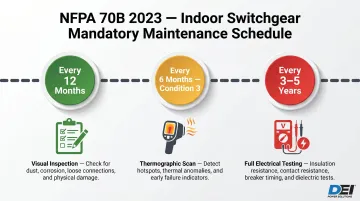
- Visual inspection of all electrical equipment at least every 12 months
- Thermographic inspection every 6 months for Condition 3 equipment
- Electrical testing every 3-5 years depending on equipment condition
Most critical application:
Mission-critical environments like data centers, hospitals, and utilities where maintenance windows are narrow and reactive repairs are far more expensive than proactive ones.
Space Efficiency in Constrained Environments
Gas-insulated indoor switchgear (GIS) and compact metal-clad designs achieve a significantly smaller physical footprint than equivalent air-insulated outdoor systems, making indoor installation viable even where land or floor space is limited.
How this plays out:
Urban commercial buildings, campus facilities, and high-density data centers can integrate switchgear within existing building envelopes rather than allocating separate outdoor yard space. This simplifies site design and reduces civil construction costs.
Siemens reports its 8DA10/8DB10 GIS is approximately 75% smaller than traditional air-insulated alternatives. Eaton data shows newer MV metal-enclosed designs reduce installation-aisle depth from 8.5 ft to 5.5 ft.
The trade-off:
GIS is compact, but it still requires a properly designed switch room with adequate headroom, cable access, and ventilation. The footprint shrinks; the engineering requirements do not.
Longer Service Life Due to Controlled Operating Environment
Indoor switchgear, shielded from weather-related stress cycles, UV degradation, and moisture ingress, typically delivers a longer service life than outdoor equipment in equivalent applications.
Eaton documents a standard 30-year technical lifetime for MV switchgear, with SF6-free vacuum designs rated for up to 40 years. IEEE PES notes many assets now 40-50 years old are reaching end of life.
Operational cost benefit:
Extended service life reduces total cost of ownership across a 20–30 year facility lifecycle. In practice, that means:
- Fewer major capital replacements over the asset's life
- More predictable depreciation and budget planning
- Higher uptime with less reactive maintenance pressure
Key Cons of Indoor Switchgear
The four disadvantages below are not reasons to avoid indoor switchgear — they are constraints that determine whether indoor switchgear fits a given project.
Higher Upfront Installation Costs
Indoor switchgear, particularly GIS and metal-clad configurations, carries a higher per-unit cost than outdoor air-insulated systems. Total installed cost includes the switch room construction, HVAC/ventilation systems, and specialized civil work not required for outdoor installations.
When this becomes a genuine constraint:
Projects with tight capital budgets or those serving high-voltage (above 36 kV) applications may find outdoor air-insulated switchgear more economically viable, despite higher operating costs over time.
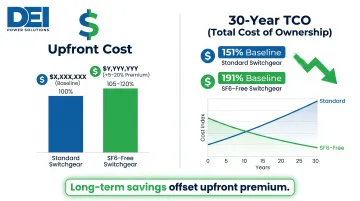
Eaton's TCO analysis shows SF6-free switchgear costs 5-20% more upfront but achieves 151% vs. 191% lifetime cost (normalized baseline), driven by lower maintenance and elimination of gas handling. When evaluating 20-30 year TCO, the upfront premium often pays for itself.
Dedicated Space Requirements
Indoor switchgear requires a properly designed, dedicated switch room with sufficient floor area, clearances, cable routing paths, access for maintenance equipment, and separation from other facility systems. This adds design complexity and potential construction cost, particularly in retrofit projects.
NEC requirements per Article 110.34:
- Minimum working space height: 6.5 ft
- Minimum working space width: 36 inches
- Working space depth: 3 ft to 12 ft, depending on voltage
- Equipment doors must open at least 90 degrees
Older commercial or industrial buildings with limited electrical room space may face significant renovation costs to accommodate indoor switchgear. Prefabricated switchgear room solutions can help manage this in tight retrofits.
Ventilation and Cooling Requirements
Electrical switchgear generates heat during normal operation. Indoor installations require adequate ventilation or active cooling systems within the switch room to maintain safe operating temperatures and prevent thermal derating or accelerated insulation aging.
IEEE C37.20.1 and IEC 61439 both set a standard maximum ambient of 40°C. ASHRAE TC9.9 specifies switchgear rated for 35°C continuous, 40°C excursion per IEC 61439.
HVAC for switch rooms must be sized for the switchgear's heat load, maintained independently, and actively monitored. This adds ongoing operational cost and complexity that outdoor systems — passively cooled by ambient air — do not require.
Limited Suitability for Very High Voltage Applications
For high-voltage (above ~66–72 kV) transmission-level applications, outdoor air-insulated switchgear remains the more common and economical choice. GIS at these voltage levels carries a substantial cost premium.
Important clarification:
Indoor switchgear is most economically justified in low- to medium-voltage distribution applications. At transmission voltages, outdoor air-insulated systems offer better economics. Projects requiring transmission-level switching should evaluate outdoor configurations from the start rather than adapting an indoor design after the fact.
What Happens When the Wrong Switchgear Is Chosen
The two most common specification errors are:
- Placing indoor-rated equipment in outdoor or semi-exposed locations where moisture and contamination cause premature failure
- Choosing outdoor equipment for indoor applications where safety enclosures and maintenance access are genuinely needed
Each error introduces real operational risk — equipment failures, safety incidents, code violations, and unplanned costs that accumulate quickly after commissioning. In data centers, hospitals, and industrial plants, unplanned outage costs routinely dwarf the savings from a lower-cost specification.
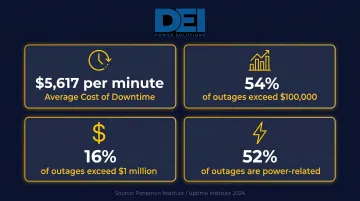
Ponemon Institute's study of 41 US data centers found an average outage cost of $5,617 per minute ($337K/hour). UPS system failure caused 29% of outages. Uptime Institute's 2024 analysis reports that 54% of significant outages cost more than $100,000, with 16% costing more than $1 million. Power-related issues cause 52% of all outages.
How to Get the Most from Indoor Switchgear
Indoor switchgear performs best when the switch room is designed around the equipment's requirements from the start. That means proper sizing for current and future load, adequate clearances, coordinated HVAC, and planned cable management — not retrofitted into whatever space is left over.
Design recommendations:
- Size electrical rooms with 20-30% capacity headroom for future expansion
- Coordinate HVAC systems to handle switchgear heat load plus safety margin
- Plan cable routing paths before equipment installation
- Ensure maintenance access meets NEC working space requirements
Manufacturer selection matters as much as room design. A supplier with in-house engineering support can catch specification gaps before they become field problems. DEI Power's UL 891-certified low-voltage switchboards, for instance, are configured to project-specific voltage, layout, and code requirements — with engineering review, submittal documentation, and lead times of 3-5 business days for in-stock configurations.
Ongoing maintenance practices:
Per NFPA 70B 2023 requirements:
- Scheduled thermal imaging and insulation resistance testing
- Documented maintenance records
- Periodic circuit breaker testing and contact resistance measurements
- Staff training on safe operating procedures
Consistent maintenance keeps the reliability that indoor switchgear was specified for in the first place. Skipping these steps is where uptime advantages quietly erode.
Frequently Asked Questions
What is indoor switchgear?
Indoor switchgear is a grounded metal enclosure housing circuit breakers, disconnect switches, fuses, protective relays, and busbars. Installed inside a building or dedicated switch room, it controls, protects, and distributes electrical power safely.
What is the difference between indoor and outdoor switchgear?
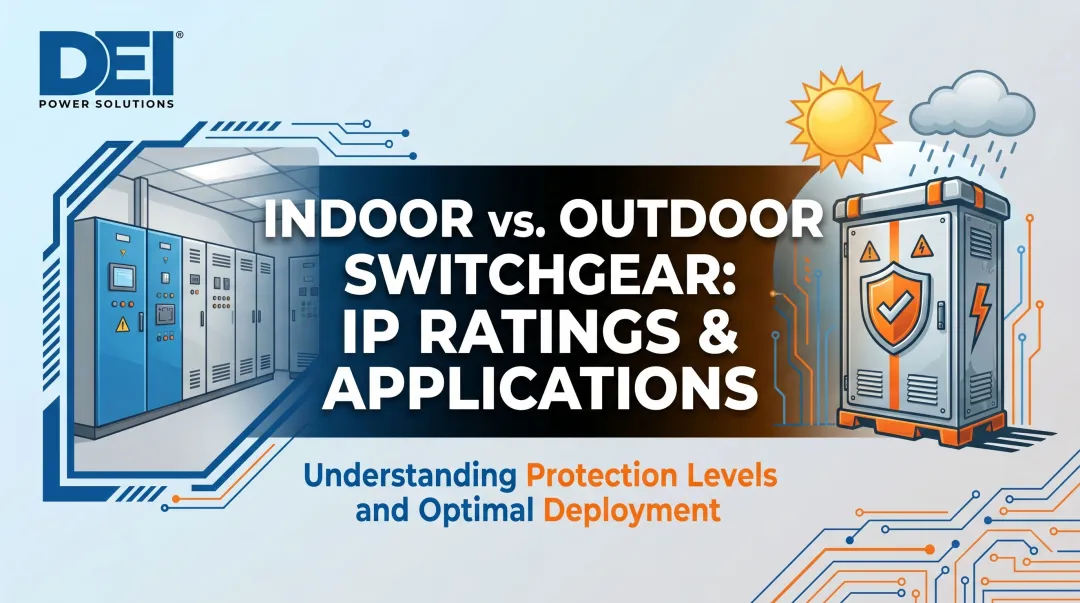
Indoor switchgear operates in a protected, controlled environment inside a building, making it less exposed to weather, corrosion, and contamination. Outdoor switchgear is designed to withstand those environmental stresses directly. Voltage level, site conditions, available space, and budget all factor into which type is appropriate.
What's the difference between HV and LV switchgear?
Low-voltage (LV) switchgear operates at voltages up to 1 kV and is common in commercial and light industrial applications. High-voltage (HV) switchgear operates above 38 kV in transmission and large utility contexts. Medium-voltage (MV) covers the 1–38 kV range typical of larger industrial and campus distribution.
What components are inside switchgear?
Core components include circuit breakers, disconnect switches, fuses, protective relays, busbars, and measuring instruments. Each handles a specific role — from interrupting fault currents and isolating circuits to monitoring voltage, current, and power quality.
What are the most common applications for indoor switchgear?
Indoor switchgear is widely used in commercial buildings, data centers and colocation facilities, hospitals, manufacturing plants, utility substations, and university or campus distribution systems — wherever uptime is non-negotiable and the environment can be controlled.
How often does indoor switchgear need to be maintained?
NFPA 70B and most manufacturers recommend annual routine inspections and comprehensive testing every 3–5 years — covering thermal imaging, insulation resistance, and circuit breaker functional tests. Actual frequency varies based on equipment age, load conditions, and how critical the facility is.