Introduction
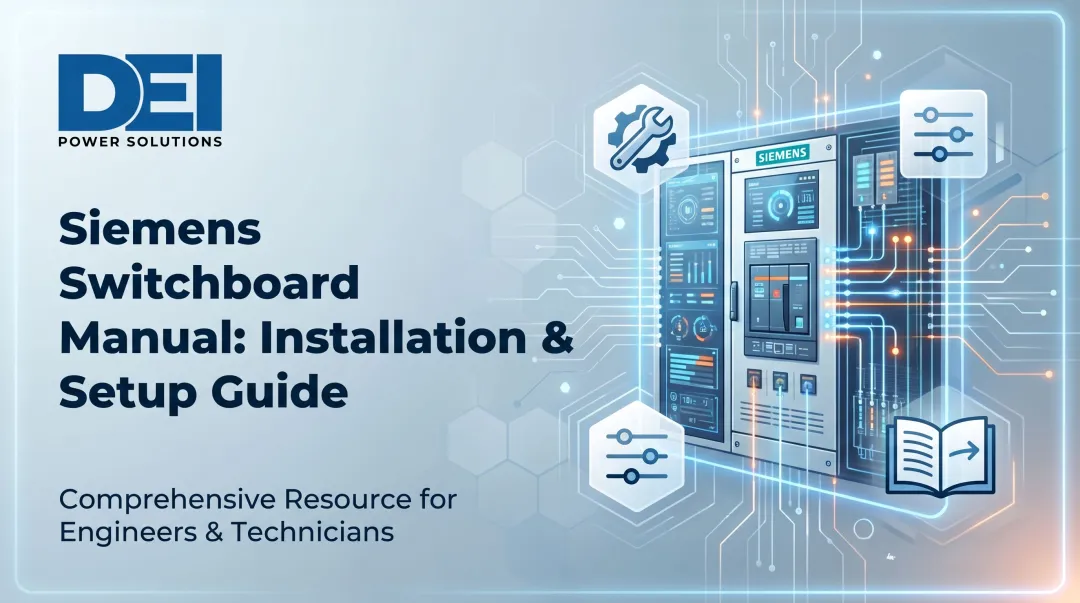
Siemens low voltage switchgear forms the backbone of commercial, industrial, and utility power distribution systems worldwide. These engineered assemblies control, protect, and isolate electrical circuits operating below 1,000V AC, serving as the critical infrastructure layer for data centers, manufacturing plants, hospitals, and electrical substations.
Yet many facility teams and contractors underestimate how much operational success depends on one factor: clear, documented maintenance procedures aligned with manufacturer requirements and national electrical codes.
The stakes are real. Unplanned outages cost data centers an average of $5,617 per minute, according to Ponemon Institute research, with some incidents exceeding $1 million in total costs. Electrical distribution failures—including switchgear faults—rank among the top root causes. Beyond downtime, neglected switchgear creates life-threatening arc flash hazards, accelerates equipment degradation, and can void manufacturer warranties while inviting OSHA citations under newly enforceable NFPA 70B-2023 standards.
This guide walks through each element of operating and maintaining Siemens low voltage switchgear assemblies:
- What LV switchgear is and how it differs from switchboards
- Why maintenance is non-negotiable from cost and compliance perspectives
- The four maintenance types and when to deploy each
- Field-tested warning signs that service is overdue
- A practical scheduling framework based on NFPA 70B and manufacturer recommendations
Key Takeaways
- Siemens LV switchgear protects circuits below 1,000V AC, combining protection, metering, and distribution in UL 891 or IEC 61439-compliant assemblies
- Preventive maintenance costs half as much as reactive repairs and can extend equipment life from 15 years to 30+ years
- Hot spots, nuisance tripping, visible arcing, and unusual noise indicate immediate maintenance needs
- NFPA 70B-2023 requires condition-based maintenance: annual inspections minimum, with thermal scans every 6-12 months
- Sourcing replacements from approved Siemens OEMs ensures UL 891 compliance and accurate configuration
What Is Siemens Low Voltage Switchgear?
Low voltage switchgear consists of factory-assembled enclosures that switch, control, protect, and isolate electrical circuits below 1,000V AC (or 1,500V DC per IEC definitions). These assemblies serve as the primary distribution hub in power systems, sitting downstream of utility transformers and feeding branch circuits throughout a facility.
Switchgear, switchboards, and motor control centers (MCCs) are often used interchangeably — but they mean different things:
- Switchgear: Individually compartmented, drawout protective devices — each circuit breaker occupies a separate, isolated compartment
- Switchboards (governed by UL 891): Dead-front construction with bolt-on or plug-in breakers in a common enclosure, without compartmentalization
- MCCs: Control equipment assemblies specifically for motor control applications with standardized plug-in units
Getting this right determines which product spec applies to your project.
Key Components in Siemens LV Switchgear Assemblies
| Component | Function | Siemens Product Examples |
|---|---|---|
| Main circuit breaker | Primary disconnect and overload protection | SENTRON 3WL series (630A–6,300A), SENTRON 3VA series (up to 1,600A) |
| Busbars | Current-carrying conductors distributing power to feeders | Copper or aluminum bars rated for continuous current and short-circuit withstand |
| Protection relays | Detect faults, coordinate protective actions, log events | Electronic trip units (ETU15B–ETU76B for 3WL series) |
| Metering instruments | Monitor voltage, current, power factor, energy consumption | Panel-mounted analog meters or digital IEDs |
| Feeder breakers | Protect and isolate individual downstream circuits | SENTRON 3VA molded-case breakers or 3WL air circuit breakers |
| Enclosure | Physical protection, arc containment, environmental sealing | NEMA 1 (indoor) or NEMA 3R (outdoor weather-resistant) |
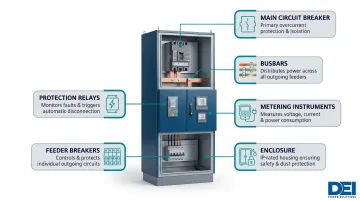
Siemens LV switchgear product lines include SIVACON S8 (up to 6,300A, IEC 61439 and IEC 61641 arc-fault tested) and SIVACON 8PT (global building/industrial platform). The SENTRON 3WL air circuit breaker series operates at temperatures down to -40°C and offers breaking capacities up to 150kA.
Governing Standards: IEC, ANSI, and UL
Three primary standards define Siemens LV switchgear construction, testing, and safe operation:
- IEC 61439-1/2: International standard covering assemblies up to 1,000V AC / 1,500V DC; mandates temperature rise, short-circuit withstand, dielectric properties, and protection against electric shock testing
- UL 891: North American safety standard for dead-front switchboards rated 1,000V or less with short-circuit ratings under 200,000A
- ANSI/IEEE C37.20.1: Covers metal-enclosed low-voltage power circuit breaker switchgear at 1,000V AC and below
For North American projects, UL 891 is the governing standard — and DEI Power's assemblies are UL 891-certified from the factory. Note that IEC 61439 eliminated the prior distinction between Type-Tested and Partially Type-Tested assemblies; all units now must meet the same safety benchmarks through testing, calculation, or design comparison.
Why Maintenance of Siemens Low Voltage Switchgear Matters
Electrical Stress and Component Degradation
Switchgear operates under continuous electrical stress. Every switching operation generates arcing that erodes contacts. Heat cycling expands and contracts metal components, loosening torqued connections. Vibration from adjacent equipment and environmental contaminants—dust, moisture, corrosive gases—degrade insulation and accelerate oxidation of conductive surfaces. These forces accumulate until a breaker fails to trip during a fault or a bus joint overheats.
Dirty or corroded contacts increase electrical resistance, causing localized heating and voltage drops. A 3% voltage drop can reduce motor efficiency by 10% or more. Heat buildup cascades—one degraded connection forces adjacent components to carry overcurrent, spreading thermal damage across the distribution system. Routine maintenance interrupts this cycle.
Safety and Regulatory Compliance
NFPA 70B-2023 transitioned from a "Recommended Practice" to the "Standard for Electrical Equipment Maintenance," with mandatory language now enforceable by Authorities Having Jurisdiction. Facilities must maintain documented inspection and testing schedules for all electrical equipment, including low-voltage circuit breakers — Chapter 15 alone covers 11 visual inspection items and 14 electrical tests.
Key compliance obligations include:
- NFPA 70B-2023: Mandatory maintenance schedules with documented records for all LV electrical equipment
- OSHA 1910.269: Annual LOTO procedure inspections, energy control programs, and verified training records
- Warranty compliance: Siemens and most OEMs condition coverage on adherence to manufacturer-specified maintenance intervals
Skipping any of these exposes facilities to failed inspections, accident liability, and voided equipment warranties.
The Cost Argument: Reactive vs. Preventive Maintenance
The financial case for preventive maintenance is straightforward. U.S. Department of Energy FEMP data shows reactive maintenance costs $18 per horsepower per year, versus $9 for predictive and $6 for reliability-centered maintenance — a 2:1 to 3:1 cost ratio. Emergency overtime, expedited parts, collateral equipment damage, and lost production push those reactive costs even higher.
A fully loaded reactive repair typically includes:
- Emergency service call at after-hours rates
- Diagnosis under time pressure
- Overnight parts shipping (if available)
- Extended downtime while awaiting components or contractor availability
- Possible collateral damage from fault events
- Lost production or missed SLA commitments
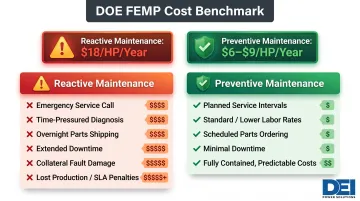
Preventive programs spread smaller, planned expenses across scheduled maintenance windows, avoiding the compounding penalties of reactive response.
Equipment Lifespan Impact
Well-maintained Siemens LV switchgear can serve reliably for 25–30 years in normal operating environments. The American Hospital Association estimates useful life at 15 years for electrical switchgear; neglected equipment often requires costly overhaul or full replacement within this range. Schneider Electric notes that properly maintained enclosures and bussing can reach 50+ years in some installations.
The gap between 15 years and 30+ years comes down to consistency. Facilities that defer inspections, skip torque checks, or ignore thermal scan alerts see failure rates climb well before capital replacement budgets are ready. IEEE Std 493 (Gold Book) ties equipment condition directly to reliability metrics — meaning each skipped maintenance cycle is a measurable step toward an unplanned outage.
Types of Maintenance for Siemens Low Voltage Switchgear
Low voltage switchgear maintenance isn't a single activity—it's a layered strategy. Most facilities deploy a combination of four approaches, calibrated to equipment criticality, operating environment, and risk tolerance. Those four approaches are: preventive, corrective, predictive, and major overhaul maintenance.
Preventive (Routine) Maintenance
Scheduled preventive maintenance follows fixed intervals regardless of equipment condition, based on manufacturer recommendations and industry standards. Tasks target known wear patterns before they trigger failures.
Core preventive tasks:
- Clean bus compartments and remove dust accumulation
- Inspect arc chutes for carbon deposits, cracks, or erosion
- Lubricate operating mechanisms (breaker linkages, racking mechanisms)
- Check contact wear indicators and alignment
- Test breaker trip functions (manual, electrical, and ground-fault)
- Torque-verify all bolted bus connections (loose connections cause 70% of thermal failures)
- Review metering accuracy and compare to baseline readings
- Perform insulation resistance tests on busbars and feeders
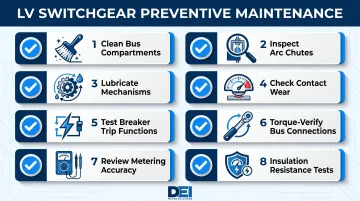
Siemens SIVACON S8 operating instructions specify visual inspection every 1 year and functional service every 5 years under normal conditions, shortened to 2 years in corrosive environments. NFPA 70B-2023 mandates similar intervals but adjusts based on equipment condition classification.
Corrective (Reactive) Maintenance
Corrective maintenance responds to fault events or operational failures: a breaker that won't close, a bus fault, a failed trip mechanism, or an arc flash event. Teams diagnose the root cause, replace damaged components, and perform post-repair testing to restore functionality.
Why over-reliance on reactive maintenance is costly:
Reactive work costs 2–3x more than preventive approaches due to emergency labor rates, expedited shipping, unplanned downtime, and often more extensive secondary damage. A breaker that fails to trip during a fault can allow fault current to propagate downstream, damaging feeders, transformers, or end-use equipment and multiplying repair costs exponentially.
NIST research indicates that approximately one-third of all maintenance costs are unnecessary or improperly carried out, often because reactive strategies address symptoms rather than root causes. The ASHE monograph documents breakers in neglected switchgear becoming permanently welded closed (unable to open during testing) or unable to hold a closed position after de-energization. Both are catastrophic end-of-life failures directly attributable to deferred maintenance.
Predictive / Condition-Based Maintenance
Predictive maintenance uses diagnostic technologies to identify failing components before outages occur. Teams schedule repairs during planned maintenance windows rather than reacting to emergencies.
Primary predictive methods for LV switchgear:
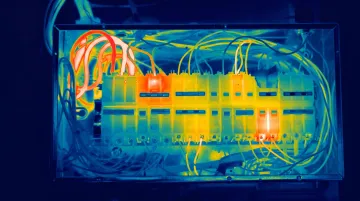
- Infrared thermography: NFPA 70B-2023 mandates thermal scans for all equipment at 6–12 month intervals. Hot spots indicate loose connections, overloaded circuits, or failing breakers
- Ultrasonic testing: Detects corona discharge and partial discharge activity in insulation, switchgear bus joints, and breaker contacts
- Partial discharge detection: Identifies insulation breakdown before flashover occurs
- Digital monitoring: Siemens IQ-series breakers support real-time load data, trip history, and fault analytics
DOE FEMP reports that functional predictive programs eliminate 70–75% of breakdowns, reduce downtime by 35–45%, and deliver a 10:1 return on investment. Predictive approaches work best for high-criticality or continuously loaded switchgear where scheduled outages are difficult to arrange, such as data centers, hospitals, and 24/7 manufacturing facilities.
Major Overhaul / Life Extension Maintenance
Overhaul maintenance is a deep-service event performed every 10–15 years, or after major fault events, involving disassembly, replacement of worn contacts and arc chutes, insulation re-testing, and full functional verification against original factory specifications.
When overhaul is required:
- Equipment reaches manufacturer-recommended service intervals
- Inspection data shows progressive degradation (contact wear exceeding limits, insulation resistance trending downward)
- After a short-circuit event or arc flash
- Prior to extended service beyond rated design life
Overhaul resets equipment condition, extending service life and deferring capital replacement costs. It makes financial sense when the switchgear's construction, ratings, and configuration still match current and projected load requirements.
Warning Signs Your Siemens Low Voltage Switchgear Needs Maintenance
Early detection prevents costly failures. Recognizing these warning signs gives you time to act before a fault becomes a forced outage.
Electrical and Operational Red Flags
- Nuisance tripping: Breakers trip without apparent fault or fail to trip during simulated fault tests, suggesting worn trip mechanisms or miscalibrated relays
- Failure to latch: Breakers won't close or hold closed position, indicating mechanical wear or contact misalignment
- Voltage imbalances: Unexplained phase-to-phase voltage differences point to loose connections or failing bus joints
- Erratic metering: Readings drift from historical baselines or show intermittent spikes, often caused by failing instrument transformers or loose wiring
Physical and Environmental Indicators
Siemens SIVACON S8 operating instructions identify these visual cues:
- Burn marks or discoloration on bus bars, connectors, or insulation
- Corrosion on contact surfaces or terminations
- Dust or moisture accumulation inside compartments
- Evidence of arcing: pitting, carbon deposits, creepage tracks on insulators
- Damaged arc chutes: cracks, erosion, or deformation
- Obstructed ventilation: clogged filter mats or blocked louvers
- Loss of identifying markings: labels, ratings, or manufacturer data plates worn away
NFPA 70B-2023 Section 15.3.1 mandates inspection of insulation for cracks and contamination, checking tightness of connections, and inspecting arc chutes for deterioration during annual visual inspections.
Heat and Noise Anomalies
Two of the most reliable early-warning signals are thermal anomalies and abnormal acoustics:
- Abnormal heat: Infrared scans revealing connections running 10°C or more above ambient or adjacent similar connections indicate high resistance and a growing failure risk. NFPA 70B requires thermal scans at 6–12 month intervals depending on equipment condition.
- Unusual sounds: Buzzing, clicking, or humming beyond normal operating levels points to loose connections (vibration-induced noise), overloading (magnetic hum), or failing mechanical interlocks — each warrants investigation before the next scheduled inspection.
NFPA 70B Condition 3 (Nonserviceable / Critical) Triggers
Equipment enters Condition 3 status—requiring the shortest maintenance intervals and immediate attention—when any of the following occur:
- Operational changes noted (temperature rise, noise, vibration)
- Missed last two successive maintenance cycles
- Previous two cycles required major component repair or replacement
- Urgent actions identified from predictive techniques (critical thermal alerts, partial discharge detection)
Once Condition 3 is confirmed, full electrical testing is required on a 12-month maximum cycle — and in practice, most facilities treat it as a trigger for immediate remediation planning.
Siemens Low Voltage Switchgear Maintenance Schedule
Maintenance frequency varies by application. Switchgear in a climate-controlled data center has different needs than equipment in a coastal utility substation exposed to salt air and temperature swings. The framework below aligns with NFPA 70B-2023 mandatory requirements and Siemens manufacturer guidance.
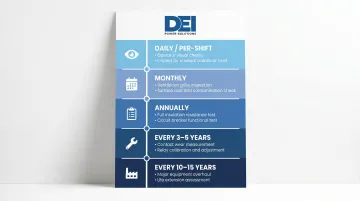
Maintenance Frequency Framework
| Interval | Tasks | Notes |
|---|---|---|
| Daily / Per-Shift | Visual check for alarm indicators, abnormal lights, audible anomalies, environmental conditions (moisture, overheating) | Operator-level inspection; log findings |
| Monthly | Inspect ventilation (clean filter mats), clean accessible surfaces, verify metering readings against baseline, check for visible corrosion or loose hardware | 15–30 minute walkthrough |
| Annually | Full insulation resistance test (≥1 megaohm per IEC 60364-6), breaker operational test (trip/close 3x per NFPA 70B), contact inspection, torque verification on all bus connections, thermal scan of energized components, review and update maintenance logs | Requires de-energization; coordinate with operations |
| Every 3–5 Years | Contact wear measurement, arc chute inspection and replacement if needed, lubrication of mechanical components, calibration of protection relays, full functional test under load | Aligns with Siemens SIVACON S8 5-year functional service interval |
| Every 10–15 Years | Major overhaul: disassembly, contact replacement, insulation re-testing, functional verification against factory specs | Life extension maintenance |
High-load or harsh-environment adjustments: Steel mills, coastal facilities, outdoor substations, or equipment operating near rated capacity should compress intervals. Siemens recommends 2-year functional service cycles in corrosive environments. NFPA 70B Condition 3 equipment requires 6-month thermal scans and 12-month full testing.
NETA MTS Frequency Matrix
ANSI/NETA MTS-2011 Section 7.1 establishes 12-month base intervals for visual/mechanical inspection and 24-month base intervals for electrical testing of switchgear assemblies. These are adjusted via a multiplier matrix:
| Equipment Condition | Low Reliability | Medium Reliability | High Reliability |
|---|---|---|---|
| Poor | 1.0x | 0.5x | 0.25x |
| Average | 1.5x | 1.0x | 0.75x |
| Good | 2.5x | 1.5x | 0.75x |
Example: Switchgear in "Good" condition with "High" reliability requirement = 24-month base × 0.75 = 18-month electrical test interval. Equipment in "Poor" condition with "High" reliability = 24 × 0.25 = 6-month interval.
When Switchgear Reaches End of Service Life
When annual maintenance costs approach 30–40% of replacement value, or when repeated failures indicate declining insulation integrity or contact wear beyond serviceable limits, replacement becomes the more cost-effective path. At that point, the priority shifts to sourcing code-compliant units that match the existing distribution system's voltage, amperage, and bus configuration.
DEI Power, an approved Siemens OEM, manufactures UL 891-certified low-voltage switchgear assemblies (400A–4000A) built with genuine Siemens components. In-stock units ship in 3–5 business days nationwide; custom configurations complete in 4–6 weeks. As-built drawings, UL certification paperwork, and configuration documentation are included to support compliance audits and maintenance recordkeeping.
Frequently Asked Questions
What is a low voltage switchgear?
Low voltage switchgear is a factory-assembled enclosure containing protective and switching devices—circuit breakers, disconnects, busbars, metering, and protection relays—used to control, protect, and isolate electrical circuits operating below 1,000V AC in commercial, industrial, and utility power distribution systems.
What are the components of low voltage switchgear?
Main components include the main circuit breaker, busbars (current-carrying conductors), feeder breakers, protection relays, metering instruments, and the enclosure with arc containment features. Siemens LV switchgear may also include intelligent electronic devices (IEDs) for digital monitoring, event logging, and remote communication.
How often should Siemens low voltage switchgear be maintained?
NFPA 70B-2023 recommends annual inspections minimum, with infrared thermography every 6–12 months. Siemens SIVACON S8 specifies visual inspection every year and functional service every 5 years. High-load or harsh environments warrant more frequent cycles.
What safety precautions are required when performing switchgear maintenance?
All maintenance requires arc flash PPE rated for the calculated incident energy, lockout/tagout (LOTO) procedures per NFPA 70E, and verification of de-energization using a properly rated voltage detector. Only qualified electrical personnel may perform internal switchgear work.
What standards apply to Siemens low voltage switchgear?
IEC 61439 governs international construction and testing (up to 1,000V AC / 1,500V DC), UL 891 covers North American switchboards (1,000V or less), and ANSI/IEEE C37.20.1 addresses metal-enclosed LV power circuit breaker switchgear. NFPA 70B establishes recommended maintenance practices mandatory in the U.S., while OSHA 1910.269 governs safety for electric power generation and distribution installations.
What is the typical lifespan of low voltage switchgear?
With proper preventive maintenance, LV switchgear typically lasts 25–30 years. The American Hospital Association pegs useful life at 15 years for depreciation purposes. Neglected equipment may require overhaul or replacement well before that threshold.