Introduction
For electrical contractors and engineers specifying switchboards, panelboards, or switchgear, few things derail a project faster than a certification mismatch. When an inspector red-tags equipment during a final walkthrough because it lacks the expected third-party mark—or carries one the Authority Having Jurisdiction (AHJ) doesn't recognize—the result is money locked in unusable equipment, delayed commissioning, and a problem that should have been caught at procurement.
This comparison matters specifically for power distribution equipment because choosing the wrong certification for your project's jurisdiction can trigger failed inspections, added liability, and costly field adjustments. Both UL and CSA are OSHA-recognized testing laboratories, but they're not universally interchangeable in practice. Knowing exactly when each mark is required can save weeks of schedule delays and thousands in rework.
This post covers what each certification is, how their requirements and geographic scope differ, and how to determine which one your project actually needs to pass inspection and stay on schedule.
Key Takeaways
- UL certification is the standard for U.S.-market electrical equipment; CSA certification covers Canada and has broader international recognition
- Both are OSHA-recognized NRTLs, meaning either mark is accepted as proof of safety compliance in U.S. workplaces
- For most U.S. commercial, industrial, and utility projects, UL certification (UL 891 for switchboards) is what inspectors and AHJs expect
- CSA certification matters for equipment headed to Canada, cross-border projects, or markets that require internationally recognized safety standards
- Choose based on installation location, AHJ requirements, and project specifications — there's no universal answer
CSA vs. UL: Quick Comparison
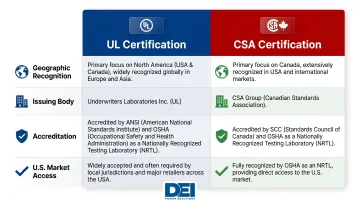
Here's how UL and CSA certifications compare across the dimensions that matter most to contractors and engineers:
| UL | CSA | |
|---|---|---|
| Geographic Recognition | Primarily the United States; accepted by U.S. AHJs for NEC compliance | Both the U.S. and Canada; broader international acceptance beyond North America |
| Issuing Body | Underwriters Laboratories | CSA Group Testing and Certification Inc. |
| Accreditation | ANSI-accredited SDO; OSHA-recognized NRTL | SCC-accredited SDO; OSHA-recognized NRTL |
| U.S. Market Access | Full — primary U.S. certification path | Full via CSA-US mark (meets U.S. NRTL requirements) |
Key Standards for Electrical/Power Equipment
UL standards relevant to power distribution:
- UL 891 – Switchboards rated 1,000 V or less (assembly design, fault isolation, circuit breaker/fuse testing)
- UL 508A – Industrial control panels for general industrial use
- UL 67 – Panelboards (construction, performance, safety)
CSA standards relevant to power distribution:
- CSA C22.2 No. 14 – Industrial control equipment rated up to 1,500 V (safety, construction, performance)
- CSA C22.2 No. 29 – Panelboards rated 600 V and less (live-part accessibility, load cycle testing, neutral assembly)
Certification Marks
UL Marks:
- UL Listed – Complete products (for example, a fully assembled switchboard)
- UL Recognized Component – Sub-components evaluated for use within a larger system
- UL Classification Mark – Products evaluated for specific properties or limited hazards
CSA Marks:
- CSA Certified Mark – Canada only
- CSA-US Mark – meets U.S. NRTL requirements
- CSA C-US Mark – meets both U.S. and Canadian standards
What is UL Certification?
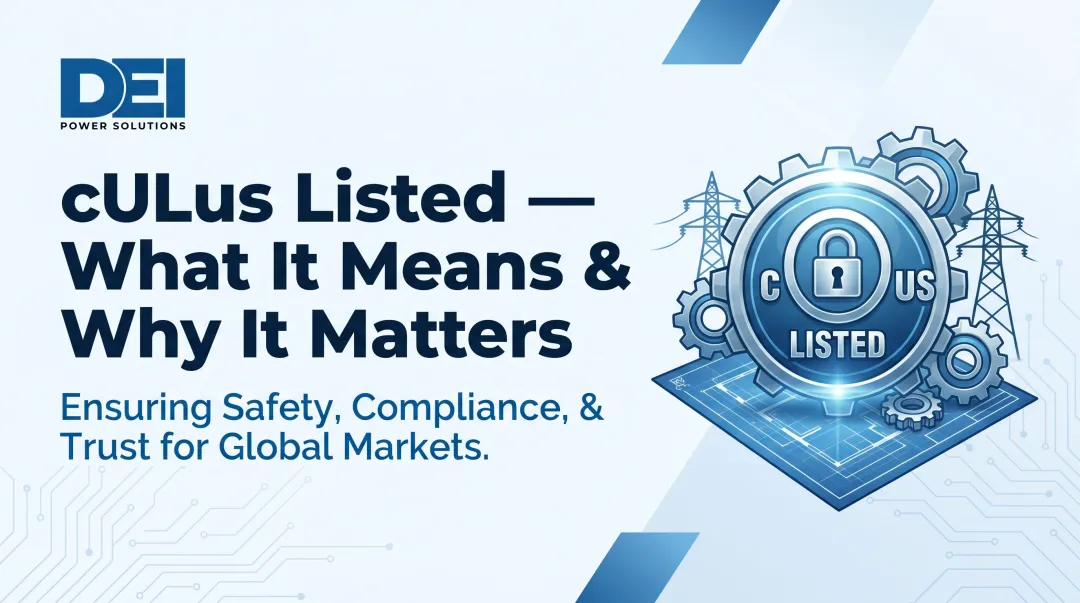
UL certification is issued by Underwriters Laboratories, a U.S.-based, OSHA-accredited NRTL and ANSI-recognized Standards Development Organization. UL tests and certifies products—including electrical equipment—against nationally recognized safety standards before they enter the U.S. market.
UL Mark Types
Contractors and engineers typically encounter two main UL marks on power distribution equipment:
UL Listed: A complete, standalone product (such as a switchboard or panelboard) that has passed UL's full safety testing for that product category. Only UL Listed products display the full UL mark in the field and can be installed as finished assemblies.
UL Recognized Component: Sub-components or parts evaluated for use inside a larger UL Listed system. These components cannot display the UL mark independently and must be integrated into a listed assembly according to specific "Conditions of Acceptability." Using a component outside those conditions can void the certification.
The Role of AHJs and NEC Compliance
In the U.S., local Authorities Having Jurisdiction and electrical inspectors frequently require UL-listed equipment to verify compliance with the National Electrical Code. NEC Section 110.2 states that conductors and equipment shall be acceptable only if "approved"—and product listing by an NRTL provides a basis for AHJ approval.
The NEC doesn't mandate UL specifically, but in practice UL listing is the fastest path to AHJ approval on commercial and industrial projects—it's the mark inspectors encounter most and accept without additional documentation requests.
Specific UL Standards for Power Distribution
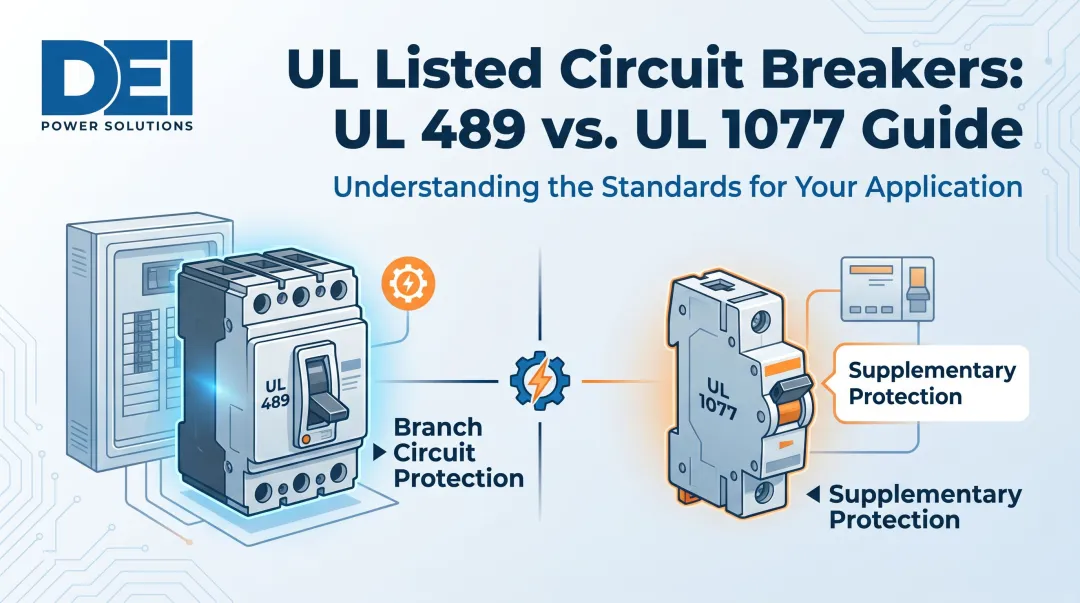
UL 891 governs dead-front switchboards. The latest edition covers material guidelines, assembly design, fault isolation, construction requirements, insulation, and short-circuit ratings for switchboards rated 1,000 V or less.
UL 508A applies to industrial control panels used in general industrial applications, covering construction, wiring, labeling, safety, and short-circuit current ratings.
UL 67 applies to panelboards, setting standards for construction, performance, and safety of panelboard assemblies.
Each standard targets distinct product categories, so the mark on a switchboard (UL 891) confirms different tested characteristics than the mark on a control panel (UL 508A).
Use Cases of UL Certification
UL listing is essential for:
- U.S. data centers and colocation facilities
- Commercial buildings and high-rise developments
- Healthcare facilities requiring reliable power
- Industrial plants and manufacturing operations
- Utility substations and infrastructure projects
Anywhere an AHJ or electrical inspector will conduct a final inspection and where NEC compliance is required, UL listing gives inspectors a recognized, NRTL-backed basis for approval—reducing back-and-forth on documentation during closeout.
Product Note: DEI Power's switchboards are UL 891 certified and manufactured in the USA, giving contractors and engineers UL 891-certified assemblies with documentation ready for AHJ review.
What is CSA Certification?
CSA certification is issued by CSA Group Testing and Certification Inc., a Canada-based NRTL also recognized by OSHA. CSA is accredited by the Standards Council of Canada as a Standards Development Organization and tests products to both Canadian (CEC) and U.S. safety standards. North American AHJs accept CSA marks, and the certification carries international recognition.
CSA Certification Marks
Not all CSA marks are valid in both countries. The distinction matters:
| Mark | Designation | Valid For | Meaning |
|---|---|---|---|
| CSA Certified Mark | CSA logo alone | Canada only | Tested to Canadian standards |
| CSA-US Mark | CSA logo + "US" | United States only | Tested to U.S. standards; CSA acting as OSHA-recognized NRTL |
| CSA C-US Mark | CSA logo + "C" and "US" | Both U.S. and Canada | Tested to both Canadian and U.S. standards |
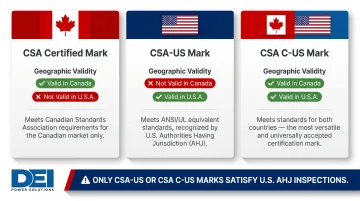
Critical distinction: The CSA Certified Mark without the "US" designation is NOT valid for U.S. AHJ inspections. Only the CSA-US or CSA C-US marks indicate certification to U.S. standards by an OSHA-recognized NRTL.
When CSA Certification Becomes Necessary
Equipment destined for Canadian installations must comply with the Canadian Electrical Code (CEC) and carry a CSA-recognized mark. CEC Rule 2-024 requires that electrical equipment be "approved"—meaning certified by a Certification Body accredited by the Standards Council of Canada.
Cross-border projects involving U.S.-manufactured equipment shipped to Canadian facilities typically require dual certification or a CSA-US mark to clear inspections in both countries.
Use Cases of CSA Certification
CSA certification is the required mark for:
- Canadian utility infrastructure and power generation projects
- Cross-border manufacturing facilities operating in both countries
- Oil and gas operations spanning the U.S.-Canada border
- Multinational companies standardizing on internationally recognized certifications
For equipment sold exclusively in the U.S., CSA certification adds cost and lead time without a compliance advantage over UL listing. Companies targeting both markets should pursue a CSA C-US mark — one certification path that satisfies Canadian and U.S. inspection requirements simultaneously, cutting procurement complexity on cross-border projects.
CSA vs. UL: Which Certification Does Your Project Actually Need?
This isn't a theoretical comparison—it's a practical decision guide for contractors, engineers, and facility teams specifying power distribution equipment.
Project Location Is the Primary Driver
If the equipment will be installed in a U.S. facility and inspected by a U.S. AHJ, UL listing to the relevant standard (UL 891 for switchboards, UL 508A for control panels) is typically required.
Under OSHA's 29 CFR 1910.7, both UL and CSA are legally equivalent NRTLs. OSHA's guidance states: "UL, CSA, or any other NRTL that is approved to use [the applicable U.S. standard] may determine if your equipment conforms to that standard."
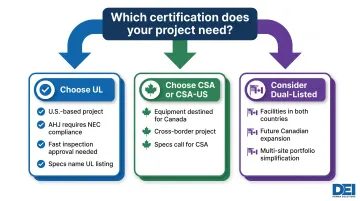
Situational Recommendations
Choose UL if:
- Your project is U.S.-based
- Your AHJ requires NEC compliance
- You need fast inspection approval with minimal documentation burden
- Project specifications name UL listing
Choose CSA (or CSA-US) if:
- Your equipment is destined for Canada
- You're working on a cross-border project
- Project specifications explicitly call for CSA certification
Consider dual-listed equipment if:
- You're procuring for facilities in both the U.S. and Canada
- Future Canadian expansion is anticipated
- You want to simplify logistics across a multi-site portfolio
The Misconception About Interchangeability
While both CSA and UL are OSHA-recognized NRTLs and AHJs should accept either, in practice many U.S. engineers and inspectors default to UL. Field reports from contractors indicate that equipment is occasionally rejected during inspection because the inspector doesn't recognize a non-UL NRTL mark—even though the mark is technically valid.
These rejections are usually resolved by directing the inspector to NEC Section 110.3 or the OSHA NRTL list, but they cause delays and added cost.
Cost and Timeline Implications
UL certification timelines and costs vary by product type. Key benchmarks for reference:
- UL 508A (industrial control panels): ~$4,500 initial setup, ~$4,500/year ongoing, plus quarterly inspections
- Simple devices: Certification can take as little as two weeks
- Complex equipment: Six to twelve weeks or longer is common
Working with a manufacturer that already holds the relevant UL listing (such as UL 891) eliminates the certification burden for the contractor or facility team entirely. Pre-certified equipment ships faster, passes inspections without escalation, and reduces project risk.
Conclusion
UL is the practical standard for U.S. power distribution projects, while CSA fills a necessary role for Canadian and cross-border applications. The right choice depends on project location, AHJ requirements, and whether equipment needs to serve both markets.
For contractors and engineers specifying switchboards and distribution equipment, working with a manufacturer whose products already carry the correct UL listing means fewer inspection delays, cleaner documentation, and more predictable project timelines. DEI Power's UL 891-certified switchboards, manufactured in Ontario, California, are built to meet those requirements from day one — so certification becomes part of the solution, not a last-minute obstacle on the critical path.
Frequently Asked Questions
Is CSA equivalent to UL?
Both are OSHA-recognized NRTLs and meet similar safety testing standards, but they are not identical. They're issued by different organizations under different SDO accreditations, and some U.S. AHJs or project specs may specifically require UL listing even though CSA-US marks are technically acceptable.
Is CSA approval accepted in the US?
CSA-US marked products are accepted in the U.S. as OSHA-recognized NRTL certifications, but the specific CSA mark matters. The CSA Certified Mark (Canada only) is not automatically valid for U.S. inspections, while the CSA-US Mark is.
Is CSA certification worth it?
CSA certification is worth it if the equipment will be sold or installed in Canada or on cross-border projects. For U.S.-only projects, UL listing delivers the same compliance benefit with a cleaner path to AHJ approval.
What is the difference between UL Listed and UL Recognized Component?
UL Listed covers complete, standalone products — such as a fully assembled switchboard — that have passed UL's full safety evaluation. A UL Recognized Component is a sub-component approved for use inside a listed system and cannot carry the UL mark on its own.
Do I need both CSA and UL certification for my electrical equipment?
Most U.S.-only projects require only UL listing. Both certifications are needed (or a dual-listed CSA-US product) when equipment must meet certification requirements in both the U.S. and Canada.
What UL standard applies to switchboards and switchgear?
UL 891 is the standard for dead-front switchboards, covering construction, insulation, and short-circuit ratings. Other relevant standards include UL 67 for panelboards and UL 508A for industrial control panels — confirm which applies to your specific equipment type before procurement. DEI Power's switchboards are manufactured and certified to UL 891, covering assemblies from 400A to 4000A.