Introduction
NEMA 3R and NEMA 4 are among the most commonly specified outdoor enclosure ratings in electrical and power distribution work — and also among the most frequently confused. Contractors and engineers often treat these ratings as interchangeable, but they provide distinctly different levels of protection. According to Bud Industries, choosing the wrong rating can mean overspending on unnecessary protection — or, more seriously, exposing equipment to conditions it wasn't built to handle.
The choice between these ratings affects equipment protection, project cost, and code compliance. NEC Section 110.28 references NEMA 250 standards for enclosures rated 1,000V or less — making correct specification both a performance and regulatory requirement, particularly for switchgear, control panels, and utility infrastructure.
This guide covers the key technical differences between NEMA 3R and NEMA 4 — including water ingress testing, sealing construction, approved applications, and how to choose the right rating for your specific project conditions.
Key Takeaways
- NEMA 3R shields against rain, sleet, snow, and ice using drainage holes — not a fully sealed enclosure
- NEMA 4 adds a weathertight gasket seal that blocks windblown dust and withstands direct hose spray
- NEMA 4 requires passing a 65 GPM hose-directed water test that NEMA 3R does not
- Choose NEMA 3R for standard outdoor utility metering, lighting control, and telecom applications
- Use NEMA 4 when washdown, heavy spray, or fine airborne dust exposure is expected
NEMA 3R vs. NEMA 4: Quick Comparison
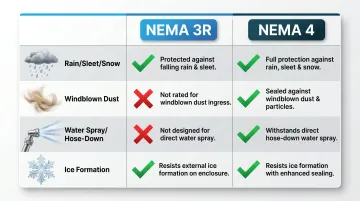
The table below covers the four core protection categories side by side. Cost and application fit follow.
| Protection Category | NEMA 3R | NEMA 4 |
|---|---|---|
| Rain, Sleet & Snow | Rain-resistant via weep holes; water enters joints and drains from the bottom — intentionally not fully sealed | Fully weathertight continuous gasket seal; no drainage holes — prevents ingress rather than managing it |
| Windblown Dust | Not required; drainage gaps also allow fine particle ingress | Continuous rubber or foam gaskets around all openings block dust and airborne contaminants |
| Water Spray / Hose-Down | No requirement; testing covers falling rain at 45° only | Must withstand direct hose water under rigorous test conditions (see specs below) |
| External Ice Formation | Must remain undamaged by ice forming on the enclosure surface | Must remain undamaged by ice forming on the enclosure surface |
NEMA 4 Hose-Down Test Specifications
NEMA 4 enclosures must pass a direct water spray test before certification. The test parameters are:
- Flow rate: At least 65 gallons per minute
- Nozzle diameter: 1 inch (25.4 mm)
- Distance: 10 to 12 feet from the enclosure
- Duration: Minimum 5 minutes, directed at all joints from all angles
NEMA 3R has no equivalent test. That gap matters in any environment where spray, splashing, or hose cleaning is routine.
Typical Cost and Application Fit
NEMA 3R costs less because its sealing requirements are simpler. It fits general outdoor applications with moderate environmental exposure — utility metering, outdoor panelboards, and similar installations.
NEMA 4 carries a higher price due to its weathertight gasket construction. It suits harsher environments: industrial facilities, washdown areas, and any location with heavy dust or direct water exposure.
What is NEMA 3R?
NEMA 3R is a rating established by the National Electrical Manufacturers Association for enclosures used indoors or outdoors. According to NEMA 250 standards, NEMA 3R enclosures protect against falling rain, sleet, snow, and external ice formation.
These ratings carry real regulatory weight. NEC Section 110.28 directly references NEMA 250 for enclosure type selection in non-hazardous locations, making the rating relevant for code compliance — not just product specs.
NEMA 3R enclosures are built with weep holes or drainage openings. Per NEMA Technical Bulletin No. 110, these openings must be 3 mm to 6 mm in diameter and positioned at the lowest point of the enclosure. Any water that enters drains out from the bottom — the enclosure is rain-resistant by design, not watertight.
NEMA 3R enclosures must pass specific water ingress testing:
- Test angle: 45 degrees from vertical to simulate wind-driven rain
- Water pressure: 34.5 kPa (5 psi) per spray head
- Nozzle specification: 5 mm spraying hole diameter
- Test duration: 1 continuous hour
- Pass criteria: No water accumulation above the lowest live electrical part
NEMA 4 testing uses higher flow rates and direct spray patterns — a meaningful step up in protection.
NEMA 3R Subvariants
NEMA 3RX adds corrosion resistance to the base 3R rating. The "X" suffix indicates protection suitable for environments with salt air, coastal exposure, or mild chemical atmospheres.
NEMA 3S and 3SX are separate variants, not upgrades to 3R. The "S" suffix means external mechanisms stay operable when ice-laden, and NEMA 3S also covers windblown dust — protection standard 3R does not include.
Common Applications for NEMA 3R
Common NEMA 3R applications include:
- Outdoor utility metering enclosures
- Outdoor panelboards and load centers under eaves or canopies
- Telecommunications equipment housings
- Outdoor lighting controls and contactors
- Electrical distribution equipment in covered outdoor locations
- Service equipment and transformers in weather-exposed locations
Where NEMA 3R is NOT appropriate:
- Environments with high airborne dust, lint, or fibers
- Locations subject to hose-down cleaning or washdown procedures
- Chemical or corrosive atmospheres (unless 3RX is specified)
- Any setting where water spray rather than rainfall is the primary hazard
- Food processing or manufacturing areas with regular cleaning protocols
What is NEMA 4?
NEMA 4 is a rating for enclosures designed for indoor or outdoor use that provides all the protection of NEMA 3R plus a fully gasketed, weathertight seal. According to NEMA 250, NEMA 4 enclosures must protect against windblown dust and hose-directed water in addition to rain, sleet, snow, and ice. This makes NEMA 4 one of the most widely specified ratings for industrial and commercial power distribution applications requiring reliable protection in demanding environments.
The NEMA 4 water ingress test is the most critical technical distinction from NEMA 3R. Per test requirements documented by Eaton:
- Flow rate: At least 65 gallons (264 liters) per minute
- Nozzle diameter: 1 inch (25.4 mm)
- Distance from enclosure: 10 to 12 feet (3.05 to 3.65 m)
- Test duration: Minimum 5 minutes, with water stream directed at all joints and seams from all angles
This test simulates direct hose-down conditions and is far more demanding than the 45-degree rain spray test required for NEMA 3R.
That higher bar is met through construction, not chance. NEMA 4 enclosures use continuous rubber or foam gaskets around the door perimeter and all openings, preventing both water and dust ingress. Unlike NEMA 3R's looser sealing with drainage accommodation, the design omits drainage holes entirely — the enclosure stops water entry rather than managing it.
NEMA 4 vs. NEMA 4X: What's the Difference?
NEMA 4X provides all the same protection as NEMA 4 but adds a corrosion-resistance requirement. Standard NEMA 4 does not specify corrosion-resistant materials, meaning a carbon steel NEMA 4 enclosure can rust in corrosive environments.
Per NEMA's published testing requirements, NEMA 4X enclosures must pass a 200-hour salt spray test benchmarked against AISI Type 304 stainless steel — on top of the standard 600-hour salt spray test required for all outdoor enclosures.
Material choices:
- NEMA 4: Carbon steel with powder coating or paint finish
- NEMA 4X: Stainless steel (304 or 316 grade), aluminum, fiberglass, polycarbonate, or ABS plastic
When to step up to NEMA 4X:
- Marine and coastal environments with salt air exposure
- Chemical processing plants
- Food and beverage facilities using chlorine or caustic cleaning agents
- Wastewater treatment plants
- Any environment where corrosive atmospheres are present
Common Applications for NEMA 4
NEMA 4 is the correct specification for:
- Industrial control panels in manufacturing plants with washdown procedures
- Power distribution equipment in food and beverage processing facilities
- Switchgear in environments with heavy weather or dust exposure
- Outdoor electrical enclosures in fully exposed locations without overhead protection
- Equipment in agriculture, water treatment, or wastewater facilities
- Factory floors with regular cleaning protocols
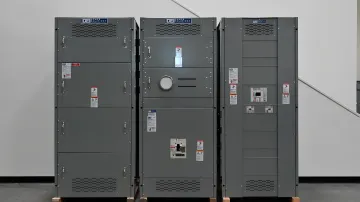
DEI Power manufactures UL 891-certified switchboards and power distribution equipment configurable for NEMA 4 and NEMA 3R enclosures. Contractors and engineers can work directly with DEI Power's team to confirm the right enclosure rating for each project's exposure conditions and compliance requirements.
NEMA 3R vs. NEMA 4: Which Rating Should You Specify?
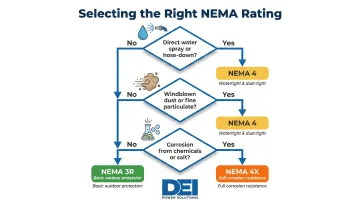
Use this decision framework based on three key environmental questions:
1. Will the enclosure face direct water spray or hose-down cleaning?
- If yes → NEMA 4 required
- If no → NEMA 3R may be sufficient
2. Is windblown dust or fine particulate a concern?
- If yes → NEMA 4 required
- If no → NEMA 3R may be sufficient
3. Is corrosion from chemicals, salt, or moisture an ongoing risk?
- If yes → NEMA 4X required
- If moderate exposure → NEMA 3RX may be sufficient
- If no → Standard ratings appropriate
A "yes" to any of these questions rules out NEMA 3R and points to NEMA 4 or higher.
Situational Recommendations by Application Type
Choose NEMA 3R for:
- Utility metering and service equipment
- Outdoor panelboards under roof or canopy cover
- Telecom equipment in moderate climates
- Electrical distribution in covered outdoor areas
- Lighting controls and contactors with overhead protection
Choose NEMA 4 for:
- Food production and processing facilities
- Industrial washdown areas with regular cleaning
- Exposed coastal or high-dust environments
- Water treatment and wastewater facilities
- Any power distribution installation where direct spray is possible
- Manufacturing plants with airborne dust or particulate
Cost and Specification Precision
Specifying NEMA 4 when NEMA 3R is sufficient adds unnecessary cost — 20-40% more due to gasket sealing requirements and weathertight construction — and may not be required by code.
However, under-specifying NEMA 3R in a NEMA 4 environment creates serious risks:
- Equipment damage from water or dust ingress
- Potential code violations if project specifications require hose-down or dusttight protection
- Costly field replacements and project delays
- Reduced equipment lifespan and increased maintenance costs
Getting the specification right — in either direction — protects both the budget and the installation.
For contractors and engineers specifying power distribution equipment for NEMA 3R or higher environments, DEI Power's team provides configuration guidance to ensure switchgear and power distribution panels meet the correct enclosure ratings for each project. Contact us at (866) 773-8050 for specification support.
Conclusion
NEMA 3R is a code-compliant, cost-effective solution for standard outdoor applications where rain, sleet, and snow are the primary concerns. NEMA 4 is the correct choice when the environment demands tighter sealing against water spray, dust, or industrial hazards. The right call depends on actual site conditions and exposure factors — not assumptions or convenience.
Specifying the correct rating from the outset protects equipment, keeps you code-compliant, and avoids costly changes after installation. For switchgear, switchboards, and power distribution equipment deployed in industrial, utility, or commercial environments, getting this right at the specification stage is far cheaper than correcting it in the field. When in doubt, consult the enclosure manufacturer's datasheet and cross-reference it against your local electrical code requirements before finalizing a specification.
Frequently Asked Questions
What is the difference between NEMA 3R, 4, and 4X?
NEMA 3R offers basic outdoor protection with drainage holes and is not fully sealed. NEMA 4 adds a fully gasketed watertight and dusttight seal plus hose-down resistance. NEMA 4X provides all NEMA 4 protection plus corrosion resistance through stainless steel, aluminum, or corrosion-resistant materials.
Is a NEMA 3R good for outdoor use?
NEMA 3R handles rain, sleet, snow, and ice formation well in outdoor settings. It is not suitable for environments with windblown dust, direct water spray, or washdown conditions, since it uses drainage holes rather than a sealed enclosure.
Is NEMA 4 good for outdoor use?
NEMA 4 is rated for both indoor and outdoor use and provides a higher level of outdoor protection than NEMA 3R. Continuous gasket sealing resists windblown dust and hose-directed water, making it suitable for harsh outdoor environments.
What are the NEMA 4 requirements?
NEMA 4 enclosures must protect against windblown dust, rain, sleet, snow, splashing water, hose-directed water, and external ice formation. Compliance is verified through a standardized hose test confirming no harmful water ingress under sustained flow.
Is NEMA 4 dust tight?
NEMA 4 is dusttight — its continuous gasket seal blocks windblown dust ingress. NEMA 3R, by contrast, has drainage openings and carries no requirement to resist airborne dust or particulate.
Can NEMA 3R be used inside?
NEMA 3R enclosures are rated for both indoor and outdoor use, providing protection against incidental contact and falling dirt indoors. For indoor-only applications with dust or drip concerns, NEMA 12 is a more appropriate and cost-effective choice.