Introduction
Getting power to the rack is only half the job. Power Distribution Units (PDUs) determine where that power goes, how much each device draws, and whether operators can act on any of it remotely — making PDU selection one of the more consequential decisions in data center design.
The stakes have risen sharply as rack densities climb. According to AFCOM's State of the Data Center 2026 report, average rack density reached 27 kW — up from 16 kW the prior year, a nearly 70% jump. At those densities, the wrong PDU type creates real exposure: wasted energy, blind spots in power usage, and limited ability to respond when something goes wrong.
Energy efficiency goals, remote management demands, and uptime requirements all factor into the decision.
What follows covers the main PDU types, how each works, and what each is best suited for — so you can match the right unit to your environment.
Key Takeaways
- PDUs distribute power from upstream sources like UPS systems or switchboards to IT equipment inside racks
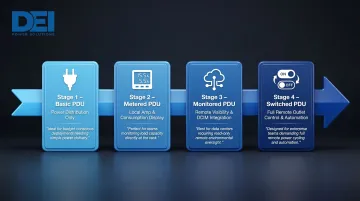
- Four main types exist: Basic, Metered, Monitored, and Switched (Intelligent), each offering different levels of visibility and control
- Basic PDUs suit simple environments; Switched PDUs are essential for high-density or remotely managed facilities
- Selection depends on operational model, power density, monitoring requirements, and budget—choose for fit, not maximum features
- PDU selection should align with upstream distribution infrastructure, including switchgear, RPPs, and panel configurations
What Is a PDU in a Data Center?
A Power Distribution Unit (PDU) takes power from an upstream source—utility feed, generator, UPS, or switchboard—and distributes it through multiple outlets to servers, network switches, and other IT equipment inside a rack or cabinet. PDUs come in two physical formats for data center use:
- Rack/cabinet PDUs — mount horizontally (1U–2U) or vertically (0U) along the rear posts of a rack, delivering power directly to equipment at the unit level
- Floor-mounted PDUs — larger standalone units serving multiple racks or entire rows, including power distribution cabinets, PDRs, and Remote Power Panels
This article focuses primarily on rack PDUs, which are most commonly discussed in the context of per-rack power management.
Beyond physical form, PDU types differ significantly in capability. Depending on the model, a PDU may simply deliver power—or it may monitor consumption, generate alerts, integrate with DCIM systems, and allow remote outlet control. Choosing the right type determines how much visibility and control you have over power at the rack level.
Why PDUs Matter in Data Center Power Management
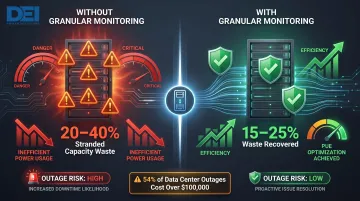
Without appropriate PDU capabilities, data center teams lack visibility into how much power each rack consumes. This increases the risk of overloads, unplanned downtime, and inaccurate capacity planning. The operational stakes are significant: Uptime Institute's 2024 Annual Outage Analysis found that 54% of respondents reported their most recent significant outage cost more than $100,000, with 16% exceeding $1 million.
Power issues remain the number one root cause. The same report found that 52% of impactful incidents or outages traced back to power problems of impactful incidents or outages. 80% of respondents believed their most recent serious outage could have been prevented with better management, processes, and configuration.
PDU selection directly connects to broader facility goals:
- Energy reporting for PUE optimization
- Tenant-level billing in colocation facilities
- Remote management in edge or unmanned deployments
- Scalability planning for high-density AI and hyperscale environments
Matching the right PDU type to each use case is where facilities either gain control or lose it. Those that implement granular power monitoring frequently uncover 15–25% power waste — stranded capacity they can recover without purchasing new equipment.
Types of PDUs in Data Centers
PDU types differ by what they can measure, report, and control. Choosing the wrong type either leaves critical needs unmet or adds cost and complexity that the environment doesn't require. The right selection comes down to matching each PDU's capabilities to the specific monitoring and management demands of the rack or facility.
Basic PDU
A Basic PDU is the entry-level form of rack power distribution. It accepts power from an upstream source and delivers it to multiple outlets with no monitoring, display, or network connectivity—functioning purely as a reliable power passthrough device. Most data centers and insurance providers require regional safety certifications: UL in North America, CE in EMEA.
There is no local display, no network port, no usage data. That simplicity is the point.
Basic PDUs work best in:
- Small or non-critical environments (lab setups, test benches)
- Racks housing low-priority equipment
- Air-gapped or secure environments where network connectivity to power infrastructure is prohibited
Low cost, minimal configuration, and high reliability are the real advantages here. The trade-off is significant: no overload detection, no usage data, and no path to remote management. For any environment where power visibility matters operationally, a Basic PDU falls short.
Metered PDU
A Metered PDU adds a local digital display showing real-time power consumption—typically current draw in amps—at the PDU or inlet level. Operators read this data directly at the rack, no network connection required. Some models offer circuit-level measurement across multiple load banks.
Compared to a Basic PDU, the difference is local measurement. Compared to a Monitored PDU, the difference is the absence of remote access—data stays on-site.
This type fits well in:
- Data centers managing load balancing during equipment deployments or moves
- Facilities without centralized reporting or remote access requirements
- Secure environments keeping power infrastructure air-gapped from the network
Metered PDUs deliver billing-grade accuracy of +/-1% for energy measurement. Integrated displays can rotate to match installation orientation, and color-coded outlet sections help technicians quickly identify which breaker controls which outlet—preventing unbalanced demand loading.
Without remote access, these PDUs only deliver value when someone is physically present. No historical trending, no DCIM integration.
Monitored PDU
A Monitored PDU provides both local and remote power monitoring through a built-in network interface. Depending on the model, it reports data at the inlet level or individual outlet level, and integrates with DCIM, BMS, or energy management platforms.
The key difference from a Metered PDU: monitoring data is accessible from any networked location. The key difference from a Switched PDU: it can read and report, but cannot control individual outlets. It's read-only from a management perspective.
Monitored PDUs are a strong fit for:
- Enterprise and colocation data centers with energy reporting requirements
- PUE tracking and threshold alerting
- Tenant-level chargeback calculations
- High-density environments where power usage effectiveness is actively managed
These PDUs support Level 3 PUE measurement at the individual IT equipment level with billing-grade accuracy, and integrate via SNMP v1/v2c/v3, Modbus/TCP, and REST APIs.
The gap is control. Without the ability to remotely reboot or shut off individual devices, Monitored PDUs lose value in edge deployments and remote locations where physical access isn't guaranteed.
Switched (Intelligent) PDU
A Switched PDU combines full outlet-level power monitoring with remote on/off and power cycling control for each individual outlet. It includes a network management interface, API support, and integration with DCIM and automation platforms.
The defining capability is control—not just visibility. Administrators can reboot hung servers or provision outlets for new devices without a site visit. This is the highest-capability PDU type in standard data center deployments.
Switched PDUs are the right call for:
- Modern enterprise data centers and hyperscale facilities
- Edge deployments and remote or unmanned locations
- High-density environments where response time is operationally critical
- Distributed multi-site operations with limited on-site staff
Power sequencing prevents inrush current from tripping circuit breakers during recovery events. Default-off outlet states block unauthorized equipment connections.
The cost and complexity are higher—network connectivity, credential management, and configuration overhead all increase. Deploying switched PDUs in low-density, non-critical racks is an easy way to overspend without gaining anything operationally meaningful.
How to Choose the Right PDU for Your Data Center
The "right" PDU is determined by operational requirements and facility constraints—not by defaulting to the most advanced or least expensive option. Getting this match right is what drives long-term reliability.
Power visibility requirements: Identify the monitoring level the environment actually requires:
- Basic — no monitoring; suitable for non-critical or simple deployments
- Metered — local-only visibility into power consumption
- Monitored — remote monitoring and reporting via network
- Switched — full remote control, outlet-level switching, and automation
Staffing levels, equipment criticality, and whether the facility supports tenant chargeback or PUE reporting will drive this choice.
Operational model and site access: Data centers with limited on-site staff, remote or edge deployments, or multi-site distributed operations benefit significantly from Switched PDUs. Centrally staffed, single-site facilities with dedicated on-floor personnel may not need this level of control. Consider how often physical access to racks is feasible versus disruptive.
Integration and scalability requirements: Determine whether the PDU needs to connect to existing DCIM, BMS, or energy management platforms. IEEE/7x24 Exchange recommends that monitoring tools support open APIs (such as Redfish or JSON-RPC) and standard protocols like SNMP, with intelligent rack PDUs integrated with DCIM for unified control.
Also assess whether anticipated growth in IT load or rack density will require more monitoring points or higher-current PDU configurations.
Upstream power infrastructure alignment: PDU selection does not happen in isolation—it should be coordinated with the upstream power distribution design, including switchboard capacity, circuit breaker sizing, and feed configurations.
For example, DEI Power's switchboards (400A–4000A, with voltage configurations including 480Y/277V, 208Y/120V, and 415/240V) and Remote Power Panels (225A–1200A, up to 84 branch circuits) can be spec'd in alignment with PDU input requirements during the design phase. Coordinating these early reduces field adjustments and change orders downstream.
DEI Power's engineering team provides specification reviews, application-specific guidance, and custom manufacturing to align switchboard and RPP configurations with PDU inputs, with a 4–6 week lead time for custom builds.
Total cost of ownership vs. upfront cost: Don't make PDU decisions based solely on unit price. Switched and Monitored PDUs often reduce long-term costs by enabling remote troubleshooting, preventing downtime, and improving energy efficiency. Basic and Metered units may carry hidden costs through manual intervention, limited visibility, and reactive operations.
Common PDU Selection Mistakes to Avoid
Three mistakes account for most poor PDU deployments:
- Overspecifying for the environment. A Switched PDU in a small, non-critical rack adds cost and configuration overhead with no operational payoff. Match complexity to actual demand.
- Overlooking what a PDU can't do. Metered units lack remote access. Monitored units lack outlet control. Switched units require integration planning. Knowing the trade-offs matters as much as knowing the features.
- Defaulting to familiarity or lowest upfront cost. Facilities that buy what they've always bought—or what's cheapest—often end up with undermonitored environments, capacity planning gaps, and reactive troubleshooting that a slightly higher-tier unit would have prevented.

The cost of under-monitoring adds up fast. Data centers commonly waste 20–40% of their allocated power capacity due to inefficient utilization and infrastructure imbalances. "Ghost" servers alone consume up to 30% of data center resources while delivering no useful workload. The right PDU tier catches this waste early—before it compounds into a capacity or budget problem.
Conclusion
PDU selection has a direct impact on how well a data center can plan capacity, respond to issues, and optimize energy use. The right type determines what visibility and control operators actually have at the rack level.
The four main types—Basic, Metered, Monitored, and Switched—exist on a capability spectrum, and each is best suited to specific environments and operational models. No single type fits every facility, which is why selection should be evaluated alongside upstream power distribution design.
Engineers, contractors, and facility teams building or expanding data centers can work with DEI Power on specification reviews, engineering guidance, and custom UL 891-certified switchboard and RPP manufacturing. That coordination ensures the entire power path from switchboard to rack is configured for current loads and future capacity requirements.
For projects requiring UL 891-certified switchboards or Remote Power Panels that feed data center rack PDUs, contact DEI Power at (866) 773-8050 or sales@deipower.com.
Frequently Asked Questions
What are the different types of data center PDUs?
The four main types are Basic, Metered, Monitored, and Switched (Intelligent). Basic PDUs provide power distribution only. Metered PDUs add local power consumption displays. Monitored PDUs enable remote power visibility and DCIM integration. Switched PDUs provide full remote outlet control and power cycling capabilities.
How does a PDU work in a data center?
A PDU receives power from an upstream source such as a UPS, generator, or switchboard and distributes it through multiple outlets to IT equipment in a rack. More advanced types also monitor power consumption and allow remote management of individual outlets.
What is PDU and RPP in a data center?
PDUs are rack-level power distribution devices that deliver power to servers and network equipment. RPPs (Remote Power Panels) are larger floor-mounted units that redistribute power from panelboards or transformers to multiple PDUs across rows of racks. They are common in high-density and large-scale facilities.
Are PDU and power strip the same?
No. PDUs are purpose-built for data center environments with higher load capacities, safety certifications (UL, CE), and depending on type, monitoring and remote management capabilities. Power strips are consumer-grade devices not designed for continuous, high-current IT loads.
What is the standard voltage in a data center?
In North America, data center equipment typically operates at 120V or 208/240V, with three-phase configurations common in high-density deployments. Internationally, 230V is standard. PDU input plugs must match the facility's available power source; most modern IT equipment accepts 96V–264V input.
What is the difference between a metered and a monitored PDU?
A Metered PDU displays power consumption data locally at the unit with no remote access. A Monitored PDU provides that same data remotely via a network interface—along with historical trending, threshold alerts, and DCIM integration capabilities.