Introduction
Data centers today face a converging set of pressures: rising AI workload density, faster build timelines, and zero tolerance for downtime — making reliable power distribution more critical than ever. A single rack running NVIDIA Blackwell NVL72 GPUs now draws 132 kW, compared to the industry average of just 8 kW per rack. Meanwhile, 54% of operators report their most recent significant outage cost more than $100,000, with 20% exceeding $1 million.
Power failures in data centers are rarely caused by insufficient grid supply. The real risk lies in how power is conditioned, transferred, and delivered on-site — the path from the utility entrance to the IT load. Power distribution failures account for 54% of all impactful outages, up from 43% in 2022.
Understanding that distribution path — and where it can fail — is what separates resilient facilities from vulnerable ones. This guide covers the full power distribution chain, key components, redundancy design principles, and best practices for maintaining uptime in mission-critical environments.
Key Takeaways
- Reliable data center power distribution spans every layer from the utility feed to the server rack, and each one is a potential failure point.
- Key components include switchboards, UPS systems, backup generators, PDUs, busway systems, and remote power panels.
- Redundancy architecture (N+1, 2N) must be matched to the facility's uptime requirements and business risk tolerance.
- 66-80% of distribution failures stem from human error, inadequate maintenance, and under-specified equipment — not design flaws.
- Sourcing pre-engineered, UL 891-certified equipment from experienced manufacturers reduces field risk and schedule delays.
Why Power Distribution Reliability Is Non-Negotiable in Data Centers
Data centers are mission-critical infrastructure supporting financial systems, healthcare records, cloud services, and AI workloads. Even minutes of downtime carry severe operational and financial consequences. The Ponemon Institute reports average unplanned outage costs of approximately $8,662 per minute for enterprise data centers, with 54% of respondents reporting their most recent significant outage cost more than $100,000.
Power-related failures consistently rank as the leading cause of data center outages. The Uptime Institute's 2024 Global Data Center Survey attributes 54% of impactful outages to power distribution — up from 43% in 2022. By comparison, network issues account for 12%, IT systems for 13%, and cooling for just 11%.
The distinction between grid availability and on-site distribution reliability is critical. Grid power is dependable in most regions. The real risk lies in how power is conditioned, transferred, and delivered internally — through switchboards, UPS systems, transfer switches, PDUs, and branch circuits.
Business Consequences of Power Distribution Failure
Downtime costs are only part of the damage:
- SLA penalties and customer churn from service interruptions
- Regulatory non-compliance in financial and healthcare sectors facing stricter oversight
- Reputational damage that persists long after systems are restored
- Re-synchronization delays that can extend outages by hours even after power is restored
- Opportunity costs from lost transactions, abandoned workloads, and delayed projects
Modern demands are pushing legacy distribution infrastructure to its design limits. AI rack densities now exceed 50-100 kW per rack, while most data centers were designed for 8-10 kW per rack. For operators running that gap, distribution infrastructure that was adequate five years ago may already be the weakest link in the facility.
The Data Center Power Distribution Path: From Grid to Server
Power flows through a data center in a carefully engineered chain: utility feed → medium-voltage substation → low-voltage switchboards/switchgear → UPS systems → PDUs or busway → IT equipment racks. At every layer, redundancy and proper engineering determine whether the facility survives a fault — or goes dark.
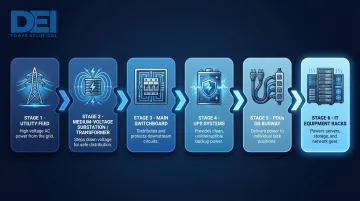
Utility Entrance and Substation Layer
Large data centers typically require power demands of 100 MW or more, with annual electricity consumption comparable to small countries. These facilities receive one or more utility feeds, use step-down transformers to convert medium-voltage grid power to low-voltage distribution levels, and deploy medium-voltage distribution switchgear to bring power onto the campus.
U.S. data center electricity consumption reached 176 TWh in 2023 (4.4% of total U.S. electricity), up from approximately 76 TWh in 2018. Projected demand for 2028 ranges from 325-580 TWh, representing 6.7-12.0% of U.S. electricity.
Main Distribution Switchboards
Main distribution switchboards receive power from the transformer, protect downstream circuits, and branch power to multiple load centers across the facility. Under-rated or non-compliant switchboards at this layer create downstream risks that are difficult and expensive to correct once the facility is operational — making UL 891 certification and correct ampacity ratings non-negotiable at this stage. Switchboards serve as the primary distribution layer between the transformer secondary and downstream UPS inputs or load centers.
DEI Power manufactures UL 891-certified switchboards rated from 400A to 4000A, built to custom specifications including voltage, layout, and ampacity requirements. These pre-engineered, factory-built assemblies reduce the variability and commissioning risk that come with field-assembled configurations — especially important on fast-moving data center projects.
UPS and Generator Layer
UPS systems provide instantaneous backup power during outages while generators spin up. Together, they define how long the facility can sustain full operations while generators come online. Modern double-conversion UPS systems deliver up to 97% efficiency in online mode and 99% in ECO mode.
Generators must cover the full IT load plus mechanical and support systems. Key specifications to understand:
- Standard fuel storage provides 24 hours of runtime per tank
- Mission-critical installations typically carry 48-72 hours of fuel (96 hours in high seismic risk areas)
- Automatic transfer switches (ATS) transition loads in 50-200 milliseconds
- Static transfer switches (STS) complete the same transition in under 4 milliseconds
Last-Mile Distribution
From load centers, power moves through PDUs and busway systems to individual server racks — the final handoff before IT equipment. This layer demands careful load balancing, real-time monitoring, and enough design flexibility to accommodate future density increases without a full infrastructure rebuild.
ENERGY STAR reports that electrical distribution system losses can account for 10-12% of total data center energy consumption. High-efficiency PDUs containing high-efficiency transformers are 2-3% more efficient overall compared to PDUs with standard-efficiency transformers.
Core Components of a Reliable Power Distribution System
Upstream Distribution: Switchboards and Main Distribution Switchgear
Switchboards and panelboards serve as the primary distribution layer between the transformer secondary and downstream UPS inputs or load centers.
What to Look for in Data Center-Grade Switchgear:
- UL 891 certification — independently tested to meet defined safety and performance criteria
- Appropriate short-circuit current ratings (SCCR) — equipment must withstand available fault currents
- Custom bus configurations — tailored to voltage, ampacity, and layout requirements
- Clear documentation — wiring diagrams, as-built drawings, and commissioning guides for field teams
Specifying pre-engineered, factory-built switchboards — rather than field-assembled configurations — reduces variability and commissioning risk on fast-moving projects. DEI Power's UL 891-certified switchboards are built to custom specs (voltage, layout, ampacity) with in-house engineering support, with delivery available in 3-5 business days from their 50,000 sq. ft. Ontario, California facility.
With upstream distribution established, the next layer addresses what happens when utility power fails or degrades.
Conditioning and Backup: UPS Systems and Generators
UPS Systems provide continuous conditioned power and seamless transition during outages, protecting sensitive IT equipment from voltage sags, surges, and frequency deviations. Modern trends favor modular, hot-swappable UPS architectures that support scalability without taking systems offline.
UPS efficiency varies significantly by facility type:
| Facility Type | UPS Efficiency Range |
|---|---|
| Edge / SMB / Enterprise Branch | 77–85% |
| Internal Enterprise / Colocation | 80–94% |
| Hyperscale / AI workloads | 90–99% |
Backup Generator Selection requires careful consideration of load matching to UPS capacity, fuel type (diesel vs. natural gas), and start-up time. Regular load testing is what separates generators that start when they're needed from ones that fail at the worst moment — run monthly tests at 30–50% load for 30 minutes minimum. Annual load bank tests at 100% rated load for 1–4 hours are required, with full 4-hour continuous load bank tests every 36 months for Level 1 EPSS systems.
Last-mile distribution — the equipment between upstream power and individual rack devices — is where capacity planning decisions become physical.
Last-Mile Distribution: PDUs, Busway, and Remote Power Panels
Power Distribution Units (PDUs) deliver conditioned power to individual devices within a rack. Intelligent/smart PDUs provide outlet-level monitoring, load balancing alerts, and integration with DCIM platforms for capacity planning.
What is a busway in a data center? A busway (or busduct) is a prefabricated metal-enclosed system of copper or aluminum busbars used to distribute high-capacity power across a data center floor or overhead. It serves as a flexible, scalable alternative to traditional cable runs and supports easier reconfiguration as IT loads change.
Busway Advantages:
- Lower voltage drop from reduced impedance
- Less labor-intensive installation
- Easier reconfiguration for changing loads
- Compact cross-section
- Engineered-to-order material efficiency
According to Eaton's busway fundamentals, busway systems are available in ampacity ratings up to 6,000A at voltages up to 38 kV for utility-to-switchgear feeds.
Remote Power Panels (RPPs) serve as intermediate distribution hubs between upstream switchboards and downstream PDUs. DEI Power's RPPs are rated from 225A to 1200A with 42 to 84 branch circuits, reducing cable runs between switchboards and rack-level PDUs. Optional branch circuit monitoring gives operations teams real-time load visibility at the panel level.
Redundancy Architecture: How to Design for Uptime
Understanding Tier Classifications
The Uptime Institute defines four tier levels that map to specific redundancy architectures and uptime percentages:
| Tier Level | Uptime | Max Annual Downtime | Redundancy | Key Characteristics |
|---|---|---|---|---|
| Tier I | 99.671% | 28.8 hours | N (no redundancy) | Single distribution path; susceptible to disruptions |
| Tier II | 99.741% | 22 hours | N+1 | Redundant components; still single distribution path |
| Tier III | 99.982% | 1.6 hours | N+1, dual paths | Concurrently maintainable — any component can be serviced without impacting IT |
| Tier IV | 99.995% | 26.3 minutes | 2N or 2(N+1) | Fault tolerant — single equipment failure does not impact operations |
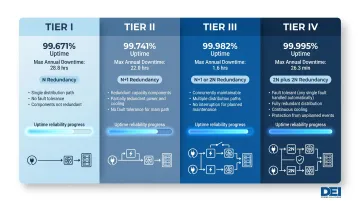
Most enterprise and colocation data centers target Tier III or Tier IV, where the redundancy model directly shapes your power distribution architecture — including how you design A and B paths.
Dual-Corded IT Equipment and A/B Power Paths
Servers with redundant power supplies draw from two independent distribution paths. This design means a single component failure in either path cannot interrupt the IT load — but only if the infrastructure behind it is properly isolated. Achieving that requires:
- Separate UPS systems for A and B paths
- Independent transfer switches and distribution panels
- Isolated branch circuits to each rack
- Load balancing across both paths
The Testing Imperative
A 2N system you've never tested under real load conditions provides false confidence. Include these as non-negotiable parts of your design process:
- Failover testing under operational load
- Periodic transfer switching exercises
- Commissioning validation with full documentation
- Regular load testing of backup systems
Common Power Distribution Failures and How to Avoid Them
Root Causes of Distribution-Layer Failures
The most frequent root causes include:
- Loose or improperly torqued connections
- Overloaded branch circuits
- Inadequate short-circuit protection
- Aging or under-specified switchgear designed for lower load densities
The equipment itself rarely fails in isolation. Uptime Institute's 25-year dataset attributes 66-80% of all downtime incidents to human error. Specific causes include:
- Staff failing to follow procedure (48%)
- Incorrect staff processes/procedures (45%)
- In-service issues (23%)
- Installation issues (20%)
- Insufficient staff (15%)
- Preventive maintenance frequency issues (14%)
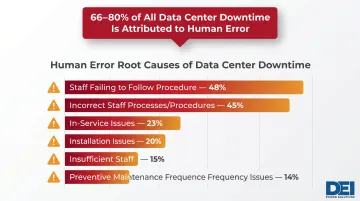
Critically, 80% of operators believe their most recent serious outage was preventable with better management, processes, or configuration.
The Execution Variability Risk
That statistic points to a specific gap: execution. Field-built or ad hoc modifications introduce cumulative inconsistency that is hard to detect until failure occurs. Common field modification problems include:
- Value engineering changes that eliminate valves required for concurrent maintainability
- Equipment consolidated onto a single ATS to reduce costs, compromising fault tolerance
- Bus ducts rerouted into locations preventing infrared scanning of joints
- UPS units ordered without necessary bus/connection components
- Compressed commissioning schedules used as buffers for construction delays
A detailed case study from Hood Patterson & Dewar traced a data center electrical disturbance to a single loose screw behind a UPS control board. That screw caused a short circuit and arc damage, triggering cascading UPS logic errors and a 236% overload on the backup UPS.
The downstream effects compounded quickly. A 179-millisecond open-transition transfer drained server power supply capacitors, creating aggregate recharge loads that far exceeded UPS ratings — all from one loose connection.
Preventive Maintenance
A structured maintenance program should cover:
- Run infrared thermography scans to catch hot spots in bus connections before they escalate
- Perform torque checks on all bus connections per manufacturer specifications
- Load test backup systems monthly and at annual intervals
- Monitor power quality continuously to catch harmonics or imbalances early
Best Practices for Long-Term Power Distribution Reliability
Align Equipment Specification to Actual and Projected Load
Right-size switchgear, UPS, and PDUs for current capacity while building in headroom for growth — typically 20-30% above projected peak. Select modular equipment that can scale without full replacement.
Integrate DCIM Platforms for Real-Time Visibility
Data Center Infrastructure Management (DCIM) systems provide:
- Power monitoring across UPS, PDUs, and branch circuits at rack and device level
- PUE calculation and historical trending
- Capacity planning with "what-if" scenario modeling for power, space, and cooling
- Asset tracking with 2D/3D visual mapping
- Environmental monitoring (temperature, humidity, airflow, leak detection)
- Real-time threshold alerts via email, SMS, or SNMP traps
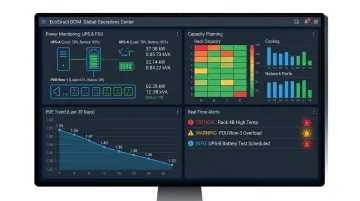
Case studies from Schneider Electric's EcoStruxure IT platform show 5-10% savings in power and energy through DCIM deployment, with one deployment achieving a 30% reduction in emissions.
Source from Manufacturers with Proven Code Compliance and Domestic Capability
DCIM gives you visibility — but that visibility only protects uptime if the underlying equipment ships on schedule. For mission-critical projects, delivery certainty is as important as product quality. A delayed switchgear order can stall an entire site commissioning timeline.
Look for manufacturers with:
- UL 891 certification and documented testing protocols
- Domestic manufacturing capability with Buy America Build America (BABA) compliance for federal and infrastructure projects
- In-house engineering support for custom configurations
- Pre-engineered, factory-built assemblies that reduce field variability
- Full documentation including wiring diagrams, as-built drawings, and commissioning guides
DEI Power manufactures UL 891-certified switchboards and remote power panels from a 50,000 sq. ft. facility in Ontario, California. Standard orders ship nationwide in 3-5 business days, and custom configurations carry typical lead times of 4-6 weeks — with in-house engineering support available throughout.
Frequently Asked Questions
What is a busway in a data center?
A busway (or busduct) is a prefabricated metal-enclosed system of copper or aluminum busbars used to distribute high-capacity power across a data center floor or overhead. It serves as a flexible, scalable alternative to traditional cable runs and supports easier reconfiguration as IT loads change.
What is the difference between a switchboard and a PDU in a data center?
A switchboard is an upstream, facility-level distribution device that receives power from the transformer and branches it to multiple circuits or load centers. A PDU is a downstream device that delivers conditioned power directly to individual IT equipment within a rack. They serve different layers of the distribution hierarchy.
What redundancy level should a mission-critical data center target?
Tier III (N+1, 99.982% uptime) or Tier IV (2N fault tolerant, 99.995% uptime) are the most common targets for enterprise and colocation data centers. The right choice depends on uptime SLA commitments, budget, and the business impact of any single component failure.
What does UL 891 certification mean for data center switchgear?
UL 891 is the standard for dead-front switchboards, covering construction, performance, and safety requirements. Equipment bearing this certification has been independently tested to meet defined safety and performance criteria, which is important for code compliance, insurance, and commissioning in commercial and industrial installations.
What is the most common cause of data center power outages?
According to the Uptime Institute's 2024 Global Data Center Survey, power-related failures — including UPS failures, transfer switching errors, overloaded circuits, and maintenance errors — account for 54% of impactful data center outages. Human error contributes to 66-80% of all downtime incidents, making on-site distribution design and maintenance the primary risk factors.
How do you calculate power capacity requirements for a data center?
Power capacity is estimated by summing the nameplate or measured power draw of all IT equipment plus cooling and facility loads, then applying a PUE multiplier and a growth headroom factor. This calculation drives sizing decisions for switchgear, UPS, generators, and PDUs at every layer of the distribution system.