
The challenge intensifies because 1600A installations serve mission-critical facilities where downtime is measured in thousands of dollars per minute: hyperscale data centers, hospitals, manufacturing plants, and utility substations. In these environments, the conductor selection must account for continuous loads running 24/7, elevated ambient temperatures in mechanical rooms, and conduit fill constraints that can reduce effective ampacity by 30% or more. This guide walks through every variable that influences 1600A conductor selection, helping engineers and contractors make compliant, reliable decisions.
Key Takeaways
- No single conductor carries 1600A safely—NEC 310.10(H) requires parallel sets of 1/0 AWG or larger
- Typical copper configurations use 4 parallel runs of 600 kcmil at 75°C (4 × 420A = 1,680A)
- Aluminum costs 75% less per pound but needs larger sizes, AL/CU-rated terminations, and antioxidant compound at connections
- Per NEC Table 250.122, size the equipment grounding conductor at 4/0 AWG copper or 350 kcmil aluminum
- Standard (80%-rated) 1600A breakers limit continuous loads to 1,280A unless 100%-rated equipment is used
What is 1600 Amp Service?
1600-amp service is a large-scale electrical service or feeder rating used in high-demand commercial, industrial, and infrastructure environments. It's standard in hyperscale data centers, manufacturing plants, large commercial campuses, hospitals, and utility substations—facilities where electrical loads far exceed typical residential (200A) or light commercial (400–800A) requirements.
According to NEC Table 310.15(B)(16), the largest single conductor listed (2000 kcmil) tops out at approximately 665A for copper at 75°C and 750A at 90°C—far below the 1600A threshold.
This physical limitation makes 1600A service a parallel-conductor-only application. No single wire can safely handle this ampacity, requiring engineers to distribute current across multiple conductor sets according to NEC 310.10(H). That design requirement adds real complexity to installation and code compliance.
Where 1600A Service Fits in Power Distribution Hierarchy
In a facility's electrical infrastructure, 1600A service typically feeds a main distribution board, switchboard, or switchgear assembly, which then routes power to downstream panels, motor control centers, or sub-feeders. BCS Switchgear confirms that 1600A-rated switchboards are commonplace in AI environments, routing utility or generator power to UPS systems, panelboards, and power distribution units.
Common facility types requiring 1600A service include:
- Data centers: Mission-critical power distribution with N+1 or 2N redundancy
- Manufacturing plants: High-load motor control and process equipment
- Healthcare facilities: Main distribution boards serving critical care systems
- Commercial campuses: Central utility feed points serving multiple buildings
- Utility substations: Distribution switchgear for grid infrastructure
What Wire Size Do You Need for 1600 Amp Service?
Common NEC-Compliant Parallel Conductor Configurations
The table below shows typical configurations for 1600A service based on NEC Table 310.15(B)(16), which governs conductor ampacity for up to three current-carrying conductors in raceway at 30°C ambient:
| Parallel Runs | Conductor Size (per run) | Material | Temp Rating | Ampacity per Conductor | Total Ampacity | Meets 1600A? |
|---|---|---|---|---|---|---|
| 4 | 500 kcmil | Copper | 75°C | 380A | 1,520A | No (requires upsizing) |
| 4 | 600 kcmil | Copper | 75°C | 420A | 1,680A | Yes (before derating) |
| 4 | 600 kcmil | Aluminum | 75°C | 340A | 1,360A | No |
| 5 | 500 kcmil | Aluminum | 75°C | 310A | 1,550A | Marginal |
| 4 | 750 kcmil | Aluminum | 75°C | 385A | 1,540A | Marginal |
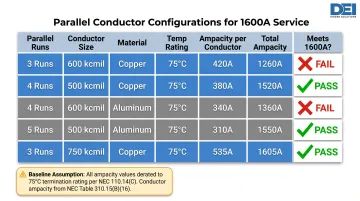
Note: These values assume 75°C termination ratings (NEC 110.14(C) requirement for circuits over 100A) and do not account for ambient temperature correction or conduit fill derating—both of which can reduce effective ampacity by 12–30%.
Parallel Conductor Requirements Under NEC 310.10(H)
Per NEC 310.10(H), all conductors installed in parallel must meet strict uniformity requirements to ensure balanced current distribution:
- Minimum size: 1/0 AWG or larger
- Same length: All conductors in each set must be identical length
- Same material: All copper or all aluminum (no mixing)
- Same cross-section: Identical circular mil area
- Same insulation: All THHN, all XHHW, etc.
- Same termination method: Identical connection approach
Violating any of these requirements can create current imbalance, leading to overheating in some conductors while others remain underloaded.
Copper vs. Aluminum Conductor Selection
Copper delivers higher ampacity per cross-sectional area: four runs of 600 kcmil at 75°C yield 1,680A before derating. Aluminum requires larger kcmil sizes to match that output, but the cost difference is significant. According to Electrical Contractor Magazine, copper trades at roughly $2.90/pound versus $0.76/pound for aluminum — about 75% cheaper by weight.
However, total installed cost differential narrows due to:
- Larger aluminum conductors requiring bigger conduit (increasing steel costs)
- Mandatory anti-oxidant compound application at terminations
- AL/CU-rated lugs (often more expensive than copper-only connectors)
- Additional labor for wire brushing at connection points
Despite these factors, aluminum remains widely preferred for large feeder runs at 1600A due to its 50% lighter weight and lower material cost. That weight advantage directly affects termination quality — which brings up a constraint that catches many engineers off guard.
Termination Temperature Rating Constraints
Most switchgear and distribution equipment is rated for 75°C terminations, even when 90°C-rated wire (THHN/THWN-2) is installed. Per NEC 110.14(C)(1)(b), circuits over 100A must size conductors using the 75°C column unless terminals are specifically marked for higher ratings. The conductor ampacity must match the lowest temperature rating in the assembly — insulation or terminal, whichever is lower. This is one of the most frequently overlooked constraints in large feeder design.
Conduit Sizing and Fill Calculations
Running three or four sets of large-kcmil conductors in parallel requires careful conduit fill calculations per NEC Chapter 9, Table 1, which limits fill to 40% of conduit cross-sectional area for three or more conductors. Based on NEC Appendix C fill tables:
| Conductor Size | 3 Conductors Min Conduit (EMT) | 4 Conductors Min Conduit (EMT) |
|---|---|---|
| 500 kcmil THHN | 2-1/2 inch | 3 inch |
| 600 kcmil THHN | 3 inch | 3 inch (EMT) / 3-1/2 inch (RMC) |
For a 1600A service using four parallel sets of three 500 kcmil THHN conductors per set (phases A, B, C), you'll need four separate conduit runs, each minimum 3-inch EMT. Each parallel set is typically run in its own conduit to comply with NEC 310.10(H) current balancing requirements.
Voltage Drop Considerations
Once conduit and conductor sizing are confirmed, run length determines whether the selection holds up. For feeders exceeding 200–300 feet, voltage drop becomes a key design factor. The NEC recommends keeping feeder voltage drop to 3% or less per NEC 215.2 Informational Note. Though not enforceable, exceeding that threshold degrades equipment performance and can shorten service life. Always verify conductor selection with a voltage drop calculator at the actual run length, especially for long feeders in large facilities.
Key Factors to Consider When Selecting Wire for 1600 Amp Service
Conductor size alone doesn't define a compliant or operationally sound 1600A installation. The following factors directly influence whether your conductor selection will pass inspection, perform safely under load, and remain reliable over decades of service.
Conductor Material: Copper vs. Aluminum
Conductor material is the first design decision. Copper offers higher ampacity per kcmil and more mechanically robust terminations, but aluminum is notably lighter, less expensive at large sizes, and widely accepted for high-ampacity feeder applications when properly terminated.
Aluminum conductors must be installed with anti-oxidant compound and AL/CU or AL9CU-rated lugs per UL 486B standards. This prevents formation of aluminum oxide (a high-resistance insulator) that can cause connection overheating. Compression lugs are strongly preferred over mechanical set-screw lugs for services above 400A.
The installed cost gap between copper and aluminum is narrower than raw material pricing suggests, but for a 1600A service with four to five parallel sets, aluminum's lighter weight can significantly reduce pulling labor—a key consideration in long conduit runs.
Temperature Rating and Equipment Terminations
The temperature rating of conductor insulation (75°C vs. 90°C) must match the equipment terminal rating. Using 90°C THHN/THWN-2 wire does not automatically allow 90°C ampacity values if the switchboard, breaker, or lug is only rated for 75°C. This is the most common code compliance error in large feeder installations.
The fundamental principle: conductors must be sized to the lowest temperature rating of either the equipment terminal or the conductor insulation. Most commercial switchgear over 100A is rated for 75°C terminations, limiting usable conductor ampacity regardless of insulation type.
One exception worth knowing: 100%-rated overcurrent devices. If the main breaker or switchboard carries a UL 489 100% continuous duty listing and is installed in its listed assembly, the 125% upsizing rule for continuous loads does not apply. This allows full use of the 1600A rating without the 80% derating constraint—delivering 320A of additional continuous capacity (1,600A vs. 1,280A).
Derating for Conduit Fill and Ambient Temperature
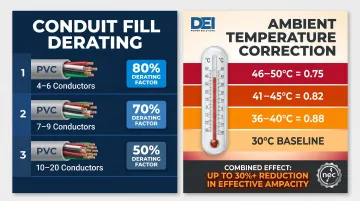
When more than three current-carrying conductors occupy the same conduit, ampacity must be derated using NEC Table 310.15(B)(3)(a) adjustment factors:
- 4–6 conductors: 80% of base ampacity
- 7–9 conductors: 70% of base ampacity
- 10–20 conductors: 50% of base ampacity
For parallel runs of 1600A service, this means the per-conductor ampacity from the NEC table must be multiplied by the derating factor. If you're running four conductors per conduit (three phases plus a neutral), you'll apply the 80% adjustment.
Ambient temperature correction applies when installation environments exceed 30°C (86°F). Per NEC Table 310.15(B)(2)(a), correction factors for 75°C-rated conductors include:
- 36–40°C (96–104°F): 0.88 correction factor
- 41–45°C (105–113°F): 0.82 correction factor
- 46–50°C (114–122°F): 0.75 correction factor
Industrial environments such as boiler rooms, rooftop conduit runs (NEC adds 33°C/60°F temperature adder for rooftop installations with less than 7/8 inch clearance), and locations near heat-producing equipment routinely trigger these correction factors. Combined with conduit fill derating, effective ampacity can drop by 30% or more.
Ground Conductor Sizing
Equipment grounding conductor (EGC) size for 1600A service is determined by NEC Table 250.122, not by phase conductor size. For a 1600A overcurrent protective device, the minimum EGC is:
- Copper: 4/0 AWG
- Aluminum: 350 kcmil
This is a separate conductor from the phase and neutral conductors and must be installed in each raceway of a parallel run.
Don't confuse the EGC with the grounding electrode conductor (GEC)—they follow different sizing rules entirely. The EGC (Table 250.122) is sized based on the OCPD rating and carries fault current until the overcurrent device clears. The GEC (Table 250.66) is sized based on the area of the largest service entrance conductor (summing all parallel conductors' circular mil areas) and connects the system grounded conductor or equipment to the grounding electrode system.
The 83% Rule for Continuous Loads
Grounding addresses fault protection. Continuous load sizing addresses sustained operating conditions—and this is where many 1600A installations are undersized in practice.
Per NEC 210.19, 215.2, and 230.42, overcurrent devices used for continuous loads (operating at or near full current for 3+ hours) must be rated at 125% of the continuous load, OR conductors must be rated at 125% of the continuous load. The "83% rule" is the inverse: a 1600A breaker can only serve up to 1,280A of continuous load (1,600 × 0.8) unless the equipment carries a 100% continuous duty listing.
If a 1600A service feeds primarily continuous loads—as is typical in data centers running server racks 24/7 or manufacturing facilities with constant process loads—the wire must be sized not just for 1,600A, but to account for the 125% continuous load requirement on the overcurrent device.
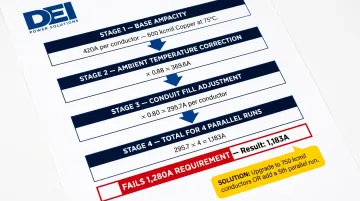
Worked example: A data center with 1,280A continuous load requires an OCPD rated at 1,280A × 1.25 = 1,600A. The conductors must also carry 1,280A continuously. If using four parallel runs of 600 kcmil copper at 75°C (420A each = 1,680A total), this initially appears adequate. But if ambient temperature is 40°C (0.88 correction factor) and four conductors share the conduit (0.80 adjustment factor), effective ampacity drops to 420A × 0.88 × 0.80 = 295A per conductor, or 1,180A total—failing to meet the 1,280A requirement. At that point, the design requires either 750 kcmil conductors or a fifth parallel set to restore compliant ampacity.
How DEI Power Can Help
Wire sizing for 1600A service is only one piece of the puzzle—the conductors must terminate into properly rated switchgear with matched lug sizes, temperature-rated terminations, and code-compliant bus ratings. DEI Power is a UL 891-certified manufacturer of custom switchboards and power distribution equipment, built and assembled in the USA at their 50,000 sq. ft. facility in Ontario, California.
DEI Power's custom UL 891 switchboards are configured to match 1600A service requirements, including parallel conductor lug configurations, proper temperature ratings, and NEC-compliant bus ratings. As an approved Siemens OEM, DEI Power integrates genuine Siemens components throughout their assemblies, ensuring components meet manufacturer specs and remain serviceable over the system's life.
Key advantages for high-ampacity projects:
- Custom switchboard configurations built to your specs, layout, voltage, and jobsite requirements
- In-house engineering support to validate conductor sizing and termination compatibility
- In-house manufacturing enables free shipping in 3–5 business days on in-stock units
- BABA-compliant construction manufactured and assembled in the USA
DEI Power serves the exact project types requiring 1600A service: hyperscale data centers, industrial plants, healthcare facilities, utility substations, and large commercial campuses. Reach the DEI Power team at sales@deipower.com or (866) 773-8050 to discuss conductor sizing, termination compatibility, and switchboard configuration for your project.
Conclusion
Selecting wire for 1600A service requires far more than referencing an ampacity table. It demands a complete understanding of conductor material, parallel configuration, temperature rating alignment, derating factors, ground conductor compliance, and continuous load rules. A conductor that appears technically adequate on paper can still fail inspection or overheat in service if any of these variables is overlooked.
Before procurement, validate your conductor selection against all applicable NEC sections. That validation should happen in coordination with the downstream switchgear specification — termination compatibility and code compliance depend on it.
Key factors that commonly force conductor sizes larger than initial calculations suggest:
- Derating for conduit fill when running multiple conductors in parallel
- Elevated ambient temperatures in mechanical rooms or outdoor installations
- Continuous load rules requiring the 125% multiplier on calculated ampacity
- Terminal temperature ratings that limit usable ampacity at connection points
Early coordination between conductor sizing and switchgear selection avoids costly change orders and keeps projects on schedule. For 1600A applications, that coordination is not optional — it's where compliant, reliable designs are built.
Frequently Asked Questions
What size ground wire for 1600 amp service?
Per NEC Table 250.122, a 1600A overcurrent protective device requires a minimum equipment grounding conductor of 4/0 AWG copper or 350 kcmil aluminum. This is distinct from the grounding electrode conductor, sized per Table 250.66 based on the total area of service conductors.
What is the 83% rule for electrical services?
The "83% rule" refers to the NEC requirement to size conductors and overcurrent devices at 125% of the continuous load, meaning a standard breaker is limited to 80% of its rating for continuous loads. In practice, a 1600A breaker is capped at 1,280A of continuous load per NEC 210.19 and 215.2.
How many parallel conductors are required for 1600 amp service?
1600A service typically requires 3 to 4 parallel conductor runs per phase, with the exact count depending on conductor size, material, temperature rating, and derating factors. NEC 310.10(H) governs parallel conductor requirements, including the 1/0 AWG minimum size per conductor.
Can aluminum wire be used for 1600 amp service?
Yes, aluminum conductors are widely used and code-compliant for 1600A feeder applications. They require larger kcmil sizes than copper conductors and must be installed with AL/CU-rated lugs and anti-oxidant compound at terminations per UL 486B standards.
What NEC table governs wire sizing for 1600 amp service?
NEC Table 310.15(B)(16) (renumbered to Table 310.16 in 2023 NEC) is the primary ampacity reference for conductors in raceway at 30°C ambient. Apply it alongside three additional tables for a complete sizing analysis:
- NEC 310.10(H) — parallel conductor rules
- Table 310.15(B)(3)(a) — conduit fill derating
- Table 310.15(B)(1) — ambient temperature correction
What conduit size is needed for 1600 amp service conductors?
Conduit size depends on conductor kcmil size and NEC Chapter 9 fill rules. At 500–600 kcmil per conductor, 4-inch or larger conduit per parallel run is typically required. Each parallel set is run in a separate conduit to ensure current balance per NEC 310.10(H).