Introduction
Air insulated switchgear carries a 25–30 year service life — yet most engineers and contractors evaluate it almost entirely on initial purchase price. That narrow focus can quietly inflate total project costs through unplanned maintenance, premature replacement, and compliance gaps that only surface after installation.
This guide walks through the full AIS selection process. You'll see how AIS functions across voltage classes, how leading brands differentiate by application type and certification scope, and how to model lifecycle costs that account for CAPEX, maintenance intervals, downtime risk, and end-of-life disposal.
Key Takeaways
- AIS dominates global switchgear installations where space constraints are manageable, using ambient air as its insulating medium across low-voltage (up to 1 kV), medium-voltage (1–36 kV), and high-voltage applications
- Top brands — Siemens, ABB, Schneider Electric, Eaton, and GE Vernova — each target distinct voltage ranges and application types, from low-voltage arc-resistant designs to utility-scale high-voltage systems
- Total cost of ownership covers equipment acquisition (GIS runs up to 2.5× the cost of AIS), maintenance every 1–2 years, outage exposure above $300,000/hour, and simpler end-of-life disposal with no SF₆ recovery needed
- Key selection factors: UL 891 or IEC 62271 certification, BABA compliance for federally funded projects, lead times of 26–32 weeks for medium voltage, and engineering support availability
What Is Air Insulated Switchgear (AIS)?
AIS uses atmospheric air as the primary dielectric insulation medium between live conductors, busbars, and grounded metal enclosures. G&W Electric describes AIS as "the most common and most cost-effective insulation option," designed to control, protect, and isolate electrical equipment across distribution networks. The simple design and environmentally neutral insulating medium make AIS the go-to choice for most applications where space constraints don't require a more compact alternative.
Core components in a typical AIS assembly:
- Circuit breakers for fault current interruption
- Disconnectors for circuit isolation during maintenance
- Busbars for power distribution
- Protective relays for fault detection and coordination
- Current and voltage transformers for monitoring and metering
- Control panels for operation and status indication
These components work together to interrupt fault currents, isolate circuits during maintenance or failure events, and coordinate protection across electrical networks.
Voltage classifications and governing standards:
| Voltage Class | Range | Applicable Standards |
|---|---|---|
| Low Voltage (LV) | Up to 1 kV | UL 891 (North America), IEC 61439 |
| Medium Voltage (MV) | 1 kV to 36 kV | IEC 62271-200 |
| High Voltage (HV) | Above 36 kV | IEC 62271 series |
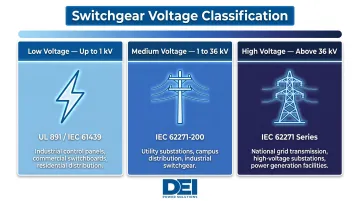
Brand selection and design priorities vary across these voltage tiers. Low-voltage applications emphasize arc flash protection and domestic manufacturing availability, while medium- and high-voltage systems prioritize short-circuit ratings and digital monitoring integration.
AIS vs. GIS: Key Differences You Should Know
The choice between AIS and GIS comes down to three factors: space, cost, and environmental compliance. GIS uses sulfur hexafluoride (SF₆) gas as its insulating medium inside sealed metal enclosures. Peer-reviewed research confirms SF₆ possesses dielectric strength approximately three times that of air at atmospheric pressure, allowing equipment to fit in a fraction of the space. GIS substations occupy 70–90% less space than equivalent AIS installations at the same voltage and functional capacity.
However, SF₆ carries significant environmental consequences. The IPCC Sixth Assessment Report revised SF₆'s 100-year global warming potential upward to 24,300 times that of CO₂, with an atmospheric lifetime of approximately 3,200 years. Regulators in the EU, California, and New York have all moved to restrict or phase out SF₆-insulated equipment as a result.
SF₆ Phase-Out Timeline:
| Jurisdiction | Regulation | Key Restrictions |
|---|---|---|
| European Union | Regulation (EU) 2024/573 | MV switchgear ≤24 kV banned from Jan 2026; >24 kV to ≤52 kV from Jan 2030 |
| California | CARB GIE Rule | Phase-out of new gas-insulated equipment starting 2025 |
| New York | 6 NYCRR Part 495 | Proposed obligations beginning 2025 |
AIS vs. GIS comparison:
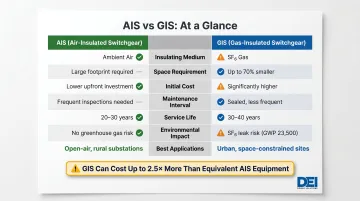
| Factor | AIS | GIS |
|---|---|---|
| Insulating medium | Ambient air | SF₆ gas (GWP: 24,300) |
| Space requirement | Standard footprint | 70–90% smaller |
| Initial cost | Baseline | Up to 2.5x more |
| Maintenance interval | 1–2 years | 10–20 years |
| Service life | 25–30 years | 30–50 years |
| Environmental impact | Zero GHG emissions | SF₆ leakage risk, recovery required |
| Best applications | Non-space-constrained sites, budget-sensitive projects, facilities with standard maintenance capabilities | Urban substations, retrofit projects, space-limited installations |
When AIS is the practical choice:
- Available floor space eliminates the need for GIS compactness
- Project budgets cannot absorb 2.5x higher equipment costs
- Facility teams have standard electrical maintenance capabilities for 1–2 year inspection cycles
- Projects require faster delivery and simpler installation without gas handling equipment
- Environmental compliance favors gas-free equipment or avoids SF₆ reporting obligations
Top Air Insulated Switchgear Brands
Brand selection affects equipment quality, spare parts availability, technical support responsiveness, compliance documentation completeness, and long-term serviceability. These factors matter as much as published specifications when evaluating 25–30 year lifecycle performance.
Siemens
Siemens' AIS portfolio includes the NXAirS product family covering 12 kV, 24 kV, and 40.5 kV applications — the widest voltage range among major OEMs. The NXAirS line offers ratings up to 4,000A and 40 kA, with compact 550mm minimum panel widths and IAC A FLR arc classification. All models use vacuum circuit breaker technology and comply with IEC 62271-200 and relevant international standards.
Siemens has committed significant capital to SF₆-free switchgear development, including a €6 million LIFE Blue 420 kV GIS project (€4.1 million from EU LIFE program) targeting 270 replications by 2032. This investment signals Siemens' strategic positioning as SF₆ regulations tighten globally.
ABB
ABB's UniGear ZS1 medium-voltage air-insulated switchgear leads the market in short-circuit capacity, offering ratings up to 63 kA in single busbar configurations — higher than competing OEM platforms. Available in single busbar (up to 24 kV, 4,000A), double busbar, and double level configurations, the ZS1 integrates AdvaSense medium-voltage sensors (Rogowski coils and voltage dividers) for real-time monitoring.
ABB's global manufacturing presence across six continents provides strong serviceability for multinational projects. Key application sectors include:
- Utility substations and power generation
- Heavy industry (mining, cement, chemicals)
- Marine and offshore installations (DNV, Lloyd's, RINA certified)
- Hospitals, data centers, and rail transportation
Seismic qualification further expands the platform's addressable applications beyond standard commercial and industrial installations.
Schneider Electric
Schneider Electric's AIS offerings span medium- and low-voltage applications with an emphasis on connectivity and building system integration. The SM6 medium-voltage switchgear features 24/7 connectivity for equipment health monitoring, while the PIX line provides companion MV capabilities. For low-voltage applications, the Prisma switchboard range covers ratings up to 4,000A.
Schneider's strength lies in integration with building management systems and SCADA platforms, making their AIS solutions particularly suitable for commercial buildings, campuses, and facilities where electrical distribution coordinates with broader energy management strategies.
Eaton
In occupied buildings and healthcare environments, arc flash mitigation often drives equipment selection. Eaton's Magnum PXR arc-resistant low-voltage switchgear is third-party tested to IEEE Std. C37.20.7 and certified Type 2B arc-resistant in NEMA 1 construction — containing and redirecting arc energy away from personnel during internal fault events.
Domestic U.S. manufacturing and strict ANSI/UL compliance position Eaton well for projects requiring UL 891 certification and domestic content verification.
GE Vernova
GE Vernova targets utility-scale and high-voltage AIS applications. Their Compact Air-Insulated Breaker Assembly (CABA) spans 72.5 kV to 245 kV with ratings up to 3,150A continuous current and 40–63 kA short-circuit breaking capacity. For ultra-high-voltage applications, GE Vernova offers live tank circuit breakers up to 1,100 kV.
Digital monitoring capabilities distinguish GE Vernova's platform, with the GridBeats portfolio including CBWatch (circuit breaker monitoring), BWatch (bushing monitoring), PDWatch (partial discharge monitoring), and integration with the EnergyAPM ecosystem. For utilities managing aging infrastructure, this monitoring stack provides the asset performance data needed to prioritize capital spending.
DEI Power
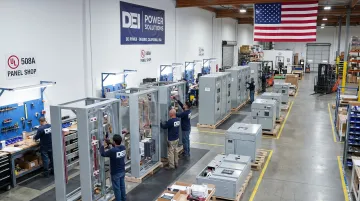
For buyers who need domestic manufacturing, fast delivery, and UL 891 compliance in low-voltage applications, DEI Power is built around that problem. As an approved Siemens OEM operating from a 50,000 sq. ft. facility in Ontario, California, DEI Power manufactures custom-configured, BABA-compliant switchboards rated 400A to 4,000A with 4–6 week lead times — faster than the 26–32 week industry standard for medium-voltage equipment.
That speed matters on time-sensitive projects where delays cascade into costly change orders. Beyond lead times, domestic manufacturing delivers three practical advantages:
- Eliminates import tariffs and reduces transportation exposure
- Simplifies federal procurement compliance for IIJA-funded infrastructure work
- Includes engineering support: submittal packages, one-line diagram review, and configuration guidance before production begins
Breaking Down the Lifecycle Cost of AIS
Purchase price represents only the initial cost layer in a 25–30 year ownership model. Total cost of ownership must account for installation, recurring maintenance, unplanned downtime exposure, and end-of-life disposal to support defensible procurement decisions.
CAPEX: Equipment and Installation
Initial capital costs include the switchgear equipment, civil and structural work (concrete pads, conduit, cable trays), installation labor, factory acceptance testing, and commissioning. AIS capital costs are up to 2.5 times lower than equivalent GIS installations, making AIS the default choice where space allows.
Additional CAPEX considerations for domestic versus imported equipment:
- Lead time risk: Current medium-voltage switchgear lead times range from 26–32 weeks, improved from pandemic peaks but still above pre-2020 levels of 12–16 weeks. Schedule delays create indirect costs through extended project timelines and deferred revenue.
- Import tariffs: Imported switchgear may incur tariffs that increase effective equipment cost by 10–25% depending on trade policy.
- BABA compliance: The Infrastructure Investment and Jobs Act requires all iron, steel, and manufactured products on federally funded infrastructure to be produced in the United States as of May 14, 2022. Non-compliant equipment disqualifies projects from federal funding.
OPEX: Maintenance and Inspection
AIS requires visual evaluation every 1–2 years and breaker maintenance approximately every 2 years, with approximately 4 hours of labor per maintenance cycle. By contrast, GIS can operate 10–20 years without significant maintenance, with drive re-greasing every 20–30 years.
Typical AIS maintenance tasks:
- Visual inspection of contacts and insulators
- Cleaning of contacts and bus connections
- Torque verification on bolted connections
- Protective relay functional testing
- Thermographic scanning to detect hotspots
That 1–2 year service cadence compounds over a 20–30 year holding period — a cost gap that grows as labor rates rise and equipment ages.
Downtime and Outage Risk
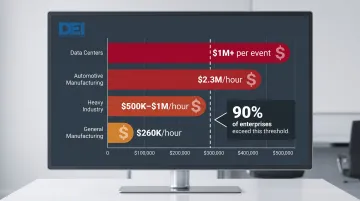
Unplanned outages represent a hidden lifecycle cost that can dwarf preventive maintenance expenses. ITIC's 2024 Hourly Cost of Downtime Report found that over 90% of mid-size and large enterprises face hourly downtime costs exceeding $300,000, with 41% reporting costs of $1M–$5M+ per hour.
Industry-specific outage costs:
- Data centers: 54% of outages exceed $100,000 total; 20% exceed $1M
- Automotive manufacturing: ~$2.3M/hour
- Heavy industry: $500,000–$1M/hour
- General manufacturing: ~$260,000/hour
AIS components are exposed to environmental factors that accelerate degradation and increase failure risk. IEEE Std 493-1997 failure data shows moisture exposure accounts for 17.7% of AIS failures, dust/contaminant exposure for 11.4%, and normal deterioration from age for 9.8%. Environmental factors collectively represent the dominant failure contributors, with average downtime per failure reaching 28–29 hours.
For procurement teams, this means the acquisition cost advantage of AIS narrows — or disappears — in harsh outdoor or industrial environments where moisture, dust, and chemical exposure drive up failure rates. That tradeoff deserves a line item in any serious TCO model.
End-of-Life and Disposal Costs
AIS has a simpler end-of-life profile than GIS. No SF₆ gas recovery or disposal is required, which eliminates specialized gas handling equipment and certified technician costs entirely. Siemens SIVACON recycling data reports overall material recycling rates above 80% for low-voltage switchgear, with steel and copper recovery efficiency at 95%.
Material composition (typical LV switchgear):
- Steel: 64.9% (95% recycling efficiency)
- Copper: 29.9% (95% recycling efficiency)
- Thermoplastic: 2.4% (30–50% recycling efficiency)
- Thermoset: 2.2% (0–10% recycling efficiency)
By contrast, GIS decommissioning requires SF₆ recovery, purification, and disposal or reuse. Based on EU ETS carbon pricing (~€77/tonne), a 1 kg SF₆ leak results in approximately €1,700–€1,950 in carbon-price exposure. As carbon pricing expands and environmental reporting requirements tighten, this hidden cost advantage for AIS grows.
20-Year TCO Comparison: AIS vs. GIS
Total cost of ownership is project-dependent, but the cost drivers follow a consistent pattern across installations. The table below frames how AIS and GIS compare across each lifecycle category:
Relative TCO framework:
| Cost Category | AIS | GIS |
|---|---|---|
| Initial equipment | Baseline | 2.0x–2.5x higher |
| Installation | Baseline | Lower (smaller footprint, less civil work) |
| Maintenance (Years 1–10) | Annual/biennial cycles | Minimal intervention |
| Maintenance (Years 11–20) | Continued annual/biennial | First major service interval |
| Downtime risk | Higher (environmental exposure) | Lower (sealed enclosure) |
| End-of-life | Simple recycling, no gas handling | SF₆ recovery required, carbon exposure |
CAI Engineering's 30-year analysis suggests GIS becomes cost-competitive when land costs and property taxes are high, as the reduced footprint offsets higher equipment costs over long holding periods. However, AIS maintains TCO advantages when:
- Land is available and low-cost
- Maintenance capabilities are in-house
- Environmental compliance favors gas-free equipment
- Project budgets cannot absorb 2.5x higher CAPEX
For teams working through a formal procurement analysis, mapping each of these cost categories against site-specific variables — land cost, labor rates, environmental exposure, and holding period — will produce the most defensible comparison.
How to Select the Right AIS Brand for Your Project
Choosing the wrong AIS brand doesn't just cost money — it costs schedule. The right brand for your project depends on four factors: certifications, performance specs, lead time, and post-sale support.
Key evaluation criteria:
Certifications and Standards Compliance
- UL 891: Governing standard for dead-front switchboards in North America. Covers low-voltage switchboards up to 4,000A at 480V (US) and 3,000A (Canada) with 100 kA short-circuit current rating. Required for most commercial and industrial low-voltage applications in the US.
- IEC 62271-200: International standard for metal-enclosed medium-voltage switchgear. Required for export projects and installations outside North America.
- BABA compliance: For federally funded infrastructure projects under the Infrastructure Investment and Jobs Act, all iron, steel, and manufactured products must be produced in the United States with component cost exceeding 55% domestic content. Verify OEM domestic manufacturing and request BABA line cards.
Performance Specifications
Confirm each candidate brand can meet your project's specific technical requirements:
- Voltage and current rating
- Short-circuit withstand capacity (kA rating)
- Arc flash rating and personnel protection features
- Indoor (NEMA 1) vs. outdoor (NEMA 3R) enclosure
- Busbar configuration and future expansion capacity
Lead Time and Fulfillment
Standard industry lead times run 26–32 weeks — a serious risk in data center, healthcare, and utility projects where uptime can't wait. Domestic manufacturers with in-house assembly can deliver in 4–6 weeks, eliminating months of schedule exposure and reducing change order risk on time-sensitive jobs.
Engineering Support Availability
Strong engineering support prevents costly field issues. Look for:
- Submittal package preparation
- One-line diagram review and coordination study support
- Configuration guidance and code compliance verification
- Responsive technical support during installation and commissioning
Decision framework:
| Factor | Weight | Evaluation Criteria |
|---|---|---|
| Budget | High | Total project CAPEX; financing constraints |
| Space availability | High | Footprint limitations; future expansion needs |
| Certifications | Critical | UL 891 (US LV), IEC 62271 (MV), BABA (federal projects) |
| Lead time | Medium-High | Project schedule; penalty clause exposure |
| Maintenance capability | Medium | In-house vs. contracted maintenance; interval preferences |
| Environmental requirements | Medium | SF₆-free preference; carbon reporting obligations |
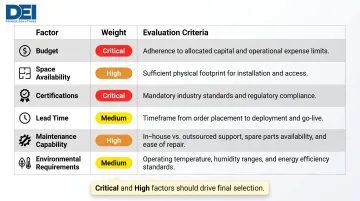
Score each brand against these criteria based on your project's constraints. The factors weighted "Critical" or "High" should drive the final decision — not price alone.
Frequently Asked Questions
What is the difference between GIS and AIS switchgear?
AIS uses ambient air as its insulating medium and requires larger footprints, lower upfront cost, and simpler maintenance procedures. GIS uses SF₆ gas (with dielectric strength approximately three times that of air) to achieve 70–90% smaller footprints and 10–20 year maintenance intervals, but costs up to 2.5 times more and carries environmental compliance obligations for SF₆ handling and disposal.
How long does air insulated switchgear last?
AIS typically has a service life of 25–30 years with proper maintenance, compared to 30–50 years for GIS. Service life depends on environmental exposure (moisture, dust, chemicals), maintenance quality, and component quality — with indoor installations in controlled environments generally outlasting outdoor or harsh industrial deployments.
What are the main maintenance requirements for AIS?
AIS requires visual inspection every 1–2 years covering contact cleaning, torque verification, relay testing, and thermographic scanning. Breaker maintenance runs approximately every 2 years at roughly 4 labor hours per cycle. Dusty, humid, or chemically contaminated environments drive more frequent schedules.
Which AIS brands are UL listed for low-voltage switchgear in the US?
Major brands including Siemens, Eaton, ABB, and Schneider Electric offer UL-listed low-voltage switchgear compliant with UL 891 (the governing standard for low-voltage switchboards in North America). Domestic manufacturers including DEI Power also hold UL 891 certification and may offer faster lead times and BABA compliance advantages for federally funded projects.
What does an AIS lifecycle cost analysis include?
A lifecycle cost analysis covers five categories: CAPEX (equipment and installation), OPEX (maintenance and inspection), downtime risk, spare parts replacement, and end-of-life disposal. For AIS, maintenance frequency (1–2 years vs. 10–20 years for GIS) and environmental failure contributors are the primary drivers of total cost variation.
Is air insulated switchgear suitable for data centers and industrial facilities?
Yes, AIS is widely used in both environments for low- and medium-voltage distribution. Key considerations include available floor space, maintenance access for 1–2 year inspection cycles, ambient conditions (temperature, humidity, dust), and uptime criticality. Data centers with high outage cost exposure ($300,000+/hour) should prioritize brands with strong arc flash protection, digital monitoring capabilities, and proven reliability records.