
This article goes beyond high-level claims to explain the specific, measurable ways low-voltage distribution systems benefit manufacturing operations in practice. You'll see how infrastructure choices show up in energy bills, safety incident rates, and equipment uptime metrics — the outcomes plant managers are accountable for.
Key Takeaways
- Low-voltage distribution systems operate below 600V and power equipment, lighting, and controls throughout manufacturing facilities
- Key benefits include reduced electrical hazards, lower energy and installation costs, and flexibility to scale as production needs change
- Poorly designed or outdated LV distribution systems drive unplanned downtime, compliance failures, and maintenance cost overruns
- Manufacturers can measure LV distribution performance directly in energy bills, safety incident rates, and equipment uptime
What Is a Low Voltage Distribution System?
A low-voltage distribution system is the portion of a facility's electrical infrastructure that delivers power from step-down transformers to end-use equipment — typically operating at voltages below 600 volts.
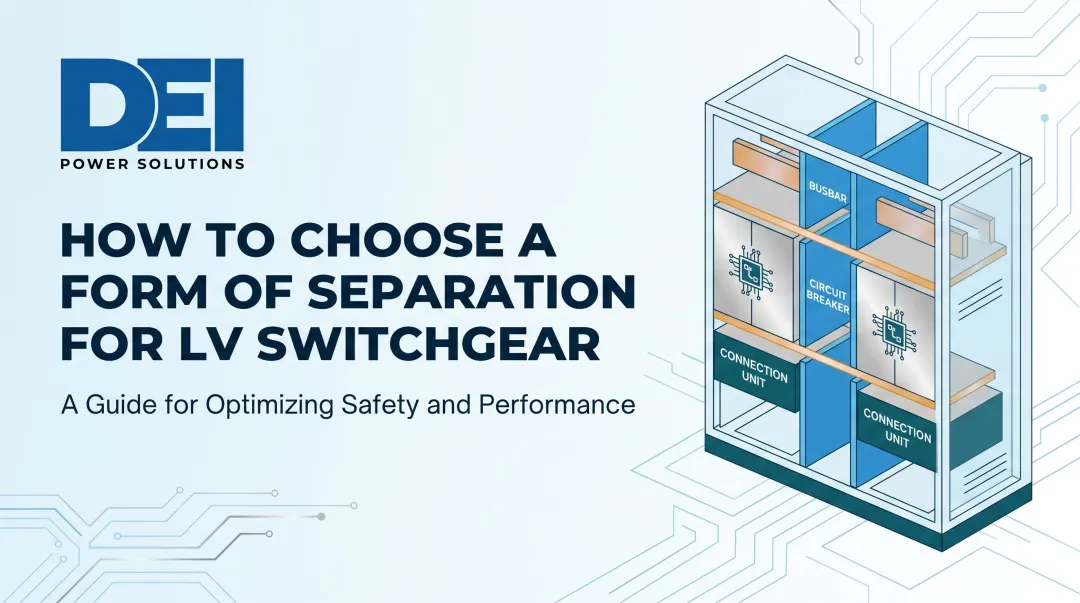
In manufacturing facilities, this infrastructure includes:
- Switchboards and distribution panels
- Circuit breakers and protective devices
- Busbars and power cables
- Control systems and monitoring equipment
Together, these components route power to production lines, motors, lighting, and HVAC throughout the facility. How well they're specified and assembled directly determines whether your plant runs reliably or faces costly, unplanned outages.
Key Advantages of Low Voltage Distribution Systems for Manufacturers
The advantages below are grounded in operational outcomes: safety incidents, energy spend, production uptime, and capital efficiency. These are the metrics plant managers, engineers, and facility teams are accountable for.
Advantage 1: Improved Electrical Safety and Reduced Compliance Risk
Low-voltage systems reduce the severity of arc flash, shock, and electrocution hazards compared to higher-voltage alternatives. This matters in environments where personnel regularly work near energized equipment.
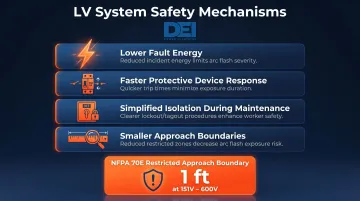
LV systems create this safety advantage through several mechanisms:
- Lower voltage levels reduce fault energy
- Protective devices (molded-case circuit breakers, residual current devices) respond faster and more precisely
- Centralized distribution panels simplify isolation during maintenance
- Shock protection approach boundaries are smaller at low voltage
NFPA 70E defines restricted approach boundaries for 151V-600V systems at just 1 foot, compared to significantly larger distances for higher voltages. This means workers can perform routine tasks with less restrictive PPE requirements and reduced risk exposure.
The business impact extends well beyond the incident itself. From 2011-2024, 120 electrical fatalities occurred in U.S. manufacturing, with a fatality rate of 0.06 per 100,000 workers. Non-fatal electrical injuries jumped 59% in 2023-2024 compared to the prior two-year period.
Each incident triggers multiple cost centers:
- Average workers' compensation claim for burns: $64,973
- OSHA citations and regulatory fines
- Production halts during investigation
- Equipment damage and replacement
- Increased insurance premiums
Manufacturing facilities must meet NEC, OSHA 70E, and relevant UL standards. A properly specified LV distribution system built to UL 891 (the standard for low-voltage switchboards) enters the facility already compliant, reducing the burden of field modifications or re-inspection.
Comprehensive safety programs that include compliant electrical infrastructure can deliver 25-40% premium reductions within three years, according to risk management data. DEI Power's UL 891-certified switchboards are engineered to meet these requirements out of the box, simplifying inspection approvals and reducing liability risk.
KPIs impacted:
- Electrical incident rate
- OSHA recordable events
- Inspection pass rate
- Arc flash incident energy levels
- Workers' compensation costs
When this advantage matters most: Facilities with frequent maintenance activity near live equipment, aging infrastructure being upgraded, or operations in regulated sectors (food processing, pharmaceuticals, automotive) where compliance audits are routine.
Advantage 2: Lower Energy Consumption and Reduced Operating Costs
Low-voltage distribution systems minimize resistive energy losses during power delivery and, when paired with energy-efficient equipment and smart monitoring, measurably reduce a facility's total electrical operating costs.
Three factors drive this reduction in practice:
- Shorter distribution distances at low voltage reduce line losses
- Modern LV panels with metering capabilities enable load analysis and smarter energy management
- Replacing outdated high-voltage drop-downs with optimized LV configurations eliminates inefficiencies baked into aging systems
Energy represents one of the largest controllable costs in manufacturing. Depending on the industry, energy accounts for 10-40% of total manufacturing operating costs — 40% for cement production, 30% for chemicals, and 10-20% for paper, steel, and food production.
Installation labor savings:
Installation labor costs are also lower with LV systems. Wiring is simpler, specialized high-voltage credentialing requirements are reduced, and in centralized remote-driver configurations, non-licensed technicians can handle portions of the install.
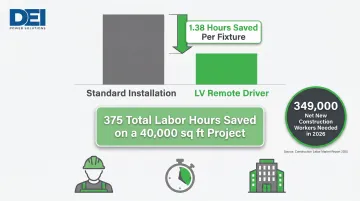
A real-world study by electrical contractor Inglett & Stubbs demonstrated savings of 1.38 hours per fixture using low-voltage remote driver units — yielding 375 total hours of labor savings on a 40,000-square-foot project. With the construction industry needing to attract an estimated 349,000 net new workers in 2026 — and approximately 20% of all electricians already over age 55 — reducing installation hours per project has direct scheduling and cost implications.
The financial case compounds over time:
- Lower upfront installation costs
- Ongoing energy savings (measured in kWh per square foot)
- Reduced maintenance frequency
- Longer equipment lifespan
Low-voltage LED distribution systems, for example, can reduce power consumption by up to 80% compared to conventional lighting, using only 20% of the energy required by line-voltage systems.
KPIs impacted:
- Energy cost per unit produced
- kWh consumption per square foot
- Installation labor hours
- Total cost of ownership over 10-year horizon
- Maintenance labor hours
When this advantage matters most: Facilities with large footprints, high lighting and HVAC loads, 24/7 operations, or those undergoing energy audits for ESG reporting will see the most immediate financial impact.
Advantage 3: Operational Flexibility and Production Continuity
Modern LV distribution systems are inherently more modular and easier to reconfigure than high-voltage alternatives — an important advantage in manufacturing environments where production lines change, machinery is added or relocated, and capacity needs evolve.
In practice, this flexibility shows up across the distribution architecture:
- LV switchboards can be expanded with additional breaker sections
- Circuits can be rerouted without major infrastructure changes
- Distributed panel layouts let maintenance teams isolate faults in one zone without shutting down the entire facility
- Wall-mounted remote power panels enable space-efficient installation in tight industrial environments
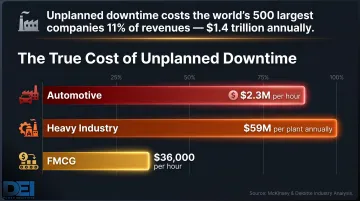
That flexibility directly limits revenue exposure when faults occur. Unplanned downtime costs the world's 500 biggest companies 11% of their revenues, totaling $1.4 trillion annually. In manufacturing specifically:
- Automotive sector: $2.3 million per hour
- Heavy industry: $59 million per plant annually
- FMCG: $36,000 per hour
A resilient, easily serviceable LV distribution system is a direct hedge against revenue loss. When a fault occurs, the ability to quickly isolate and restore power in one zone without affecting the entire facility can save tens of thousands of dollars per incident.
Modular LV architecture also means manufacturers can phase investment — adding capacity as production grows rather than over-engineering from the start. This improves capital efficiency and reduces upfront project costs.
That scalability matters as automation demands increase. 92% of manufacturing leaders believe smart manufacturing will be the primary driver of competitiveness over the next three years, with 78% allocating more than 20% of their improvement budget toward smart manufacturing initiatives. As facilities add robotics, sensors, PLCs, and IoT monitoring, structured low-voltage power distribution becomes the backbone that makes integration possible.
KPIs impacted:
- Mean time between failures (MTBF)
- Unplanned downtime hours per month
- Production throughput
- Time to isolate and restore power after a fault
- Capital expenditure per capacity unit added
When this advantage matters most: Most critical in facilities undergoing expansion, automation upgrades, or frequent line reconfigurations — and in high-volume production environments where every hour of downtime has a direct, calculable cost.
What Happens When LV Distribution Is Neglected or Poorly Designed
When LV distribution systems are undersized, outdated, or improperly configured, common failure modes emerge:
- Frequent nuisance tripping that disrupts production
- Voltage sag affecting sensitive CNC or PLC equipment
- Overheating panels that create fire hazards
- Inability to isolate faults without full production shutdowns
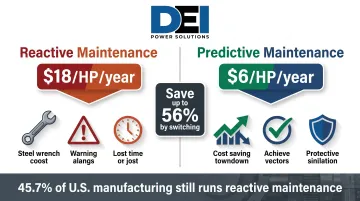
These failure modes carry real costs beyond the immediate disruption. Rising reactive maintenance costs represent the most visible symptom. NIST research shows that reactive maintenance costs $18 per horsepower per year — three times the cost of predictive maintenance at $6 per horsepower per year.
Switching to predictive maintenance saves up to 56% in costs. Yet the average U.S. manufacturing operation still runs 45.7% reactive maintenance.
Other consequences include:
- Non-compliance findings during inspections
- Inability to add new machinery without expensive infrastructure overhauls
- Ongoing energy waste from inefficient power distribution that inflates operating costs
- Equipment damage from power quality issues
Each of these consequences compounds the others. 42% of unplanned downtime is caused by equipment failure, with electrical and control system failures cited as a leading category. Many manufacturers underestimate LV distribution risk until a failure event forces a shutdown — at which point emergency procurement, after-hours labor, and lost production far outweigh what a properly specified system would have cost.
How to Get the Most Value from Your LV Distribution System
LV distribution delivers full value when it's right-sized to actual load requirements from the start. Oversized systems waste capital; undersized ones create bottlenecks.
Conduct a Thorough Load Analysis
Before specifying panel configurations, breaker ratings, and busbar sizing, conduct a comprehensive load analysis that accounts for:
- Current machinery and equipment loads
- Planned expansion and future capacity needs
- Power factor and harmonic considerations
- Diversity factors for non-simultaneous loads
Select Code-Compliant Equipment
Specify equipment that meets applicable codes — UL 891 for switchboards, NEC Article 408 for panels and switchgear. Work with manufacturers who provide accurate documentation, configuration guidance, and engineering support. This reduces change orders and field adjustments that erode project budgets.
DEI Power, for example, builds UL 891-certified switchboards to spec using genuine Siemens components from a 50,000 sq. ft. facility in Ontario, California. Every unit ships with complete wiring diagrams, configuration specs, and compliance documentation — giving contractors and facility teams what they need to close out projects cleanly.
Plan for Ongoing Value
Periodic load reviews and system inspections protect the investment beyond commissioning — ensuring the distribution system scales with production rather than creating capacity gaps as demands grow.
Key maintenance practices include:
- Annual infrared thermography inspections
- Periodic breaker testing and calibration
- Load monitoring and analysis as new equipment is added
- Documentation updates reflecting system changes
Conclusion
For manufacturers, low-voltage distribution systems deliver compounding value across dimensions that directly affect the bottom line: safety and compliance, installation cost reduction, and the operational flexibility to scale without disrupting production.
Realizing those benefits depends on proper specification, code-compliant equipment, and a distribution architecture matched to the facility's actual and projected load. Facilities that treat LV infrastructure as a long-term investment — rather than a line item to minimize — spend less time managing electrical failures and more time running production.
Frequently Asked Questions
What are the benefits of low-voltage distribution systems for manufacturers?
Low-voltage distribution systems reduce electrical hazard risk, lower energy and installation costs, and provide flexibility to scale power distribution as production needs change. For manufacturers, that means fewer unplanned outages, better safety outcomes, and tighter control over operating costs.
What are the main types of ELV (extra-low-voltage) systems used in manufacturing?
Extra-low-voltage (ELV) systems typically operate below 50V AC or 120V DC and are commonly used in manufacturing for control circuits, sensors, PLCs, safety interlocks, and communication systems. These are distinct from low-voltage distribution systems (below 600V) that power machinery and facility loads.
What is the difference between LVP and LVR in low-voltage distribution systems?
LVP (Low Voltage Protection) disconnects and does not automatically restart a motor if voltage drops, requiring manual restart for safety. LVR (Low Voltage Release) automatically restores power when voltage returns.
Is low-voltage distribution safer than high-voltage for manufacturing environments?
LV systems generally present lower shock and arc flash energy risks, making them easier to maintain safely and less demanding in terms of personal protective equipment (PPE) requirements. However, all electrical work requires adherence to NFPA 70E and site-specific safety protocols regardless of voltage level.
How do I know if my manufacturing facility's LV distribution system needs an upgrade?
Watch for these warning signs:
- Frequent breaker trips or unexplained voltage irregularities
- Panels running near rated capacity with no room to add equipment
- Distribution gear installed before current NEC and UL standards
An electrical contractor can assess your system and determine whether an upgrade is warranted.
What is UL 891 certification and why does it matter for LV switchboards in manufacturing?
UL 891 is the safety standard for dead-front switchboards, covering construction, performance, and safety requirements for equipment rated 600V or less. Specifying UL 891-certified switchboards ensures the equipment meets recognized national safety benchmarks, simplifies inspection approvals, and reduces liability risk for facility owners and installing contractors.