Introduction
Specifying low-voltage power distribution equipment means navigating hundreds of product options, evolving code requirements, and timelines that don't tolerate delays. Every role in the project carries its own pressure:
- Engineers must match interrupting ratings to available fault current before drawings are finalized
- Contractors juggle submittal deadlines against equipment lead times now stretching months out
- Facility teams need systems that satisfy NEC 2026 arc flash labeling rules and BABA domestic content thresholds — often with minimal guidance on what those requirements actually mean
Those pressures are compounding as demand outpaces supply. According to Wood Mackenzie, US data center electrical equipment demand will surge from $20 billion in 2025 to $65 billion by 2030, pushing lead times for critical components to 18–36 months. The global low-voltage switchgear market is on pace to nearly double — from $45.23 billion in 2024 to $84.29 billion by 2032 — with supply chains stretched and pricing increasingly volatile.
This guide breaks down the Siemens LV switchgear catalog for 2026 — covering product families, interrupting ratings, bus configurations, and compliance requirements — so you can make accurate selections before submittal, not after equipment arrives on site.
TLDR: Siemens LV Switchgear Catalog 2026 — Key Takeaways
- Siemens' WL and VL series cover 150A to 5,000A, spanning mission-critical switchgear and distribution-tier applications with interrupting ratings up to 200 kA
- NEC 2026 requires arc flash labels listing incident energy levels, boundaries, PPE category, and study date; generic warning stickers no longer comply
- BABA-compliant assemblies require 55% domestic component cost; verify compliance documentation before bidding federally funded projects
- DEI Power — an approved Siemens OEM — delivers UL 891-certified custom builds in 4–6 weeks with full BABA compliance documentation
What Is Siemens Low-Voltage Switchgear and Why It Matters in 2026
Low-voltage switchgear consists of metal-enclosed assemblies containing power circuit breakers, bus structures, protective relays, and metering — designed for systems operating at 1,000V AC or below. Per ANSI/IEEE C37.20.1, these assemblies control, protect, and isolate electrical circuits in mission-critical environments. The defining characteristic is the draw-out breaker design with test, connected, and disconnect positions, which allows maintenance without de-energizing adjacent equipment.
Switchgear vs. Switchboard vs. Panelboard
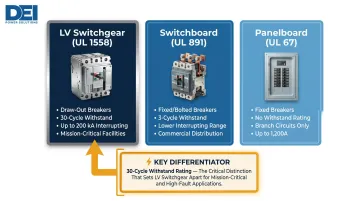
| Attribute | LV Switchgear (UL 1558) | Switchboard (UL 891) | Panelboard (UL 67) |
|---|---|---|---|
| Breaker Mounting | Draw-out (3 positions) | Fixed/bolted | Fixed |
| Short-Time Withstand | 30 cycles (0.5 sec) | 3 cycles | N/A |
| Interrupting Capacity | Up to 200 kA | Lower range | Branch circuit only |
| Bus Rating | Up to 10,000A | Varies | Up to 1,200A typical |
| Primary Application | Mission-critical facilities, data centers, utility substations | Commercial distribution | Branch circuits |
The 30-cycle short-time withstand capability is what separates switchgear from switchboards. It enables selective coordination: upstream breakers hold while downstream devices clear the fault, preventing a single incident from taking down an entire facility's distribution system.
Why 2026 Is a Turning Point
Those spec differences matter more in 2026 than they did five years ago. Three shifts in the market are driving procurement decisions in new directions.
Regulatory tightening. NEC 2026 Section 110.16 now mandates arc flash labels that include all four of the following — or the installation is out of code:
- Incident energy levels
- Arc flash boundaries
- Required PPE category
- Date of the IEEE 1584 study
Generic warning stickers no longer satisfy the requirement. Labels must be backed by current hazard calculations and reviewed every five years.
Data center demand. Wood Mackenzie projects US data center capacity will grow from 24 GW in 2026 to 110 GW by 2030, accounting for 68% of total US load growth. That translates to over 400,000 GWh of new electricity consumption — eight times the projected increase from electric vehicles over the same period.
DC architecture shift. In April 2026, Siemens launched the SENTRON 3QD2 semiconductor circuit breaker for DC applications, providing interruption in the microsecond range — up to 1,000 times faster than mechanical breakers. The DC switchgear segment is growing at 10.49% CAGR versus 8.15% for the overall LV switchgear market, reflecting a real shift toward DC architectures in data centers and battery storage facilities.
Primary Applications Driving Demand
- Data centers: Require N+1 or 2N redundancy, typically spec'd with main-tie-main configurations and 30-cycle selective coordination
- Industrial facilities: Need draw-out breakers for maintenance without downtime, coordination with downstream motor control centers
- Utility substations: Demand high interrupting ratings (100–200 kA) and outdoor enclosures (NEMA 3R)
- Healthcare campuses: Require life safety compliance, transfer switches, and backup generator coordination
- Large commercial buildings: Use switchgear for main distribution above 1,600A with feeder switchboards downstream
Siemens LV Switchgear Product Families: 2026 Catalog Overview
The Siemens North American LV catalog divides products by voltage class (480V and 600V standard) and application tier. Two series dominate commercial and industrial specifications:
Siemens WL Series (Air Power Circuit Breakers)
The WL Series serves as Siemens' flagship LV power circuit breaker for metal-enclosed switchgear assemblies. Built for main and tie positions in mission-critical facilities, the WL line delivers high fault interrupting capacity, arc flash mitigation features, and communication-ready electronic trip units.
Frame Sizes and Ratings:
- FS1: 800A, 1,200A, 1,600A, 2,000A
- FS2: 800A through 3,200A (UL 1066)
- FS3: 3,200A (UL 1066), 4,000A, 5,000A
Interrupting Ratings:
- UL 489: 65 kA to 150 kA at 480V
- UL 1066: 50 kA to 200 kA (fused) at 480V
Electronic Trip Units (ETUs):
- ETU745: LSI protection with rotary switch parameterization
- ETU748: LS protection for simpler applications
- ETU776: LSI with graphical display, dual protective settings, and support for Dynamic Arc-Flash Sentry (DAS)
The ETU776 supports Dynamic Arc-Flash Sentry (DAS), which temporarily lowers available fault current via faster coordinated trip settings when personnel enter the arc flash boundary. The Remote Breaker Racking Device extends that protection further, allowing racking from 30 feet away — outside the arc flash boundary — to reduce incident energy exposure during maintenance.
For system integration, WL breakers support PROFIBUS-DP, MODBUS RTU/RS485, and Ethernet (TCP/IP) via the Breaker Data Adapter, enabling real-time monitoring and connection to facility management platforms.
When to Specify WL: Main and tie positions above 800A where selective coordination, draw-out capability, advanced metering, and arc flash protection are required. Common applications include data center main distribution, utility interconnects, and industrial plant mains.
Siemens VL Series (Molded-Case Circuit Breakers)
Where the WL handles main and tie positions, the VL Series steps in for distribution-tier applications from 150A to 1,600A — offering current-limiting performance in a compact footprint at a lower cost point.
Frame Sizes:
- DG (150A), FG (250A), JG (400A), LG (600A), MG (800A), NG (1,200A), PG (1,600A)
Interrupting Ratings:
- N-Class: 35 kA at 480V
- H-Class: 65 kA at 480V
- L-Class (Current Limiting): 100 kA at 480V, 200 kA at 240V
L-Class current-limiting breakers use contact magnetic repulsion to shield downstream components from the thermal and dynamic effects of high-magnitude faults, protecting sensitive electronics and preventing bus damage.
Trip Unit Options:
- Model 525: Thermal-magnetic with fixed overload, adjustable short-circuit
- Model 545: Electronic with status LEDs, integrated self-test, True RMS sensing
- Model 576: Electronic LCD with fully adjustable LSI/LSIG, thermal memory, communication-ready
When to Specify VL: Distribution feeders below 1,600A where current-limiting performance, compact footprint, and lower cost outweigh the need for 30-cycle withstand. This covers feeder circuits from switchgear to switchboards, panelboard mains, and motor control centers.
Understanding WL vs. VL Selection
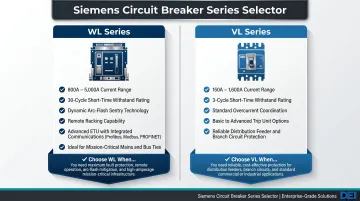
| Criteria | WL Series | VL Series |
|---|---|---|
| Current Range | 800A–5,000A | 150A–1,600A |
| Withstand | 30-cycle short-time | 3-cycle (fixed mount) |
| Arc Flash Features | DAS, remote racking | Standard coordination |
| Metering | Advanced ETU with comms | Basic to advanced trip units |
| Application Tier | Mission-critical mains/ties | Distribution feeders/branches |
Siemens PN vs. SN Series — Important Clarification
PN and SN are residential load center designations, not switchgear product families. These appear in the Siemens SPEEDFAX catalog under residential panelboards:
- PN (Plug-On Neutral): Copper bus, convertible (main lug to main breaker), two factory ground bars
- SN (Plug-On Neutral): Aluminum bus, non-convertible, one factory ground bar
These designations apply to residential and light commercial branch circuit panels rated 150A–225A, not to low-voltage switchgear. When specifying commercial or industrial switchgear, reference WL and VL series only.Mistaking a load center series for a switchgear family is a common source of specification errors — one that can result in non-compliant equipment orders and costly field corrections.
Key Ratings, Standards, and Compliance for LV Switchgear
Critical Electrical Ratings Explained
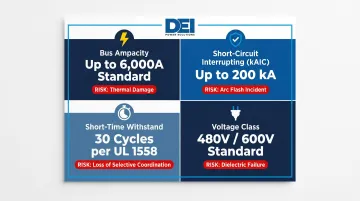
Four ratings drive every LV switchgear specification. Understanding where each one applies — and what happens when one is undersized — prevents costly field corrections.
| Rating | Definition | Typical Value | Risk if Undersized |
|---|---|---|---|
| Bus Ampacity | Max continuous current without exceeding temperature rise limits | Up to 6,000A standard; 10,000A parallel-source | Thermal damage, code violations |
| Short-Circuit Interrupting (kAIC) | Max fault current the breaker can safely interrupt and clear | Up to 200 kA (fused WL) | Breaker fails to clear fault; arc flash incident |
| Short-Time Withstand (SWR) | Fault current the assembly can withstand for a set duration | 30 cycles (0.5 sec) per UL 1558 | Loss of selective coordination; nuisance upstream trips |
| Voltage Class | Operating voltage range | 480V/600V standard; UL 1066 to 635V AC | Dielectric failure; insulation breakdown |
Dielectric insulation testing occurs at 2.2 kV to confirm safe operation across the voltage class.
Governing Standards
Three standards govern LV switchgear selection. The choice between them affects cost, installation complexity, and fault protection capability.
| Standard | Scope | Short-Time Withstand | Draw-Out Capability | Typical Application |
|---|---|---|---|---|
| UL 1558 | Metal-enclosed LV power circuit breaker switchgear, up to 600V AC | 30 cycles (0.5 sec) | Yes | Mission-critical, high fault-current environments |
| UL 891 | Dead-front switchboards, fixed-mount breakers | Not required | No | Commercial buildings, cost-sensitive projects |
| ANSI/IEEE C37.20.1 | Design and performance criteria for metal-enclosed LV switchgear | 30 cycles (0.5 sec) | Yes | Complements UL 1558; used in industrial and utility specs |
UL 1558 assemblies also require temperature rise testing to confirm Class 90 insulation (90°C) and Class 105 ratings for silver-surfaced bus connections. UL 891 assemblies cost less and install faster, but lack draw-out capability and the 30-cycle withstand that high-fault environments demand.
Arc Flash and Safety Compliance
NEC 2026 Section 110.16 now requires arc flash labels to include:
- Incident energy levels (cal/cm²)
- Arc flash boundaries (working distance)
- Required PPE category
- Date of the IEEE 1584 arc flash study
Labels must be durable enough for the installation environment and reviewed every five years — generic warning stickers no longer meet code.
IEEE 1584-2018 provides the methodology for calculating arcing current, arc duration, incident energy, and arc flash boundary. IEEE 1584-based studies are required before labeling equipment; outdated tables or estimates do not meet NFPA 70E.
Zone-Selective Interlocking (ZSI) and Arc Flash Reduction Maintenance Mode in Siemens ETU776 trip units allow faster clearing for personnel safety without sacrificing coordination under normal operation.
BABA (Buy America, Build America) Compliance
Three core requirements apply to federally funded projects (effective May 14, 2022):
- Iron and Steel — All manufacturing processes from initial melting through coating must occur in the US
- Manufactured Products — Must be manufactured in the US, with domestic component cost exceeding 55% of total component cost
- Final Assembly — FHWA requires final assembly in the US for Federal-aid projects (effective October 1, 2025)
OEM-assembled electrical switchgear qualifies as a manufactured product under this framework. The 55% threshold applies to domestically produced components relative to total component cost, and BABA requirements must flow down to all subcontracts and purchase orders.
Before submitting bids on federally funded projects, request BABA compliance letters from suppliers or OEMs. Waivers require formal agency approval and typically apply only when domestic supply is unavailable or cost-prohibitive — generally defined as a cost increase exceeding 25%.
How to Select the Right Siemens LV Switchgear for Your Project
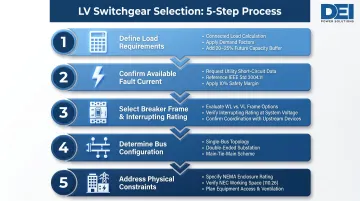
Practical Selection Framework
Step 1: Define Load Requirements.
- Calculate total connected load and apply NEC demand factors
- Add 20-25% future capacity unless project scope explicitly prohibits
- Determine main bus ampacity (standard ratings: 1,600A, 2,000A, 2,500A, 3,200A, 4,000A, 5,000A, 6,000A)
Step 2: Confirm Available Fault Current.
- Request fault current data from the utility at the service entrance
- Calculate fault current at each switchgear location using IEEE Std 3004.11 methodology
- Select breaker interrupting ratings exceeding calculated available fault current by at least 10% margin
Step 3: Select Breaker Frame and Interrupting Rating.
- WL Series for mains/ties above 800A requiring selective coordination
- VL Series for feeders below 1,600A where current-limiting is beneficial
- Verify interrupting rating at system voltage (480V, 600V, or 635V)
Step 4: Determine Bus Configuration.
- Single-Bus: Simplest, lowest cost, single point of failure
- Double-Ended (Main-Main-Tie): Two sources with normally open tie breaker, allows maintenance on one source
- Main-Tie-Main: Highest reliability for mission-critical loads, supports N+1 redundancy
Step 5: Address Physical Constraints.
- Indoor: NEMA 1 enclosures standard
- Outdoor: NEMA 3R weather-resistant enclosures with rain testing per UL 1558
- Working Space: NEC Article 110 defines minimum clearances based on voltage conditions; dedicated electrical space of six feet (or to structural ceiling) above switchgear must remain clear
- Front-Connected vs. Rear-Connected: Front-connected eliminates rear-access requirements in tight spaces
Common Specification Mistakes to Avoid
Even a well-structured one-line can break down during specification. These four errors come up repeatedly on real projects:
1. Bus ampacity and breaker interrupting ratings mismatched. A 4,000A bus doesn't help if available fault current is 85 kA and the breaker is only rated 65 kA. Always confirm the breaker interrupting rating exceeds available fault current before finalizing the spec.
2. Draw-out gear specified where fixed-mount suffices. Draw-out breakers cost 30-50% more than fixed-mount equivalents. If maintenance windows allow complete de-energization, UL 891 switchboards with fixed breakers deliver the same protection at lower cost.
3. UL listing confirmed on components, not the complete assembly. Individual breakers may carry UL 489 or UL 1066 listings, but the complete assembly must carry UL 1558 or UL 891 listing. Request the UL file number for the configured assembly — component listings don't cover the whole unit.
4. Arc flash study treated as optional. NEC 2026 requires labels based on IEEE 1584 calculations. Guessing incident energy or using outdated tables violates code and exposes personnel to unquantified hazards.
When to Involve an OEM Early
Avoiding the mistakes above becomes significantly easier with OEM involvement from the start. If you're working with an approved Siemens OEM — DEI Power being one example — early engagement is especially valuable when:
- One-line diagrams include non-standard configurations (bus transfers, generator tie-ins, dual utility feeds)
- Utility interconnect requirements impose specific metering, relaying, or communication protocols
- Tight project timelines require parallel engineering and procurement
- Physical layout constraints (ceiling height, access restrictions, seismic zones) affect enclosure design
Early involvement prevents costly field changes and shortens lead times. It also ensures the complete assembly — not just individual components — meets UL listing and code requirements.
How to Source Siemens LV Switchgear with Confidence
Pre-Purchase Verification Checklist
Before placing an order, confirm the following:
Request the UL file number for the complete configured assembly — not just individual component listings. Confirm the listing covers your specific voltage, ampacity, and configuration.
Get lead time commitments in writing. With industry-wide delays stretching 18–36 months, verbal promises don't protect schedules. Ask for written guarantees and penalty clauses.
Engineering documentation package, including:
- One-line diagrams
- Short-circuit coordination studies
- Arc flash hazard analysis (IEEE 1584-based)
- Submittal packages with dimensional drawings and specifications
Confirm whether the supplier can accommodate post-order changes without restarting the full production cycle.
Pre-Engineered Catalog vs. Custom-Built Assemblies
Pre-Engineered Catalog Configurations:
- Standard ampacities (400A, 600A, 800A, 1,200A, 1,600A)
- Fixed bus arrangements and breaker positions
- Faster delivery for standard in-stock units (days to a few weeks depending on supplier)
- Lower cost due to volume production
- Best for straightforward applications matching standard configurations
Custom-Built Switchgear Assemblies:
- Tailored to project-specific requirements (bus configuration, metering, breaker layout, enclosure type)
- Longer lead times (typically 4-6 weeks)
- Higher cost but eliminates field modifications
- Best for complex one-line configurations, utility interconnects, or non-standard physical layouts
When Custom Assembly Is the Faster Path
For projects with specific utility requirements, unusual bus configurations, or tight space constraints, ordering from an approved Siemens OEM often moves faster than sourcing catalog components and modifying them in the field. The engineering review before production catches conflicts early — eliminating change orders and inspection delays that routinely push out timelines.
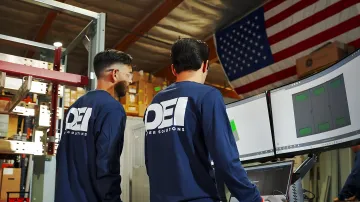
DEI Power is an approved Siemens OEM operating from a 50,000 sq. ft. facility in Ontario, California. They build UL 891-certified switchboards to custom specifications, with 4-6 week lead times for custom assemblies and 3-5 business days for in-stock configurations. Free nationwide shipping and BABA compliance documentation help contractors and engineers hit deadlines on federally funded and time-sensitive projects.
Documentation and Compliance Checklist
Request the following before finalizing purchase:
- UL 891 or UL 1558 listing documentation — confirm it covers the complete assembly, not just individual breakers
- Factory test reports confirming hi-pot, continuity, and trip testing
- BABA compliance letter for federally funded projects — verify the 55% domestic content threshold is met
- Short-circuit coordination curves and time-current curves for selective coordination verification
- Manufacturer-provided arc flash incident energy calculations if you're not commissioning a separate IEEE 1584 study
Having this documentation in hand before installation reduces change orders, accelerates AHJ inspections, and protects schedules.
Frequently Asked Questions
What is the difference between Siemens PN and SN?
PN and SN are residential load center designations, not switchgear series. Both apply to residential panelboards up to 225A and fall outside the scope of commercial or industrial LV switchgear. For commercial and industrial applications, the relevant product lines are Siemens WL and RL draw-out breaker switchgear assemblies rated 400A–4000A.
What is the life expectancy of low-voltage switchgear?
LV switchgear enclosures and bussing typically last 30-50 years with proper maintenance. IEEE 493 (Gold Book) data shows poor maintenance increases failure rates by 28%, and 77.8% of breaker failures with maintenance gaps exceeding 24 months were maintenance-related. Establish NETA-aligned maintenance intervals of no more than 24 months.
Where is Siemens switchgear manufactured?
Siemens manufactures LV switchgear components at multiple North American facilities. Approved OEM partners like DEI Power assemble UL 891-listed switchgear domestically in Ontario, California, meeting BABA compliance requirements for federally funded projects with 55% domestic component cost thresholds.
What is the difference between low-voltage switchgear and a switchboard?
Switchgear (UL 1558) features draw-out breakers with 30-cycle short-time withstand, enabling selective coordination and maintenance without de-energizing adjacent equipment. Switchboards (UL 891) use fixed-mount breakers with 3-cycle withstand, cost less, and install faster but lack draw-out capability. For most commercial and industrial projects, UL 891 switchboards offer the right balance of compliance, cost, and lead time.
How do I know if a Siemens LV switchgear assembly is UL listed?
Request the UL listing documentation for the complete assembly—not just individual components. Verify the listing applies to your specific configuration (voltage, ampacity, bus arrangement). Confirm the manufacturer or OEM holds the relevant UL file number and that the nameplate on the equipment matches the listing documentation.