
Introduction
Switchboard manufacturing is changing faster than at any point in the past two decades. Data center expansions, renewable energy integration, and industrial electrification are pushing electrical infrastructure well beyond what legacy distribution panels were designed to handle.
Today's switchboards are evolving into intelligent, connected assets — capable of real-time monitoring, remote diagnostics, and adaptive load management. For contractors, engineers, and facility teams, that shift creates both opportunity and complexity.
This article breaks down the key innovations shaping switchboard manufacturing in 2026: from digital metering and arc flash mitigation to prefabricated assemblies and Buy America compliance requirements — so you can make procurement decisions with the full picture in front of you.
Key Takeaways
- Robotic assembly, digital twin modeling, and AI quality control are cutting defects and compressing delivery timelines
- IIoT-embedded switchboards now support real-time monitoring and condition-based maintenance in mission-critical facilities
- Modular designs reduce deployment time while accommodating custom voltage and layout requirements
- SF₆-free insulation and eco-friendly materials are gaining ground as regulatory pressure intensifies
- BABA-compliant domestic manufacturing and built-in arc flash protection are reshaping U.S. infrastructure procurement
AI and Automation Are Reshaping Switchboard Manufacturing
The global industrial robotics market in the electronic and electrical sector was valued at USD 8.12 billion in 2025 and is projected to reach USD 24.67 billion by 2034. That capital is flowing directly into switchboard manufacturing — compressing design cycles, tightening quality control, and reducing the manual labor that once dominated assembly floors.
AI-Assisted Design and Digital Twin Simulation
AI-powered design software accelerates layout planning and reduces engineering cycle time by automating configuration selection, load calculations, and code compliance checks. Digital twin modeling — virtual simulations of switchboard assemblies — allows manufacturers to test configurations, identify design flaws, and shorten production timelines before physical builds begin. This reduces costly change orders and field rework.
Robotic Assembly and Quality Control
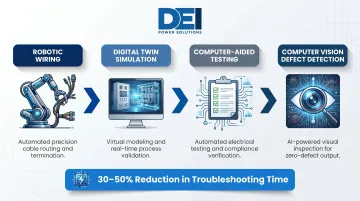
Robotic wiring systems and automated assembly lines are displacing manual processes, cutting labor hours while holding tighter tolerances than hand-wiring allows. The National Electrical Switchboard Manufacturers Association of Australia (NESMA) documents four active AI-driven applications in switchboard production:
- Automates wiring runs with robotic systems, reducing assembly time and human error
- Runs digital twin simulations to catch design conflicts before production starts
- Embeds computer-aided testing directly into quality control workflows
- Applies real-time defect detection via computer vision for continuous compliance checks
AI-powered quality control systems use computer vision and sensor data to detect wiring faults, component misalignments, and assembly defects during production, maintaining output quality without sacrificing throughput. Industry benchmarks show digital transformation initiatives can cut troubleshooting time by 30-50% and reduce unnecessary parts replacements by approximately 40%.
Smart Switchboards and IIoT Integration
Smart switchboards combine embedded IIoT sensors, communication modules, and cloud-connected platforms to turn standard distribution panels into actively monitored power infrastructure. Over 59% of new switchboard products now include IoT integration, enabling real-time visibility and control across power distribution systems.
Predictive Maintenance and Downtime Reduction
Real-time monitoring capabilities — load measurement, temperature tracking, and fault detection — allow facility teams to shift from calendar-based to condition-based maintenance. Fluke Corporation's 2025 research found that 55% of U.S. manufacturers experienced unplanned downtime in the past year, with losses reaching up to USD 207 million weekly. Predictive maintenance enabled by IIoT-connected switchboards addresses this directly by identifying problems before they cause outages.
Data Center Demand Driving Smart Switchboard Adoption
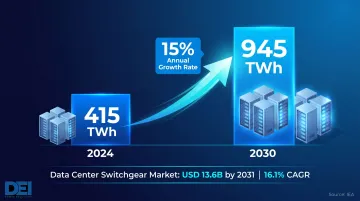
The exponential growth of hyperscale data centers directly accelerates demand for smart switchboards. The IEA projects global data center electricity consumption doubling from 415 TWh in 2024 to approximately 945 TWh by 2030, growing at approximately 15% per year. The data center switchgear market is forecasted to grow at 16.1% CAGR to USD 13.6 billion by 2031, driven by high-density power distribution needs, remote diagnostics, and rapid fault isolation.
Smart Grid Integration
Smart switchboards support smart grid interoperability across an increasingly complex energy mix. Key capabilities now expected in commercial and utility specifications include:
- Renewable energy inputs: Direct integration with solar, wind, and other distributed generation sources
- Battery storage tie-ins: Coordinated control of on-site energy storage for peak shaving and backup
- Demand response participation: Automated load adjustment in response to grid pricing or capacity signals
What was once a premium feature is now a baseline specification requirement, as facility operators need real-time control over distributed energy resources to maintain uptime and grid compliance.
Modular Design and Custom-Engineered Switchboard Solutions
Modular switchboard architecture uses standardized sections, plug-and-play components, and pre-engineered configurations for faster assembly, easier field modification, and scalable capacity additions without full panel replacement. The modular switchboard market is projected to grow from USD 5.5 billion in 2024 to USD 8.2 billion by 2033, driven by demand for faster deployment and reduced on-site labor.
Custom Engineering for Project-Specific Requirements
Custom-engineered switchboards built to project-specific voltage, layout, and load specs reduce change orders and field adjustments on large commercial and industrial projects. In-house manufacturing capabilities are critical to delivering these configurations quickly and accurately. Industry data shows modular designs can reduce deployment times by as much as 50% compared to traditional designs.
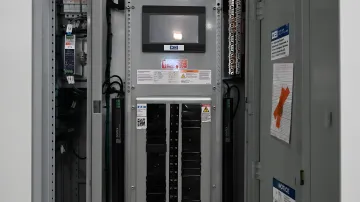
DEI Power's custom UL 891-certified low-voltage switchboards are built to client-specified layouts, voltages (120/240V through 480Y/277V), and jobsite requirements. In-house manufacturing at their 50,000 sq. ft. Ontario, California facility means faster builds and fewer delays than relying on outsourced supply chains — a clear advantage for U.S.-based contractors and engineers managing tight schedules.
Factory Testing and Pre-Commissioning
Pre-engineered and factory-tested switchboard assemblies reduce installation errors on jobsites. Each assembly goes through a standard pre-shipment protocol before leaving the facility:
- Dielectric strength verification
- Operational function testing
- Torque verification on all connections
Domestic manufacturers like DEI Power ship most in-stock orders within 1 business day, making fast fulfillment a real differentiator on time-sensitive infrastructure projects.
Eco-Friendly Designs and SF₆-Free Technologies
SF₆ (sulfur hexafluoride) — long used as an insulating gas in switchgear — is under intense regulatory scrutiny globally and in the U.S. SF₆ has a global warming potential 23,500 times greater than CO₂, with an atmospheric lifetime of approximately 3,200 years.
Regulatory Phase-Out Timelines
EU Regulation 2024/573 bans SF₆ in new medium-voltage switchgear up to 24 kV beginning January 2026. California's CARB phase-out begins in 2025, with New York's voltage-based phase-out starting in 2027. While these regulations primarily target medium- and high-voltage equipment, the regulatory trajectory creates downstream pressure for low-voltage switchboard manufacturers in procurement and sustainability specifications.
Alternative Technologies
SF₆-free alternatives include:
- Vacuum interrupter designs for arc suppression without gas insulation
- Clean-air insulation systems using synthetic air (80% nitrogen, 20% oxygen)
- Solid dielectric materials for compact, gas-free designs
Green Building Alignment
These technology shifts extend beyond gas replacement — they connect directly to how projects get specified and awarded. Switchboard manufacturers are aligning product designs with broader sustainability requirements through:
- Recyclable materials and energy-efficient components to support lifecycle longevity goals
- LEED-compatible designs that meet green building certification requirements
- Procurement-ready compliance documentation for infrastructure, healthcare, and utility projects
Environmental compliance is now a procurement prerequisite in many public and commercial sectors. Manufacturers who meet these requirements early are better positioned to win contracts where sustainability specifications are non-negotiable.
Advanced Arc Flash Protection and Cybersecurity
Arc flash incidents claimed 147 lives in 2023 alone — a figure that has held steady for a decade despite significant advances in protection technology. For switchboard manufacturers and facility teams, that plateau signals a gap between available innovation and actual deployment.
Arc Flash Safety Innovations
NFPA reports 147 electrical fatalities in 2023, maintaining a 10-year average. Updated standards including NFPA 70E 2024 and IEEE 1584-2018 have introduced new electrode configurations, enclosure dimension factors, and strengthened risk assessment requirements.
Technologies now considered baseline rather than optional on mission-critical projects include:
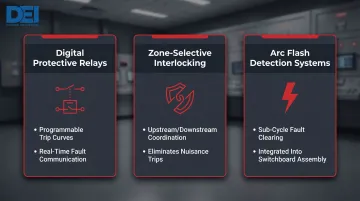
- Digital protective relays with programmable trip curves and built-in communication ports for real-time fault data
- Zone-selective interlocking that coordinates upstream and downstream devices to isolate faults without nuisance trips
- Arc flash detection systems integrated directly into switchboard assemblies for sub-cycle fault clearing before arc energy escalates
Cybersecurity for Connected Switchboards
IIoT-enabled panels are now networked infrastructure — which makes them attack surfaces. In October 2025, CISA issued advisory ICSA-25-301-01 for Schneider Electric EcoStruxure with a CVSS v4 score of 8.2, exposing vulnerabilities that could allow attackers to disrupt real-time process data from control systems. This isn't an isolated case. Uptime Institute's 2025 outage analysis found that cyber events are rising in data center environments even as overall outage frequency declines — and when they hit, the impacts tend to be severe and lasting.
Manufacturers and facility teams should prioritize:
- Built-in cyber hardening and network segmentation
- Role-based access controls for remote monitoring platforms
- Regular firmware updates and vulnerability patching protocols
- Network monitoring and anomaly detection for electrical distribution systems
What's Driving These Innovations — and What to Watch Next
Market Forces Converging
Several structural forces compress the timeline for switchboard technology adoption:
| Market Segment | 2024-2026 Value | CAGR | Projection |
|---|---|---|---|
| Global LV switchgear | USD 86.1B (2024) | 7.6% | Through 2034 |
| U.S. switchgear (all voltages) | USD 18.12B (2026) | 4.69% | USD 22.79B by 2031 |
| Data center switchgear | Growing to USD 13.6B by 2031 | 16.1% | Driven by hyperscale growth |
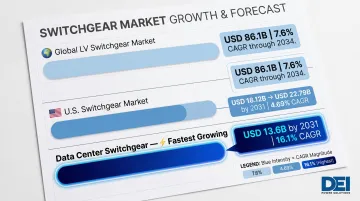
Global data center electricity consumption is projected to double by 2030, with the U.S. accounting for 45% of global consumption and nearly 50% of U.S. electricity demand growth. That demand surge touches every trend covered in this article — from AI-ready power distribution to modular assembly.
Regulatory and Compliance Pressure
Regulatory forces — NEC code updates, UL certification requirements, and BABA (Buy America, Build America) provisions — are reshaping what buyers require from switchboard manufacturers. The Build America, Buy America Act mandates that all iron, steel, manufactured products, and construction materials used in covered infrastructure projects be produced in the United States.
For federally funded infrastructure projects, BABA compliance is no longer optional. USA-manufactured switchboards that meet these provisions are increasingly a procurement prerequisite, not a differentiator.
UL 891 Edition 12, revised March 21, 2025, introduces new requirements for forced-air cooling, multiple-source switchboards, and emergency circuits, with compliance effective March 21, 2027. Manufacturers must begin product redesign and testing now to meet the deadline.
Workforce Gap Amplifies Technology Adoption
The U.S. will see 80,000 new electrician job openings annually through 2031, but nearly 30% of union electricians are near retirement. This structural labor deficit increases the value proposition of factory-assembled, modular switchboards and AI-driven manufacturing. Shifting complexity from the jobsite to the factory reduces project risk when field labor is scarce.
Future Signals Worth Watching
Three trends will shape switchboard specification decisions through the end of the decade:
EV charging load growth: The U.S. added approximately 35,000 public charging points in 2024 but must average 58,000 annually through 2030 to meet projected targets. Commercial switchboard load planning must account for EV charging as a significant, variable new demand type.
Grid-edge AI: Emerging platforms like Sense's Waveform AI use edge-powered intelligence to identify arcing, downed lines, and equipment degradation at the distribution level. Embedded grid-edge intelligence in distribution equipment will expand as grid resilience demands increase.
Standards convergence through 2027: UL 891's March 2027 compliance deadline, the NEC's three-year update cycle ahead of a major 2029 structural reorganization, and evolving UL 3141 requirements for Power Control Systems will push manufacturers toward embedded sensing and standards-ready designs.
Conclusion
The five innovations covered in this guide represent a fundamental shift in what switchboards are and how they're built:
- AI-driven manufacturing for faster, more precise production
- IIoT-enabled smart panels for real-time monitoring and diagnostics
- Modular and custom design for faster deployment and project-specific fit
- Eco-friendly technologies meeting tightening regulatory requirements
- Advanced safety systems reducing risk across installation and operation
As electrical infrastructure modernizes to support data centers, renewable energy, industrial electrification, and grid resilience, switchboards must evolve from static distribution assets into intelligent, connected, and adaptable infrastructure.
Contractors, engineers, and facility teams who engage early with these trends — by specifying innovation-aligned switchboards and partnering with manufacturers who lead on compliance, speed, and customization — will deliver more reliable, future-ready power infrastructure with fewer delays and fewer change orders. Regulatory pressure, tightening lead time expectations, and surging data center demand are all accelerating the pace of adoption — the practical question is no longer whether to specify smarter switchgear, but how quickly you can get the right equipment on site.
Frequently Asked Questions
What are the latest technological innovations in switchboard manufacturing in 2025?
The top innovations include AI-assisted design and production automation, IIoT-enabled smart switchboards with real-time monitoring, modular architectures for faster deployment, SF₆-free insulation technologies, and integrated arc flash protection systems. These advances improve manufacturing speed, operational reliability, and safety compliance across commercial and industrial applications.
What is the difference between a traditional switchboard and a smart switchboard?
Traditional switchboards passively distribute power without feedback or monitoring. Smart switchboards incorporate embedded sensors, communication modules, and cloud connectivity to enable real-time monitoring, remote diagnostics, and condition-based maintenance, so facility teams can detect problems before they cause outages.
How is AI being used in switchboard manufacturing?
AI is applied across four areas of switchboard manufacturing:
- Design automation: Accelerates layout planning and reduces errors
- Digital twin simulation: Tests configurations before physical builds
- Robotic assembly: Improves consistency and lowers labor costs
- AI-powered quality control: Uses computer vision to detect production defects
Together, these capabilities shorten lead times and improve output quality.
What does UL 891 certification mean for low-voltage switchboards?
UL 891 is the industry standard for dead-front switchboards, covering construction, performance, and safety requirements. UL 891 certification signals that a switchboard meets rigorous testing and code-compliance standards required for commercial, industrial, and utility installations — ensuring safety, reliability, and regulatory acceptance.
How is the growth of data centers affecting switchboard design and manufacturing?
Hyperscale and colocation facilities need high-density, fault-tolerant power distribution with real-time monitoring and fast fault isolation. That demand is pushing the low-voltage switchboard market toward smarter, more configurable designs with shorter fulfillment timelines — reflected in a 16.1% CAGR for data center switchgear versus 7.6% for the broader low-voltage switchgear market.
What is driving the shift away from SF₆ gas in switchboard and switchgear manufacturing?
SF₆ has a global warming potential 23,500 times greater than CO₂ and persists in the atmosphere for 3,200 years. EU phase-outs begin January 2026, with California and New York adding further regulatory pressure, pushing manufacturers toward vacuum interrupter and clean-air alternatives across both medium- and low-voltage equipment.