Introduction
When an electrical assembly fails under fault conditions — whether from a short-circuit, thermal overload, or internal arc — the consequences are immediate and serious. NFPA research reports that non-home electrical distribution fires cause an annual average of $718 million in direct property damage, 22 civilian deaths, and 210 injuries. Beyond fire risk, ABB's 2023 Value of Reliability survey found that unplanned industrial outages cost roughly $125,000 per hour.
Those numbers make the case for verified assembly performance — not just listed components. "Type-tested" is the designation that confirms an assembly has passed documented fault and performance testing as a complete unit, not just as a collection of individually rated parts.
This article covers what type-tested means, how the certification tests work, how type-testing differs from routine factory verification, and what UL 891 requires for US projects.
Key Takeaways
- Type-tested assemblies are verified as a complete system — not just as individual components
- Tests cover temperature rise, dielectric properties, short-circuit withstand, protective circuit effectiveness, clearances, and IP rating
- Modifying a type-tested assembly without re-verification shifts compliance liability to whoever made the change
- In the US, UL 891 governs low-voltage switchboards; IEC 61439 applies internationally
- UL 891-certified switchboards arrive with pre-validated performance data, ready for jobsite deployment
What Does "Type-Tested" Mean for Low-Voltage Switchgear and Controlgear Assemblies?
Type-tested means a representative prototype of a specific assembly design has been subjected to a defined series of tests confirming the design meets a recognized standard. The testing happens once per design — the results then apply to all assemblies built to that exact specification.
The Governing Standards
Two standards define what type testing requires for LV assemblies:
- IEC 61439-1:2020 — the international standard (replacing the older IEC 60439 series, which was retired in November 2014) covering general rules for LV switchgear and controlgear assemblies up to 1000V AC / 1500V DC
- UL 891 — the US/North American standard for dead-front switchboards rated 1000V or less, currently in its 12th edition (last revised March 2025)
Both serve the same function: confirming the assembly performs safely as a complete, integrated system.
Why System-Level Testing Matters
A circuit breaker, busbar, or terminal block may pass its own product standard when tested individually in free air. That doesn't mean it behaves the same way inside a populated enclosure where multiple devices are generating heat, creating magnetic forces, and competing for airflow.
Type testing validates how all components interact — busbars, protection devices, interconnections, and enclosure — under real operating and fault conditions. An assembly built from individually certified components is not the same as a system that has been verified as a whole — and the difference shows up under fault conditions.
The "Original Manufacturer" Rule
The organization that carries out the original design verification owns the type-tested status. If a panel builder deviates from that verified design — substituting unverified components or altering busbar layouts — they assume the original manufacturer's technical and legal obligations. They are then responsible for re-verification before the assembly can claim compliance.
Three Verification Categories
| Category | What It Means |
|---|---|
| Fully type-tested | All arrangements verified against the standard |
| Partially type-tested | Some arrangements verified; others rely on calculation or design rules |
| Non-type-tested | No formal system-level verification performed |
The Key Type Tests Performed on LV Switchgear Assemblies
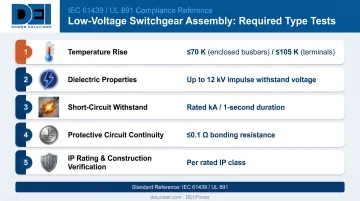
IEC 61439 and UL 891 both require a defined set of design verification tests conducted on a complete, fully assembled representative unit — not on individual components. Some tests — particularly short-circuit tests — are intentionally destructive. They cannot be run on units intended for service.
| Test | Standard Reference | Key Threshold |
|---|---|---|
| Temperature Rise | IEC 61439 / UL 891 | 70 K (terminals), 105 K (bare Cu busbars) |
| Dielectric Properties | IEC 61439 | Up to 1,890V AC rms; up to 12 kV impulse |
| Short-Circuit Withstand | IEC 61439 | Rated kA, 1-second standard duration |
| Protective Circuit Continuity | IEC 61439 | ≤ 0.1 ohm; ≥ 10A applied |
| IP / Construction | IEC 61439 | Per rated classification |
Temperature Rise Test
This test applies rated current until temperatures stabilize throughout the assembly, then measures hotspots at conductors, busbars, terminals, and accessible surfaces.
Key limits from IEC 61439:
- Terminals for external insulated conductors: 70 K rise maximum
- Accessible external metal surfaces: 30 K rise maximum
- Bare copper busbars: 105 K rise maximum (above this, copper begins to anneal)
Excessive heat accelerates insulation aging and shortens component life. Adding a new device to an existing assembly — even a low-dissipation one — can insulate an adjacent component and create a localized hotspot that wasn't present in the original verified configuration.
Dielectric Properties Test
This confirms insulation won't break down under rated operating voltage. Two tests are involved:
- Power-frequency withstand: AC voltage applied for 5 seconds (design verification) or 1 second (routine testing) at levels tied to rated insulation voltage — for example, 1,890V AC rms for assemblies rated 300–690V
- Lightning impulse withstand: Simulates switching surges; preferred values include 2.5 kV, 4 kV, 6 kV, 8 kV, and 12 kV depending on the system
Failure isn't gradual. It's sudden insulation breakdown under operating voltage — with no warning before it occurs.
Short-Circuit Withstand Test
This exposes the assembly to fault-level currents — typically specified in kA, with a standard duration of 1 second (though 0.2s and 3s durations are also assigned) — to verify that busbars, supports, contacts, and enclosures do not deform or fail under extreme thermal and electrodynamic stress.
Real short-circuit faults impose forces that can physically destroy an undersized or unverified assembly. A unit that passes component ratings alone may still fail at the system level — this test draws that line.
IEC 61439 does not require this test where:
- Rated short-time withstand current does not exceed 10 kA rms, or
- A current-limiting device restricts cut-off current to 17 kA peak
Effectiveness of the Protective Circuit
This verifies that the protective earth path is continuous, adequate, and thermally capable of withstanding the maximum short-circuit stress.
The test applies a current of at least 10A AC or DC between the protective conductor terminal and all exposed conductive parts. Per ABB's IEC 61439 workbook, resistance between assembly parts and the external protective conductor terminal must not exceed 0.1 ohm.
A broken or undersized earth path means fault current can flow through unintended paths — creating real electrocution risk for personnel who contact exposed metal during a fault event.
Additional Required Verifications
Beyond the four major tests above, IEC 61439 requires verification of:
- Clearances and creepage distances — measured between live parts and exposed conductive parts to prevent flashover
- Mechanical operation — operating cycles on drawout racks and door mechanisms
- Degree of protection (IP rating) — confirming the enclosure resists dust and moisture ingress at its rated classification
- Construction quality checks — resistance to mechanical impact, rust, damp, heat, fire, and mechanical performance of fixings
Type Testing vs. Routine Testing: Key Differences
Type testing and routine testing serve different purposes at different stages of the assembly lifecycle — and both are required for a fully compliant switchgear assembly.
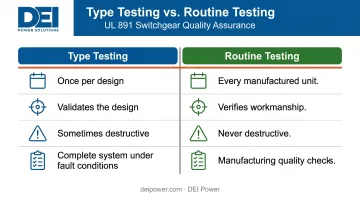
Routine testing (also called factory acceptance testing or FAT) is performed on every single unit after manufacture. It doesn't re-validate the design; it confirms workmanship. A unit can be built to a fully verified type-tested design and still leave the factory with a wiring error, missing connection, or assembly defect. Routine testing catches those issues before delivery.
IEC 61439 routine checks include:
- Degree of protection verification
- Clearances and creepage distances
- Protective circuit continuity
- Dielectric properties (1-second power-frequency withstand)
- Internal wiring and connection verification
- Mechanical operation
| Type Testing | Routine Testing | |
|---|---|---|
| Frequency | Once per design | Every manufactured unit |
| Purpose | Validate the design | Verify workmanship |
| Destructive? | Sometimes (short-circuit test) | Never |
| Scope | Complete system under fault conditions | Manufacturing quality checks |
DEI Power tests every switchboard before shipment — fully assembled and verified against documented quality assurance procedures — so the unit arriving on your jobsite matches exactly what was designed and certified.
What's at Stake with Non-Type-Tested Assemblies
Without system-level verification, there's no reliable way to know whether components interact safely under real fault conditions. Individual component ratings are assigned in free air — but once grouped inside an enclosure, thermal interaction, reduced clearances, and mutual heating effects can lower their effective ratings. An assembly can appear compliant on paper while behaving differently under load.
These gaps become real problems when it's time for inspection, certification, or a fault event.
Compliance and Liability
If anyone modifies a type-tested assembly — substituting components, changing layouts, or adding unverified devices — they assume the original manufacturer's compliance obligations. Re-verification becomes their responsibility. Depending on how extensively the assembly was modified, that can mean full retesting, revised documentation, and rescheduled inspections.
Project and Schedule Risk
Non-type-tested or improperly modified assemblies can fail AHJ inspection, require field rework, or be rejected outright. Type-tested assemblies with proper certification documentation simplify the approval process and reduce change orders — both of which directly protect project timelines and budgets.
Operational Benefits of Verified Assemblies
- Predictable performance under fault conditions
- Simplifies end-user certification and AHJ approval
- Reduces maintenance complexity through standardized components
- Longer service life from verified thermal management
What This Means for US Projects: UL 891 and Type-Verified Switchboards
For US projects, the applicable standard is UL 891 — not IEC 61439. UL 891 governs the construction and performance of dead-front low-voltage switchboards rated 1000V or less, and is the most common listing standard for switchboards in North America.
UL 891 certification functions as the US equivalent of type-tested design verification. It confirms the switchboard has been built and tested to a nationally recognized standard, supporting NEC Article 408 compliance (which covers switchboards, switchgear, and panelboards) and simplifying AHJ approval for commercial, industrial, and utility installations.
Note: always verify NEC Article 408 requirements against the active edition — currently the 2026 NEC per NFPA.
What UL 891 Means in Practice
For contractors and engineers, a UL 891-certified switchboard means:
- The assembly has been listed through UL's Follow-Up Services program, with ongoing onsite certification inspections confirming continued compliance
- AHJ approval is straightforward with proper submittal documentation
- The switchboard's performance under normal and fault conditions has been validated, not assumed
For federally funded projects, specifying US-manufactured, UL 891-certified equipment also supports Buy America Build America (BABA) compliance. Under 2 CFR Part 184, a manufactured product must be produced in the US with domestic component costs exceeding 55% of total component cost. UL listing alone doesn't satisfy BABA — documentation must address manufacturing location and component-cost content directly.
DEI Power: UL 891-Certified Switchboards, Built in the US
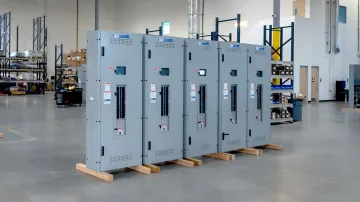
DEI Power manufactures UL 891-certified low-voltage switchboards (400A–4000A) from its 50,000 sq. ft. facility in Ontario, California. As an approved Siemens OEM, DEI Power builds switchboards using genuine Siemens components under documented quality assurance procedures, with each unit tested and verified before shipment.
For time-sensitive projects, DEI Power offers:
- In-stock units ship in 3–5 business days with free shipping nationwide
- Submittal and compliance documentation structured for AHJ approval
- BABA-compliant documentation for federally funded projects
For project-specific configuration support, contact DEI Power at (866) 773-8050 or sales@deipower.com.
Frequently Asked Questions
What does "type-tested" mean for low-voltage switchgear and controlgear assemblies?
A type-tested assembly has been subjected to a defined series of tests — covering temperature rise, short-circuit withstand, dielectric performance, and more — to verify the complete system meets a recognized standard such as IEC 61439 or UL 891. Testing is done once per design and the results apply to all assemblies built to that specification.
What standard governs type-tested LV switchgear assemblies in the US?
In the US, UL 891 is the applicable standard for low-voltage dead-front switchboards. IEC 61439 applies in international markets. Both define design verification requirements that establish equivalent assurance of system-level performance.
What is the difference between type testing and routine testing for switchgear?
Type testing validates the design once using a representative prototype, including destructive tests where required. Routine testing (factory acceptance testing) is performed on every unit to verify workmanship quality and catch manufacturing defects before delivery.
Can I add components from a different manufacturer into a type-tested assembly?
Adding unverified components — even from the same manufacturer — may invalidate the type-tested status. Any modification not reviewed and approved by the original manufacturer shifts full re-verification responsibility — and all associated compliance liability — to the installer.
How long does type test certification remain valid?
IEC 61439 defines no fixed expiration period for type test results. UL 891 certification is maintained through UL's Follow-Up Services program, with periodic onsite inspections confirming continued compliance.
Why does type testing matter for commercial and industrial power distribution projects?
Type-tested assemblies provide verified performance under fault conditions, simplify AHJ approval, and reduce the risk of field failures and schedule delays. For contractors and engineers, pre-verified equipment — like UL 891-certified switchboards — means fewer surprises after installation and faster project close-out.