
Introduction
Open any electrical panel specification meeting and you'll hear the same question: "How many breakers can we put in that 400A panel?" Too often, the answer defaults to "42" — a holdover from pre-2008 NEC rules that no longer apply. Worse still, some contractors assume a 400A panelboard can accommodate an unlimited number of breakers, leading to overcrowded panels, failed inspections, and dangerous thermal overload risks.
Whether you're designing power distribution for a data center, an industrial plant, or a commercial facility, the real answer depends on NEC code requirements, manufacturer stab ratings, and load calculations — not a single default number.
Key Takeaways
- Breaker count is set by the manufacturer's listed capacity under NEC 408.54, not the 400A amperage rating
- Most 400A panelboards offer 42–84 circuit spaces depending on model
- Stab amperage limits often reduce the number of usable circuits below that listed maximum
- CTL design physically prevents overcrowding; bypassing it violates NEC 110.3(B)
- Continuous loads are capped at 320A (80% rule), and breakers must be sized at 125% of continuous load
- Always verify the maximum circuit count on the panelboard's nameplate label
How Many Breakers Can a 400A Panelboard Hold?
A 400A panelboard does not have a universal breaker count — the number is set by the manufacturer's UL listing and reflected on the panel's nameplate label, not by the 400A rating itself. The 400A rating refers to the maximum current capacity of the main bus bars, not how many circuit breakers the panel can physically hold.
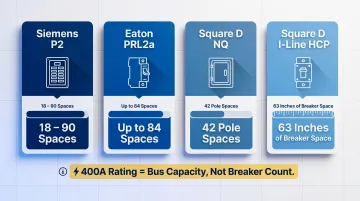
Circuit space ranges vary significantly by manufacturer:
- Siemens P2 series: 18 to 90 circuit spaces at 400A
- Eaton PRL2a series: Up to 84 branch circuit devices at 400A
- Square D NQ series: 42 pole spaces at 400A
- Square D I-Line HCP: 63 inches of breaker space at 400A
That variation matters for project planning. If none of the standard configurations fit your load requirements, DEI Power manufactures custom UL 891-certified switchboards as an approved Siemens OEM — built to your exact slot count, voltage, and layout from the start.
Circuit Spaces vs. Circuits
Understanding the difference between "circuit spaces" and "circuits" is critical:
- A 42-space panel allows 42 single-pole breakers OR 21 double-pole breakers
- A three-pole breaker consumes three adjacent slots
- The mix of single-pole and multi-pole breakers directly affects total breaker count
Example: A 42-space three-phase panel filled entirely with three-pole breakers yields only 14 circuits (42 ÷ 3 = 14), compared to 42 circuits if using only single-pole breakers.
Physical Slots Don't Equal Usable Slots
Having empty slots doesn't mean you can fill them all. The max amps per stab constraint — a limit on how much load each bus stab can carry — often reduces usable breaker count before you run out of physical space. A panel with 60 circuit spaces may only accommodate 40–45 breakers when stab limits and load calculations are properly applied.
NEC Rules That Govern Breaker Count in a 400A Panelboard
NEC 408.54: Maximum Number of Overcurrent Devices
NEC 408.54 requires that every panelboard include physical means to prevent the installation of more overcurrent devices than the panel is rated for. This is the foundational rule — not a separate "400A rule."
The code states: "A panelboard shall be provided with physical means to prevent the installation of more overcurrent devices than that number for which the panelboard was designed, rated, and listed."
Key clarification: a 2-pole breaker counts as two overcurrent devices; a 3-pole breaker counts as three overcurrent devices.
The Old 42-Circuit Rule and Why It No Longer Applies
Prior to the 2008 NEC, Section 408.35 imposed a hard limit of 42 overcurrent devices in lighting and appliance branch-circuit panelboards. The 2008 NEC revision eliminated this cap, replacing it with manufacturer-determined limits.
According to IAEI Magazine: "The revisions remove the 42 overcurrent device limitations for panelboards and also result in requirements that now address power panelboards and lighting and appliance panelboards in the same fashion."
This is why the panelboard nameplate — not the amperage — is the authoritative source for maximum circuit count. Manufacturers now offer panels with 84 circuits and higher.
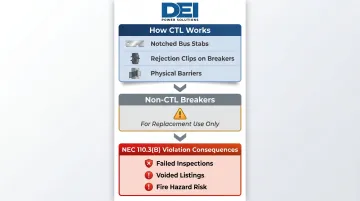
CTL (Circuit Total Limitation)
CTL panels use mechanical rejection features that physically enforce the circuit cap:
- Notched bus stabs at designated positions where breakers are permitted
- Rejection clips on breakers that interact with notched stabs
- Physical barriers preventing installation of non-listed breakers
These mechanical features exist for a reason. Non-CTL breakers are still manufactured for legacy repairs in pre-1965 panels, but they carry a clear label: "For replacement use only. Not for CTL assemblies."
Installing non-CTL breakers in a modern CTL panel violates NEC 110.3(B), which requires all equipment to be installed per its listing and manufacturer instructions. That means failed inspections, voided listings, and potential fire hazards.
Max Amps Per Stab: The Real Limiting Factor
What is a Bus Stab?
A bus stab (or bus finger) is a conductive metal tab protruding from the main vertical bus bars inside the panel that breakers snap onto. In a typical panelboard:
- Each stab serves two breaker slots (one on each side of the bus)
- A 42-space panel has 21 stabs per phase
- Both breakers sharing a stab draw current through the same connection point
Why Manufacturers Cap Per-Stab Load
Manufacturers specify a maximum total amperage that both breakers sharing a stab can carry in combination. This limit appears on the panelboard's wiring diagram or data label — it's there to prevent excessive heat buildup at the stab connection.
Per-stab ratings vary by model and must be verified from the panel's documentation. The rule is consistent across manufacturers: the combined rating of all breakers on a single stab cannot exceed the listed maximum.
How Per-Stab Limits Shrink Available Capacity
Consider a stab rated at 200A:
- One side has a 150A double-pole breaker installed
- The opposite side cannot exceed 50A (200A - 150A = 50A)
- Even if a physical slot is available, exceeding this limit violates the listing
This constraint can significantly reduce the total number of breakers you can realistically install, even in a panel with ample circuit spaces.
Main Breaker vs. Per-Stab Limits
The 400A main breaker controls aggregate load across all stabs — but individual stabs still have their own limits. The main breaker amperage does not override per-stab limits. Overcrowding a single stab creates fire and thermal hazards no matter what the main breaker rating is.
That's why, when DEI Power engineers custom 400A switchboards, per-stab amperage limits are built into the design from the start and documented for the customer — ensuring installations meet both manufacturer specifications and NEC requirements.
The 80% Rule and the 125% Rule: What They Mean for a 400A Panel
The 80% Rule (NEC 210.20, 215.3)
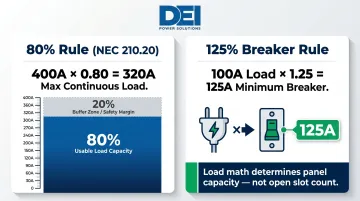
NEC 210.20(A) requires that circuit breakers not be loaded beyond 80% of rated capacity for continuous loads (loads running 3 hours or more).
For a 400A panel, the practical continuous load capacity is 320A (400A × 0.80 = 320A) — not 400A.
This thermal constraint exists because standard breakers are tested to a 50°C rise above 40°C ambient (90°C total). Exceeding 80% of rated current risks thermal degradation of connections and insulation over sustained operation.
The 125% Breaker Rule
The 125% rule is the inverse of the 80% rule: when sizing a breaker for a continuous load, the breaker must be rated at 125% of the load current.
Formula: Breaker rating ≥ noncontinuous load + (1.25 × continuous load)
Example: If a continuous load draws 100A, the breaker must be at least 125A (100A × 1.25 = 125A).
Together, these rules shift the focus from physical slot count to actual load math. A panel with 42 open circuit spaces can still be functionally full if oversized breakers push the aggregate load past 320A. Engineers and contractors need to run load calculations first — slot availability is secondary.
Do Tandem Breakers Expand Circuit Count in a 400A Panelboard?
What Are Tandem Breakers?
A tandem (duplex) breaker is two independent breakers in a single-slot form factor. Each serves a separate 120V circuit connected to the same pole. Tandem breakers can effectively double circuit count in designated slots, but only if the manufacturer explicitly permits them.
Manufacturer Designation Requirements
Tandem breakers are only permitted in specific slots:
- Designated positions identified on the panel's wiring diagram
- Physical notched bus stabs at approved locations
- Model numbers may encode tandem capacity (e.g., "3040" = 30 spaces, 40 max circuits)
Critical Limitations
Tandem breakers increase circuit count, but they don't change the underlying current limits. Each stab has a maximum amperage rating, and adding tandem breakers doesn't override it. Both mini-breakers sharing a stab must stay within the manufacturer's combined rating.
When tandem breakers are installed on both sides of a stab, four breakers share a single stab. All four must remain within the per-stab maximum — exceeding it creates an overload risk regardless of how the breakers are physically installed.
Code Violations
Installing tandem breakers in non-designated slots violates:
- NEC 408.54: Exceeds the panel's listed maximum circuit count
- NEC 110.3(B): Contradicts manufacturer listing and labeling instructions
Some installers bypass CTL rejection features by filing or breaking breaker tabs. This violates both NEC requirements and manufacturer listings, and commonly results in failed inspections or fire hazards that aren't covered under the panel's warranty.
Single-Phase vs. Three-Phase 400A Panelboards: Does the Phase Configuration Change Breaker Count?
Bus Bar Configuration Differences
| Feature | Single-Phase (120/240V) | Three-Phase (208Y/120V or 480Y/277V) |
|---|---|---|
| Hot bus bars | 2 (Hot 1, Hot 2) | 3 (Phase A, Phase B, Phase C) |
| Phase alternation | Alternates between 2 phases | Rotates A-B-C across stabs |
| Line-to-line voltage | 240V | 208V or 480V |
| Line-to-neutral voltage | 120V | 120V or 277V |
In a single-phase panel, each stab alternates between two hot buses. In a three-phase panel, stabs rotate through phases A, B, and C in sequence.
Slot Consumption Impact
Phase configuration determines how many breakers fit:
In a 42-space panel:
- Single-pole breakers: 42 circuits
- Double-pole breakers: 21 circuits (42 ÷ 2 = 21)
- Three-pole breakers: 14 circuits (42 ÷ 3 = 14)
Practical Scenario
A three-phase 400A panelboard serving motor loads and HVAC equipment burns through slots faster than one running mostly single-pole lighting circuits. If your project calls for 20 three-pole breakers at 30A each, that's 60 circuit spaces (20 × 3 = 60) — a standard 42-space panel won't cut it.
DEI Power builds 400A switchboards in both single-phase (120/240V) and three-phase (208Y/120V, 480Y/277V) configurations using Siemens components. Specifying your voltage configuration and circuit count early prevents costly rework — reach out to DEI Power's technical team to nail down the right setup before your project breaks ground.
Frequently Asked Questions
How many breakers can I have in a 400 amp panelboard?
Manufacturer's UL-listed capacity — printed on the panel's nameplate — sets the breaker limit, not the 400A amperage rating itself. Most 400A panels offer 42 to 84 circuit spaces, but actual usable circuits depend on stab limits and load calculations.
What is the 125% breaker rule?
NEC 210.20(A) requires breakers serving continuous loads (those running 3+ hours) to be rated at 125% of the load current. A 100A continuous load, for example, requires a minimum 125A breaker.
What is the 80% rule for breakers?
Never continuously load breakers beyond 80% of their rated ampacity. For a 400A panelboard, that puts the safe continuous load ceiling at 320A — preventing nuisance tripping and premature wear on overcurrent devices.
Can you add tandem breakers to a 400A panelboard to increase circuit count?
Tandem breakers can increase circuit count only in slots the manufacturer designates for tandems. The max amps per stab limit still applies, and installing tandems in non-approved slots violates NEC 408.54.
What is the maximum number of circuits in a 400A three-phase panelboard?
The circuit count depends on the panel's listed space count and the mix of single-, double-, and triple-pole breakers used. Three-pole breakers for motor loads consume three slots each, reducing total breaker count compared to single-pole-heavy configurations.