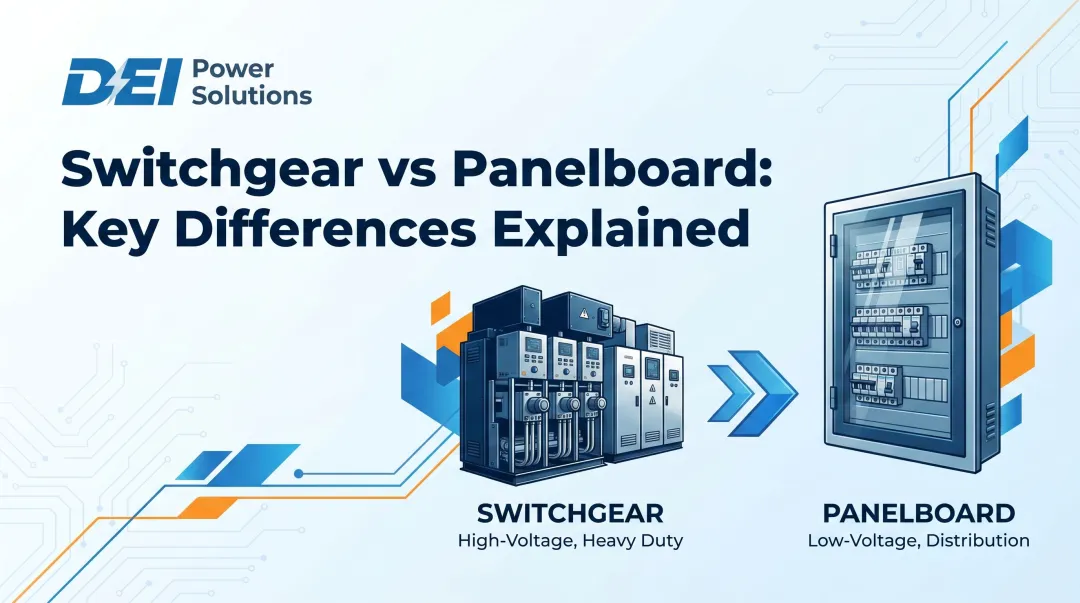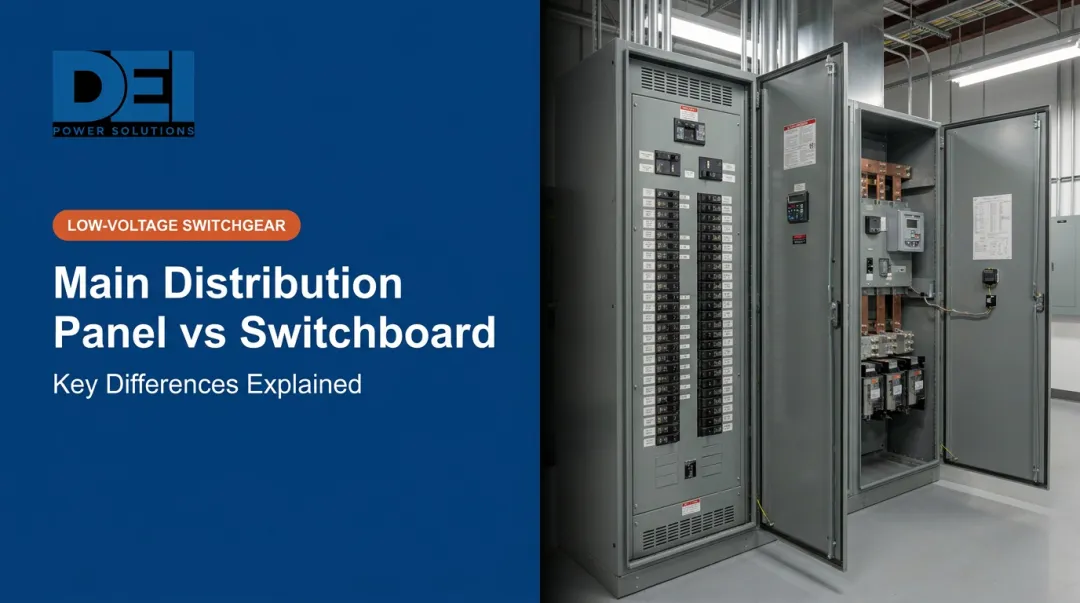
These three devices — panelboards, switchboards, and switchgear — serve distinct roles in a power distribution system, each governed by a different UL standard, built to different physical configurations, and rated for different voltage and current demands. Choosing among them requires understanding what separates them, not just what they have in common.
This guide gives contractors, engineers, and facility teams a practical breakdown of each device, their governing standards, and the selection criteria that actually matter on the job.
Key Takeaways
- Panelboard (UL 67): Wall-mounted, front-access only, up to 600V / 1,200A — branch circuit distribution in commercial and residential builds
- Switchboard (UL 891): Floor-mounted, up to 600V / 5,000A, for main distribution in large commercial and industrial facilities
- Switchgear (UL 1558 / IEEE C37.20.2): Fully compartmentalized, rated to 6,000A / 38kV — built for mission-critical and medium-voltage applications
- Key differentiators: voltage range, amperage ceiling, UL standard, short-circuit withstand, mounting style, and maintenance access
- Selection filters: load size, voltage level, available space, fault current exposure, downtime tolerance, and utility requirements
Switchboard vs Switchgear vs Panelboard: Quick Comparison
Three specification decisions — voltage rating, current capacity, and fault protection — separate these devices. Here's how they compare at a glance.
Voltage, Current, and Standards
| Device | Typical Voltage | Current Range | Governing Standard |
|---|---|---|---|
| Panelboard | Up to 600V | Up to 1,200A | UL 67, NEMA PB 1 |
| Switchboard | Up to 600V | Up to 5,000A | UL 891, NEMA PB 2 |
| LV Switchgear | Up to 1,000V | Up to 6,000A | UL 1558, ANSI/IEEE C37.20.1 |
| MV Switchgear | 4.76kV – 38kV | Application-specific | IEEE C37.20.2 |
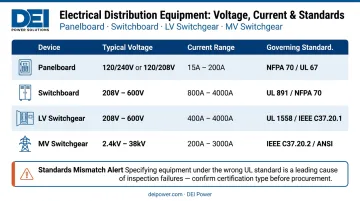
Specifying the wrong UL standard creates real permitting problems. An inspector looking for a UL 891 label on a switchboard won't accept a UL 67 panelboard, regardless of how the equipment is configured in the field.
Short-Circuit Withstand and Access
Two differences separate switchgear from everything else:
- Short-circuit withstand: Switchboards (UL 891) are rated for a minimum 3-cycle withstand under fault conditions. UL 1558 switchgear is rated for 30-cycle withstand — ten times longer. That gap matters enormously for selective coordination in facilities where upstream breakers need time to let downstream devices clear a fault first.
- Access: Panelboards are front-access only, mounted in or against a wall. Switchboards are floor-mounted with front access standard. Switchgear provides front and rear access with draw-out breakers that can be removed individually while the assembly stays energized.
Cost and Complexity
No reliable published pricing benchmarks exist for these product categories, but cost tracks directly with construction complexity:
- Panelboards are mass-produced, simple to install, and the most budget-friendly option
- Switchboards occupy the mid-range with greater customization depth and higher bus ratings
- Switchgear carries the highest cost due to compartmentalized construction, draw-out breaker design, and engineered fault protection. That premium needs to be weighed against fault exposure and downtime risk, not just purchase price.
What Is a Switchboard?
Per NEC Article 408, a switchboard is a large, freestanding assembly of switches, overcurrent devices, buses, and instruments — not installed in a cabinet or wall. Governed by UL 891, switchboards operate up to 600V and sit between panelboards and switchgear in the distribution hierarchy, with bussing typically rated from 1,200A up to 5,000A. NEMA PB 2 covers deadfront switchboards up to 6,000A at 600V or less.
Core components include:
- Panel frames and metal enclosures forming the freestanding structure
- Bus bars that receive and distribute power across circuits
- Overcurrent devices — typically bolt-on or group-mounted MCCBs
- Optional metering and monitoring instruments for load visibility
Switchboards use a dead-front, open-chassis construction with fewer internal barriers between cables, breakers, and bus than switchgear. That design supports their 3-cycle withstand rating and makes them cost-effective for applications that don't require compartmentalized fault protection.
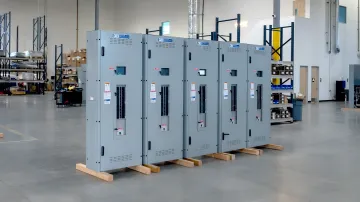
DEI Power manufactures UL 891-certified low-voltage switchboards in amperage configurations from 400A to 4,000A, with voltage options including 208Y/120V, 480V, 480Y/277V, and others. Units are built with genuine Siemens components as an approved Siemens OEM, available in NEMA 1 or NEMA 3R enclosures, and meet seismic requirements for all zones.
Where Switchboards Fit
Switchboards sit downstream of a utility service entrance, feeding multiple panelboards or large loads throughout a facility. They're the right tool when amperage demands exceed what a panelboard can handle but medium-voltage or draw-out capability isn't required.
Typical deployment contexts include:
- Commercial office buildings and campuses as main distribution equipment
- Data centers requiring high-density low-voltage distribution
- Industrial plants with large motor loads
- Educational and healthcare campuses with centralized electrical rooms
The front-access standard design (which can be placed against a wall) suits facilities where maintenance teams need serviceable gear without dedicated rear clearance. If rear access is needed, specify that configuration before the build — retrofitting it later adds cost and delay.
What Is Switchgear?
Switchgear is a fully enclosed assembly with all sides and top covered in sheet metal, housing primary power circuit switching and interrupting devices, buses, and connections. Access is through doors or removable covers.
Governing standards split by voltage: low-voltage switchgear falls under UL 1558 and ANSI/IEEE C37.20.1, while medium-voltage metal-clad switchgear follows IEEE C37.20.2, rated from 4.76kV to 38kV.
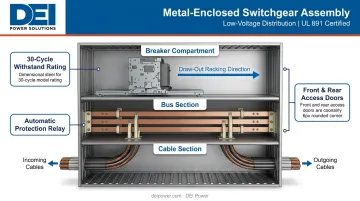
The defining structural feature is compartmentalization: each power circuit breaker occupies its own metal-enclosed compartment, with solid barriers separating the breaker, bus, and cable sections. That construction enables the 30-cycle short-circuit withstand rating, and it's what makes switchgear substantially more expensive than a switchboard at equivalent amperage.
Additional distinguishing features:
- Draw-out breakers that move to test and disconnect positions, and can be fully withdrawn for maintenance while the assembly remains energized
- Automatic protection mechanisms — relays, fuses, and protective devices that detect fault conditions and interrupt circuits before damage propagates
- Front and rear access standard in most configurations
Switchgear Types
| Type | Standard | Voltage Range | Key Characteristic |
|---|---|---|---|
| LV Metal-Enclosed | UL 1558, ANSI C37.20.1 | Up to 1,000V | Compartmentalized, draw-out LV power breakers |
| MV Metal-Clad | IEEE C37.20.2 | 4.76kV – 38kV | Grounded metal barriers, insulated bus, automatic shutters |
| Metal-Enclosed Interrupter | IEEE C37.20.3 | Above 1kV to 48.3kV | Interrupter switches, power fuses, less compartmentalization |
Where Switchgear Fits
Switchgear is the default for facilities where operational continuity isn't negotiable. Hospitals, hyperscale data centers, military facilities, rail systems, and utility substations all share one characteristic: a single-breaker maintenance event that takes down the entire lineup is unacceptable. Draw-out breakers solve that problem.
It's also the right specification when:
- Utility service requirements mandate fully compartmentalized, metered service entrance gear
- Medium-voltage feeds from a distribution transformer need high-capacity, arc-fault-rated interruption
- Engineers specify selective coordination — where the 30-cycle withstand allows upstream breakers to delay while downstream devices clear faults
What Is a Panelboard?
Per NEC Article 100, a panelboard is a single panel or group of panel units containing buses and automatic overcurrent devices, designed to be placed in a cabinet or cutout box mounted in or against a wall, accessible only from the front. Governed by UL 67 and NEMA PB 1, commercial panelboards support up to 600V and up to 1,200A.
Load centers — the residential-grade units found in homes — are a subset of panelboards, typically maxing out around 400A with plug-in breakers only. Commercial panelboards like Eaton's PRL4X or Siemens' 600V distribution panels are distinct from load centers in construction, rating, and application.
Panelboards are the most widely deployed distribution device in commercial construction. Their appeal comes down to three factors:
- Low cost relative to switchboards and switchgear
- Compact footprint that fits recessed into standard stud walls
- Simple installation with front-access-only wiring
The tradeoffs are just as clear: front-only access, lower short-circuit withstand capacity, and a 1,200A ceiling that disqualifies them from main distribution roles in large facilities.
Where Panelboards Fit
Panelboards operate downstream from a switchboard or switchgear main, serving branch circuits throughout a building. Typical applications include:
- Lighting and receptacle panels on individual office floors
- HVAC and mechanical equipment circuits in retail and restaurant environments
- Branch distribution in healthcare clinics, school classrooms, and warehouses
- Any application under 1,200A where wall-mounted, front-access installation is practical
The space efficiency advantage matters in commercial environments: panelboards can be recessed into 2×4 or 2×6 stud walls, preserving floor space that carries real cost. When the main distribution uses a switchboard or switchgear, panelboards handle the last mile — branch circuits feeding individual floors, rooms, and equipment zones.
How to Choose: Switchboard, Switchgear, or Panelboard?
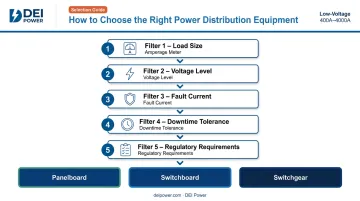
The right device is determined by five filters applied in order:
- Load size — What's the total amperage demand at this point in the distribution system?
- Voltage level — Is this a low-voltage application (under 1,000V) or does the utility feed arrive at medium voltage?
- Fault current — What's the available fault current at the point of installation, and what withstand rating does the equipment need?
- Downtime tolerance — Can this facility support a full shutdown for breaker maintenance, or is continuous operation mandatory?
- Regulatory requirements — Does the utility or AHJ specify fully compartmentalized service entrance gear?
Choose a Panelboard When:
- Loads are under 1,200A
- The application is branch circuit distribution within a building
- Wall-mounted, front-access installation is practical
- Budget is a primary constraint
Choose a Switchboard When:
- Main distribution requires more than 1,200A but stays at 600V or below
- The facility is commercial or industrial in scale
- A freestanding floor-mounted assembly is acceptable
- 3-cycle withstand and fixed or group-mounted breakers are sufficient for the fault environment
Choose Switchgear When:
- Medium-voltage feeds are involved (4.76kV–38kV)
- Current demands approach or exceed 5,000A
- The facility is mission-critical with no tolerance for full-lineup shutdowns
- Selective coordination requires 30-cycle withstand at the service entrance
- Utility or AHJ requirements specify fully compartmentalized, compartment-metered gear
One practical caution: skipping the short-circuit study to save time upfront is how projects end up with undersized gear in high-fault-current environments. The result is a change order, a safety liability, and a potential NEC compliance failure — often discovered after the equipment is already on site.
For low-voltage applications in the 400A–4,000A range, DEI Power's in-house engineering team works with contractors, engineers, and facility teams to match the right switchboard configuration to their amperage requirements, enclosure type, and site conditions. Custom builds cover bus rating, voltage, seismic compliance, and layout — with most built-to-order units completed in 4–6 weeks and in-stock configurations shipping in 3–5 business days.
Frequently Asked Questions
Is a switchboard considered switchgear?
No. They're distinct equipment types under the NEC and by UL standard — switchboards fall under Article 408 and UL 891, while switchgear is governed by UL 1558 (LV) or IEEE C37.20.2 (MV) with fully enclosed compartmentalized construction. The terms get used interchangeably in the field, but EC&M notes that treating them as equivalent leads to real misunderstandings in specification and procurement.
What is the maximum amperage for a panelboard vs. a switchboard?
Commercial panelboards top out at 1,200A per UL 67. Switchboards go significantly higher — NEMA PB 2 covers deadfront switchboards up to 6,000A at 600V or less. Whenever loads exceed 1,200A, a switchboard is the right low-voltage solution.
What UL standards apply to each device?
Panelboards: UL 67, NEMA PB 1. Switchboards: UL 891, NEMA PB 2. Low-voltage switchgear: UL 1558, ANSI/IEEE C37.20.1. Medium-voltage metal-clad switchgear: IEEE C37.20.2. Inspectors and AHJs verify UL listings against the specified standard — not just the general equipment category — so getting this right upfront prevents costly rejections.
Can switchgear handle medium-voltage applications?
Yes — switchgear is the only one of the three capable of medium-voltage service. IEEE C37.20.2 metal-clad switchgear covers 4.76kV to 38kV, making it the required choice for facilities served directly from a distribution transformer at primary voltage, utility substations, and industrial plants with medium-voltage feeds. Panelboards and switchboards are low-voltage only.
What is a draw-out breaker and why does it matter?
A draw-out breaker can be racked to test or disconnect positions, or fully removed for replacement, while the rest of the switchgear lineup stays energized. That's why switchgear is specified in hospitals, data centers, and industrial plants where taking an entire lineup offline for one breaker swap isn't viable.
Which is more expensive: switchgear, switchboard, or panelboard?
Panelboards are least expensive (mass-produced, minimal customization). Switchboards fall in the mid-range with higher bus ratings and more configuration flexibility. Switchgear carries the highest cost due to compartmentalized construction, draw-out breaker design, and custom engineering — but total cost of ownership, including uptime value and fault risk, should drive that decision, not purchase price alone.