NEMA enclosure ratings are standardized classifications defined in ANSI/NEMA 250-2020, the governing North American standard for electrical enclosures up to 1,000V. Each type addresses a specific hazard profile — and selecting the right one requires understanding what each type actually tests for, not just its number.
This guide covers every NEMA type, their protection levels, IP equivalents, and a practical framework for matching the right rating to your installation environment.
Key Takeaways
- NEMA ratings classify how well an enclosure protects against dust, water, ice, corrosion, and submersion — verified by standardized testing
- NEMA numbers are not linear: NEMA 12 and 13 are indoor-only, while NEMA 4 and 4X include full outdoor and hose-directed water protection
- Key types to know: NEMA 1 (indoor, basic), NEMA 4/4X (dust-tight, watertight — 4X adds corrosion resistance), NEMA 6/6P (submersion-rated), and NEMA 12 (indoor industrial)
- NEMA and IP ratings are not interchangeable — IP65 is not equivalent to NEMA 4X
- Wrong enclosure type = equipment failure, safety violations, potential NEC non-compliance
What NEMA Enclosure Ratings Represent
NEMA — the National Electrical Manufacturers Association — is a Standards Development Organization. It publishes ANSI/NEMA 250, which sets construction, testing, and marking requirements for electrical enclosures. NEMA does not certify products. That role belongs to NRTLs like UL (which applies UL 50/UL 50E) or Intertek (ETL Listed Mark). When a spec requires certified compliance, verify that a recognized third party has tested the enclosure — not just that it carries a NEMA type designation.
With that certification distinction clear, here's what the ratings themselves actually cover: NEMA types govern both construction requirements (materials, gaskets, sealing methods) and performance criteria (specific tests an enclosure must pass). Any enclosure claiming a NEMA type must demonstrate it cleared those tests.
The Non-Linear Rating Problem
This is where most misspecification begins. NEMA types are independent classifications, not a ranked ladder. Consider:
- NEMA 13 is indoor-only, covering circulating dust and oil splash
- NEMA 4 is fully outdoor-rated, dust-tight, and resistant to hose-directed water
- NEMA 6P is rated for prolonged submersion outdoors
A higher type number does not mean more protection. Match the type to the specific hazard conditions of the installation — not to the highest number on the list.
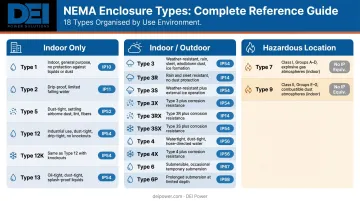
Complete NEMA Enclosure Rating Chart
The table below covers all standard NEMA types from ANSI/NEMA 250-2020, organized by use classification.
| NEMA Type | Indoor/Outdoor | Key Protections | IP Equivalent |
|---|---|---|---|
| 1 | Indoor | Falling dirt, incidental contact | IP10 |
| 2 | Indoor | Falling dirt, drips, light splash | IP11 |
| 3 | Indoor/Outdoor | Windblown dust, rain, sleet, snow, ice | IP54 |
| 3R | Indoor/Outdoor | Rain, sleet, snow, ice (no windblown dust) | IP14 |
| 3S | Indoor/Outdoor | Type 3 + ice-laden mechanism operability | IP54 |
| 3X | Indoor/Outdoor | Type 3 + corrosion resistance | — |
| 3SX | Indoor/Outdoor | Type 3S + corrosion resistance | — |
| 4 | Indoor/Outdoor | Windblown dust, rain, sleet, hose-directed water, ice | IP66 |
| 4X | Indoor/Outdoor | Type 4 + corrosion resistance | IP66 |
| 5 | Indoor | Falling dirt, settling airborne dust/lint, drips | IP52 |
| 6 | Indoor/Outdoor | Hose-directed water, occasional submersion, ice | IP67 |
| 6P | Indoor/Outdoor | Hose-directed water, prolonged submersion, corrosion, ice | IP68 |
| 7 | Hazardous (Indoor) | Class I, Div. 1 flammable gases/vapors (Groups A–D) | — |
| 8 | Hazardous (Indoor/Outdoor) | Class I, Div. 1 — oil-immersed method | — |
| 9 | Hazardous (Indoor) | Class II, Div. 1 combustible dust (Groups E–G) | — |
| 10 | Hazardous | MSHA 30 CFR Part 18 mining requirements | — |
| 12 | Indoor | Circulating dust/lint, drips, no knockouts | IP52 |
| 12K | Indoor | Same as Type 12, with knockouts | IP52 |
| 13 | Indoor | Circulating dust, drips, oil/coolant splash | IP54 |
Indoor-Only NEMA Types
These types share one hard boundary: none are suitable for outdoor deployment.
- NEMA 1 — Basic indoor protection against falling dirt and incidental contact. Appropriate for electrical closets, dry utility rooms, and office equipment panels
- NEMA 2 — Adds drip and light splash protection for areas with condensation risk, such as mechanical rooms with overhead pipe runs
- NEMA 5 — Dust-tight against settling airborne particles, plus drip protection. Common in textile mills, woodworking facilities, and grain handling areas
- NEMA 12 / 12K — Protects against circulating dust, lint, and non-corrosive dripping liquids. The difference: 12K has knockouts for conduit entry, 12 does not. Widely used in factory automation and indoor machine enclosures
- NEMA 13 — Same dust and drip profile as 12, but adds resistance to spraying oil and non-corrosive coolants — standard in machining environments with coolant mist
Outdoor and Dual-Use NEMA Types
NEMA 3, 3R, and Sub-Variants
- NEMA 3 — Full weather package: windblown dust, rain, sleet, snow, and external ice. Used on construction sites, outdoor utility boxes, and transit infrastructure
- NEMA 3R — Rain, sleet, and snow protection, but without windblown dust resistance. Drain holes allow limited air circulation. Standard for rooftop equipment, meter boxes, and pad-mounted gear
- NEMA 3S — Type 3 protection with the added requirement that external mechanisms (handles, latches) remain operable when ice-laden — critical for cold-climate outdoor controls
- NEMA 3X / 3SX — Corrosion-resistant versions of Type 3 and 3S respectively. Appropriate for coastal environments, bridge electrical gear, or anywhere salt air is a factor
DEI Power's UL 891-certified switchboards are available in both NEMA 1 and NEMA 3R configurations across the full 400A–4000A range, covering the two most commonly specified ratings for commercial and industrial power distribution.
NEMA 4 vs. NEMA 4X
Both are fully dust-tight and resistant to hose-directed water — the standard test involves a direct water stream, not just splash. The distinction:
- NEMA 4 — Dust-tight, watertight, rated for outdoor use. Handles washdown environments, outdoor control panels, and industrial process areas
- NEMA 4X — Identical to Type 4, plus formal corrosion resistance requirements. Required for marine, coastal, chemical processing, and any environment with persistent chemical exposure or salt air
For switchboards and control panels in commercial and industrial facilities, the deciding factor is straightforward: if any corrosive agent is present — salt air, chemical exposure, coastal humidity — NEMA 4X is required.
NEMA 6 vs. NEMA 6P
- NEMA 6 — Rated for hose-directed water and occasional, temporary submersion. Suitable for underground vaults, damp equipment pads, and flood-prone floor-level installations
- NEMA 6P — Rated for prolonged submersion, plus corrosion resistance. Required for wastewater treatment plants, marine deck equipment, and any location where extended water immersion is realistic
NEMA vs. IP Ratings: Understanding the Equivalents
IP ratings come from IEC 60529 and use a two-digit code: the first digit rates solid ingress protection (0–6 scale), the second rates liquid ingress (0–9 scale). They're used internationally and cover dust and water ingress only.
NEMA types go further. NEMA types include additional criteria that IP ratings don't address: corrosion resistance, ice formation, lubricant resistance, and construction details. According to the NEMA FAQ, NEC 110.28 states explicitly that IP ratings are not substitutes for Enclosure Type ratings.
The NEMA-to-IP crosswalk (from ANSI/NEMA 250 Annex A, Table A-1) is a one-way reference only:
| NEMA Type | IEC 60529 Equivalent |
|---|---|
| 1 | IP10 |
| 2 | IP11 |
| 3 / 3S | IP54 |
| 3R | IP14 |
| 4 | IP66 |
| 4X | IP66 |
| 5 | IP52 |
| 6 | IP67 |
| 6P | IP68 |
| 12 / 12K | IP52 |
| 13 | IP54 |
The IP65 ≠ NEMA 4X Gap
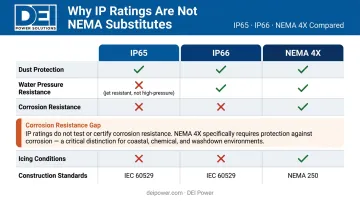
This is a common and costly misconception in procurement. Intertek's IEC 60529 testing breakdown identifies IP65 as dust-tight plus water jets (low pressure) and IP66 as dust-tight plus powerful water jets. NEMA 4X requires:
- Withstands hose-directed water at higher pressure than IP65 specifies
- Meets formal corrosion resistance criteria not tested under IP ratings
- Complies with additional NEMA construction standards beyond ingress protection
Substituting an IP66-rated enclosure where NEMA 4X is specified creates a corrosion protection gap. Substituting IP65 creates both a water pressure gap and a corrosion gap. When cross-referencing international specs, verify each criterion against the actual NEMA standard — an equivalent IP number does not confirm equivalent protection.
How to Select the Right NEMA Enclosure Type
Selection comes down to four variables: installation location, liquid exposure type, particulate environment, and chemical exposure. Map the actual hazards before picking a type.
Application-Based Selection Guide
| Environment | Primary Choice | Avoid |
|---|---|---|
| Dry indoor electrical room | NEMA 1 | Paying for outdoor ratings with no exposure |
| Indoor with drips or condensation | NEMA 2, 12, or 13 | Treating NEMA 1 as liquid-protected |
| Indoor automation, machinery | NEMA 12 or 12K | Deploying NEMA 12 near loading docks or open-air exposure |
| Outdoor rain/sleet, no dust | NEMA 3R | Using NEMA 12 outdoors |
| Outdoor with windblown dust | NEMA 3 or 3S | Using NEMA 3R without dust protection |
| Industrial washdown, outdoor controls | NEMA 4 | Substituting IP65/IP66 without verifying NEMA criteria |
| Coastal, chemical, or corrosive outdoor | NEMA 4X | Using painted steel NEMA 4 without corrosion testing |
| Underground vault, temporary submersion | NEMA 6 | Using NEMA 4 in submersion-risk locations |
| Wastewater, prolonged submersion | NEMA 6P | Using NEMA 6 where extended submersion is likely |
When to Apply the "X" Suffix
Any environment with salt air, chemical exposure, or persistent high humidity should default to an X-designated type — 3X, 3SX, or 4X — regardless of whether water ingress alone would justify the upgrade. The "X" isn't a premium add-on; it's a separate hazard category.
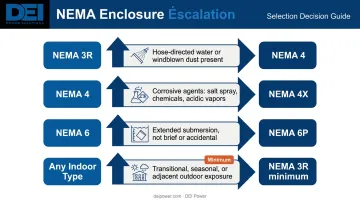
When to Step Up Between Types
- NEMA 3R → NEMA 4: When hose-directed water (not just rain) is present, or when windblown dust is a factor
- NEMA 4 → NEMA 4X: When any corrosive agent — salt spray, cleaning chemicals, acidic vapors — exists in the environment
- NEMA 6 → NEMA 6P: When submersion could be extended, not just accidental or brief
- Any indoor type → NEMA 3R minimum: When the installation environment is transitional, seasonal, or adjacent to outdoor exposure
Avoiding Over-Specification
Over-specifying carries real costs. Unnecessary material, sealing complexity, and corrosion treatment add to unit cost without adding protection benefit in the wrong environment. A NEMA 6P enclosure in a dry climate-controlled server room delivers zero additional protection over a NEMA 1 and costs considerably more. Target the lowest NEMA type that fully satisfies the actual environmental hazard profile.
For projects where the installation environment spans multiple hazard categories — or where switchgear must meet specific NEMA ratings for the deployment location — DEI Power's engineering team can review specifications during the configuration process. Call (866) 773-8050 to discuss project requirements.
Common Misinterpretations of NEMA Ratings
Treating the Numeric Scale as Linear
NEMA 13 outranks NEMA 4 numerically, but NEMA 13 is an indoor-only rating for oil and coolant splash. NEMA 4 covers full outdoor weather and hose-directed water. Each type describes an independent hazard profile. A higher number doesn't mean broader protection.
Assuming IP and NEMA Ratings Are Interchangeable
Procurement teams sourcing internationally often substitute IP-rated enclosures where NEMA types are specified. The crosswalk table provides approximate guidance, but NEMA types include criteria that IP ratings don't capture:
- Corrosion resistance
- Protection against icing conditions
- Construction and material standards
NEC 110.28 (which governs enclosure selection) makes this explicit: IP ratings are not substitutes for NEMA Enclosure Type ratings.
Deploying Indoor Ratings in Transitional Environments
NEMA 12 enclosures are regularly installed near loading docks, equipment rooms with seasonal air exposure, or during construction phases before HVAC is operational. NEMA 12 carries no outdoor rating — none. Even brief rain or windblown moisture during installation can compromise the seal and trigger NEC compliance issues down the line.
Frequently Asked Questions
What is a NEMA enclosure rating?
A NEMA enclosure rating is a standardized classification from the National Electrical Manufacturers Association that defines what environmental hazards — dust, water, ice, corrosion, submersion — an enclosure can withstand. Ratings are defined in ANSI/NEMA 250-2020 and apply primarily in North America.
Is NEMA 7 rated for outdoor use?
No. NEMA 7 is a hazardous location rating for Class I, Division 1 indoor environments containing flammable gases or vapors. It addresses explosion containment, not weather resistance — it should not be confused with outdoor-rated types like NEMA 3 or 4.
What is a NEMA 4X enclosure rating?
NEMA 4X provides dust-tight and watertight protection, including resistance to hose-directed water, plus formal corrosion resistance. It's the correct choice for marine, coastal, chemical wash-down, and harsh outdoor environments.
Is IP65 equivalent to NEMA 4X?
No. IP65 covers dust-tight protection and low-pressure water jets only. NEMA 4X requires resistance to higher-pressure hose-directed water and includes corrosion resistance criteria that IP65 doesn't address. The gap between them is significant for specification purposes.
What is the difference between NEMA 4 and NEMA 4X?
Both ratings are dust-tight and protect against hose-directed water. NEMA 4X adds a corrosion resistance requirement. In any environment with salt air, chemical exposure, or persistent moisture, NEMA 4X is the correct specification — NEMA 4 alone is insufficient.
Which NEMA ratings are suitable for outdoor industrial applications?
NEMA 3, 3R, 4, 4X, 6, and 6P are the primary outdoor-rated types. For industrial outdoor environments, NEMA 4X is most commonly specified due to its combined dust, water, and corrosion protection.