Introduction
A single PDU failure in a 10 kW rack hosting production workloads doesn't just take one server offline — it can cascade across dependent systems, trigger cooling alarms, and force unplanned outages that cost organizations an average of $9,000 per minute according to Uptime Institute research. Choosing the wrong PDU creates operational blind spots, strands capacity, and introduces compliance gaps that surface only when it's too late.
Undersized PDUs trip breakers under load. Non-monitored units leave teams blind to circuit overloads until failure hits. Poor upstream integration forces costly field rework during commissioning.
This guide covers six critical factors — capacity, PDU type, form factor, phase configuration, scalability, and code compliance — that contractors, engineers, and facility teams must evaluate before specifying a unit.
Key Takeaways
- A data center PDU distributes AC power from an upstream source (UPS, switchboard, or generator) to IT equipment in racks — it does not generate or condition power
- Four main PDU types — Basic, Metered, Monitored, and Switched — each suit different operational visibility and control requirements
- Plan capacity with 80% headroom to avoid overloads — form factor (0U vertical vs. horizontal) and phase configuration matter just as much as amperage
- Three-phase PDUs suit high-density deployments; single-phase units work for smaller or lower-density racks
- Match PDU selection to upstream power infrastructure to prevent compatibility issues and commissioning delays
- UL 62368-1 certification and UL 891-compliant upstream switchboards are non-negotiable in mission-critical environments
What Is a Data Center PDU?
A data center PDU (Power Distribution Unit) is a rack- or cabinet-mounted device that accepts electrical power from an upstream source and distributes it to multiple IT devices within a single rack. Unlike consumer-grade power strips, data center PDUs are built to handle sustained high-amperage loads, carry UL safety ratings, and (in advanced models) provide remote monitoring and outlet-level control capabilities.
The distinction matters: a basic power strip might handle 15A for a home office, while a data center PDU routinely distributes 30A, 60A, or more across dozens of outlets — often with sub-1% metering accuracy to support capacity planning and PUE calculation.
How Does a Data Center PDU Work?
Power flows through a defined chain: utility power enters the facility switchboard, passes through a UPS for protection against outages and surges, and is routed to the PDU. The PDU then distributes power to servers, switches, storage arrays, and other rack-mounted equipment through multiple outlets.
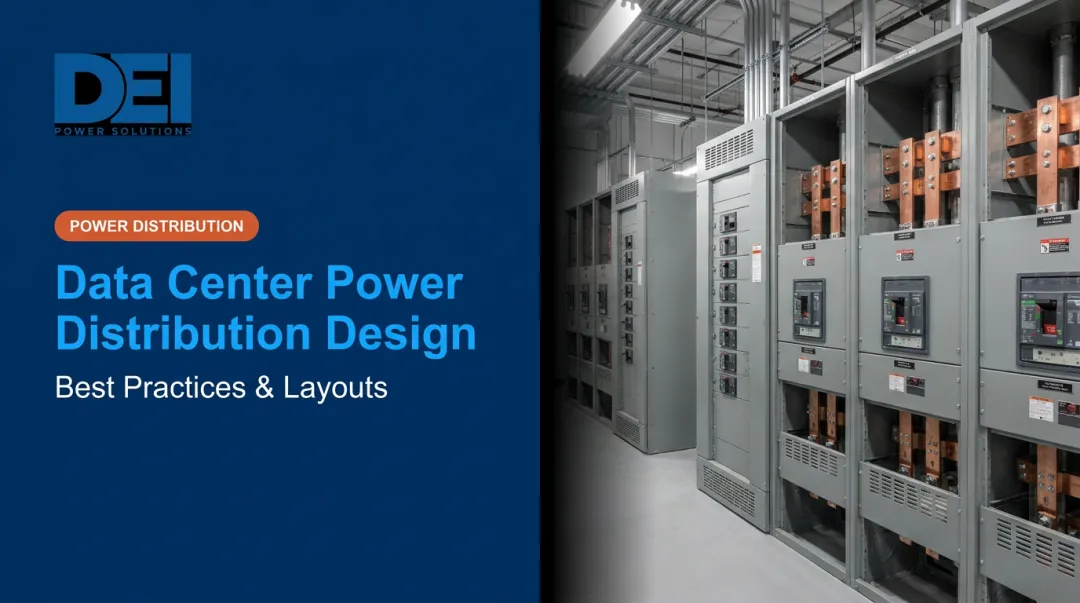
DEI Power's UL 891-certified switchboards serve as the upstream distribution source in this chain, feeding power to floor PDUs or directly to rack PDUs. These switchboards support voltage configurations including 480Y/277V, 208Y/120V, and 415/240V, with amperage ratings from 400A to 4000A.
That range makes switchboard selection and PDU selection closely linked decisions. A mismatch between upstream breaker capacity and downstream PDU input requirements creates compatibility issues that surface during commissioning, not procurement.
Monitored and switched PDUs go further, relaying real-time power consumption data — at the inlet or outlet level — back to DCIM platforms or facility management systems via SNMP, RESTful API, or Modbus protocols. This enables operators to calculate PUE (Power Usage Effectiveness), track capacity utilization, allocate energy costs per tenant in colocation environments, and identify circuits approaching their rated limits before they trip.
Types of Data Center PDUs
The industry recognizes four primary PDU types, each serving a distinct operational scenario. These are not ranked by preference — the right choice depends entirely on your facility's visibility and control requirements.
| PDU Type | Key Capabilities | Network Access | Best Fit |
|---|---|---|---|
| Basic | Power distribution only; optional locking outlets | None | Small server rooms with on-site IT staff and predictable loads |
| Metered | Local LCD display showing current, voltage, power factor | None (local only) | Air-gapped environments; facilities planning future monitoring upgrades |
| Monitored | Remote monitoring via web interface; outlet-level power tracking; threshold alerts; environmental sensor integration | Yes (IP network, SNMP, API) | High-density data centers; colocation billing; cloud providers needing capacity planning data |
| Switched | All monitored features plus remote outlet on/off/reboot; outlet-level power limiting | Yes (full remote management) | Large-scale facilities; remote/edge sites where on-site truck rolls cost $350+ per hour |
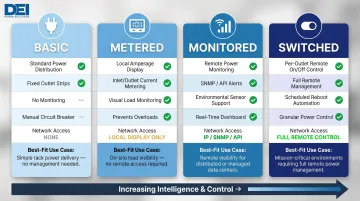
Sources: Vertiv (2019); Raritan (2019)
Monitored PDUs enable fault-tolerant daisy chaining and IP aggregation, allowing up to 50 rack PDUs to report through a single network IP address. Switched PDUs layer relay hardware on top of that, enabling remote power cycling without dispatching on-site staff. Knowing how each type works sets the foundation for matching the right PDU to your facility's load profile, density, and monitoring requirements.
Key Factors to Consider When Choosing the Right Data Center PDU
PDU selection is not a one-size-fits-all decision. A basic PDU suited to a five-rack lab environment can be wholly inadequate, and potentially dangerous, in a hyperscale facility running AI training workloads at 30+ kW per rack. The six factors below map operational requirements to the right technical specification.
Power Capacity and Load Requirements
This is the first and most fundamental selection criterion: the PDU must handle the total power draw of all connected equipment plus a safety headroom buffer. The National Electrical Code (NFPA 70) establishes the 80% rule for continuous loads — a circuit breaker or overcurrent device must not carry more than 80% of its rated capacity under continuous operation. A 30A PDU, for example, should not exceed 24A of sustained load.
Miscalculating load capacity leads to tripped breakers, forced shutdowns, or stranded power (where downstream equipment can't draw available capacity because upstream circuits are already saturated).
Rack density trends directly influence this calculation. According to the Uptime Institute Global Data Center Survey 2025, rack densities are rising into the 10-30 kW range, while AFCOM's 2026 State of the Data Center report cites an industry average of 27 kW per rack. McKinsey (December 2025) projects that AI training workloads will push frontier deployments to 1 MW per rack.
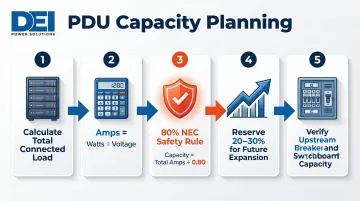
Capacity Planning Checklist:
- Calculate total connected load (watts) for all planned equipment
- Convert to amperage: Amps = Watts ÷ Voltage
- Apply 80% rule: PDU rated amperage must be ≥ (calculated load ÷ 0.80)
- Account for future expansion: reserve 20-30% headroom beyond current load
- Verify upstream breaker and switchboard capacity support the selected PDU rating
PDU Type and Level of Monitoring
The choice between Basic, Metered, Monitored, and Switched PDUs maps directly to operational priorities. Facilities focused purely on reliability with predictable loads may need only metered units. Colocation facilities requiring tenant-level energy billing need outlet-level monitored PDUs. Edge or remote sites benefit most from switched PDUs that allow remote power cycling without dispatching a technician.
The operational ROI is measurable. A Raritan white paper documents that remote management capabilities deliver a 66% decrease in mean-time-to-repair (MTTR) and up to a 92% decrease in labor costs by eliminating travel delays and enabling immediate diagnostics. When the average cost of a technician trip to a remote facility is $350 per hour, the price premium for a switched PDU often pays for itself within a single avoided truck roll.
Monitoring level also influences key performance indicators:
- PUE calculation: Metered inlet PDUs enable accurate Power Usage Effectiveness tracking when measurement accuracy is ±1% or better
- Capacity planning: Outlet-level monitoring identifies underutilized circuits and prevents overprovisioning
- Billing accuracy: Colocation providers use outlet-metered PDUs to allocate energy costs to specific tenants
The cost delta between tiers varies by manufacturer and feature set, but the primary drivers are relay/switching hardware, firmware complexity, and network interface capabilities. In most cases, the avoided cost of a single unplanned truck roll or billing dispute covers the premium between a basic and a switched PDU.
Form Factor and Mounting Configuration
PDUs mount in two primary configurations, each with distinct trade-offs for outlet count, rack space consumption, and cable management.
Horizontal PDUs (1U/2U):
- Mount inside the rack, consuming 1-2U of equipment space
- Typically offer 8-16 outlets
- Provide front or side access to outlets
- Suitable for smaller racks or low-density environments
Vertical PDUs (0U):
- Mount at the rear or side of the enclosure, consuming zero U-space
- Offer up to 54-60 outlets depending on model
- Maximize usable rack space for IT equipment
- Preferred for high-density racks near full capacity
When racks approach 80-90% capacity, every U-space matters. A vertical PDU preserves equipment mounting space while delivering higher outlet counts. Cable management also factors into this decision: horizontal PDUs in dense racks can create cable congestion that restricts front-to-back airflow, increasing cooling load and reducing efficiency. Vertical PDUs route power cables along the rear of the rack, keeping the equipment mounting area clear.
Selection Guidance:
- Racks <50% full with stable equipment mix: Horizontal PDU acceptable
- Racks >70% full or planning future expansion: Vertical PDU recommended
- High-density environments (>10 kW/rack): Vertical PDU strongly preferred
Once the physical form factor is set, the next decision is the electrical configuration feeding it.
Phase Configuration and Outlet Compatibility
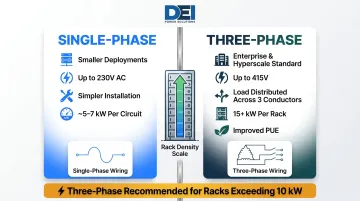
Single-phase and three-phase PDUs serve different deployment scenarios based on power density and efficiency requirements.
Single-Phase Power:
- Common in smaller deployments and lower-density racks
- Delivers up to 230V AC in North America
- Simpler installation and lower upfront cost
- Limited to approximately 5-7 kW per circuit at 30A
Three-Phase Power:
- Standard in enterprise and hyperscale environments
- Distributes load across three conductors for greater efficiency
- Delivers up to 415V and enables higher power density in the same cable footprint
- Supports consistent, continuous power delivery vs. variable single-phase output
- Enables organizations to optimize PUE and increase uptime
As rack densities climb, three-phase becomes the practical choice for delivering 15+ kW per rack without oversized wiring or expensive cable upgrades.
Outlet Compatibility:
Outlet types must match the power requirements of connected equipment. The IEC 60320 standard defines common data center connectors:
| Outlet Type | North American Rating | Typical Use |
|---|---|---|
| C13 | 125/250V, 15A | Standard servers, switches, storage (most common) |
| C19 | 125/250V, 20A | High-power servers, blade chassis, large UPS units |
Mismatched outlets force field rework during installation. Hybrid PDUs offering combination C13/C19 designs provide flexibility when rack configurations are expected to change, though they typically reduce total outlet count compared to single-outlet-type models.
Scalability, Redundancy, and DCIM Integration
PDU selection must account for future growth, not just current load — overlooking expansion headroom or evolving monitoring requirements often forces premature replacement.
Design Features That Support Growth:
- Hot-swappable intelligence modules that allow monitoring upgrades without replacing the entire PDU
- Daisy-chaining capability for expanding monitored PDU coverage
- IP aggregation to reduce network port costs (up to 50 PDUs per IP address)
- Modular outlet configurations supporting field upgrades
Scalability features reduce replacement cycles, but redundancy planning determines whether a single-PDU failure can take down the rack.
Redundancy Requirements:
Tier III and Tier IV data centers increasingly deploy A+B dual-feed configurations — two independent PDUs per rack, each fed from separate upstream power paths.
The Uptime Institute Tier Classification System defines Tier III as "concurrently maintainable" with redundant distribution paths, and Tier IV as "fault tolerant" with independent, physically isolated systems. Dual-PDU deployment ensures that a single PDU failure does not take down the rack.
Automatic Transfer Switch (ATS) PDUs provide another redundancy approach, automatically switching between two input power sources when the primary feed fails. Data centers represent nearly 25% of total ATS demand, reflecting their role in mission-critical infrastructure.
With redundancy in place, the remaining question is visibility — which is where DCIM integration enters.
DCIM Integration:
Monitored and switched PDUs integrate with Data Center Infrastructure Management platforms via SNMP, RESTful API, or Redfish protocol. This integration enables:
- Centralized real-time monitoring across hundreds of racks
- Automated threshold alerts before circuits approach rated capacity
- Historical trend analysis for capacity planning
- Energy cost allocation in multi-tenant environments
Without DCIM integration, capacity planning relies on manual circuit surveys — a process that doesn't scale past a few dozen racks.
Certifications, Code Compliance, and Upstream Infrastructure Compatibility
UL listing and regional code compliance are non-negotiable in data center environments. Uncertified PDUs can void insurance, fail AHJ (Authority Having Jurisdiction) inspections, and create liability in the event of an electrical incident.
Rack PDU Certifications:
As of January 1, 2022, UL/CSA 60950-1 was formally superseded by UL 62368-1 for audio/video, information, and communication technology equipment safety requirements. Rack-mounted PDUs now fall under UL 62368-1 certification, which covers safety requirements for IT equipment.
Upstream Switchboard Compliance:
PDU selection cannot be made in isolation from upstream power distribution infrastructure. The PDU's input plug, voltage, and amperage must match the receptacle and breaker configuration of the floor PDU or switchboard feeding it.
UL 891 is the North American standard for dead-front switchboards rated at 1000V AC or less, with bus ratings from 800A to 6000A. UL 891 switchboards serve as the primary upstream distribution source in data center power chains, providing the structured, code-compliant foundation that rack PDUs connect to.
UL Solutions confirms that "code authorities require proof that equipment complies with recognized safety standards before systems can be energized or facilities can be commissioned." Non-compliant equipment risks "costly delays, rework, or replacement" and can disrupt construction schedules.
Compatibility Verification Checklist:
- Confirm PDU input voltage matches upstream distribution voltage
- Verify PDU input amperage does not exceed upstream breaker rating
- Ensure plug/receptacle types are compatible (NEMA, IEC, or twist-lock)
- Request submittal documentation showing UL listing for both PDU and upstream equipment
- Validate that upstream switchboard capacity supports total planned PDU load across all racks
Facilities working with UL 891-certified switchboards benefit from pre-validated upstream infrastructure, reducing compatibility risk, field adjustments, and change orders during commissioning.
How DEI Power Can Help
DEI Power is a domestic manufacturer of UL 891-certified switchboards and power distribution equipment with over 10 years of experience serving hyperscale data centers, colocation facilities, and mission-critical commercial projects. While DEI Power does not manufacture rack PDUs, the company serves as the upstream power distribution partner whose switchboards, switchgear, and Remote Power Panels (RPPs) form the foundation that rack PDUs plug into.
Key Differentiators for Data Center Power Infrastructure:
- 50,000 sq. ft. Ontario, CA facility: In-stock switchboards ship within 1 business day; custom configurations deliver in 4–6 weeks
- Built-to-spec configurations: Project-specific voltage (120/240V through 480Y/277V), amperage (400A–4000A), layout, and jobsite requirements
- UL 891 certified and BABA eligible: Code-compliant for federally funded projects out of the box
- Approved Siemens OEM: Genuine components for long-term reliability and infrastructure compatibility
- In-house engineering support: Spec review, configuration validation, and submittal documentation reduce change orders and field rework

When upstream distribution infrastructure is engineered correctly from the start, downstream PDU selection becomes straightforward. It eliminates compatibility risks, avoids voltage and amperage mismatches, and keeps projects on schedule.
DEI Power's switchboards support the full range of data center deployment scenarios: from high-density colocation rows requiring 480Y/277V three-phase distribution to enterprise facilities standardizing on 208Y/120V configurations.
That foundation matters most during planning. For facilities managing new builds, expansions, or equipment upgrades, starting the power infrastructure conversation at the switchboard level ensures every downstream component — including rack PDUs — fits without rework. Contact DEI Power at (866) 773-8050 or sales@deipower.com to discuss your facility's power distribution requirements.
Conclusion
PDU selection is a layered decision that starts with load requirements and ends with how well the selected unit integrates into the facility's power chain, monitoring strategy, and compliance posture. The right PDU matches your facility's current operational model while leaving room for growth — not simply the most feature-rich unit available.
As rack densities increase, workloads evolve, and facilities expand, power infrastructure decisions must be revisited. A 15A basic PDU that served a 5 kW rack reliably for five years may become inadequate when that same rack scales to 15 kW for GPU-accelerated workloads. Treat PDU selection as part of an ongoing infrastructure review, not a one-time purchase.
Ensure that every layer of the power chain — from the switchboard feeding your floor PDUs to the rack PDU powering individual servers — meets the same standard of reliability, compliance, and scalability. When upstream and downstream components are selected with compatibility and future growth in mind, facilities gain three concrete advantages:
- Avoid costly rework when capacity requirements shift
- Minimize unplanned downtime from mismatched power infrastructure
- Retain the ability to scale or reconfigure without disrupting live operations
Frequently Asked Questions
What is a data center PDU?
A data center PDU (Power Distribution Unit) receives electrical power from an upstream source — such as a UPS, generator, or facility switchboard — and distributes it to servers, switches, and storage equipment within a rack or cabinet. It is the final link in the data center power chain, delivering AC power directly to IT devices.
How does a data center PDU work?
A PDU accepts AC power from a single upstream input and distributes it to multiple outlets for connected IT equipment. Advanced PDUs measure consumption at the rack or outlet level and relay that data to management systems via SNMP, API, or Modbus protocols. The PDU distributes power only; it does not generate or condition it.
What are the types of PDUs used in data centers?
The four main types are Basic (power delivery only), Metered (local current display), Monitored (remote visibility via network), and Switched/Intelligent (remote outlet control plus monitoring). Selection depends on the facility's operational visibility and control requirements, not a ranked preference.
What is the difference between a data center PDU and a UPS?
A UPS (Uninterruptible Power Supply) conditions and stores power to protect equipment from outages and surges; a PDU simply distributes whatever power it receives. In most data centers, the UPS sits upstream of the PDU, providing battery backup and surge protection before power reaches the rack level.
What is the difference between a PDC and a PDU?
A PDC (Power Distribution Cabinet or Center) is a facility-level enclosure that receives high-voltage input and feeds multiple downstream circuits or rack PDUs. A rack PDU is a smaller unit installed directly in IT racks, delivering power to individual servers and devices within that rack.
How many PDUs per rack?
Most standard racks use one PDU, but mission-critical environments typically deploy two PDUs per rack (an A-feed and a B-feed from independent power paths) to ensure that a single PDU failure does not cause downtime. The number also depends on outlet count requirements and total rack power load.