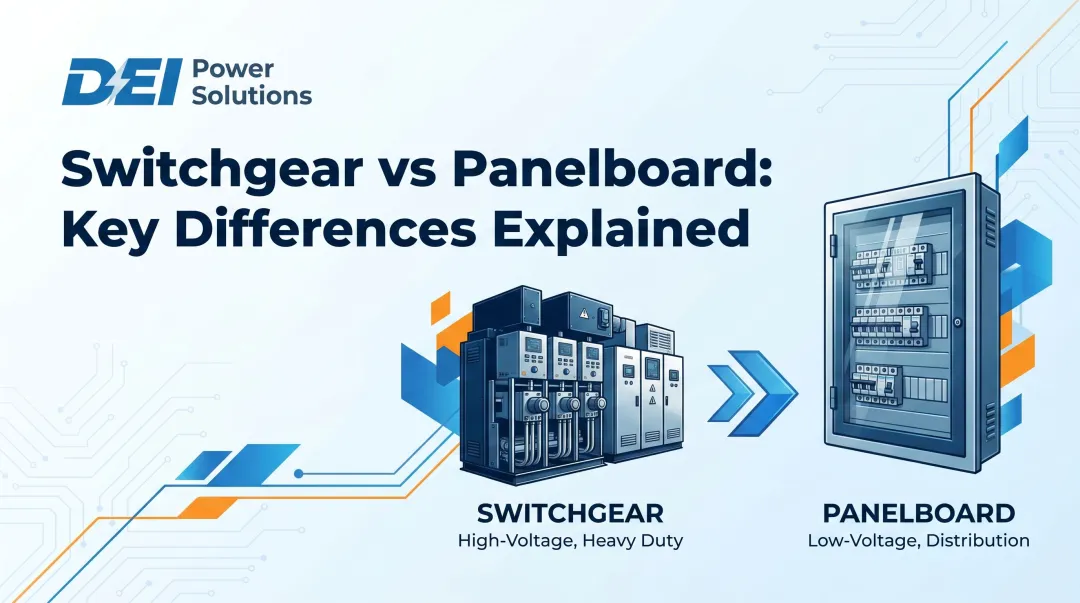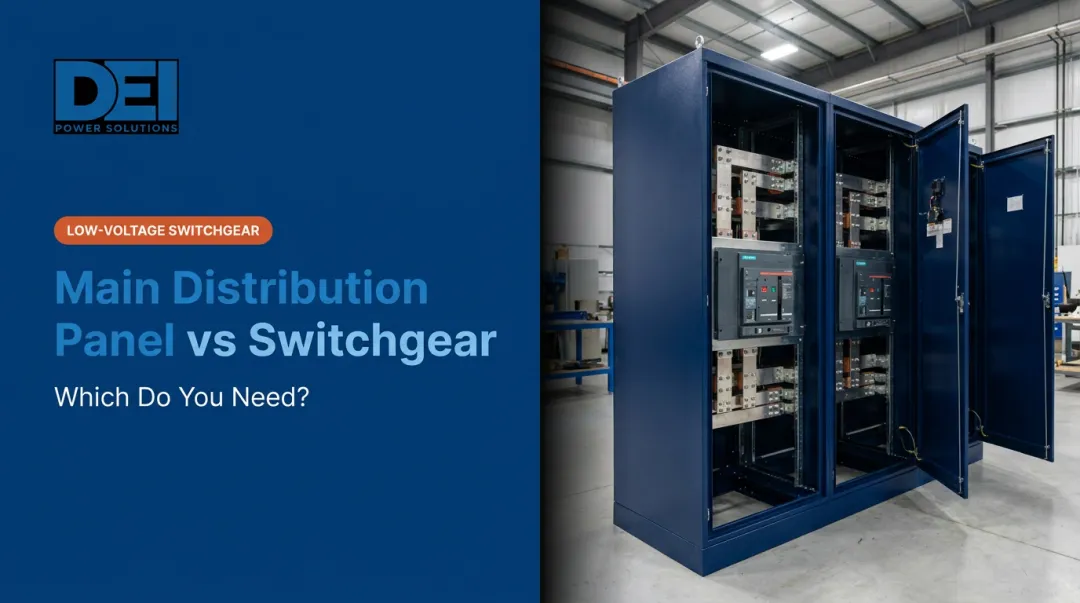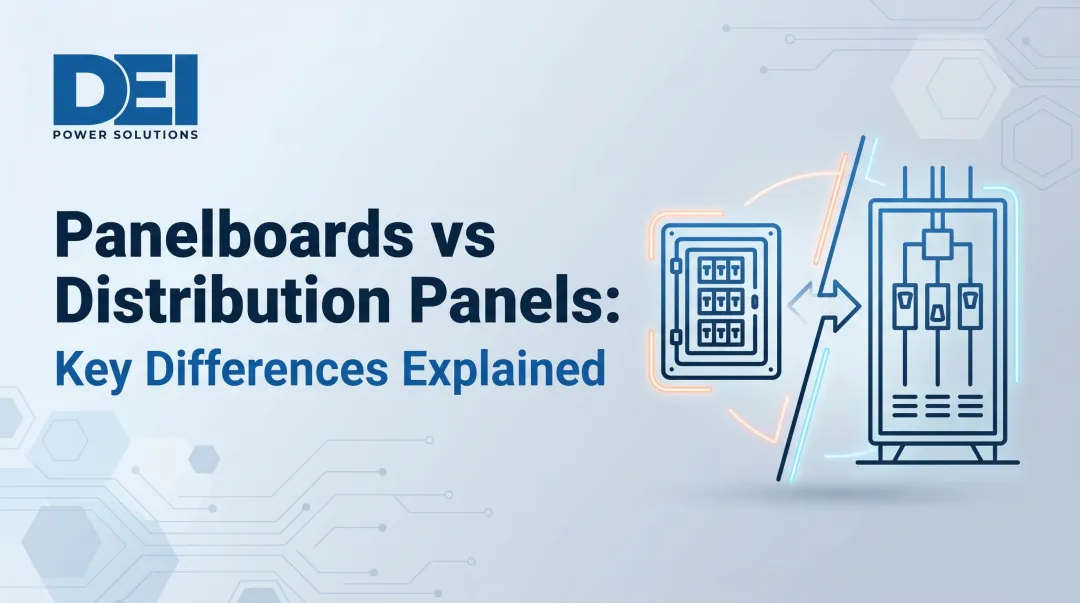
The confusion is understandable. Both appear in commercial and industrial electrical rooms, both fall under NEC Article 408, and both get loosely called "distribution equipment" in everyday conversation. The differences that matter — mounting style, current capacity, governing standards, maintenance access — only surface when you're trying to make a real project decision.
This article breaks down the technical distinctions between MDPs and switchboards, clarifies the applicable NEC and UL standards, and provides a practical decision framework for contractors, engineers, and facility teams specifying equipment for commercial and industrial projects.
Key Takeaways
- MDPs (panelboards) are wall-mounted, UL 67/NEMA PB 1-governed units rated up to 1,600A for moderate commercial loads.
- Switchboards are freestanding, floor-mounted assemblies under UL 891/NEMA PB 2, rated up to 6,000A for industrial and mission-critical applications.
- The four deciding factors: mounting style, current capacity, maintenance access, and governing UL/NEMA standard.
- Choose a switchboard when loads exceed panelboard ratings, rear access is needed, or modular expandability is required.
- Specifying the right device from the start prevents costly change orders and code compliance issues.
Main Distribution Panel vs. Switchboard: Quick Comparison
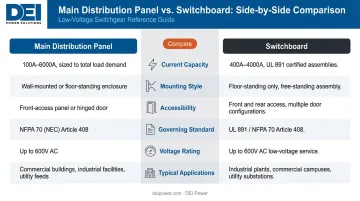
The table below summarizes the key differences at a glance — use it to quickly identify which equipment fits your project's load requirements, physical constraints, and governing standards.
| Feature | Main Distribution Panel | Switchboard |
|---|---|---|
| Current Capacity | Mains up to 1,600A; branch devices up to 1,200A (NEMA PB 1 scope) | Up to 6,000A (NEMA PB 2 scope) |
| Mounting Style | Flush- or surface-mounted in a wall or cabinet | Freestanding, floor-mounted |
| Accessibility | Front access only | Front access standard; rear access available |
| Governing Standard | UL 67 / NEMA PB 1 | UL 891 / NEMA PB 2 |
| Voltage Rating | 600V and less | 600V and less |
| Typical Applications | Offices, schools, retail, mid-size commercial | Data centers, hospitals, industrial plants, large campuses |
What Is a Main Distribution Panel?
A main distribution panel (MDP) is a panelboard — defined under NEC Article 100 as a single panel or group of panel units assembled as one, including buses and automatic overcurrent devices, placed in a cabinet or cutout box and accessible only from the front. The "main" designation reflects its position at the top of a facility's distribution hierarchy: it receives incoming utility power and divides it into branch circuits, each protected by a circuit breaker or fuse.
Panelboards operate under UL 67 and NEMA PB 1 standards, which set the following hard limits:
- Maximum voltage: 600V
- Maximum main rating: 1,600A
- Maximum branch device rating: 1,200A (breakers or fuse switches)
Manufacturer product lines from Eaton and Siemens reflect these ceilings — their panelboard mains top out at 1,200A with corresponding branch device ratings.
Physical Characteristics
- Wall- or flush-mounted with a dead-front enclosure
- Front access only — by definition, panelboards cannot be accessed from the rear
- Enclosure depths vary by size; larger panels require deeper boxes (Eaton's PRL4X lists a 10.40" box depth versus 5.75" for smaller models)
- Suitable for service equipment use when listed and marked for that application
Where MDPs Fit
MDPs are the preferred solution for:
- Commercial construction — office buildings, retail spaces, schools, and healthcare clinics
- Multi-tenant facilities — where individual tenant or floor panels feed downstream from the MDP
- Renovation projects — where electrical room space is constrained and wall mounting is the practical option
- Light industrial — applications with stable, moderate load profiles that stay within panelboard ratings
These use cases share a common thread: loads stay within panelboard ratings and front-only access is workable. The picture changes in demanding environments. When load projections push beyond standard panelboard ratings, when high-density equipment — large HVAC systems, industrial motors, or data center loads — enters the picture, or when code-required maintenance access demands rear entry, a switchboard becomes the appropriate solution.
What Is a Switchboard?
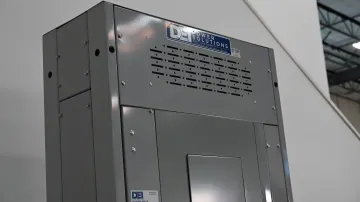
A switchboard is defined under NEC Article 100 as a large single panel, frame, or assembly of panels on which switches, overcurrent protective devices, buses, and instruments are mounted — accessible from the front and rear and not intended for installation inside cabinets. Unlike panelboards, switchboards are freestanding, floor-mounted assemblies.
Switchboards are governed by UL 891 and NEMA PB 2, which covers floor-mounted deadfront distribution switchboards rated at 600V and less and 6,000A or less. UL 891 defines testing and construction requirements including fault current withstand ratings, bus bar insulation, and short-circuit performance. Specifying a UL 891-listed switchboard is a code compliance requirement — not a preference — on commercial and industrial projects where this equipment class is called for.
Physical Characteristics
- Freestanding, floor-mounted — not installed in walls or cabinets
- Eaton specifies switchboards at 90 inches tall with a minimum depth of 18 inches
- Front and rear access capability allows for complex wiring configurations and easier field maintenance
- Modular section design supports additions as load requirements grow
- Available with bolt-on and draw-out breaker configurations
Switchboards in High-Demand Environments
Switchboards are the standard specification for facilities where capacity, redundancy, and accessibility drive the design. U.S. data center electricity consumption has tripled over the past decade and is projected to double or triple again by 2028, per a 2024 DOE/LBNL report. Data centers now account for approximately 4.4% of total U.S. electricity consumption — a share that makes high-amperage, floor-mounted distribution equipment essential infrastructure.
Switchboards are the dominant choice for:
- Data centers and colocation facilities — hyperscale and enterprise deployments with dense, high-draw compute loads
- Healthcare facilities — life-safety branch requirements and strict uptime standards demand it
- Industrial plants — processing and manufacturing operations requiring stable, high-capacity distribution
- Large commercial campuses — where a centralized distribution point feeds multiple downstream panels
- Utility substations and infrastructure — applications at the upper end of low-voltage distribution capacity
DEI Power's UL 891-certified switchboards are deployed across all of these environments, with configurations from 400A to 4000A built with genuine Siemens components at their 50,000 sq. ft. facility in Ontario, California.
Which Should You Choose?
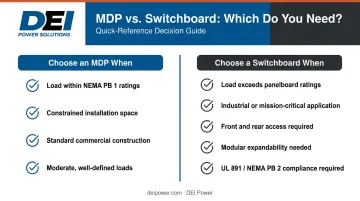
The decision comes down to five factors: total connected load, available space, maintenance access requirements, NEC compliance obligations, and project timeline.
Choose an MDP When:
- The facility's peak demand falls within NEMA PB 1's rated scope (mains to 1,600A, branch devices to 1,200A)
- Space is constrained and wall-mounted installation is necessary to preserve floor area
- The project is standard commercial construction — office, retail, school, light industrial
- Budget favors a cost-effective solution for moderate, well-defined loads
Choose a Switchboard When:
- Incoming service or aggregated load exceeds standard panelboard ratings
- The application is industrial, mission-critical, or high-density (data centers, manufacturing, hospitals)
- Front and rear maintenance access is required, whether by site conditions or operational practicality
- The project requires modular expandability or draw-out breaker capability
- NEC and UL compliance for the application points to UL 891/NEMA PB 2 equipment
A Note on Lead Times
Custom switchboard configurations — specific voltage ratings, bus sizes, metering, enclosure types — require longer lead times through most distribution channels. Industry-standard lead times for custom switchgear typically run 16 weeks or more.
DEI Power's in-house manufacturing cuts that gap considerably. In-stock configurations (800A, 1200A, and 1600A units are regularly available) ship within 3–5 business days. Custom-configured units typically complete in 4–6 weeks — faster than most distribution channels by 10 weeks or more on complex builds.
Engineers and contractors specifying switchboards should lock in configurations early. Each of the following affects production scheduling:
- Voltage rating and bus size
- Enclosure type (NEMA 1 indoor vs. NEMA 3R outdoor)
- Metering requirements and layout
DEI Power's engineering team provides specification review, submittal documentation, and application guidance from initial inquiry through shipment — reducing the back-and-forth that extends procurement timelines on complex projects.
Conclusion
MDPs and switchboards solve different problems. MDPs are the right specification for commercial facilities with moderate, well-defined load requirements — cost-efficient, space-saving, and code-compliant for a wide range of standard applications. Switchboards belong on projects where capacity, accessibility, modularity, or mission-critical uptime push beyond what a wall-mounted panelboard can deliver.
The practical inputs for this decision come down to four steps:
- Run your load calculations to confirm amperage and growth headroom
- Verify your NEC compliance obligations for the facility type and jurisdiction
- Assess site constraints — available floor space, front clearance, and access requirements
- Match the equipment to the application, not the other way around
Working with a manufacturer who offers engineering guidance alongside UL 891-certified, fast-fulfillment equipment means fewer change orders and a cleaner path from spec to installation.
Frequently Asked Questions
Is a switchboard the same as a distribution panel?
No. A distribution panel (panelboard) is wall-mounted, accessible from the front only, and governed by UL 67 and NEMA PB 1. A switchboard is a freestanding, floor-mounted assembly rated to 6,000A under NEMA PB 2 and tested to UL 891. They differ in construction, amperage rating, and governing standards.
What is another name for a distribution panel?
Distribution panels are commonly called panelboards, breaker panels, or electrical panels — with "main distribution panel" (MDP) referring specifically to the primary service entrance panel. Avoid using "load center" interchangeably; that term applies to residential equipment only.
What is the maximum amperage for a main distribution panel vs. a switchboard?
NEMA PB 1 covers panelboards with mains rated at 1,600A and less and branch devices rated at 1,200A and less. NEMA PB 2 covers switchboards at 6,000A and less. For high-demand applications, switchboards are the correct specification.
Which NEC and UL standards govern switchboards vs. main distribution panels?
Panelboards fall under UL 67 and NEMA PB 1; switchboards are governed by UL 891 and NEMA PB 2. Both equipment types are subject to NEC Article 408 for installation requirements, with definitions in NEC Article 100 and working space requirements under NEC 110.26.
Can a switchboard replace a main distribution panel?
A switchboard can serve at the service entrance and is the standard specification for large commercial or industrial applications. For smaller facilities with modest load and space requirements, a panelboard is the more practical fit.