Introduction
Average rack power density in enterprise data centers has crossed 10 kW per rack—and AI-focused deployments are pushing well past 30 kW. At that scale, simply routing power to servers is not enough. Data centers managing AI workloads, colocation tenants, and ESG reporting requirements need precise, real-time visibility into how every watt is consumed, along with the ability to act on that data without sending a technician to the floor.
This article explains what a smart PDU is, how it differs from basic power distribution units, the types available, their core features, and what to consider when selecting one. We'll also explore how reliable upstream infrastructure—including properly specified switchboards and switchgear—ensures consistent, code-compliant power delivery to these intelligent devices.
Key Takeaways
- Smart PDUs connect to your network to enable real-time power monitoring, remote outlet control, and threshold-based alerts
- Unlike basic PDUs, they track consumption at the outlet level and remotely reboot frozen devices without truck rolls
- Environmental sensors, DCIM integration, and SNMP notifications give ops teams full visibility down to the rack level
- Critical for data centers managing AI workloads, edge deployments, and energy compliance reporting such as PUE benchmarking
What Is a Smart PDU?
A smart PDU (also called an intelligent PDU or iPDU) is a rack-mounted power distribution unit that connects to your data center's IT network to enable remote monitoring, management, and control of power delivery to connected equipment. Unlike a basic power strip, it provides real-time visibility into electrical conditions and allows administrators to take action without physical presence.
As data centers grow more power-intensive (driven by AI and cloud workloads), operators need granular, real-time visibility into power consumption at the rack and device level. Without it, you manage power reactively: discovering overloads only after breakers trip, diagnosing thermal issues only after servers throttle or fail.
What Smart PDUs Measure
Smart PDUs collect and transmit six core electrical data points:
- Current (Amps) — measures load on each circuit
- Voltage (Volts) — tracks input quality and sags
- Wattage (Watts) — shows active power consumption
- Frequency (Hz) — monitors grid or generator stability
- Power Factor — reveals inefficiency in AC loads
- Energy consumption (kWh) — enables cost allocation and trending
Top-tier models like the Server Technology PRO4X achieve billing-grade accuracy of ±0.5% under IEC 61557-12 PMD-III standards, while most monitored PDUs offer ±1% accuracy. This data is accessible via web interface, SNMP, SSH, or integrated DCIM platforms, enabling both real-time monitoring and historical trend analysis.
Market Context
The intelligent PDU market is valued at $3.52 billion in 2025, projected to reach $5.53 billion by 2030 at a 3.52% CAGR, according to Mordor Intelligence. Rack-mounted units hold 78.4% of the overall PDU market by form factor, and switched PDUs capturing 32.4% of the intelligent PDU segment in 2024.
Where Smart PDUs Fit in the Power Chain
Smart PDUs sit at the final stage of a multi-tier power distribution chain:
- Utility or generator feeds
- Upstream switchgear and switchboards
- UPS systems
- Remote power panels (RPPs) for branch circuit distribution
- Rack-mounted PDUs delivering power to IT equipment
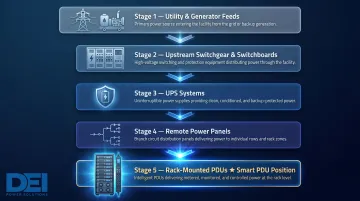
Reliable upstream infrastructure is essential. Properly specified switchboards and switchgear, such as the UL 891-certified units manufactured by DEI Power, ensure consistent, code-compliant power delivery to downstream smart PDUs and support the high availability these intelligent devices depend on.
Smart PDU vs. Basic PDU: Key Differences
A basic PDU is essentially an industrial-grade power strip. It distributes power from a single input to multiple outputs but has no network interface, metering, monitoring, or remote control capabilities. It's purely passive: you must be physically present to assess power conditions or reset a tripped circuit.
Side-by-Side Comparison
| Capability | Basic PDU | Metered PDU | Smart PDU (Monitored) | Smart PDU (Switched) |
|---|---|---|---|---|
| Network connectivity | No | Optional | Yes | Yes |
| Power metering | No | Aggregate only (local display) | Unit or outlet-level | Unit or outlet-level |
| Remote monitoring | No | Limited | Yes | Yes |
| Remote outlet control | No | No | No | Yes |
| Environmental sensors | No | No | Yes | Yes |
| Threshold alerting | No | No | Yes | Yes |
| DCIM integration | No | No | Yes | Yes |
Metered PDUs sit in between—they display aggregate power data locally (voltage, current, kW) and may offer some remote monitoring, but lack remote outlet control and the deeper intelligence of a true smart PDU.
The Real-World Consequence
Choosing a basic PDU in a mission-critical environment means:
- No early warning of overloads before breakers trip
- No remote reboot capability when devices freeze
- No environmental visibility to detect thermal anomalies
- Reactive management instead of proactive prevention
Uptime Institute reports that 54% of significant outages cost more than $100,000, with 16% exceeding $1 million. Industry benchmarks show unplanned downtime averages approximately $9,000 per minute, or $540,000 per hour.
Smart PDUs shift power management from reactive to proactive—giving teams the visibility to catch issues before they trigger those costs.
Types of Smart PDUs
Smart PDUs come in three primary configurations, each suited to different operational needs.
Monitored PDUs
Monitored PDUs provide both local and remote (network-accessible) visibility into power usage at the unit or individual outlet level, with threshold-based alerting. The core question they answer: How much power am I using?
These units fit well in:
- Data centers focused on understanding energy trends and improving PUE
- Environments where physical access is available but remote visibility is needed
- Compliance and reporting requirements like the EU Energy Efficiency Directive
- Budget-conscious deployments where remote control isn't required
Switched PDUs
Switched PDUs add outlet-level remote control to monitoring capabilities. Administrators can remotely power cycle, turn on/off, or reboot individual devices without physical presence. In short: Can I fix this problem remotely?
Good candidates for switched PDUs include remote facilities, edge deployments, and any multi-site operation where on-site visits are expensive. They're also the right choice for unattended infrastructure that requires controlled power sequencing or scheduled reboots.
ZPE Systems reports that single truck rolls commonly cost "thousands of dollars" when factoring labor, overtime, fuel, and opportunity costs—making remote switching a high-ROI capability.
Switched PDUs with Outlet Metering
This is the most capable type, combining remote outlet control with per-outlet power measurement. They answer: What is each device consuming, and can I control it remotely?
This tier is the standard choice for:
- Granular charge-back billing in colocation and multi-tenant environments
- Accurate capacity planning and right-sizing
- Device-level efficiency tracking and zombie server identification
- Hyperscale and AI deployments requiring precision load management
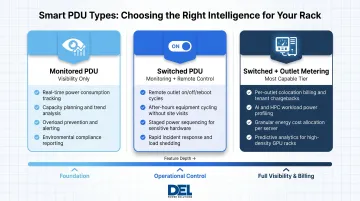
Per-outlet metering at this level delivers measurement accurate enough for tenant billing and capacity planning—capabilities that monitored or basic switched PDUs simply can't provide.
Key Features of Smart PDUs
Outlet-Level Monitoring and Control
The ability to meter and manage individual outlets—not just the full PDU—gives data center managers visibility into each connected device's actual power consumption. This enables:
- Right-sizing: Identify oversized power supplies or underutilized servers
- Charge-back billing: Allocate costs accurately in colocation environments
- Load balancing: Distribute loads evenly across circuits and phases
- Zombie server detection: Raritan notes that approximately one-third of servers run idle in data centers; outlet-level metering helps identify and shut down these power-wasting devices
Environmental Monitoring
Smart PDUs can incorporate or connect to external sensors measuring:
- Temperature — detect hot spots before thermal throttling occurs
- Humidity — monitor conditions that affect equipment lifespan
- Airflow — verify cooling effectiveness
- Differential air pressure — ensure proper containment
- Water/leak detection — catch coolant leaks early
Server Technology PRO4X PDUs support up to 32 sensor functions per unit via plug-and-play sensor buses, while Raritan NX1 models use wireless Zigbee 3.0 sensors with 5-year battery life.
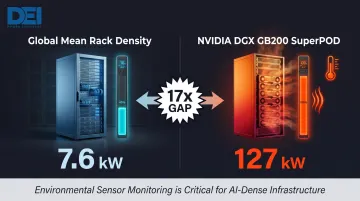
Environmental monitoring becomes more critical as rack densities rise. The global mean rack density is 7.6 kW (Uptime Institute, 2025), yet NVIDIA DGX GB200 SuperPOD racks operate at approximately 127 kW — a roughly 17x gap. Without sensor coverage, thermal issues in these high-density deployments can spread to adjacent equipment before staff have time to respond.
Alerting and Threshold-Based Notifications
User-configurable alerts notify staff of approaching overload conditions, threshold breaches, or environmental anomalies—shifting power management from reactive to proactive.
Alerts are delivered via:
- SNMP traps (v2/v3 with TRAPs and INFORMs)
- SMS
- Syslog
Configurable thresholds give teams early warning on the conditions that matter most — for example:
- Current draw exceeds 80% of rated capacity
- Voltage sags below acceptable thresholds
- Temperature rises above ASHRAE recommended ranges
- Power factor drops, indicating inefficiency
That early visibility directly supports remote response — which brings in the next capability: out-of-band management.
Remote Management and Out-of-Band Communication
Network-connected smart PDUs allow admins to access, configure, and control the PDU from anywhere. Most models offer:
- Web-based GUI for browser access
- SSH/Telnet for command-line management
- RESTful APIs for automation
Some models include out-of-band communication via serial console or secondary network path as a fallback when the primary network is unavailable—critical for maintaining control during network outages.
IP Aggregation and DCIM Integration
IP aggregation allows multiple PDUs (typically 2 to 50 units) to share a single IP address, reducing switch port costs and simplifying deployment. For example, Raritan NX1 models support up to 31 Smart Ready PDUs daisy-chained via RS485 to one Smart Node controller.
Smart PDUs integrate with DCIM platforms via:
- SNMP v2/v3 with identical MIBs across product families
- Redfish RESTful API for hardware management
- JSON-RPC for lightweight communication
- Modbus/TCP for industrial and BMS integration
This integration aggregates power and environmental data into a single management interface for trend analysis, capacity planning, and regulatory reporting.
Benefits of Smart PDUs for Data Centers
Improved Uptime and Proactive Fault Prevention
Real-time monitoring and alerting allow teams to catch overload conditions, failing circuits, or environmental issues before they cause unplanned downtime. Raritan highlights that monitoring at inlet, outlet, and circuit breaker levels enables early detection of heavy loads before breakers trip.
Additional availability features include:
- Hot-swappable communication cards reduce MTTR by enabling replacement while the unit remains operational
- Resettable overcurrent protection (circuit breakers vs. fuses) allows quick resets without an electrician
- Redundant dual-input configurations for N+1 power paths in mission-critical applications
In environments where a single outage carries significant business and financial consequences, proactive monitoring delivers measurable risk reduction.
Energy Efficiency and Cost Optimization
Access to granular power data allows managers to:
- Identify energy-intensive or underutilized equipment
- Optimize load distribution across circuits
- Reduce stranded power capacity
- Improve Power Usage Effectiveness (PUE)
The Green Grid recommends automated, real-time monitoring with data captured every 15 minutes or less as best practice for accurate PUE measurement. Rack PDUs provide the IT load component essential for PUE calculation.
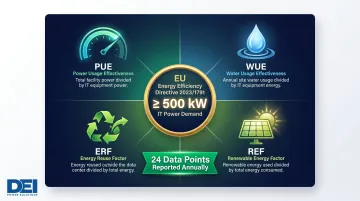
The EU Energy Efficiency Directive (2023/1791) requires data centers with IT power demand ≥500 kW to report annually on PUE, WUE, ERF (Energy Reuse Factor), and REF (Renewable Energy Factor) across 24 data points. Smart PDUs provide the rack-level metering data necessary for compliance — and support broader ESG and sustainability reporting obligations in the process.
Enablement of Remote and Edge Operations
Switched smart PDUs make it possible to:
- Remotely reboot servers stuck in failed states
- Manage power sequencing for controlled startups
- Maintain infrastructure at unstaffed or remote facilities
- Respond to incidents without costly on-site dispatch
This capability improves operational response time and reduces truck roll expenses, which commonly exceed thousands of dollars per incident when factoring labor, travel, and opportunity costs.
Of course, smart PDUs depend on reliable upstream power delivery to function as intended. UL 891-certified switchboards and switchgear — such as those manufactured by DEI Power in ratings from 400A to 4000A — provide the code-compliant power distribution infrastructure that edge and remote data center deployments require.
What to Consider When Selecting a Smart PDU
Power Density and Future-Proofing
Evaluate current and anticipated rack power requirements. The significant jump in power density that AI and machine learning workloads introduce—from a 7.6 kW average to 127 kW for GPU clusters—demands careful planning.
Select PDUs rated for:
- Current load requirements
- Projected growth over 3-5 years
- Three-phase distribution when exceeding ~15 kW per rack
- Modular or upgradeable designs to avoid full unit replacement
Consider whether your upstream switchgear and Remote Power Panels (RPPs) can support these densities. DEI Power's RPPs range from 225A to 1200A and support up to 84 branch circuits, providing the structured distribution needed for high-density deployments.
Reliability and Temperature Rating
Source PDUs from manufacturers who:
- 100% test every unit before shipment
- Provide detailed test documentation and compliance certificates
- Use hydraulic magnetic circuit breakers instead of thermal magnetic types for reduced temperature sensitivity
Confirm the PDU's maximum operating temperature is appropriate for your facility's thermal environment. Vertiv recommends intelligent rack PDUs rated to withstand 55°C or higher, as hot-aisle temperatures reach at least 50°C. Some models exceed that baseline — Raritan NX1 units are rated to 60°C, giving additional thermal headroom as facilities raise setpoints to cut cooling costs.
Redundancy, Security, and Integration
Each of these three areas can determine whether a smart PDU supports or undermines your uptime goals:
1. Redundancy configurations:
- Dual-input or N+1 redundancy for mission-critical applications
- Hot-swappable components to reduce MTTR
- Resettable overcurrent protection for fast recovery
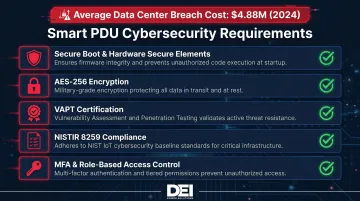
2. Cybersecurity protections: Smart PDUs are network-connected devices with their own OS and firmware stacks, creating potential attack surfaces. Legrand reports the average data center breach cost at $4.88 million in 2024.
Require:
- Secure Boot and hardware Secure Elements
- AES-256 encryption for communications
- VAPT certification (Vulnerability Assessment and Penetration Testing)
- NISTIR 8259 compliance for IoT device cybersecurity
- Multi-factor authentication (MFA) and role-based access control (RBAC)
3. DCIM platform compatibility: Verify the PDU supports multi-protocol integration (SNMP, Redfish, Modbus/TCP) to maximize data value and avoid being locked into a single management platform. Look for identical MIBs across product families to simplify management as you scale.
Frequently Asked Questions
What is the difference between a smart PDU and a normal PDU?
A basic (normal) PDU simply distributes power with no network connectivity or monitoring. A smart PDU connects to your network to enable real-time power monitoring, remote outlet control, threshold alerting, and integration with data center management systems.
What is smart power distribution?
Smart power distribution uses intelligent, network-connected devices (like smart PDUs) to monitor, manage, and optimize how electrical power is delivered to IT equipment. This gives operations teams the visibility they need to act on capacity, efficiency, and uptime — before problems occur.
What are the main types of smart PDUs?
The three primary types are monitored PDUs (power visibility without remote control), switched PDUs (monitoring plus remote outlet control), and switched PDUs with outlet metering (the most capable, combining per-outlet measurement and remote switching).
Do I need a smart PDU for my data center?
Basic PDUs work fine for small, easily accessible environments. If you're managing multiple racks, remote locations, AI workloads, high-density infrastructure, or ESG reporting requirements, smart PDU capabilities become essential.
Can a smart PDU integrate with DCIM software?
Yes. Most smart PDUs support integration with DCIM platforms via SNMP, REST APIs, or native connectors, allowing power and environmental data to be centrally aggregated and visualized — giving operators a single view across the full data center infrastructure.