Introduction
Both UL 489 and UL 1077 appear on circuit breakers used across commercial, industrial, and utility power systems. They may look nearly identical — but using the wrong standard in the wrong location is a safety violation. Failed inspections, voided equipment warranties, and unprotected downstream circuits are the practical result.
Many engineers and contractors confuse "UL Listed" with "UL Recognized," or assume any UL-marked breaker is interchangeable. The distinction has real consequences. Per Viox's circuit breaker standards breakdown, electrical inspectors and AHJs routinely red-tag UL 1077 devices installed as branch circuit protectors — creating project delays and liability exposure.
This guide covers what each standard means, how they differ in testing rigor and permitted use, and how to select the right certification for your application.
Key Takeaways
- UL 489 covers molded-case circuit breakers for standalone branch circuit protection, carrying a "UL Listed" designation
- UL 1077 covers supplementary protectors used inside equipment, carrying a "UL Recognized" designation that requires upstream UL 489-listed breakers or fuses
- UL 489 mandates a minimum 5,000A interrupting rating; UL 1077 allows manufacturer-specified ratings as low as 200A
- NEC requires UL 489-listed breakers for branch circuit protection; installing UL 1077 devices without upstream protection violates code
- The deciding factor is circuit position, not form factor
UL 489 vs. UL 1077: Quick Comparison
Both are UL standards for circuit breakers, but they govern entirely different roles in a power system. Specifying a UL 1077 device where NEC requires UL 489 protection is one of the most common compliance errors in panel design — and it won't pass inspection.
| Attribute | UL 489 | UL 1077 |
|---|---|---|
| Standard Purpose | Branch circuit and feeder protection — standalone use | Supplementary protection inside equipment — requires upstream protection |
| UL Designation Type | UL Listed (full certification) | UL Recognized (component-level certification, limited scope) |
| Minimum Interrupting Rating | 5,000A minimum (higher for breakers rated above 100A or 250V) | 200–5,000A, specified by manufacturer |
| NEC Compliance for Branch Circuits | Required and accepted | Not acceptable as standalone branch circuit device |
| Standalone Installation | Yes — can be installed in panelboards, switchboards, and service entrance equipment | No — must operate downstream of UL 489-listed breaker or branch-rated fuse |
What is UL 489?
UL 489 is Underwriters Laboratories' standard for molded-case circuit breakers (MCCBs), fused circuit breakers, and breakers with integrated ground-fault protection. Devices certified under this standard receive a "UL Listed" designation, meaning they have passed full, independent safety testing and are approved for standalone use as the primary overcurrent protection device on a branch circuit.
Testing Rigor That Earns UL Listed Status
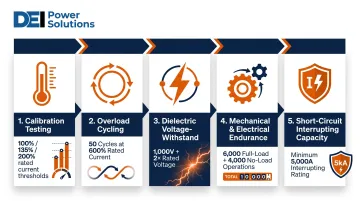
UL 489 testing protocols include:
- Calibration testing: 100% rated current (must hold without tripping at 40°C), 135% rated current (must trip within one hour at 25°C), and 200% rated current (must trip within 2 minutes at 25°C)
- Overload cycling: 50 cycles at 600% rated current with 0.4-0.5 lagging power factor
- Dielectric voltage-withstand: Test voltage of 1,000V plus 2 times the rated voltage applied between live parts and metal mounting surfaces
- Mechanical and electrical endurance: 6,000 full-load operations plus 4,000 no-load operations for breakers rated 0-100A (lower cycle counts for higher amperage ratings)
- Short-circuit interrupting capacity: Minimum 5,000A (higher for breakers above 100A or 250V), with device remaining operable at 200% after three short-circuit operations
Legal and Practical Meaning of "UL Listed"
The NEC requires Listed equipment for branch circuit protection. NEC Section 110.3(B) mandates:
"Listed or labeled equipment shall be installed and used in accordance with any instructions included in the listing or labeling."
NEC Article 240 governs overcurrent protection for branch circuits. UL 489 compliance directly satisfies that requirement for circuit breakers.
Key Performance Characteristics
UL 489-listed breakers must exhibit:
- Verified interrupting capacity to safely clear high fault currents
- Reliable trip response at specified thresholds, whether thermal-magnetic or electronic
- Arc suppression to prevent sustained arcing and equipment damage
- Full resettability — the device remains functional after clearing an overcurrent event
Use Cases of UL 489
UL 489-listed breakers belong in:
- Service entrance equipment
- Main distribution panels
- Feeder circuits
- Branch circuits
- Switchboard assemblies
If a breaker serves as the primary overcurrent defense, UL 489 certification is required. That covers a wide range of industries:
- Commercial buildings
- Industrial plants
- Data centers
- Healthcare facilities
- Utility infrastructure
- Manufacturing environments
High available fault current in these settings demands a verified interrupting rating of 5,000A or more — which is why substituting a supplementary protector here creates real risk. As a 2024 Eaton industry analysis puts it: "the use of supplemental protectors for branch circuit protection is a violation of the device's intended use, and creates a situation of increased liability."
What is UL 1077?
UL 1077 is UL's standard for supplementary protectors — devices designed to provide overcurrent protection within equipment or appliances that already have upstream branch circuit protection in place. Devices tested under UL 1077 receive a "UL Recognized" designation (not "UL Listed"), which signals a component-level certification intended for use inside a larger listed assembly, not as standalone protection.
Why UL 1077 Testing Parameters Are Less Rigorous
A UL 1077 protector always operates behind a UL 489 branch circuit breaker or branch-rated fuse, so its testing parameters are far less rigorous. Manufacturers of UL 1077 devices self-specify their calibration, overload, and short-circuit test parameters — meaning two "UL Recognized" devices from different manufacturers can have widely different performance characteristics even though they carry the same designation. UL does not publish these parameters, so datasheet comparison is the only valid way to evaluate device capability.
Safety Consequence of Misapplication
If a UL 1077 supplementary protector is installed without upstream branch circuit protection, it is exposed to fault currents far exceeding its rated interrupting capacity. OptiFuse warns that such misuse puts the device "at risk of damage" and can cause it to "partly rupture or explode."
This is why the NEC does not permit UL 1077 devices to serve as the sole overcurrent protection on a branch circuit.
Use Cases of UL 1077
UL 1077 supplementary protectors are appropriate inside:
- Listed industrial equipment and electronic appliance assemblies
- Appliances and HVAC equipment
- Control panels and motor control panels
- PLCs
These devices are fed by a UL 489-protected branch circuit or plug into a wall outlet. Their lower interrupting requirements allow more compact, cost-effective form factors — which is precisely why verified upstream protection is a prerequisite, not an option.
UL 489 vs. UL 1077: Which Standard Applies to Your Application?
The decision is determined by where in the power system the device will be installed, not by preference or cost. If the breaker is the first protective device between the power source and the load — on a branch circuit, feeder, or service entrance — it must be UL 489 Listed. If it sits inside equipment that already has upstream UL 489 or branch-rated fuse protection, UL 1077 is appropriate.
NEC Compliance Implication
Installing a UL 1077-only device as the sole branch circuit protector violates NEC Article 240, which inspectors and AHJs will flag. Insurance carriers and facility owners increasingly require evidence of Listed breaker use — uncertified or misapplied devices can void equipment warranties and create liability exposure.
Interrupting Capacity as a Secondary Selection Factor
Engineers must confirm the available fault current at the point of installation and verify the breaker's interrupting rating exceeds it. UL 489's mandatory 5,000A floor provides a baseline, but high-density industrial or utility environments may require much higher ratings. This information should be verified using the facility's short-circuit study.
Situational Guidance
Choose UL 489 when:
- The breaker is installed in a panelboard, switchboard, or any location serving as primary overcurrent protection
- The device is the first protective device between the power source and the load
- The installation is subject to NEC branch circuit requirements
Choose UL 1077 only when:
- Protects sub-circuits within a listed piece of equipment
- The equipment is itself protected upstream by a UL 489 breaker or branch-rated fuse
- The application is explicitly for supplementary protection, not branch circuit protection
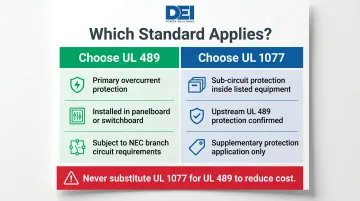
Never substitute UL 1077 for UL 489 to reduce cost.
Switchboard Specification Context and DEI Power
In switchboard and power distribution assemblies — such as UL 891-certified switchboards — all circuit breakers providing branch circuit protection must be UL 489 Listed to maintain the assembly's listing and NEC compliance.
DEI Power builds UL 891-certified switchboards with genuine Siemens components and conducts detailed specification reviews before production to confirm every breaker is correctly rated for its role. Operating from a 50,000 sq. ft. facility in Ontario, California with over ten years of switchgear manufacturing experience, the company provides submittal documentation and configuration guidance throughout the build process.
This structured review process helps engineers and contractors avoid misapplication issues, reduce change orders, and maintain NEC compliance from the start.
For configuration guidance on code-compliant power distribution solutions, contact DEI Power at (866) 773-8050 or email sales@deipower.com.
Conclusion
UL 489 and UL 1077 each have a specific, non-interchangeable role: UL 489 for branch circuit protection as the primary safety device, UL 1077 for supplementary protection inside equipment with confirmed upstream branch circuit coverage. Getting this right is not a bureaucratic formality — it determines whether the circuit is actually protected under real-world fault conditions.
For contractors, engineers, and facility teams, applying the correct standard has direct consequences:
- Inspections pass without costly rework or field corrections
- Liability exposure drops when protection is properly documented and code-compliant
- Equipment warranties remain intact with the right breaker type installed
- Uptime is preserved in environments where a single fault can shut down operations or endanger personnel
Knowing which standard applies to your application isn't just about compliance — it's the difference between a system that holds up under fault conditions and one that fails the moment it's tested.
Frequently Asked Questions
What is a UL-listed breaker?
A UL-listed breaker is one that Underwriters Laboratories has tested against the full requirements of an applicable standard — such as UL 489 for MCCBs — on representative production samples, with ongoing factory inspections to confirm continued compliance. NEC and local codes accept UL-listed breakers for standalone branch circuit installation.
What is a UL classified breaker?
A UL Classified breaker has been evaluated by UL Solutions only for specific properties or under limited conditions — often for use as a replacement in a named panel or equipment type. It is not a full "UL Listed" device and differs from both UL Listed and UL Recognized designations, typically marked "Classified" with a scope statement on the device.
Which is better, UL-listed or UL certified?
For circuit breakers, UL Listed is the designation that matters most — it confirms full evaluation for standalone use. "UL Certified" is an umbrella mark launched in 2013 that can appear on both Listed and Classified products and does not represent a separate performance tier. The practical distinction is Listed (standalone, branch circuit use) versus Recognized (component-level, supplementary use only).
What breakers are compatible with UL?
UL-compatible breakers span several categories: UL 489-listed MCCBs for branch circuits, UL 1077-recognized supplementary protectors for equipment-internal use, and specialized types such as AFCI, GFCI, and PV-rated breakers. To verify compatibility with a specific panel or switchboard, check the equipment label and cross-reference the UL Product iQ database.
Can a UL 1077 supplementary protector replace a UL 489 breaker?
No, a UL 1077 device cannot replace a UL 489 breaker as the primary branch circuit protector. Without upstream UL 489 or branch-rated fuse protection, a UL 1077 device can be exposed to fault currents well beyond its interrupting capacity — a safety hazard and an NEC code violation.
Do UL 489 circuit breakers meet NEC requirements for branch circuits?
Yes, UL 489 Listed circuit breakers satisfy the NEC's requirement (Article 240 / 110.3) for Listed overcurrent protection devices on branch circuits. Inspectors and AHJs across North America recognize UL 489 as the governing standard for branch-circuit MCCBs.