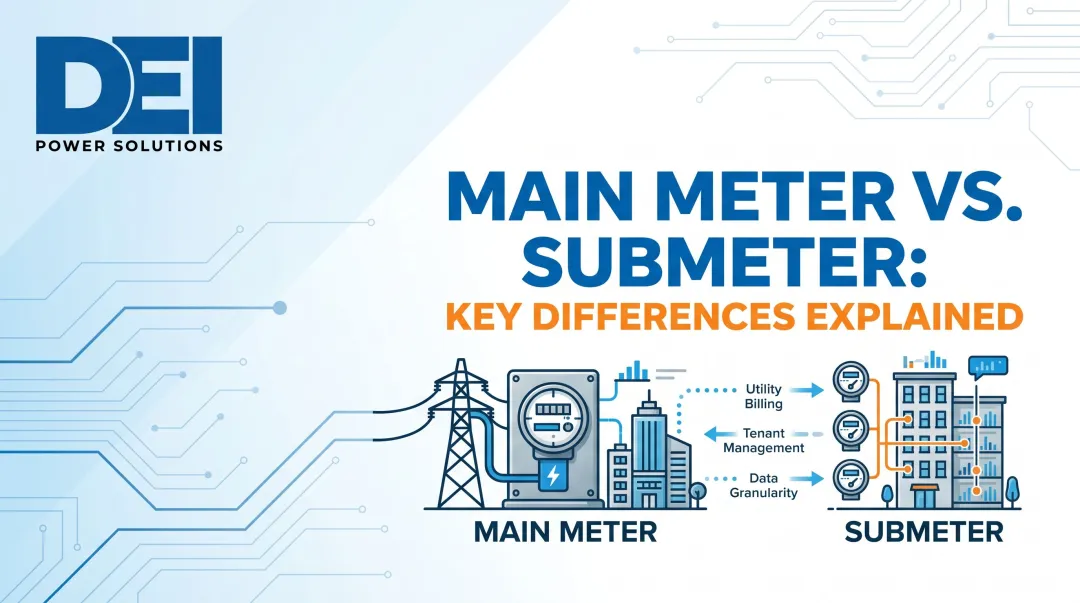
The problem is that many contractors, facility managers, and even experienced tradespeople use "meter main," "meter base," and "meter socket" interchangeably. They aren't the same thing. Mixing them up leads to wrong equipment orders, failed inspections, and expensive field corrections.
This guide explains exactly what a meter main is, how power moves through it, and how it connects to whatever distribution equipment sits downstream.
Key Takeaways
- Meter mains combine a utility meter socket and a main disconnect breaker in a single exterior enclosure
- It satisfies NEC service disconnect requirements and gives first responders a single shutoff point outside the structure
- Available from 100A to 400A for residential and light commercial applications
- 320A socket ratings and 400A service ratings are not interchangeable — confusing them creates code violations
- In commercial installations, meter mains feed downstream switchboards or distribution panels — not branch circuits directly
What Is a Meter Main?
A meter main is a listed electrical enclosure that integrates a utility-grade meter socket with a factory-installed main circuit breaker in one self-contained unit. It eliminates the need for a separate meter base and a separate main disconnect — two components that historically occupied two different enclosures.
Why the Combined Unit Exists
For most of the 20th century, the setup was straightforward: the utility owned a standalone meter socket mounted outside, and the homeowner's main panel (with its own main breaker) was installed inside. That worked fine until code requirements around emergency access tightened.
NEC Section 230.70 requires a disconnecting means for all ungrounded service conductors, located outside or inside nearest the point of service-conductor entrance. NEC 230.85, introduced in the 2020 edition, went further — mandating an outdoor emergency disconnecting means for one- and two-family dwellings so first responders can cut power without waiting for the utility.
A meter main satisfies both requirements in a single listed enclosure — no field-assembled workarounds required.
What a Meter Main Is NOT
This distinction matters for equipment selection:
- A meter base (or meter socket) only houses the revenue meter — no breaker, no disconnect capability on the customer side
- A full main panel distributes power to multiple branch circuits; a meter main typically has one main breaker and few or no branch circuit positions
- Substituting a meter base where a meter main is required fails the exterior disconnect mandate
Three Main Types
| Type | Description | Common Use |
|---|---|---|
| Meter main with breaker only | Single socket + main breaker, no branch spaces | Feeds a downstream subpanel |
| Meter main with integrated load center | Includes branch breaker positions | Smaller residential installations |
| Ringless vs. ring-type socket | Differs in how the utility seals the meter | Utility-specific requirement |
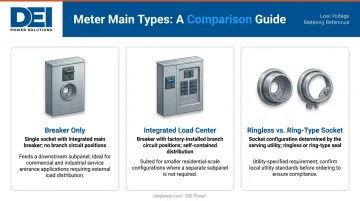
Ring or ringless configuration isn't your choice to make — it's determined by the serving utility. Check their metering requirements before specifying.
How a Combined Meter Panel Works
The meter main operates as both a measurement point and a control point. Utility power enters, gets measured, passes through the main breaker, and exits as protected power toward the building's distribution system.
Utility Entry and Metering
Service entrance conductors (whether overhead from a weatherhead or underground from conduit) terminate at the line-side lugs of the meter socket. From there, current flows through the revenue meter, which records consumption in kilowatt-hours (kWh).
A few critical points about the line side:
- It is always energized, even when the main breaker is off
- It is utility territory — only utility personnel may access it
- The utility seals the meter and enclosure to prevent tampering; breaking that seal creates legal and safety problems regardless of who did it
The meter socket's job is to hold the meter securely, make the electrical connection between utility lines and the load side, and give the utility a tamper-evident installation they can trust for accurate revenue metering.
Main Breaker Function
After passing through the meter, power reaches the load-side lugs, which connect to the main breaker. This breaker does two things:
- Manual disconnection — A single switch operation cuts all power to the building, accessible from outside the structure. This is the emergency disconnect first responders need.
- Automatic overcurrent protection — If service load exceeds the breaker's rated ampacity, it trips — protecting downstream wiring from thermal damage before conductors overheat.
The breaker is sized to match service amperage. A 200A service gets a 200A main breaker. Mismatching breaker size to service amperage is a code violation — one that can void listings and trigger failed inspections.
Once power passes through the closed main breaker, it exits through the load-side terminals. Depending on the installation, that downstream connection feeds one of the following:
- A subpanel serving branch circuits
- A switchboard distributing power across multiple feeders
- Integrated branch circuits built directly into the meter main enclosure
Types of Meter Mains and Amperage Ratings
Siemens offers meter combinations from 100A to 400A, which reflects the standard range across the residential and light commercial market. Matching the meter main's amperage rating to the utility's approved service size is non-negotiable. Getting this wrong is one of the most common causes of failed inspections.
Standard Residential Ratings
- 100A — Older homes, smaller structures, limited load applications
- 200A — Standard modern residential service; the most common residential specification
- 320A / 400A — Higher-demand residential or light commercial applications
The 320A vs. 400A Question
These are not the same, and the naming causes real confusion in the field.
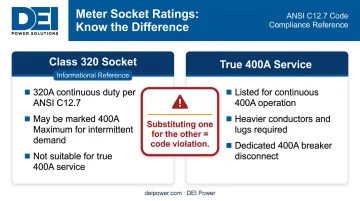
Per ANSI C12.7-2022, watthour meter sockets are rated for up to 320A continuous duty per socket opening. A Class 320 meter panel is rated 320 amperes continuous, though it may be marked "400 Amperes Maximum" to reflect intermittent demand capacity.
A true 400A service requires equipment specifically listed for that application, with heavier conductors and lugs rated for continuous 400A operation. Milbank, for example, markets dedicated 400A meter mains with a single 400A breaker disconnect for exactly this purpose.
Using a Class 320 socket on a true 400A service creates a code violation and a thermal hazard. Before ordering, pull the equipment datasheet and confirm the continuous ampacity rating — not just the maximum marked value.
Single-Position vs. Multi-Position
- Single-position — One meter socket, one main breaker. Standard for single-family residential
- Multi-position (meter stacks) — Multiple sockets in one enclosure for multi-tenant buildings, apartment complexes, or subdivisions. Each position serves a separate tenant or unit
Where Meter Mains Are Used
As of March 1, 2026, NFPA's enforcement data shows 40 states operating under either the 2020 or 2023 NEC. With NEC 230.85's outdoor emergency disconnect mandate now active across most of the country, meter mains have become the default solution for new residential construction — not just a preferred option.
Primary Installation Environments
- Single-family residential — The most common application; a meter main on the exterior wall feeds an interior subpanel
- Multi-family and apartment buildings — Meter stacks with multiple positions serve individual units from one service entrance point
- Light commercial — Retail spaces, small offices, and similar facilities with services in the 100A–400A range
- Manufactured and modular construction — Pre-wired meter main units simplify factory-built installations
The Commercial Handoff Point
In commercial and industrial facilities with higher service demands, the meter main's role shifts. It still serves as the service entrance equipment and provides the required disconnect — but it's not distributing power to individual circuits. Instead, load-side terminals feed a downstream switchboard or main distribution panel that handles actual load distribution.
For these larger installations, the switchboard on the load side does the actual distribution work. DEI Power's UL 891-certified switchboards, for example, are available from 400A to 4000A and cover commercial buildings, industrial facilities, data centers, and utility infrastructure. When an AHJ requires submittals before approving service entrance equipment on a large job, UL-listed assemblies with full documentation make that review straightforward.
Meter Main vs. Separate Meter Base and Panel
| Configuration | Layout | When It's Used |
|---|---|---|
| Meter main combo | Single exterior enclosure (meter + disconnect), interior subpanel | Code requires exterior disconnect; limited interior space; new construction |
| Separate meter base + main panel | Standalone exterior meter socket, main panel with breaker inside | Older construction; jurisdictions without exterior disconnect mandate; interior panel required by design |
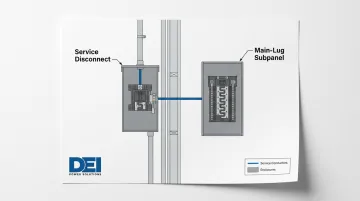
Choosing the combo route has one key implication: the interior panel becomes a subpanel. It no longer needs its own main breaker because the meter main's breaker serves as the service disconnect. This catches homeowners and less experienced contractors off guard — many assume every interior panel requires a main breaker.
The correct configuration — consistent with NEC 2020 requirements and Eaton's published guidance — pairs a meter main socket with an integral main breaker on the outside with a main-lug panel on the inside. The meter main's breaker is the service disconnect; the interior panel distributes from that point. This configuration meets code requirements when the meter main carries a proper listing and the AHJ accepts it. For contractors specifying new service installations, that combination is the one to verify before roughing in.
Conclusion
A meter main isn't just a convenient combination product: it's the engineered response to a specific code requirement: every building must have a single, accessible means of disconnection at the point where utility power enters. Understanding where the meter socket ends, where the main breaker takes over, and where downstream distribution equipment picks up clarifies both the technical logic and the liability boundaries.
For contractors specifying service entrance equipment, engineers reviewing drawings, or facility managers planning an upgrade, that clarity directly prevents specification errors: wrong equipment ordered, failed inspections, and change orders that add cost and schedule risk.
Those errors become especially consequential at the interface between the meter main and downstream distribution. When load-side terminals connect to equipment like a UL 891 switchboard, every element of the chain must be matched correctly to service size, voltage, and the AHJ's requirements.
Frequently Asked Questions
What does a meter main do?
A meter main measures incoming utility power through an integrated meter socket and provides a single exterior shutoff through the main breaker — combining metering and disconnect functions in one listed enclosure. It's the handoff point between utility power and the building's electrical system.
What's the difference between a meter main and a meter base?
A meter base (or meter socket) only houses the revenue meter — there's no breaker or disconnect capability on the customer side. A meter main adds a factory-installed main circuit breaker in the same enclosure, satisfying NEC disconnect requirements without a separate component.
Is a 320 amp meter base the same as 400 amp?
No. A Class 320 socket is rated for 320A continuous duty per ANSI C12.7, though it may carry a "400A Maximum" label for intermittent demand. A true 400A service requires equipment specifically rated for 400A continuous operation. Substituting one for the other is a code violation.
How much does it cost to replace a meter base?
Costs vary based on service size, enclosure type, local labor rates, permit fees, and whether the installation must meet current NEC provisions. Utility disconnect/reconnect charges add to the total. Get quotes from licensed electrical contractors and confirm your utility's coordination requirements before budgeting.
What does a meter base look like on a house?
It's a weatherproof metal enclosure — typically gray — mounted on the exterior wall. A glass or plastic dome covers the meter face. Conduit enters from the top for overhead service or from the bottom for underground service. A meter main looks similar but is noticeably larger to accommodate the breaker section.
Can a meter main be used for commercial or multi-unit buildings?
Yes. Light commercial and multi-unit residential buildings commonly use meter mains, often in multi-position meter stacks with several sockets per enclosure. In larger commercial or industrial facilities, the meter main serves as the service entrance disconnect and feeds a downstream switchboard or distribution panel rather than branch circuits directly.