Introduction
Data centers, manufacturing plants, utility substations, and healthcare facilities share one non-negotiable requirement: reliable, code-compliant power infrastructure. Selecting the wrong engineering firm or equipment supplier creates measurable consequences—failed inspections, costly downtime, and project delays that ripple through construction schedules and operational budgets.
The stakes have escalated in 2026. Rising industrial energy demand is driving the global switchgear market from $103.71 billion in 2025 toward $136.65 billion by 2030, while U.S. data center electrical equipment spending alone is projected to surge from $20 billion to $65 billion by 2030. Grid modernization initiatives backed by $10.5 billion in federal GRIP funding are accelerating infrastructure upgrades nationwide.
Build America Buy America (BABA) compliance requirements are adding sourcing complexity for federally funded projects, creating procurement bottlenecks for contractors who wait too long to secure manufacturer commitments.
This article provides a curated list of top electrical engineering firms and switchgear manufacturers for industrial power distribution in 2026. Each was evaluated on:
- Certifications — particularly UL 891 compliance
- Lead times — current availability and fulfillment speed
- Domestic manufacturing capability — including BABA eligibility
- Sector experience — data centers, industrial, utility, and healthcare
- Engineering support — pre-sale configuration guidance and documentation
Brand recognition alone didn't make the cut.
Key Takeaways
- Industrial power distribution firms are evaluated on UL certifications, lead times, manufacturing capability, and engineering support—not revenue alone
- Global leaders like Siemens, Eaton, Schneider Electric, and ABB deliver comprehensive portfolios for multinational infrastructure projects
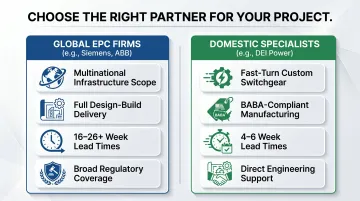
- U.S. specialists like DEI Power offer 4–6 week lead times, custom builds, and BABA-compliant equipment vs. 16–26+ weeks from global OEMs
- Prioritize UL-certified equipment, in-house engineering support, and proven fulfillment speed for mission-critical projects
- Match the partner to the project: global EPC firms for complex megabuilds, domestic specialists for fast custom switchgear
What Industrial Power Distribution Demands from an Electrical Engineering Firm
Industrial power distribution covers the systems—switchboards, switchgear, busways, distribution panels—that route electrical power from utility service points to end-use loads across industrial, commercial, and utility environments.
This discipline differs from general electrical contracting. It requires specialized engineering expertise, UL-certified equipment, sophisticated load management, and compliance with NEC Article 408 standards that residential or light commercial work never encounters.
The market context makes firm selection in 2026 unusually high-stakes:
- The low-voltage switchgear market reached $42.1 billion in 2024, projected to hit $76.8 billion by 2033 (6.8% annually)
- U.S. data center capacity is expected to grow from 24 GW to 110 GW between 2026 and 2030, driving 68% of total U.S. load growth
- Medium-voltage switchgear lead times now run 40 to 60+ weeks, with critical components delayed 18 to 36 months
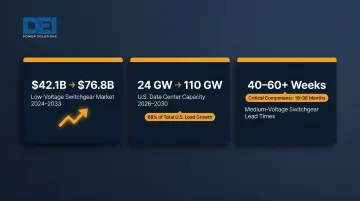
The firms below were selected for proven capability in industrial-scale power distribution — covering design engineering, equipment manufacturing, UL certifications, and lead time performance across contractors, engineers, and facility teams in demanding sectors.
Top Electrical Engineering Firms for Industrial Power Distribution in 2026
These firms were selected for reliability, technical depth, certified product portfolios, and proven track records in industrial power distribution—not simply brand recognition or overall revenue.
Siemens AG
Siemens has operated at the center of industrial electrification since 1847. Its power division covers MV/LV switchgear, power distribution systems, and digital grid solutions deployed across manufacturing facilities, utilities, and large commercial installations in 190+ countries. Siemens Smart Infrastructure posted record orders of €7.2 billion in Q1 FY2026, with a total order backlog reaching €120 billion.
Siemens differentiates through its Spectrum Power grid control technology, Electrical Digital Twin simulation capability for pre-installation system validation, and IoT-enabled predictive maintenance integrated into power distribution infrastructure. The 8DA/B gas-insulated switchgear provides compact, maintenance-free modular power distribution for primary systems, backed by decades of utility and industrial project execution.
| Core Capabilities | Medium- and low-voltage switchgear, smart grid systems, digital energy management, Spectrum Power grid control, Electrical Digital Twin |
|---|---|
| Key Certifications | IEC, UL, ISO-compliant product lines; global regulatory approvals across 190+ countries |
| Best Suited For | Utility substation modernization, large industrial plants, multinational infrastructure projects, smart grid integration |
Eaton Corporation
Eaton's electrical division spans switchgear, circuit protection, power distribution units, busway systems, and UPS solutions across more than 160 countries. The company reported 2025 annual revenue of $27.4 billion and has invested over $1.5 billion in global manufacturing capacity since 2023, including a new 370,000-square-foot MV switchgear facility in Bellevue, Nebraska.
The Brightlayer digital platform ties together switchgear, software, and real-time monitoring into a single power management ecosystem. Compliance with NEC, OSHA, and UL standards makes Eaton a reliable choice for facilities with strict uptime requirements. Recent acquisitions — Exertherm (thermal monitoring, May 2024), Fibrebond ($1.4 billion modular power, April 2025), and Resilient Power Systems (August 2025) — signal continued investment in integrated power infrastructure.
| Core Capabilities | LV/MV switchgear, circuit breakers, busway systems, power distribution units, Brightlayer digital platform |
|---|---|
| Key Certifications | UL, NEC-compliant, NEMA, IEC, OSHA-aligned safety standards |
| Best Suited For | Industrial manufacturing, data centers, healthcare facilities, commercial campuses requiring integrated power management |
Schneider Electric SE
Schneider Electric has built its industrial power offering around a single unifying platform: EcoStruxure, which integrates IoT, AI, and cloud analytics into power distribution infrastructure. The company serves industrial facilities, data centers, utilities, and commercial buildings across 100+ countries.
The portfolio runs end-to-end — from MV switchgear and motor control centers to microgrid solutions and energy management software. EcoStruxure Power specifically delivers:
- Electrical safety monitoring and power availability optimization
- Predictive maintenance with digital twin capabilities
- Cybersecurity controls for electrical networks
- Real-time power monitoring and sustainability reporting
Schneider holds ISO 50001 certification for energy management systems.
| Core Capabilities | MV/LV switchgear, EcoStruxure platform, motor control centers, microgrid solutions, energy monitoring software |
|---|---|
| Key Certifications | IEC, UL, ISO 50001 Energy Management, LEED-aligned product lines |
| Best Suited For | Industrial plants seeking digitalized power management, data centers, utilities pursuing energy efficiency targets |
ABB Ltd
ABB formed in 1988 from the merger of ASEA (Sweden) and BBC (Switzerland) and is now headquartered in Zürich. Its industrial power division covers modular substations, HVDC systems, low-voltage switchgear, and power quality solutions for manufacturing, transportation, utilities, and process industries across 100+ countries.
ABB's HVDC transmission technology is among the most proven in the industry. ASEA built the world's first commercial HVDC line in 1954; ABB later developed the first 110 kV gas-insulated switchgear in 1965 and completed the 580 km NorNed submarine HVDC cable in 2008. Modular substation designs compress deployment timelines for large-scale projects.
The company's sustainable manufacturing practices and ISO 14001 environmental management certification make it a preferred partner for industrial electrification projects with ESG requirements.
| Core Capabilities | HVDC systems, modular substations, LV switchgear, industrial electrification, power quality solutions |
|---|---|
| Key Certifications | IEC, UL, ISO 14001 (environmental), global regulatory compliance across major markets |
| Best Suited For | Large-scale industrial electrification, utility-scale transmission projects, manufacturing automation, long-distance power infrastructure |
DEI Power
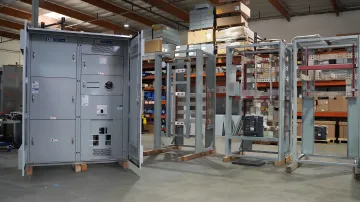
Based in Ontario, California, DEI Power is a U.S. switchgear manufacturer and power distribution solutions provider with over 10 years of experience building UL 891-certified switchboards for commercial, industrial, and utility power systems. The company operates from a 50,000 sq. ft. facility purpose-built for rapid domestic manufacturing and fulfillment.
DEI Power distinguishes itself through:
- In-house manufacturing that eliminates third-party delays
- Custom switchboard configurations built to project-specific voltage, layout, and jobsite requirements (supporting 120/240V, 208Y/120V, 240/120V, 480V, 480Y/277V, and 415/240V)
- Standard lead times of 4-6 weeks for custom builds with shipping in 3-5 business days
- Buy America Build America (BABA) compliance for federally funded projects
- Approved Siemens OEM status delivering precision-engineered equipment
- In-house engineering support providing submittal drawings, single-line diagrams, and spec sheet reviews that reduce change orders and field adjustments
| Core Capabilities | UL 891-certified low-voltage switchboards (400A-4000A), custom switchgear manufacturing, in-house engineering support, rapid domestic fulfillment, BABA-compliant equipment |
|---|---|
| Key Certifications | UL 891 certified, approved Siemens OEM, USA-manufactured, BABA-compliant |
| Best Suited For | Contractors and engineers needing fast-turn custom switchgear for industrial plants, data centers, utility substations, healthcare facilities, and commercial campuses across the U.S. |
How We Chose These Firms
This list was not based on company size or global revenue. The evaluation focused on factors directly relevant to industrial power distribution: UL or equivalent certifications, proven product portfolios in industrial/utility applications, manufacturing and fulfillment capability, engineering support quality, and the ability to serve contractors, engineers, and facility teams with minimal project risk.
A common mistake buyers make is choosing based on brand recognition without evaluating lead times, BABA compliance, domestic manufacturing capability, or engineering support availability — factors that often have greater impact on project outcomes than name recognition.
The current market makes this more consequential than ever. Data center project cancellations quadrupled to 25 in 2025 from 6 in 2024, with equipment shortages cited as a primary cause. Manufacturers are imposing 20% price increases on year-old purchase orders to maintain delivery schedules.
Given those pressures, the right partner depends heavily on project scope:
- Global EPC firms like Siemens or ABB are appropriate for massive multinational infrastructure projects requiring full design-build delivery
- Specialized domestic manufacturers like DEI Power are the smarter choice for U.S.-based contractors and facility teams needing certified custom switchgear delivered fast without supply chain risk
Conclusion
Industrial power distribution decisions carry real consequences. The right firm must align with your project's compliance requirements, timeline, and uptime demands—not just offer the lowest price or the most recognizable brand.
Before committing, evaluate each firm against the criteria that matter most to your project:
- Domestic manufacturing capability and BABA compliance
- UL certifications and documentation readiness
- Engineering support availability during procurement and installation
- Lead times relative to your construction schedule
With switchgear lead times reaching 40–60+ weeks and critical components facing 18–36 months of delay industry-wide, early manufacturer selection has become essential to project planning.
For contractors, engineers, and facility teams sourcing UL 891-certified, USA-manufactured low-voltage switchgear, DEI Power manufactures BABA-compliant switchboards (400A–4000A) at their Ontario, California facility with some of the shortest lead times in the industry. Contact them at (866) 773-8050 or sales@deipower.com to discuss your project requirements.
Frequently Asked Questions
What is industrial power distribution and how does it differ from standard electrical contracting?
Industrial power distribution refers to the systems and equipment—switchgear, switchboards, busways, distribution panels—that route and control electrical power at scale in industrial, commercial, and utility environments. Standard electrical contracting doesn't qualify — industrial distribution demands UL-certified equipment, licensed power systems engineers, and load management expertise that residential and light commercial work simply doesn't cover.
What is UL 891 certification and why does it matter for switchgear procurement?
UL 891 is the UL standard for dead-front switchboards, certifying that equipment meets established safety and performance benchmarks for low-voltage power distribution. Specifying UL 891-certified switchgear is essential for code compliance, insurance coverage, and AHJ (Authority Having Jurisdiction) approval on industrial and commercial projects.
What certifications should an electrical engineering firm have for industrial power distribution projects?
Key certifications to verify include:
- UL 891 (switchboards), UL 1558 (switchgear), UL 67 (panelboards)
- NEC compliance and NEMA enclosure standards
- OEM manufacturer approvals (Siemens, Eaton) and AHJ-recognized certification marks
For federal projects covered under BABA, also confirm domestic content verification.
How long does it typically take to get custom switchgear manufactured and delivered?
Lead times vary widely. Large multinational manufacturers may quote 16-26 weeks or more for custom switchgear, while domestic specialists like DEI Power can deliver UL 891-certified custom switchboards in 4-6 weeks plus 3-5 business days shipping. Manufacturer selection is a critical factor for time-sensitive projects.
What is the difference between a switchboard and switchgear?
Switchboards (UL 891) are dead-front assemblies that distribute power to branch circuits in commercial and industrial applications. Switchgear (UL 1558) is heavier-duty equipment with individually isolated compartments — built for higher fault ratings and safer maintenance on energized systems in mission-critical environments.
When should I choose a specialized switchgear manufacturer over a large EPC firm for power distribution?
Large EPC firms fit comprehensive megaprojects that require full design-build delivery. Specialized domestic manufacturers are the better choice when you need fast-turn certified equipment, custom configurations, BABA-compliant domestic manufacturing, or direct engineering support — without the overhead of multinational procurement cycles.