Introduction
A certified Type 1 metal electrical enclosure is a metal housing — designed, cut, formed, welded, and finished — that meets UL's Type 1 indoor protection standard under a recognized certification program. For contractors, engineers, and facility teams specifying enclosures for electrical panels, switchgear, and control equipment, that certification distinction is what separates a field-approved installation from a costly rework.
Proper fabrication means building to documented processes verified by third-party audits — not just assembling a metal box. A certified Type 1 enclosure protects personnel from accidental contact with live parts and blocks falling dirt, but only when those manufacturing controls are in place. Specification teams that conflate self-declared ratings with independently verified listings routinely discover the difference at inspection, when delays and field rework are already on the table.
Key Takeaways
- Type 1 enclosures provide baseline indoor protection against personnel contact and falling dirt—not liquids, dust ingress, or outdoor exposure
- "Certified" means third-party verification and ongoing audits—not a manufacturer's self-declaration
- Poor fabrication quality can disqualify an enclosure from its rating and cause it to fail AHJ inspection
- UL Type 1 requires independent testing; NEMA 1 is self-declared with no verification
- Specifying Type 1 by default in dusty, wet, or outdoor settings causes premature failure and compliance gaps
What Is a Certified Type 1 Metal Electrical Enclosure?
A UL Type 1 enclosure is rated for indoor use, designed to prevent accidental personnel contact with enclosed electrical equipment and to limit ingress of falling dirt. It is not a sealed or weatherproof enclosure. Per UL 50 standards, Type 1 represents the baseline indoor protection level for general-purpose electrical equipment in controlled environments.
"Certified" in this context means the enclosure is manufactured under a recognized third-party program—such as UL's authorization scheme—where the facility, processes, materials, and staff qualifications are verified. This is distinct from a manufacturer simply declaring their product meets a specification without independent validation.
How Type 1 differs from related ratings:
- Type 2 adds protection against limited falling water and dripping liquids, making it appropriate for areas near indoor water sources
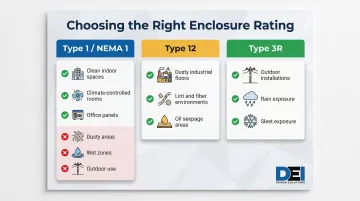
- Type 12 adds dust-tight construction and resistance to circulating dust, lint, fibers, and oil seepage for industrial environments
For most commercial and light industrial applications, Type 1 is the appropriate baseline—provided the installation environment is clean, stable, and fully indoors. DEI Power's UL 891-certified switchboards are available in Type 1 (NEMA 1) configurations for exactly these environments, built and certified to meet the same third-party verification standards described above.
Why Type 1 Enclosure Certification Matters
UL Certification vs. NEMA Self-Declaration
The most consequential distinction in enclosure specification is between UL certification and NEMA self-declaration. Per NEMA's own FAQ document, "NEMA 250 is an ANSI standard used for self-declaration of enclosure Type ratings." NEMA does not test products, provide listings, or certify compliance—manufacturers self-assess whether their products meet NEMA specifications.
UL certification operates differently. UL requires manufacturers to:
- Submit samples for independent third-party testing
- Undergo periodic unannounced facility audits (often several times per year)
- Maintain documented manufacturing procedures
- Use UL-recognized components and materials
- Provide traceability records
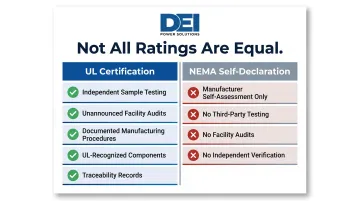
This is why Authorities Having Jurisdiction (AHJs) and electrical inspectors consistently accept UL-rated enclosures and may reject NEMA-only claims. According to Electrical Contractor Magazine, "inspection jurisdictions rely heavily on the use of listed equipment as a basis for issuing approvals."
NEC and Inspection Implications
The National Electrical Code creates a compliance framework that makes UL listing practically mandatory for most installations:
- NEC Section 110.2 requires equipment to be "approved"
- NEC Section 110.3(B) requires listed or labeled equipment to be installed per listing instructions
- NEC Article 409 requires industrial control panels to be listed or evaluated by a Nationally Recognized Testing Laboratory (NRTL)
Non-certified enclosures can halt project sign-off, trigger costly rework, and create liability exposure if an incident occurs. Without a UL label, an AHJ may reject an installation outright, forcing contractors to replace equipment or obtain expensive field evaluations.
What UL Authorization Requires of Fabricators
The UL authorization program imposes rigorous requirements on manufacturers:
- Qualified technical staff with current certification
- Documented and auditable manufacturing procedures
- Verified use of UL-recognized components and materials
- Traceability records linking materials to finished products
- Ongoing compliance verified through unannounced factory inspections
UL authorization means maintaining process discipline throughout fabrication — from material sourcing through final assembly, not just at the point of labeling. A certified process produces enclosures with verified structural integrity, correct gauge thickness, proper bend radii, and compliant access controls.
Switchboard and Enclosure Compatibility
These fabrication standards directly affect how enclosures integrate with the power distribution equipment they house. For UL 891-certified switchboards and switchgear assemblies, the enclosure must meet compatible certification standards — a mismatch creates inspection failures regardless of how well-built either component is individually. DEI Power manufactures UL 891-certified switchboards in both Type 1 (NEMA 1) and Type 3R enclosures, so the full installation passes inspection without field adjustments or change orders.
Specifying certified Type 1 fabrication upfront eliminates the risk of discovering enclosure incompatibility during final inspection, when schedule pressure makes equipment replacement particularly expensive.
How Type 1 Metal Enclosure Fabrication Works
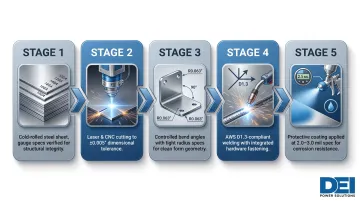
Type 1 enclosure fabrication moves raw sheet metal through cutting, forming, joining, surface treatment, and dimensional verification — with each stage executed against documented procedures and formal quality checkpoints before the enclosure reaches component integration.
Step 1: Material Selection and Preparation
Material choice must align with both application requirements and UL specifications:
- Carbon steel provides cost-effective indoor protection for standard applications
- Stainless steel resists corrosion in cleanroom or chemically exposed environments
- Aluminum reduces weight for structural load-sensitive installations
Certified fabrication requires incoming material inspection and traceability documentation, not merely sourcing the correct alloy. Per industry standards, cold-rolled steel (CRS) maintains dimensional tolerances of ±0.001" per ASTM A1008, with mill certifications providing traceability for material composition and mechanical properties.
Typical gauge specifications for certified enclosures:
| Enclosure Type | Standard Gauge | Thickness |
|---|---|---|
| Wall-mount | 16 ga | 0.060" (1.52mm) |
| Floor-standing | 14 ga | 0.075" (1.91mm) |
Step 2: Precision Cutting and Forming
Core sheet metal operations include:
Laser cutting or CNC punching for panel dimensions and component cutouts, typically held to tolerances of ±0.005" for industrial enclosure fabrication.
Press brake forming creates accurate bends and structural reinforcement. Bend radii must account for material characteristics:
- Cold-rolled steel: 1.5x material thickness
- Stainless steel: 2.0x material thickness (due to higher work-hardening)
Dimensional precision directly determines whether the enclosure achieves the contact protection Type 1 requires. Gaps, inconsistent gauge, or deformed bend radii compromise both personnel protection and structural integrity. Standard tolerances follow ISO 2768-m (±0.1mm) for CNC operations.
Step 3: Welding, Hardware Integration, and Finishing
Welding joins structural elements using TIG, MIG, or spot welding methods governed by AWS D1.3 (Structural Welding Code for Sheet Steel). Quality welding requires qualified procedures, certified welders, and defined acceptance criteria for fusion and penetration.
Hardware integration includes hinges, latches, and mounting brackets that must operate reliably to maintain access control under Type 1 requirements. Faulty latches or hinges directly undermine the access-control protection the Type 1 rating requires — regardless of how well the enclosure body is built.
Finishing protects the enclosure surface without compromising the rating. Industry standard powder coat specifications include:
- Thickness: 2.0-3.0 mils (50-75 microns)
- Pre-treatment: Iron phosphate conversion coating at 50-150 mg/ft²
- Adhesion: Verified daily via ASTM D3359 cross-hatch testing
- Corrosion resistance: Minimum 1,000 hours to 5% surface rust per ASTM B117 salt spray testing
UL labeling and marking requirements — covering placement, content, and traceability — are mandatory elements of certified output, not optional finishing touches.
Where Type 1 Enclosures Are Specified
Type 1 is the right choice for environments where stable indoor conditions and personnel protection from contact are the primary requirements:
- Climate-controlled electrical rooms
- Office and commercial building distribution panels
- Clean manufacturing control stations
- Data center power infrastructure
- Healthcare facility electrical closets
- Industrial control rooms (where airborne contaminants are not present)
These applications cover a wide range of real-world projects. DEI Power regularly supplies Type 1 enclosures for commercial buildings and industrial plants where switchgear supports lighting systems, HVAC controls, machinery power distribution, and process control systems.
Lifecycle Points for Type 1 Specification
Type 1 enclosures appear at specific project phases:
- New construction electrical infrastructure
- Equipment upgrades in existing facilities
- Switchgear and switchboard housing for power distribution systems
- Industrial control panel enclosures for automation equipment
Type 1 is typically a one-time installation choice, but re-evaluation is warranted when environmental conditions change — such as a facility expanding into areas with dust, moisture, or chemical exposure.
Infrastructure modernization is driving steady demand for indoor-rated enclosures. The global electrical enclosure market was valued at $8.32 billion in 2024 and is projected to reach $16.55 billion by 2035 — growth fueled by the same industrial automation and facility upgrades where Type 1 specifications are most common.
Key Factors That Affect Type 1 Enclosure Fabrication
Material and Gauge Consistency
Variation in sheet metal gauge or alloy composition—even within a nominally correct material specification—affects structural rigidity, weld quality, and finish adhesion. Certified fabrication programs address this through incoming inspection protocols that verify material against specifications like ASTM A1008, not just through vendor selection.
Mill certifications provide essential traceability, documenting that material composition and mechanical properties meet design requirements before fabrication begins.
Dimensional Tolerances and Forming Accuracy
Tight tolerances on cutouts, bend angles, and door alignment directly determine whether the enclosure achieves the contact protection Type 1 requires. The process variables that most influence this outcome include:
- Press brake setup and tooling condition
- Operator qualification and experience
- Fixture design and maintenance
- Quality verification methods
Even small deviations from specified tolerances can create gaps that compromise personnel protection or allow dirt ingress beyond acceptable limits.
Surface Finishing and Corrosion Protection
Inadequate powder coat coverage, improper pre-treatment, or pinholes in the finish cause premature corrosion that compromises enclosure integrity over time—even in indoor Type 1 applications. Certified fabrication specifies:
- Finish thickness requirements (2.0-3.0 mils)
- Adhesion testing protocols (ASTM D3359 performed daily)
- Pre-treatment procedures (iron phosphate conversion coating)
- Corrosion resistance targets (1,000+ hours salt spray resistance)
Document these as process requirements, not just final inspection criteria.
Audit Readiness and Documentation
A fabricator's ability to produce traceability records—material certifications, inspection logs, component verification records—is itself a factor in whether an enclosure is truly "certified" or simply built to specification without the paper trail to prove it.
DEI Power maintains documented quality assurance at each production stage—from incoming material inspection through final assembly—so traceability records are available when projects require them.
Buyers should ask fabricators for:
- Current UL authorization status
- Material traceability documentation
- Inspection logs demonstrating ongoing quality verification
- Component verification confirming UL-recognized hardware
Common Misconceptions About Type 1 Enclosures
Misconception 1: "Type 1 and NEMA 1 Are Interchangeable"
While protection expectations are similar, NEMA 1 is self-certified by the manufacturer while UL Type 1 requires third-party verification and ongoing audits. In jurisdictions where inspectors require a listed product, NEMA 1 alone may not be accepted.
The practical implication: always specify UL Type 1 (or verify UL listing) when submitting for AHJ approval under the NEC. Submitting a NEMA 1 self-declaration instead can result in a failed inspection and required rework before the project moves forward.
Misconception 2: "Any Metal Enclosure Built to the Right Dimensions Qualifies as Type 1"
Type 1 certification is not about dimensions alone. It requires the manufacturer to be enrolled in a recognized authorization program with documented processes — an enclosure fabricated outside such a program cannot carry the UL mark, regardless of build accuracy.
Sourcing from fabricators with active UL authorization is what makes the difference. The UL mark reflects a validated manufacturing process, not just the physical characteristics of a finished enclosure.
Misconception 3: "Type 1 Is Sufficient for Any Indoor Application"
Dusty manufacturing floors, areas near washdown zones, or equipment rooms with condensation require Type 12 or higher ratings. Per UL 50E, Type 1 provides no protection against "condensation, icing, corrosion, or contamination" that may occur within the enclosure or enter via unsealed openings.
Defaulting to Type 1 simply because a space is indoors is a common specification error. Airborne dust, dripping water, or corrosive conditions each demand a higher-rated enclosure — and premature failure or compliance gaps are the cost of getting that wrong.
Frequently Asked Questions
What is a UL Type 1 enclosure?
A UL Type 1 enclosure is rated for indoor use, designed to prevent accidental personnel contact with energized components and limit ingress of falling dirt. It is not suitable for wet, dusty, or outdoor environments.
What is the difference between Type 1 and Type 2 enclosures?
Type 2 adds protection against falling water and dripping liquids, making it appropriate for indoor areas near water sources such as mechanical rooms. Type 1 is limited to contact protection and falling dirt.
Can a Type 1 enclosure be used outdoors?
No. Type 1 enclosures are rated for indoor use only and are not suitable for outdoor installation. Outdoor applications require Type 3R at minimum (for protection against rain and sleet) or Type 4/4X for more demanding weather or washdown conditions.
How do UL, NEMA, and IP enclosure ratings compare?
UL and NEMA ratings use similar protection categories (UL Type 1 ≈ NEMA 1), but UL requires third-party testing and periodic manufacturer audits while NEMA compliance is self-declared. IP ratings use a numeric code for solids and liquid ingress per IEC 60529 and are commonly used in European and global specifications. NEMA 1 corresponds to approximately IP10, though exact equivalence varies by product.
What is a Type 1 enclosure CEC?
In most equipment specifications, "Type 1 enclosure" follows the standard NEMA 250/UL 50 definition — not a separate CEC classification. The term may also appear in healthcare electrical system standards (such as Type 1 Essential Electrical Systems per NEC Section 517.29), which is an unrelated use of the label.
What certifications should a fabricator have to manufacture Type 1 enclosures?
Fabricators should hold active UL authorization for the relevant enclosure category and be subject to periodic UL facility audits. Before purchasing, request documentation confirming:
- Current UL authorization status
- Qualified, certified technical staff
- Documented, auditable manufacturing processes