Introduction
Electrical switchgear serves as the critical control and protection layer in every power system — from a commercial building's distribution panel to a utility substation. But not all switchgear is interchangeable.
Voltage class (LV, MV, or HV) is the primary factor that determines design, component selection, standards compliance, and system placement. Choosing the wrong class creates safety risks, code failures, and costly rework.
This article breaks down each of the three types, explains how they differ, where each is used, and how to select the right class for your project.
Key Takeaways
- Switchgear is classified into three types by voltage: LV (up to 1 kV), MV (1–36 kV), and HV (above 36 kV)
- LV handles final distribution; MV manages site-level backbone; HV handles bulk transmission
- Each type follows different standards — UL 891 and IEC 61439 govern LV; IEC 62271 and IEEE C37 cover MV and HV
- Components, insulation methods, and enclosure requirements vary significantly across all three
- The right choice comes down to system voltage, position in the power chain, environment, and applicable standards — equipment cost is rarely the deciding factor
What Is Electrical Switchgear?
Per IEC TC 17 (2022), switchgear is "an essential part of an electric power system used to control, protect and isolate equipment." In practice, that means integrating switching and protective devices — circuit breakers, fuses, disconnect switches, and relays — into a coordinated assembly that manages power distribution across a system.
Switchgear performs two primary roles:
- Routine operation — managing and directing power flow to connected loads under normal conditions
- Fault response — detecting and isolating faults in milliseconds to prevent equipment damage and protect personnel
Why Voltage Classification Matters in Power Systems
Voltage level is the single most critical design parameter in switchgear. Higher voltages require:
- More robust insulation
- Greater physical clearances
- More sophisticated arc-extinguishing methods
- Stricter compliance standards
All of these factors directly affect cost, footprint, and safety requirements.
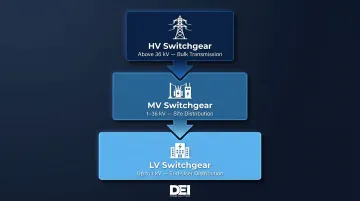
Using equipment outside its rated voltage class is both a code violation and a serious safety hazard — not just a performance mismatch. Before specifying or purchasing any switchgear, knowing which classification applies to your system is the first step toward a compliant, safe installation.
The 3 Main Types of Electrical Switchgear
LV, MV, and HV switchgear are not interchangeable variations of the same product. They are purpose-built for distinct positions in the power delivery chain, each with different engineering requirements, components, and standards.
Low-Voltage (LV) Switchgear
LV switchgear operates at AC voltages up to 1,000 V (1 kV) and serves as the final stage of power distribution — the point where electricity reaches end-use loads such as lighting, HVAC, motors, and outlets.
Typical components include:
- Molded case circuit breakers (MCCBs)
- Air circuit breakers (ACBs)
- Miniature circuit breakers (MCBs)
- Fuses and isolators
These are organized into incomer, sub-incomer, and feeder sections. Standard voltage levels include 120/208V, 240V, 277/480V, 480V, 347/600V, and 600V for North American 60 Hz systems.
LV is the only class where equipment interfaces directly with end users and building systems. It operates at the lowest voltages, requires the shortest insulation clearances, and is governed by standards focused on personnel safety and circuit protection at the load side. Primary standards include:
- UL 891 (North America) — covers dead-front switchboards at 1,000 V or less for general commercial and industrial use
- IEC 61439 (international) — covers low-voltage switchgear and controlgear assemblies
UL 891 covers general-purpose applications (offices, schools, commercial spaces), while UL 1558 covers metal-enclosed LV power circuit breaker switchgear for mission-critical environments requiring greater compartmentalization and arc flash mitigation.
Best suited for:
- Commercial buildings, data centers, and hospitals
- Manufacturing facilities
- Any application distributing power to equipment, lighting, or motor loads at the building or floor level
Key strengths:
- Compact and modular design allows flexible layout and future expansion
- Lower cost and simpler installation compared to MV/HV
- Well-established North American code compliance pathway via UL 891
- Internal compartmentalization in modern LV assemblies limits fault propagation and makes maintenance safer
- Short-circuit withstand ratings tested from 10,000 to 200,000 amperes
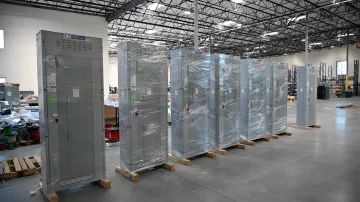
DEI Power manufactures UL 891-certified LV switchboards from 400A to 4000A for commercial and industrial projects. Stock units ship in 3–5 business days; custom builds include in-house engineering support and BABA-compliant construction for federally funded projects.
Limitations/trade-offs:
- Limited to low-voltage applications only — cannot be used where system voltages exceed 1 kV
- Not suitable for primary distribution roles or utility-side applications
- As system scale increases, LV switchgear must be paired with upstream MV or HV equipment
Medium-Voltage (MV) Switchgear
MV switchgear operates between 1 kV and 36 kV AC and serves as the backbone of power distribution networks — receiving power from the high-voltage transmission side (via transformers) and redistributing it to industrial loads, large campuses, or secondary substations.
Primary components include:
- Vacuum circuit breakers (VCBs)
- SF₆ circuit breakers
- Disconnectors
- Instrument transformers
These are housed in metal-enclosed or metal-clad assemblies. Metal-clad switchgear (per IEEE C37.20.2) requires drawout main switching devices, grounded metal barriers completely enclosing all major primary circuit parts, and automatic shutters.
MV occupies the middle tier of the power system — not the final delivery point (that's LV) nor the bulk transmission layer (that's HV). It handles significantly higher fault currents than LV while operating in environments where personnel access is routine, making internal arc flash protection (IAC rating) a critical design and safety requirement.
Governed by:
- IEC 62271-200 (AC metal-enclosed switchgear, 1 kV to 52 kV)
- IEEE C37.20.2 (metal-clad switchgear, 4.76 kV to 48.3 kV)
Note: IEC formally titles the 1 kV–52 kV range as "high-voltage switchgear," but industry practice consistently refers to this range as Medium Voltage.
Best suited for:
- Industrial plants and large-scale manufacturing
- Data center campuses and hospitals
- Utility distribution substations
- Renewable energy facilities
- Sites receiving power at medium voltage from the grid for redistribution to large loads or step-down transformers
Limitations/trade-offs:
- Significantly higher cost and installation complexity than LV
- Arc flash risk is substantially greater, requiring specialized protective equipment for maintenance and strict adherence to IAC ratings
- SF₆-based equipment faces growing regulatory scrutiny — the EU bans SF₆ in new MV switchgear up to 24 kV starting January 2026, and California began phasing out SF₆ in 2025
High-Voltage (HV) Switchgear
HV switchgear operates at voltages above 36 kV — often in the hundreds of kilovolts — and is used at power generation plants, primary transmission substations, and long-distance grid infrastructure. Its role is bulk power transfer, upstream from the distribution tiers handled by MV and LV equipment.
Equipment includes:
- High-voltage SF₆ or air circuit breakers
- Disconnectors
- Instrument transformers
- Earthing switches
Deployed in either air-insulated (AIS) or gas-insulated (GIS) configurations.
HV is the front end of the power system, operating at the highest energy levels furthest upstream from end users. Design challenges here shift away from personnel-accessible enclosures toward extreme insulation integrity, lightning impulse withstand capability, and interrupting enormous fault currents without equipment damage.
Governed by:
- IEC 62271-203 (gas-insulated metal-enclosed switchgear for AC rated voltages above 52 kV)
- IEC 62271-205 (compact switchgear assemblies above 52 kV)
- IEEE C37.20.3 (metal-enclosed interrupter switchgear)
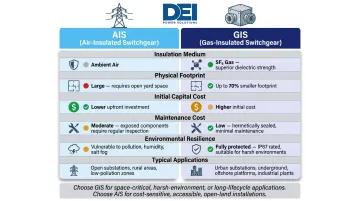
AIS vs. GIS Comparison:
| Factor | AIS (Air-Insulated) | GIS (Gas-Insulated) |
|---|---|---|
| Insulation medium | Ambient air | Gas (traditionally SF₆) in sealed enclosures |
| Footprint | Larger — requires wider clearances | Much more compact |
| Initial cost | Lower upfront equipment cost | Higher due to specialized manufacturing |
| Maintenance cost | Higher over time (environmental exposure) | Lower (sealed design) |
| Environmental resilience | Susceptible to humidity, dust, salt | Sealed against contaminants |
| Typical applications | Industrial plants, outdoor substations, mining | Urban substations, underground, data centers |
Best suited for:
- Utility transmission substations and power generation switchyards
- Grid interconnection points
- Large-scale infrastructure projects moving massive blocks of energy across long distances
Limitations/trade-offs:
- Highest cost and complexity of the three types
- Outdoor AIS installations require substantial land area for electrical clearances
- GIS is more compact but carries SF₆ environmental concerns — SF₆ has a global warming potential (GWP) of 24,300 (per IPCC AR6)
- HV equipment is not applicable to commercial or industrial building power distribution
How to Choose the Right Type of Switchgear
Switchgear selection comes down to two primary factors: where in the power system the equipment will be installed and what voltage it will operate at. Getting either wrong creates compliance, safety, and performance problems that are expensive to fix after the fact.
Factor 1 — System Voltage
Confirm the actual operating voltage of the circuit being controlled or protected:
- LV: Up to 1 kV
- MV: 1–36 kV (IEC); 4.76–48.3 kV (IEEE C37.20.2)
- HV: Above 36 kV (IEC); above 52 kV in some classifications
If the voltage falls at a boundary (e.g., 33 kV), consult the applicable regional standard to confirm classification. 33 kV is classified as MV under both IEC and IEEE standards.
Factor 2 — Position in the Power System and Load Type
Determine whether the equipment is:
- Serving end-user loads (LV)
- Redistributing power across a site or to step-down transformers (MV)
- Handling bulk transmission (HV)
Also consider whether loads are critical (data centers, hospitals) where withdrawable/modular designs and high service continuity are essential.
Factor 3 — Installation Environment and Applicable Standards
Indoor commercial and industrial installations typically call for LV or MV metal-enclosed equipment meeting:
- UL 891, UL 1558, or IEC 61439
Outdoor or utility-scale installations may require HV-rated AIS or GIS equipment meeting IEEE/IEC transmission standards.
NEMA enclosure ratings govern environmental protection for LV equipment in North America:
| NEMA Type | Environment | Protection Level |
|---|---|---|
| 1 | Indoor | Protection against access to hazardous parts; ingress of solid foreign objects (falling dirt) |
| 3R | Indoor or outdoor | Protection against falling dirt, rain, sleet, snow; undamaged by external ice formation |
| 4 | Indoor or outdoor | Protection against windblown dust, rain, sleet, snow, splashing water, hose-directed water |
| 4X | Indoor or outdoor | Same as Type 4 with additional corrosion resistance |
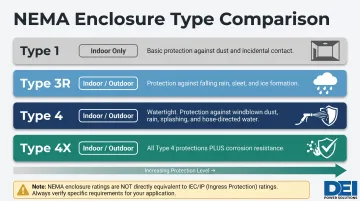
Note: Per NEMA's FAQ document, "It is not possible to state that an IP degree rating is equivalent to a NEMA Type designation." NEMA types include tests for icing, corrosion resistance, and construction details that IP ratings do not address.
Factor 4 — Maintenance Requirements and Uptime Criticality
For facilities where downtime is costly (data centers, manufacturing, healthcare):
- Specify withdrawable-design MV switchgear to enable live-aisle maintenance
- Ensure LV switchboards have proper internal compartmentalization
For HV applications, factor in clearance requirements and whether AIS or compact GIS better fits the site footprint.
For LV projects requiring USA-manufactured, BABA-compliant switchgear, DEI Power builds UL 891-certified switchboards to project specs from its Ontario, California facility, with 4–6 week lead times and full submittals for federally funded work.
What to Check Before Finalizing Your Switchgear Selection
Before committing to a voltage class or equipment type, run through these three checkpoints:
- Match voltage class to actual system requirements. Specifying MV equipment for an LV application adds cost, complexity, and maintenance burden with no operational benefit. Confirm system voltage before selecting a type.
- Verify listings and certifications for your jurisdiction. Equipment must carry the correct certification for the installation type — for example, UL 891 for LV switchboards in North America and appropriate NEMA enclosure ratings for the environment. Unlisted equipment can fail inspection, delay projects, and void insurance coverage.
- Weigh lifecycle cost, not just purchase price. Each switchgear type carries trade-offs between upfront cost and long-term operational cost — including maintenance complexity, arc flash hazard management, and service continuity. The lowest-cost option at purchase often carries the highest cost over the system's life.
Conclusion
LV, MV, and HV switchgear each serve a distinct role in the power delivery chain. LV distributes power to end users, MV manages distribution across sites and substations, and HV handles bulk transmission. The right choice depends entirely on where the equipment sits in the system and what it needs to do.
Matching the right switchgear type to the application's voltage level, position in the system, standards requirements, and uptime needs ensures safety, code compliance, and long-term reliability.
For projects requiring UL 891-certified low-voltage switchgear — from 400A service entrances to 4000A main distribution assemblies — DEI Power manufactures and ships from Ontario, California, with some of the fastest lead times in the industry. Contact the team at sales@deipower.com or call (866) 773-8050 to discuss your project specs.
Frequently Asked Questions
What are LV, MV and HV switchgear, and what is the difference between them?
LV switchgear operates up to 1 kV and handles end-user distribution; MV operates from 1–36 kV and manages site-level or grid backbone distribution; HV operates above 36 kV for bulk transmission. Each type uses different components, insulation methods, and must meet different engineering standards (e.g., UL 891/IEC 61439 for LV; IEC 62271/IEEE C37 for MV/HV).
What are the three sections of switchgear?
LV switchgear assemblies are typically organized into three sections: the incomer (main breaker receiving power from the supply), the sub-incomer (intermediate breakers managing major sub-circuits), and feeders (individual circuit breakers or fuses supplying specific loads). This functional organization is common industry practice for managing power distribution efficiently.
Is 33 kV considered MV or HV?
33 kV falls within the MV range under IEC standards (which define MV as 1–36 kV), making it medium voltage in most international and North American contexts. IEC 62271-200 covers up to 52 kV, and IEEE C37.20.2 covers metal-clad switchgear from 4.76 kV to 48.3 kV. Always verify against the applicable regional standard for the project, as terminology can vary.
What is an MV-to-LV substation?
An MV-to-LV substation (also called a distribution or unit substation) is a facility where a transformer steps medium-voltage supply (e.g., 13.8 kV or 4.16 kV) down to low voltage (e.g., 480V or 208V) for building or facility distribution. It includes MV switchgear on the incoming side and LV switchgear or switchboards on the outgoing side.
What does NEMA 1 mean, and can a NEMA 1 enclosure be used outside?
NEMA 1 is the most basic enclosure rating, designed for indoor use only. It protects against incidental contact with enclosed equipment but offers no protection against moisture, dust, or weather, making it unsuitable for outdoor installation where NEMA 3R or higher ratings are required.
What is 6.6 kV switchgear and where is it used?
6.6 kV is a medium-voltage level commonly used in industrial facilities, mining operations, and offshore platforms — particularly where it serves as the standard distribution voltage for large motors and equipment. IEC 60038 lists 6.6 kV as a standard nominal voltage for three-phase AC systems in the 1 kV to 35 kV range.