Introduction
Electrical contractors, engineers, and facility teams regularly encounter "service entrance-rated" on project specs and equipment submittals—but confusion often surrounds what this designation actually means, how it differs from standard distribution switchgear, and when NEC code explicitly requires it.
Specifying the wrong equipment type at the utility service point carries real consequences. Non-SE-rated switchgear installed where SE-rated is required will fail AHJ inspection, trigger costly field rework, delay project completion, and create safety hazards during fault conditions.
This guide covers what you need to know to specify and select correctly:
- What "service entrance-rated" actually means and how it's defined
- The technical features that make switchgear SE-rated
- How SE-rated equipment differs from standard distribution switchgear
- Applicable NEC requirements under Article 230
- Practical guidance for selecting the right configuration for your application
Key Takeaways
- SE-rated switchgear is the first disconnect and overcurrent protection point between utility power and a building's electrical system (NEC Article 230)
- UL listing and the "suitable for use as service equipment" label (NEC 230.66) are non-negotiable requirements—not optional markings
- Integrated overcurrent protection and a disconnecting means must live in the same enclosure; downstream gear does not qualify
- Wrong equipment means failed inspections and costly rework—coordinate with your utility and AHJ early
What Is Service Entrance-Rated Switchgear?
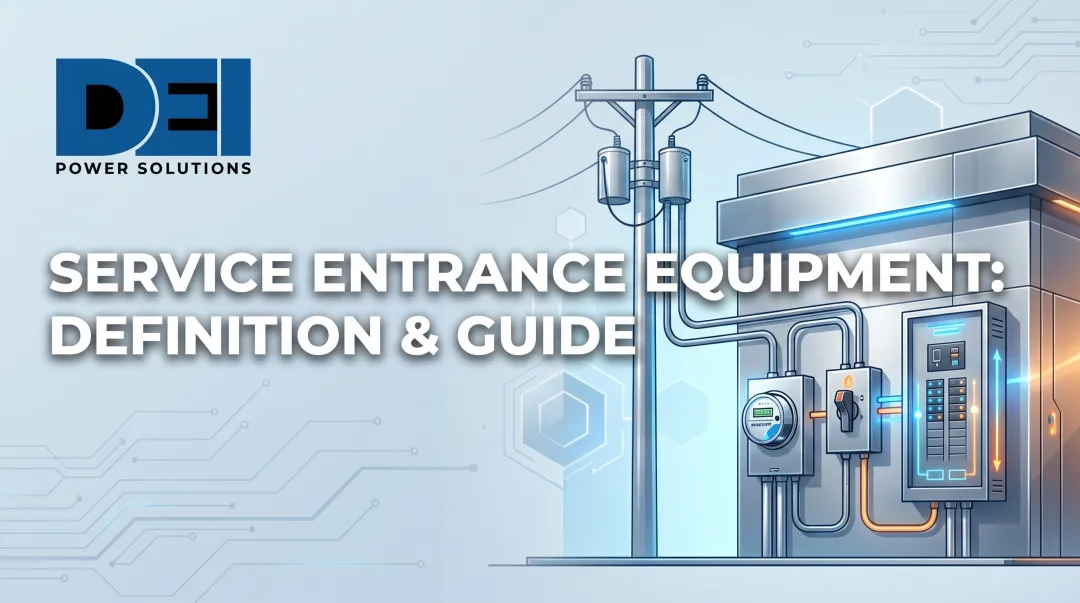
Service entrance-rated switchgear is electrical equipment specifically listed and approved for installation at the point where utility power enters a building, functioning simultaneously as the main disconnect and overcurrent protective device for the entire electrical service. That classification is code-driven: the equipment must be engineered, tested, and listed to handle unprotected utility-side current before any building-side protection exists.
The Service Equipment Designation
The NEC defines "Service Equipment" in Article 100 as "the necessary equipment, consisting of a circuit breaker(s) or switch(es) and fuse(s) and their accessories, connected to the serving utility and intended to constitute the main control and disconnect of the serving utility." The equipment must serve both functions: main control and main disconnect from the utility supply.
NEC 230.66 establishes the marking requirement: "Service equipment rated at 1000 volts or less shall be marked to identify it as being suitable for use as service equipment." Since the 2014 NEC, all service equipment must be listed by a Nationally Recognized Testing Laboratory (NRTL); the 2017 edition expanded this to "listed or field labeled."
Physical and Functional Role
SE-rated switchgear is the first piece of electrical equipment on the load side of the utility meter. At this location, utility conductors arrive without any upstream overcurrent protection — so the equipment must be specifically rated to handle fault currents before they reach anything downstream. SE-rated switchgear handles three core functions at that point:
- Controls the incoming utility supply to the building
- Protects the downstream system against overcurrent and fault events
- Isolates the entire electrical service when required
Regular distribution-grade switchgear is neither designed nor listed for this role. Equipment at the service entrance faces higher available fault current than anything deeper in the distribution system, which is why the service equipment designation exists as a distinct code category.
UL 891 and Other Applicable Listings
UL 891 covers low-voltage switchboards rated at 1,000V or less and serves as the primary product standard for SE-rated switchboards in commercial and industrial applications. Annex G permits design variations up to 4000A at 480V and 100kA SCCR for U.S. constructions without requiring full UL re-evaluation.
Meeting those UL 891 thresholds in practice requires more than component selection — it demands controlled manufacturing and verified assembly. DEI Power builds UL 891-certified switchboards from 400A to 4000A at their Ontario, California facility, using genuine Siemens components as an approved Siemens OEM. Each unit is manufactured to meet service equipment requirements across multiple voltage configurations.
What Is a Service Entrance?
The service entrance is the point where utility conductors connect to a building's wiring system—typically at or just past the utility meter. Everything on the building side of this point falls under the responsibility of the building owner and must comply with NEC Article 230.
Components of a Service Entrance
Three elements define a service entrance:
- Service conductors — utility-supplied wiring that terminates at the building connection point
- Service disconnect — the main switching device that isolates the building from utility power
- Overcurrent protection — circuit breakers or fuses that protect against overload and fault conditions
Why Service Entrance Matters for Switchgear Selection
Utility-side conductors arrive without any upstream protection, which means standard distribution equipment is not designed or listed to handle this condition. Service entrance equipment must be specifically rated to interrupt fault currents at the utility connection point—where available short-circuit current can reach 3.5 kA to 63 kA for typical 480V services, depending on transformer size.
Common Points of Confusion
The service entrance is not the utility meter enclosure (which remains utility property). NEC 230.66 explicitly states: "Individual meter socket enclosures shall not be considered service equipment." Nor is it the main distribution panel located downstream. The service entrance is where the building legally takes ownership of incoming power—nothing upstream of that point is the facility's responsibility.
Service Entrance-Rated vs. Non-Service Entrance-Rated Switchgear
Understanding the difference between SE-rated and non-SE-rated switchgear is critical for code compliance and proper system design.
Defining Non-SE-Rated Switchgear
Non-SE-rated switchgear is designed to be installed downstream of a separately installed service disconnect. It lacks integrated overcurrent protection at the utility-side connection point and cannot legally serve as the first disconnect means from utility power.
Installation and Structural Differences
The core distinction comes down to where each type lives in the system and what it integrates. SE-rated switchgear includes a built-in, listed main disconnect with overcurrent protection in the same enclosure as the service conductors. Non-SE-rated switchgear assumes protection already exists upstream and is designed for distribution applications only.
| Equipment Type | Installation Location | Code Compliance | |----------------|----------------------|-----------------|| | SE-rated switchgear | Can be the first and only disconnect between meter and building distribution | Complies with NEC 230 service equipment requirements | | Non-SE-rated switchgear | Must be installed after a separately mounted, code-compliant service disconnect | Cannot serve as service equipment |
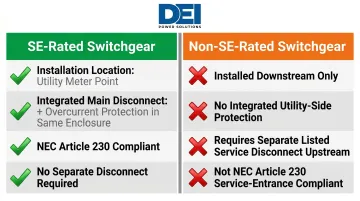
This placement difference affects both project cost and installation scope. SE-rated switchgear eliminates the need for a separate disconnect enclosure, reducing conduit runs, equipment footprint, and total installed cost—especially relevant in new construction and ground-up industrial projects.
Cost and Complexity Tradeoff
SE-rated switchgear typically costs more upfront due to integrated components and specialized listings. However, it reduces total installed cost by eliminating:
- Separate service disconnect panel
- Additional enclosure and mounting hardware
- Conduit runs between disconnect and distribution equipment
- Additional installation labor
For many projects, the integrated approach delivers lower total cost and a cleaner installation. That cost efficiency, however, only holds when the equipment is correctly specified — which makes compliance the other side of the same equation.
Compliance Risk
Inspectors and AHJs verify that equipment at the service entrance point carries the correct listing and marking. Installing non-SE-rated equipment at this location will fail inspection. The result: costly rework, project delays, and potential safety code violations requiring correction before the system can be energized.
Key Technical Features of SE-Rated Switchgear
SE-rated switchgear carries specific technical requirements that standard distribution equipment doesn't have to meet — starting with how it handles fault current from the utility with no upstream protection to fall back on.
Integrated Main Disconnect with Overcurrent Protection
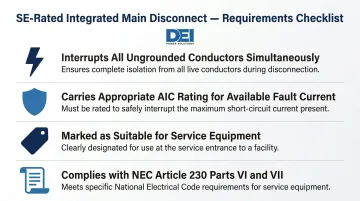
SE-rated switchgear must include a listed main circuit breaker or fused switch capable of interrupting fault current from the utility without relying on any upstream protection. The integrated disconnect must:
- Interrupt all ungrounded service conductors simultaneously
- Carry appropriate interrupting rating (AIC) for the available fault current
- Be marked as suitable for use as service equipment
- Comply with NEC Article 230 Part VI (disconnecting means) and Part VII (overcurrent protection)
Short-Circuit Current Rating (SCCR) and Interrupting Capacity
SE-rated switchgear must be rated for the available fault current at the service entrance, which often exceeds fault currents deeper in the distribution system.
Three NEC sections establish fault current requirements:
- NEC 110.9 (Interrupting Rating) — overcurrent devices must have interrupting ratings equal to or greater than the current available at line terminals
- NEC 110.10 (SCCR) — equipment SCCR must be selected and coordinated to permit circuit protective devices to clear faults without extensive damage
- NEC 110.24 (Fault Current Marking) — service equipment in non-dwelling units must be field-marked with maximum available fault current and calculation date
Typical available fault current ranges:
| Service Voltage | Transformer Range | Approximate Fault Current |
|---|---|---|
| 480/277V | 75 kVA to 3750 kVA | 3.5 kA to 63 kA |
| 120/208V | 75 kVA to 1500 kVA | 7.6 kA to 63 kA |
Standard equipment SCCR ratings are available at 10 kA, 14 kA, 22 kA, 35 kA, 42 kA, 65 kA, and 100 kA. Specifiers must match the switchgear's SCCR to the utility's available short-circuit current at the point of connection.
Listing and Labeling Requirements
Fault current compliance only matters if the equipment carries valid listing marks. SE-rated switchgear must be labeled as suitable for use as service equipment and comply with both:
- Product standard (for example, UL 891 for switchboards)
- NEC Article 230 Part V requirements for service equipment
NEC 110.3(B) requires listed equipment to be installed per the manufacturer's listing instructions. AHJs verify NRTL certification marks against the OSHA list of nationally recognized testing laboratories per NEC 110.3(C).
Where SE-Rated Switchgear Is Required
NEC Article 230 applies to all buildings receiving utility service regardless of occupancy type. No occupancy-specific exemption exists from service entrance equipment requirements.
Commercial Buildings and Campuses
Any multi-tenant building, office complex, or campus facility where utility power enters at a central switchboard location requires service entrance equipment at that point. SE-rated switchgear serves as the building's main service equipment, providing:
- Single point of utility disconnect
- Overcurrent protection for entire facility
- Code-compliant service entrance configuration
- Foundation for downstream distribution system
Industrial Plants, Data Centers, and Critical Infrastructure
Large facilities with high-amperage services require switchgear capable of handling utility-level fault current. That equipment must also serve as both the primary disconnect and overcurrent protection. Common applications include:
- Manufacturing plants with 2000A+ services
- Hyperscale data centers requiring 4000A main switchboards
- Hospitals and healthcare facilities with critical power systems
- Water treatment facilities and municipal infrastructure
- Energy production and distribution facilities
These facilities often face available fault currents in the 42 kA to 65 kA range, requiring equipment with appropriately rated SCCR and AIC values.
New Construction vs. Retrofit Considerations
| Scenario | Key Consideration |
|---|---|
| New construction | SE-rated switchgear is standard practice — it simplifies design, eliminates a separate disconnect panel, and typically offers the most direct path to code compliance. |
| Retrofit or upgrade | Before specifying replacement gear, evaluate whether existing upstream equipment already provides a compliant service disconnect. If a listed disconnect remains in service, downstream distribution equipment may not require SE rating. |
How to Choose the Right SE-Rated Switchgear for Your Project
Three steps ensure proper equipment selection and code compliance.
Start with Utility Coordination Data
Before specifying any SE-rated switchgear, obtain three critical values from the utility:
- Available short-circuit current (in kA) at the point of service — drives the switchgear's SCCR rating and breaker interrupting capacity
- Service voltage — determines voltage class and wiring configuration (208Y/120V, 480Y/277V, etc.)
- Metering requirements — may dictate enclosure configuration, compartmentalization, and meter socket integration
Contact the utility early in design to request a formal fault current letter. If utility data is unavailable, use IEEE C57.12.00 standard transformer impedances for conservative calculations. Maintain a file of previous fault letters from the same utility for reference on future projects.
Confirm AHJ and Code Requirements
NEC Article 230 establishes the national baseline, but local jurisdictions often have amendments or specific labeling requirements. Key verification points:
- Approximately 25 states enforce the 2023 NEC; many others still use the 2020 edition — confirm which applies before specifying equipment
- Check for marking or documentation requirements beyond standard NEC provisions, which vary by jurisdiction
- Barrier requirements — NEC 230.62(C) requires barriers in all service equipment to prevent inadvertent contact with energized parts
- Number of disconnects — NEC 230.71 was fundamentally changed in 2020 to require one service disconnect per service, with specific exceptions under 230.71(B)
Confirm requirements with the AHJ before submitting for permit. Under NEC 90.4, the AHJ has final authority to interpret the code, approve or reject listed equipment, and grant special permission.
Once utility data and AHJ requirements are confirmed, the final step is selecting a manufacturer whose documentation and certifications hold up under inspection.
Select a Manufacturer With Documented Compliance and Engineering Support
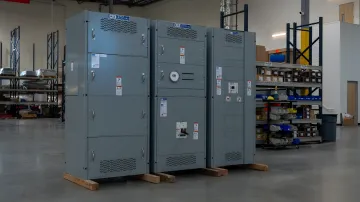
DEI Power manufactures UL 891-certified switchboards for commercial, industrial, and utility applications from a 50,000 sq. ft. facility in Ontario, California. As an approved Siemens OEM with over ten years in the field, their configurations are built to pass inspection — not just meet it on paper.
Key specifications available:
- Amperage range from 400A to 4000A, covering mid-size facilities through hyperscale installations
- Voltage classes including 120/240V, 208Y/120V, 480Y/277V, 415/240V, and custom configurations
- NEMA 1 (indoor) and NEMA 3R (outdoor weather-resistant) enclosure options
- In-house engineering support for specification review, utility coordination, and AHJ documentation
- Build America Buy America (BABA)-compliant domestic manufacturing
- In-stock units ship within 1 business day; custom configurations typically deliver in 4–6 weeks
For service entrance applications with utility-specific requirements, contact DEI Power's specialist team at (866) 773-8050 or sales@deipower.com for configuration guidance and quotes.
Frequently Asked Questions
What is service entrance rated switchgear?
Service entrance-rated switchgear is equipment specifically listed and designed for installation at the utility service entrance point. It incorporates an integrated main disconnect and overcurrent protection, meeting NEC Article 230 and applicable UL listing requirements (typically UL 891 for switchboards).
What is a service entrance?
The service entrance is the point where utility conductors connect to a building's electrical system—typically at or past the utility meter. At this point, the building owner takes legal and physical responsibility for the incoming electrical service.
What is the difference between service entrance rated and non-service entrance rated?
SE-rated equipment includes an integrated main disconnect with overcurrent protection, allowing direct installation at the utility connection point. Non-SE-rated equipment lacks this integration and must be placed downstream of a separately installed, listed service disconnect.
What is the NEC code for service entrances?
NEC Article 230 governs services and requires a means to disconnect all ungrounded service conductors at the point where the service enters the building. Part V of Article 230 specifically covers service equipment requirements, including the marking requirement in NEC 230.66.
What's the difference between ATS and STS?
An ATS (Automatic Transfer Switch) switches between utility and backup power when an outage is detected, with transfer times measured in seconds. An STS (Static Transfer Switch) uses solid-state components for near-zero interruption—typically under 4 milliseconds. SE-rated versions of either device carry dual listings under UL 891 and UL 1008.