Introduction
Service-entrance equipment marks the beginning of the electrical system for commercial, industrial, and institutional buildings. A single missing or improperly installed bonding connection at this critical point compromises safety and reliability across the entire downstream system. When an energized conductor contacts a metal enclosure during a fault, the system's ability to clear that fault safely depends entirely on the bonding connections made at the service entrance.
Bonding often gets treated as a checkbox during installation — yet its consequences show up clearly during fault events, inspection failures, and equipment damage incidents. Grounding and bonding ranks among the top three most common electrical code violation categories encountered during inspections, according to the International Association of Electrical Inspectors.
Understanding why this requirement exists — and what NEC actually demands — is the difference between an installation that passes and one that fails under real-world conditions.
Key Takeaways
- Bonds the grounded conductor, equipment grounding conductors, and enclosures at the service entrance
- Creates the low-impedance fault-current path that enables overcurrent devices to clear faults fast
- Establishes a stable voltage reference, preventing dangerous potential differences between metal parts and earth
- NEC Article 250 mandates bonding via the main bonding jumper, supply-side bonding jumper, and grounding electrode conductor
- Missing or improper bonding leads to shock hazards, uncleared faults, equipment damage, and failed inspections
What Is Service-Entrance Equipment Bonding?
Service-entrance equipment bonding is the intentional electrical connection made at the first point of disconnection where utility power enters a building. This connection joins the grounded conductor (neutral), equipment grounding conductors, and metal enclosures of service equipment, ensuring they share the same electrical potential.
Bonding applies specifically at the service disconnect, main switchboard, or meter-main combination — the first means of disconnection for the premises. It is not performed at downstream subpanels or branch circuit panels.
NEC 250.24(A)(5) explicitly prohibits grounded conductor connections to equipment grounding conductors on the load side of the service disconnecting means. This prevents neutral current from splitting between the neutral conductor and metallic raceways.
Bonding vs. Grounding: Understanding the Difference
These terms are frequently confused but serve distinct functions:
- Bonding (NEC Article 100): connects conductive parts to establish electrical continuity between metal enclosures, conductors, and equipment
- Grounding (NEC Article 100): connects the system to earth through grounding electrodes to stabilize voltage relative to ground
Bonded equipment shares the same potential but is not necessarily grounded unless it's also connected to the grounding electrode system. NEC 250.4 explicitly states "the earth shall not be considered as an effective ground-fault current path" — bonding creates the low-impedance metallic path that enables fault current to trip overcurrent protection, while grounding handles voltage stabilization.
Why Service-Entrance Equipment Bonding Is Necessary
The reasons below focus on what bonding actually does in field conditions, not abstract code theory. Each reason directly affects safety outcomes, system reliability, and operational risk.
Reason 1: It Creates the Low-Impedance Fault-Current Path That Clears Dangerous Faults
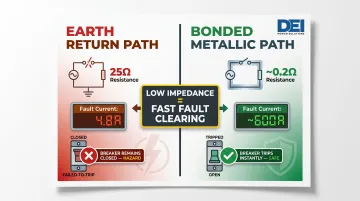
When an energized conductor contacts a metal enclosure or conductive surface, fault current must have a fast, unobstructed path back to the source to cause the circuit breaker or fuse to operate. The main bonding jumper and supply-side bonding jumper create that path by tying equipment grounding conductors and enclosures to the grounded conductor at the service.
Without bonding at the service, fault current has no reliable low-impedance return path. It may attempt to return through the earth, which is a high-impedance path incapable of generating enough current to trip a breaker. On a 120V system with 25-ohm earth resistance, fault current reaches only 4.8A — insufficient to trip a 20A breaker. A metallic path at approximately 0.2 ohms produces approximately 600A, clearing the fault instantaneously.
Why this matters operationally:
A fault that doesn't clear fast enough causes sustained arcing, electrical fires, or lethal shock conditions. Properly bonded service equipment ensures the overcurrent device operates within its rated clearing time, protecting personnel and equipment. NEC 250.4 reinforces this by stating the earth shall not be considered an effective ground-fault current path, making the bonded metallic return path essential.
According to IEEE 1584-2018, arc flash incident energy is directly proportional to fault duration. High-impedance paths that prevent rapid overcurrent device operation extend arc duration and increase incident energy proportionally. The Bureau of Labor Statistics reported 130 electrical fatalities in 2024, with 7 specifically attributed to arc flash exposure.
KPIs impacted: Fault-clearing time, arc flash incident energy, personnel safety outcomes, equipment damage from sustained faults
When this matters most: High-fault-current environments such as commercial switchgear installations, industrial plants, and data center service entrances where rapid fault clearing prevents cascading failures and protects sensitive downstream loads.
Reason 2: It Establishes a Stable Voltage Reference and Prevents Shock Hazards on Exposed Metal Parts
By bonding all metal enclosures, raceways, and equipment frames to the grounded conductor at the service, the system ensures all conductive surfaces remain at the same electrical potential — at or near zero volts relative to earth. Touching any metal surface on a properly bonded system does not expose a person to a voltage difference that could cause shock.
Without bonding, metal parts of service equipment can float to unpredictable voltages during fault conditions, lightning events, or line surges. Bonding at the service anchors all those parts to the same reference point, eliminating dangerous potential differences.
Why this matters operationally:
NEC 250.4(A)(1) requires electrical systems to be grounded to limit voltage imposed by lightning, line surges, or unintentional contact with higher-voltage lines. NEC 250.4(A)(2) requires grounding to stabilize voltage to earth during normal operation. This dual requirement — bonding for continuity and grounding for voltage reference — keeps the system stable during abnormal conditions.
The Electrical Safety Foundation International reports 2,070 occupational electrical fatalities from 2011 to 2024, with ground faults accounting for 4% of those deaths.
Non-fatal injuries tell a similar story: 5,180 electrical injuries involving days away from work occurred in 2023-2024 combined — a 59% increase from the prior period. Proper bonding directly addresses both risks by preventing exposed metal parts from reaching dangerous voltages.
KPIs impacted: Personnel shock injury rates, equipment insulation stress, voltage stability at service entrance, lightning/surge damage incidents
When this matters most: Facilities with large metallic structures, significant worker exposure to electrical equipment, or high lightning strike frequency — including industrial plants, substations, and utility infrastructure where personnel regularly interact with service-entrance equipment.
Reason 3: It Satisfies NEC Code Compliance and Enables Inspection Approval
NEC Article 250 mandates specific bonding connections at the service. Failure to install these correctly results in code violations that prevent occupancy approvals and create liability exposure.
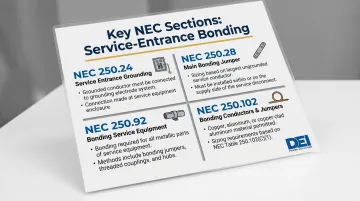
Key NEC sections governing service-entrance bonding:
| NEC Section | Requirement |
|---|---|
| 250.24 | Main bonding jumper, grounding electrode conductor connection, grounded conductor routing |
| 250.28 | Materials (copper, aluminum, copper-clad aluminum, or corrosion-resistant), sizing per 250.102 |
| 250.92 | Four acceptable bonding methods; standard locknuts/bushings not permitted as sole bonding means |
| 250.102 | Sizing requirements for supply-side bonding jumpers |
NEC Table 250.102(C)(1) specifies minimum sizing based on the largest ungrounded service conductor. When conductors exceed 1100 kcmil copper or 1750 kcmil aluminum, the supply-side bonding jumper must be at least 12.5% of the circular mil area of the largest ungrounded conductor.
Those sizing requirements leave room for field error when conductors are selected and terminated on-site. Starting with UL 891-certified switchboards — like those manufactured by DEI Power — means bonding provisions, bus configurations, and conductor termination points are engineered to NEC requirements from the factory, reducing the variables that lead to failed inspections and change orders.
Why this matters operationally:
Non-compliant bonding is among the most commonly cited deficiencies during electrical inspections. A missed or undersized bonding jumper halts projects, triggers costly change orders, and delays energization — outcomes that directly affect project schedules and budgets. Improper bonding discovered after energization may require de-energizing the service to remediate, a significant operational disruption in mission-critical facilities.
KPIs impacted: Inspection pass rates, project completion schedules, change order frequency, liability exposure on failed inspections or post-incident investigations
When this matters most: New service installations, switchgear upgrades, and tenant improvement projects where Authority Having Jurisdiction inspections are required before the service can be energized.
What Happens When Service-Entrance Bonding Is Missing or Done Wrong
Unbonded or improperly bonded service-entrance equipment creates fault currents with no reliable low-impedance return path. Breakers may fail to trip or trip slowly, allowing faults to sustain long enough to ignite insulation, melt conductors, or cause arc flash events that damage equipment and injure personnel.
A common error involves bonding neutral to ground at multiple locations downstream. When grounded conductors and equipment grounding conductors are bonded at subpanels in addition to the service, return current flows on both the neutral and grounding conductors simultaneously.
This creates "objectionable current" on metal enclosures, conduit, and equipment frames that personnel may contact. NEC 250.6 specifically requires systems to be arranged to prevent this condition.
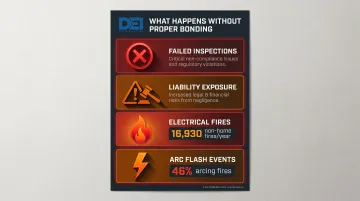
Inspection and liability consequences compound these risks:
- Systems without proper service-entrance bonding fail inspection outright
- Contractors, engineers, and facility owners face significant liability if a fault occurs on an unbonded system
- NFPA data shows 16,930 non-home electrical distribution fires per year, resulting in 22 deaths, 210 injuries, and $718 million in property damage annually
- Arcing was involved in 46% of those fires — improper bonding directly contributes to conditions that allow sustained arcing
How to Get the Most from Service-Entrance Equipment Bonding
Bonding delivers full value only when applied correctly and consistently:
Proper sizing and installation:
- Size the main bonding jumper per NEC Table 250.102(C)(1)
- Install at the service disconnect enclosure, not downstream
- Use corrosion-resistant materials with listed connectors
- Verify bonding conductor sizing when ungrounded conductors are upsized for voltage drop — the bonding jumper must be scaled proportionally per NEC 250.102(C)
Equipment selection:
Equipment that supports correct bonding from the factory reduces field errors and inspection callbacks. Look for:
- Listed grounding and bonding provisions built into the enclosure
- Proper neutral-to-ground separation features
- Clearly identified termination points for bonding conductors
- Bus configurations that match NEC-required conductor sizing
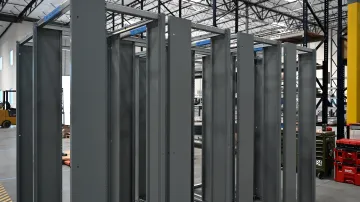
DEI Power's UL 891-certified switchboards are manufactured with Siemens components and include factory-set bonding provisions designed to meet NEC requirements. As an approved Siemens OEM, DEI Power uses matched Siemens bus components with pre-verified termination points — reducing the field adjustments that lead to inspection delays.
Ongoing verification:
Don't treat bonding as a one-time installation task:
- Verify connections during commissioning
- Re-inspect after any service modifications or equipment additions
- Review when calculating available fault current changes
- Changes in utility source or service conductor sizing may require re-sizing bonding conductors
Conclusion
Service-entrance equipment bonding is the foundational protection mechanism that makes fault-current clearing possible, stabilizes voltage across the entire system, and keeps exposed metal parts safe to touch. Without it, the most critical safety systems in a building cannot function as designed.
Getting bonding right at the service — through correct sizing, proper placement, compliant materials, and code-specified connections — is an investment in long-term system reliability, personnel safety, and AHJ sign-off. When a fault occurs, a properly bonded system clears it. When an inspector arrives, a properly bonded system passes. There's no substitute for getting it right the first time.
Frequently Asked Questions
Why is bonding service entrance equipment necessary?
Bonding service-entrance equipment creates the low-impedance fault-current return path required for overcurrent devices to clear faults quickly, stabilizes the voltage reference across the system, and prevents exposed metal enclosures from reaching dangerous voltages during fault or surge events.
Is there a difference between bonding and grounding equipment?
Grounding connects the electrical system to earth through grounding electrodes, while bonding connects conductive metal parts to ensure electrical continuity. Bonded equipment shares the same potential but is not considered grounded unless it's also connected to the grounding electrode system.
What is the NEC code for grounding and bonding?
NEC Article 250 governs grounding and bonding requirements for electrical systems under 1,000 volts AC. It covers grounding electrode systems, equipment grounding conductors, bonding jumpers, and service-entrance bonding requirements.
What is the NEC code for bonding bushing?
NEC 250.92 and 250.97 address bonding requirements for service-entrance conduit and metal enclosures, including use of bonding bushings with a bonding jumper when standard locknuts alone cannot ensure electrical continuity across the enclosure entry point.
What is the NEC Code 250.64 C?
NEC 250.64(C) addresses installation of grounding electrode conductors, specifying that conductors run to rod, pipe, or plate electrodes shall be protected from physical damage and, if spliced, shall use listed means. The section also covers ferrous metal enclosure requirements to prevent inductive heating.
Does low voltage need to be grounded?
NEC Article 250 applies to systems under 1,000 volts. Solidly grounded AC systems at voltages such as 120/240V or 208Y/120V are required to be grounded. Some low-voltage systems may qualify as ungrounded or impedance-grounded, each with separate NEC requirements under Article 250.