Introduction
When energy bills spike or tenants dispute charges, the root cause often traces back to one thing: not knowing where power is actually going. In commercial, industrial, and multi-tenant facilities, two different types of meters serve that accountability function — the main meter and the submeter — and confusing one for the other creates real problems in billing, compliance, and energy management.
The main meter is the utility's instrument, recording total consumption at the service entrance. Submeters are yours — installed downstream to track usage at the circuit, tenant, or equipment level. Understanding how they differ in function, ownership, and application determines how well you can control costs and meet code.
This article breaks down how each meter type works, where they sit in a power distribution system, and when you need one versus the other.
Key Takeaways
- A main meter is installed by the utility at the service entrance and measures total facility consumption
- Submeters sit downstream in the distribution system, tracking consumption by individual tenant, floor, or load
- The two differ in ownership, placement, billing purpose, and how granularly they report usage
- Submeters work alongside main meters to provide deeper visibility into power usage
- Choosing between them — or combining both — comes down to facility type, tenant count, and energy management goals
Main Meter vs. Submeter: Quick Comparison
| Attribute | Main Meter | Submeter |
|---|---|---|
| Installed by | Utility company | Property owner or facility manager |
| Owned/maintained by | Utility company | Property owner or facility manager |
| Placement | Service entrance, before main disconnect | Downstream within distribution system |
| What it measures | Total building consumption | Specific tenant, department, or load |
| Data granularity | Single aggregate reading | Detailed, circuit-level data |
| Used for billing by | Utility company | Property owner (tenant billing or cost allocation) |
| Typical applications | All buildings with electrical service | Multi-tenant buildings, data centers, hospitals, industrial plants |
| Integration with switchgear | Before main switchboard | Within or alongside distribution panels and switchboards |
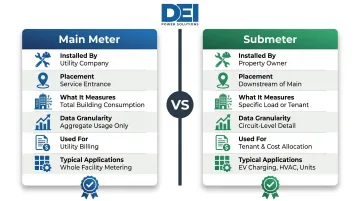
These two meter types work together, not in opposition. Most large commercial and industrial facilities use both—the main meter serves the utility billing function while submeters provide internal load visibility.
What is a Main Meter?
A main meter is the utility-grade metering device installed at a building's service entrance, typically near the utility transformer connection point. It measures total electrical energy consumed by the entire property and generates the electricity bill.
Also called a "utility meter," "service meter," or "master meter," it establishes the billing boundary between the utility company and the customer.
Ownership and Regulatory Role
The main meter is owned and maintained by the utility company. Property owners have no authority to modify, bypass, or tamper with it. Main meters must meet utility accuracy and revenue-grade metering standards governed by ANSI C12.1, with accuracy classes of 0.1% (+/-0.1%), 0.2% (+/-0.2%), or 0.5% (+/-0.5%) at full load. Under standard US utility tariff rules, the customer owns the meter socket but the utility owns the meter itself.
Physical Placement
The main meter sits between the utility transformer and the building's main electrical service entrance—before the main disconnect or main switchboard. In large facilities, there may be multiple utility meters serving different service entrances, but each still feeds a distinct main distribution point.
Limitations
While the main meter provides accurate total consumption data, it gives no insight into how that energy is distributed internally. In a multi-tenant building, data center, or campus with multiple departments, a single main meter cannot identify where waste or inefficiency is occurring.
Use Cases of a Main Meter
A main meter alone is sufficient when one entity owns and pays for the full energy load. Typical applications include:
- Single-tenant commercial buildings where one entity pays the full utility bill
- Small industrial facilities with a single operational owner
- Standalone structures like warehouses, retail locations, or office buildings
In facilities like data centers, manufacturing plants, or multi-building campuses, the main meter sets the total consumption baseline — but submeters are needed to break that figure down by tenant, system, or load type.
What is a Submeter?
A submeter is any secondary metering device installed downstream of the utility's main meter, within the building's own electrical distribution infrastructure. It measures consumption for a specific load, circuit, tenant space, floor, department, or piece of equipment—not for the entire building.
Unlike the main meter, submeters are owned, installed, and maintained by the property owner or facility manager—meaning procurement, installation, calibration, and ongoing maintenance fall to the building side of the equation.
Physically, submeters install within or alongside distribution switchboards, panelboards, or power distribution units (PDUs), downstream of the main service entrance. Proper integration requires accurate configuration to match voltage, CT ratios, and load characteristics. DEI Power's UL 891-certified switchboards (400A–4000A) and Remote Power Panels (225A–1200A) are routinely specified with integrated submetering compartments, supporting branch circuit monitoring and precise CT sizing to project specifications.
Types of Submetering
- Tenant submetering bills individual occupants based on actual consumption, not square footage
- Departmental submetering allocates costs by cost center across universities, hospitals, or corporate campuses
- Plant and equipment submetering tracks efficiency of specific systems—HVAC, lighting, or manufacturing lines
- Circuit-level submetering monitors individual loads in data centers and industrial facilities with high granularity
Data and Operational Benefits
Submeters provide granular, real-time consumption data that main meters cannot. Facility managers use this data to:
- Identify energy waste and inefficiency
- Benchmark department performance
- Detect equipment anomalies early
- Support sustainability reporting
- Resolve tenant billing disputes with actual measured usage
Where Submeters Deliver the Most Value
- Multi-tenant commercial buildings and apartment complexes recover unmetered energy costs through per-unit billing
- Data centers and colocation facilities track per-client or per-rack consumption for billing accuracy and capacity planning
- Healthcare facilities allocate department-level costs without manual estimates
- Industrial plants monitor process efficiency and catch underperforming equipment before it escalates
- University campuses drive accountability and behavioral change through departmental reporting
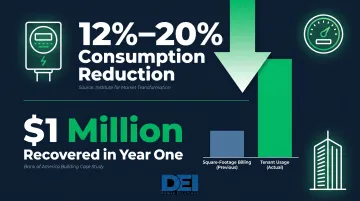
According to the Institute for Market Transformation, providing tenants with specific energy use information through submetering leads to consumption reductions of 12% to 20% in residential contexts. At the Bank of America Building in San Francisco, installing 120 tenant submeters recovered approximately $1 million in energy costs in the first year. Tenant usage had exceeded square-footage-based billing rates by 300%.
Main Meter vs. Submeter: Which is Right for Your Facility?
The decision isn't either/or—it's about understanding what each does and when adding submeters makes operational or financial sense.
Key Decision Factors
- Number of tenants or cost centers
- Size and complexity of the facility
- Energy management goals
- Local codes or utility regulations requiring submetering
- Cost of installation vs. value of granular data
When the Main Meter Alone Is Sufficient
A main meter alone works for:
- Single-tenant, single-owner facilities with no need to allocate costs internally
- Smaller buildings with simple, predictable load profiles
- Situations where flat-rate or ratio utility billing is adequate and cost-effective
When Submetering Is the Right Addition
Submetering becomes valuable for:
- Multi-tenant buildings where fair, usage-based billing is required
- Facilities with high energy costs needing to identify efficiency opportunities
- Data centers or industrial operations where load monitoring is critical to uptime
- Buildings in jurisdictions that mandate submetering
Many jurisdictions now require submetering by law. For example:
- New York City Local Law 88: Buildings over 50,000 sq ft with tenant spaces over 10,000 sq ft must install submeters by January 1, 2025
- California Title 24: New multi-unit buildings started after January 1, 2018 require mandatory submeters for water, gas, and electric
- IECC 2024: Commercial buildings 10,000 sq ft and larger require end-use submetering with data recorded at 15-minute intervals
Beyond these state and municipal rules, ASHRAE Standard 90.1, Section 8.4.3 requires separate metering for buildings over 25,000 square feet, covering total electrical energy, HVAC, interior lighting, exterior lighting, receptacles, and process loads.
Practical Infrastructure Note
Adding submeters requires proper placement within the existing power distribution system. For facilities undergoing new construction or switchgear upgrades, this is the right time to design submeter integration into the switchboard configuration: CT sizing, metering ports, and communication interfaces are far easier to specify upfront than to retrofit later.
DEI Power's custom manufacturing process supports switchboards configured to spec with metering provisions built in. Typical lead times are 4–6 weeks for custom orders and 3–5 business days for in-stock units. Engineers or contractors specifying projects with submeter integration can reach DEI Power at (866) 773-8050 or sales@deipower.com to discuss CT configurations, technical requirements, and system layout options.
Conclusion
Main meters and submeters serve different but complementary roles. The main meter establishes the total billing boundary with the utility; submeters provide the internal visibility needed to manage, allocate, and reduce that consumption. Neither replaces the other—together, they give facility operators a complete picture of power usage.
The choice connects directly to real operational outcomes:
- Accurate tenant billing
- Reduced energy waste
- Better capital planning
- Code compliance
- Faster detection of energy anomalies and losses
Evaluate your facility's complexity, energy goals, and regulatory requirements to determine the right metering strategy. For facilities with multiple tenants, high energy costs, or demanding efficiency targets, submetering is frequently mandated by code and delivers the granular data needed to make confident operational and capital decisions.
Frequently Asked Questions
What is the difference between a main meter and a submeter?
A main meter is installed by the utility at the building's service entrance to measure total consumption for billing purposes. A submeter is installed downstream within the building to track usage for a specific tenant, department, or load, with the property owner responsible for the submeter.
How to tell if a meter is a submeter?
A submeter is located inside the building—not at the service entrance—is not sealed or maintained by the utility, and measures only a portion of the total load. It's typically found near distribution panels, switchboards, or tenant electrical rooms.
Can a building have both a main meter and submeters?
Yes, most commercial and industrial buildings use both. The main meter handles utility billing for the entire facility, while submeters track consumption internally for specific areas or tenants. The sum of all submeter readings generally reconciles against the main meter total.
Who is responsible for maintaining a submeter?
The property owner or facility manager is responsible for submeters—not the utility. This includes installation, periodic calibration, and any repairs or replacements over time.
Do submeters require approval from the utility company?
Submeters sit on the customer's side of the utility meter and generally don't require utility approval. That said, some jurisdictions mandate accuracy standards, certifications (such as ANSI C12.1 or CTEP in California), or tenant notification. Verify local codes before installation.
What types of facilities benefit most from submetering?
Multi-tenant commercial buildings, data centers, hospitals, university campuses, and industrial facilities benefit most from submetering—particularly those with multiple cost centers, high energy spend, or individual consumption-based billing requirements.