Introduction
480V electrical panels power commercial, industrial, and data center distribution systems — and they carry significantly higher shock and arc flash risk than residential panels. At 480V, arcing fault current can produce incident energy exceeding 40 cal/cm², well above the 1.2 cal/cm² threshold for second-degree burns. IEEE 1584-2018 data shows this voltage tier requires substantially more working space than 120/240V systems, making proper clearance not a suggestion but a legal and safety requirement.
Those stakes make clearance compliance non-negotiable. This guide covers NEC Article 110.26 working space dimensions, the three conditions that determine depth (36", 42", or 48"), dedicated space rules, OSHA alignment, and the violations most likely to trigger a failed inspection — whether you're a contractor laying out an electrical room, an engineer specifying switchgear, or a facility manager auditing an existing installation.
TL;DR: 480V Panel Clearance at a Glance
- Working space width: 30 inches minimum (or panel width, whichever is greater)
- Working space depth: 36", 42", or 48" — determined by what faces the panel (Conditions 1–3)
- Headroom: 78 inches minimum from floor
- Breaker handle height: 79 inches maximum from finished floor
- Door swing: Panel doors must open 90° without obstruction
- OSHA adopts NEC minimums; violations trigger fines and failed inspections
Why 480V Panels Require More Working Space Than Lower-Voltage Equipment
Voltage-to-Ground Classification Drives Clearance Requirements
480V systems fall into two common configurations, each placing different demands on equipment ratings:
- 480Y/277V wye system: Each ungrounded conductor measures 277V to ground (the grounded neutral)
- 480V delta system: Voltage to ground can reach the full 480V, depending on grounding method
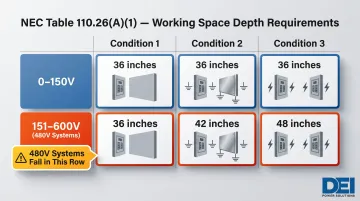
Both configurations place 480V equipment in the 151-600V row of NEC Table 110.26(A)(1), triggering increasing depth requirements of 36", 42", or 48" depending on the condition. By contrast, 120/240V systems in the 0-150V row require only 36" under all three conditions.
Elevated Arc Flash and Electrocution Risk
At 480V with 25 kA available fault current, arc flash incident energy can exceed 40 cal/cm² — more than 30 times the 1.2 cal/cm² threshold for second-degree burns. IEEE 1584-2018 doesn't even require arc flash calculations for equipment below 240V and 125 kVA because the hazard is too low to sustain significant arcs.
Higher voltage means:
- Greater energy release during faults
- More space needed to jump clear or exit quickly
- Increased risk of inadvertent contact during routine maintenance
In 2023, 142 workers died from electrical exposure and 5 from electric arcs (147 total) — numbers that explain why NEC working space requirements aren't arbitrary minimums.
Common 480V Applications
These hazards show up wherever 480V equipment operates — and that covers a wide range of environments:
- Data centers: Global capacity demand is growing 19-22% annually through 2030, with rack densities now exceeding 100 kW
- Industrial plants running motor drives, process controls, and heavy manufacturing equipment
- Commercial buildings where large HVAC chillers, elevators, and compressors all pull 480V loads
- Utility substations: Distribution equipment and infrastructure projects
These environments often feature larger panels, higher amperage, and equipment-dense electrical rooms — increasing the probability of Condition 2 or Condition 3 scenarios.
NEC Article 110.26: The Complete Clearance Specifications for 480V Panels
NEC Article 110.26(A) governs working space around electrical equipment rated 0-1000V. The 2017 NEC expanded Table 110.26(A)(1) to include the 601-1000V range; always verify which edition your jurisdiction has adopted.
Working Space Width
Minimum: 30 inches or the full width of the panel, whichever is greater
The panel does not need to be centered within this 30-inch zone — it can be offset as long as the total clear width equals at least 30 inches.
Working Space Height (Headroom)
Minimum: 78 inches (6 ft 6 in) from the floor
This allows a person to stand upright and work safely. If the equipment itself exceeds 78 inches in height, headroom must equal the equipment height.
Maximum Breaker Height
79 inches (6 ft 7 in) above finished floor
This refers specifically to the topmost operable handle — not the top of the enclosure. This ensures any breaker can be operated without a ladder or tool.
Working Space Depth (Overview)
Required depth in front of a 480V panel ranges from 36 to 48 inches, determined by the three working space conditions in NEC Table 110.26(A)(1). Always measure depth from the live parts, or from the enclosure face when live parts are enclosed.
Additional Requirements
- Panel doors must open a minimum of 90 degrees without obstruction
- Permanent fixed lighting is required — flashlights don't qualify, and motion sensors cannot be the sole light source
- No furniture, stored materials, or locked barriers may block panel access at any time
- Working space cannot be used for storage under any circumstances
The Three Working Space Conditions That Determine Required Depth for 480V Panels
NEC Table 110.26(A)(1) defines three conditions that govern working space depth. For 480V equipment in the 151-600V range, each condition requires a different minimum depth. When mixed scenarios exist, the worst-case condition governs the entire working space.
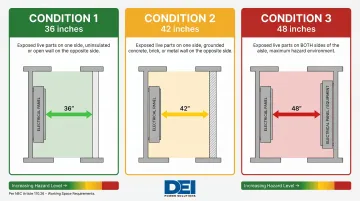
Condition 1 — 36 Inches
Exposed live parts on one side, with no live or grounded parts on the other — or only insulated live parts opposite. The minimum depth is 36 inches (3 feet).
A typical example: a 480V panelboard mounted on a wall with open space opposite it, or a wall finished with drywall or other non-conductive material.
Condition 2 — 42 Inches
Exposed live parts on one side and grounded parts on the other. The minimum depth is 42 inches (3.5 feet).
Grounded surfaces include concrete, brick, grounded metal, or any other grounded conductive material. A grounded surface opposite the panel creates a path that could complete a circuit if a worker's body bridges the gap — the extra 6 inches reduces that risk and provides more room to avoid contact during an arc flash event.
Condition 3 — 48 Inches
Exposed live parts on both sides of the working space. The minimum depth is 48 inches (4 feet).
This is the most hazardous scenario — two 480V panels or switchboards facing each other across an aisle, or any layout where a worker can access energized equipment on both sides at once. Simultaneous exposure on both sides increases arc flash risk and requires the widest clearance zone to allow safe egress.
Applying the Conditions in the Field
Consider an industrial electrical room with a row of 480V switchboards on one wall and a concrete masonry wall opposite. The concrete wall is grounded, triggering Condition 2 (42 inches).
Now place a second row of 480V equipment on the opposite wall. The working space has exposed live parts on both sides, upgrading the requirement to Condition 3 (48 inches).
The condition is determined by the actual field configuration, not what appears on a drawing. Any modification that introduces grounded surfaces or additional live equipment must be re-evaluated for compliance.
A Note on the 2017 NEC Update
The 2017 NEC added a 601-1000V row to Table 110.26(A)(1) with Condition 1/2/3 depths of 3 ft, 4 ft, and 5 ft respectively — 480V systems remain in the 151-600V row. Always confirm which NEC edition your jurisdiction has adopted, since older editions may have different table structures.
Dedicated Space Requirements and Special Rules for Large 480V Switchgear
Working Space vs. Dedicated Space
These two terms are often confused but govern different things:
- Working space covers front, side, and height clearance needed for maintenance access — the dimensions outlined earlier in this guide.
- Dedicated space is the equipment footprint (width and depth of the panel) extending from the floor to 6 feet above the equipment, or to the structural ceiling, whichever is lower.
No foreign systems — plumbing, HVAC piping, gas lines, or non-electrical equipment — may be located within the dedicated space. Sprinkler systems are the one exception: per the 2020 NEC, sprinkler piping is permitted within the dedicated space, and sprinkler heads may spray into it.
Above the 6-foot zone, foreign systems are allowed provided protection (drip pans, insulated ducts) prevents condensation, leaks, or breaks from damaging the electrical equipment below.
Dual-Exit Rule for Large Switchgear
Switchboards and panelboard assemblies rated over 1,200 amps and more than 6 feet wide must either:
- Have an exit door at each end of the working space (each exit at least 24 inches wide and 6.5 feet high), or
- Provide double the required working space depth
This rule directly affects layout planning for 480V equipment in industrial plants and data centers, where large switchboards frequently exceed both thresholds. Getting ahead of this requirement starts with knowing your equipment's actual dimensions. DEI Power's UL 891-certified switchboards (available from 1200A through 4000A) include documented dimensional specs — 30" wide × 14" deep × 90" tall — so facility teams and engineers can model compliant clearance zones before the equipment ships.
Prohibited Locations
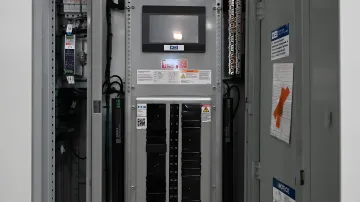
Panels must not be installed in:
- Bathrooms (moisture hazard)
- Clothes closets (fire risk from flammable materials)
- Spaces subject to moisture without appropriate NEMA-rated enclosures (NEMA 3R for outdoor/wet locations)
Panels must remain readily accessible at all times. They cannot be located behind equipment or in spaces where the required working clearance cannot be maintained.
OSHA Requirements and Common 480V Clearance Violations to Avoid
OSHA Adopts NEC Working Space Requirements
OSHA's electrical safety standards incorporate NEC working space requirements by reference:
- 29 CFR 1910.303 (General Industry)
- 29 CFR 1926.403 (Construction)
OSHA does not publish separate clearance dimensions — it adopts NEC minimums. However, OSHA enforcement officers can cite facilities for violations during inspections, resulting in fines and mandatory corrective action.
Current OSHA penalty structure (2025):
| Violation Type | Maximum Penalty |
|---|---|
| Serious | $16,550 per violation |
| Willful or Repeated | $165,514 per violation |
Source: OSHA.gov Penalties page
Common Clearance Violations and How to Avoid Them
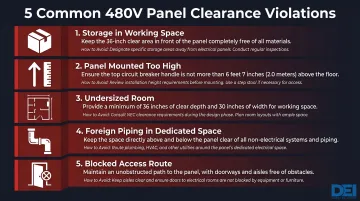
Sections 1910.303 and 1910.305 accumulated more than 1,900 citations in a 2022–2023 12-month period — exceeding machine guarding citations. The most common violations include:
Storing materials in front of or above the panel: Violates the 36"–48" depth zone. Keep the entire working space clear at all times.
Mounting panels too high: Top breaker handle exceeds 79 inches. Verify handle height before installation.
Installing panels in undersized rooms: Room dimensions don't allow required working space. Measure and plan before equipment arrives.
Foreign system piping through dedicated space: HVAC ducts, plumbing, and gas lines routed within the 6-foot zone above the panel violate dedicated space rules. Route these systems outside the zone or above it with proper protection.
Blocked access routes: Locked doors or fixed equipment with no compliant bypass route. Every panel needs a clear, unobstructed path — plan egress before finalizing layouts.
Real Consequences of Non-Compliance
Beyond OSHA fines, non-compliance leads to:
- Failed electrical inspections that halt construction or occupancy permits
- Voided insurance coverage in the event of an arc flash incident
- Increased liability if a worker is injured while accessing an improperly cleared panel
- Operational downtime when panels must be relocated or rooms reconfigured
For projects subject to Buy America Build America (BABA) requirements — utility, government, and federally funded installations — equipment compliance is also a procurement prerequisite, not just a safety checkbox. Specifying BABA-compliant, UL 891-certified switchgear from the start reduces documentation burden and avoids bid disqualification. DEI Power manufactures its switchboards in Ontario, California and maintains BABA compliance, which can streamline the inspection and closeout process on qualifying projects.
Frequently Asked Questions
What is the minimum clear working space required in front of a 480V electrical panel or switchboard?
The minimum depth ranges from 36 to 48 inches depending on the working space condition: 36" (Condition 1 – nothing facing), 42" (Condition 2 – grounded surface facing), or 48" (Condition 3 – live parts on both sides), per NEC Table 110.26(A)(1) for equipment in the 151-600V range.
What is the OSHA requirement for electrical panel clearance?
OSHA (29 CFR 1910.303 / 1926.403) adopts NEC working space requirements by reference, meaning the same minimums apply: at least 30 inches wide, 78 inches tall, and 36-48 inches deep depending on the condition. Non-compliance is an OSHA citable violation.
Do electrical panels require 36 inches of clearance?
36 inches is the minimum depth only under Condition 1 (nothing grounded or energized directly facing the panel). For 480V panels facing grounded surfaces (Condition 2), 42 inches is required; facing live equipment (Condition 3), 48 inches is required.
How much unobstructed space is required around an electrical panel?
NEC requires at minimum 30 inches of width, 36-48 inches of depth in front (based on condition and voltage), and 78 inches of headroom. The panel must remain readily accessible with a clear, unobstructed path — no stored materials, furniture, or locked barriers blocking access.
What are the required phase-to-phase clearances for 480V and 600V equipment?
Phase-to-phase (internal busbar) clearances are specified by equipment standards such as UL 891 for switchboards, not NEC Article 110.26 (which governs working space). Internal clearances are validated at the time of equipment certification; buyers should confirm their switchgear carries the appropriate UL listing.
What is the 125% rule in the NEC?
The NEC 125% rule (NEC 210.19 / 215.2) requires that conductors supplying continuous loads be sized at no less than 125% of the continuous load current. This is a conductor ampacity rule, not a clearance rule, but it commonly affects how feeders to 480V panels are sized.
Need 480V switchgear with documented dimensions for clearance planning? DEI Power manufactures UL 891-certified switchboards (400A-4000A) in NEMA 1 and NEMA 3R enclosures at our Ontario, California facility — with 4-6 week lead times and free nationwide shipping.
Contact us at (866) 773-8050 or sales@deipower.com for technical specs and application support.