This article explains what mission-critical power actually encompasses at the distribution level, why the traditional approach is failing, and what a better model looks like for contractors, engineers, and facility teams managing high-stakes projects.
TLDR:
- Mission-critical power requires distribution equipment designed for zero tolerance of unplanned downtime—not just backup generation
- Traditional procurement methods create schedule delays, compliance gaps, and costly field modifications
- AI workloads and infrastructure investment are driving unprecedented demand for custom-configured switchgear
- A new approach built on in-house manufacturing, UL 891 compliance, and engineering support reduces project risk
- DEI Power manufactures USA-built, BABA-compliant switchgear with 4–6 week lead times from its Ontario, California facility
What Is Mission-Critical Power?
Mission-critical power is more than backup generation. It encompasses the entire chain of systems responsible for ensuring continuous, reliable power delivery from the utility connection through switchgear and distribution equipment to the point of load, in environments where any interruption carries severe operational, financial, or life-safety consequences.
The distinction between general commercial power needs and mission-critical requirements is fundamental: the latter demands zero tolerance for unplanned downtime, designed redundancy, code-compliant configurations, and distribution equipment that can handle continuous full-load conditions without failure.
What separates mission-critical power from standard commercial infrastructure is what's at stake when it fails. The financial exposure is severe:
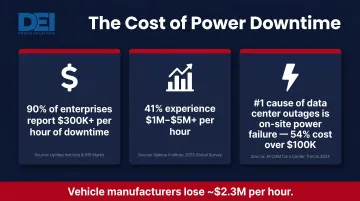
- 90% of mid-size and large enterprises report that a single hour of downtime exceeds $300,000, with 41% experiencing costs of $1 million to over $5 million per hour
- On-site power failure is the #1 cause of impactful data center outages, with 54% of outages costing more than $100,000
- Vehicle manufacturers lose approximately $2.3 million per hour to unplanned downtime
When failure costs millions per hour, every component in the power distribution chain—from the switchgear to the remote power panel—has to be specified, sourced, and built to perform without exception. That's precisely why a traditional approach to procurement and configuration is no longer sufficient.
The Old Approach to Mission-Critical Power Is Breaking Down
The traditional procurement model creates more problems than it solves. Engineers spec standard switchgear from a catalog, contractors submit purchase orders to distributors with limited configuration options, and facilities accept whatever ships first—often resulting in equipment that doesn't match the actual site layout, voltage requirements, or load profile.
Extended Lead Times Have Become a Project Liability
Supply chain disruptions have stretched procurement timelines to breaking point:
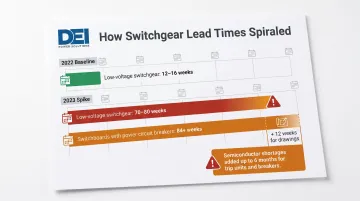
- Low-voltage switchgear lead times extended from 12–16 weeks in Q2 2022 to 70–80 weeks by March 2023
- Switchboards with power circuit breakers now require 84+ weeks, with an additional 12 weeks for drawings
- Semiconductor shortages delayed trip units and circuit breakers by up to 6 months
Each delay pushes back energization dates, stalls commissioning, and puts downstream milestones at risk. The result: data center project cancellations climbed to 25 in 2025, up from just 6 in 2024 and 2 in 2023.
Compliance and Configuration Mismatches
Delayed equipment compounds a second problem: the wrong equipment. Generic or improperly specified switchgear frequently requires field modifications, triggers change orders, or fails inspection. 85% of construction projects experience change orders, accounting for 10–15% of total contract value—with some projects reaching 25% or more.
Mission-critical facilities have no margin for that kind of rework. Every change order adds cost, time, and risk that already-tight schedules cannot absorb.
The Engineering Support Gap
Configuration problems don't end at delivery. Many contractors and facility teams receive equipment without adequate documentation, accurate single-line diagrams, or responsive technical guidance. This forces teams to piece together configuration decisions on the jobsite—introducing errors, delaying installation, and increasing the likelihood of inspection failures.
Aging Infrastructure Compounds the Problem
Many facilities are also carrying systems built to specifications that no longer hold up—out of step with current NEC requirements and undersized for the load demands of today's AI workloads, EV infrastructure, and high-density computing environments.
When replacement or expansion becomes necessary, that mismatch doesn't just slow the project down. It forces engineers to design around equipment constraints that a purpose-built solution would have eliminated from the start.
The Forces Driving the Demand for Change
AI and Hyperscale Data Center Power Surge
The rapid growth in power demand driven by AI workloads is creating unprecedented pressure on power distribution equipment procurement:
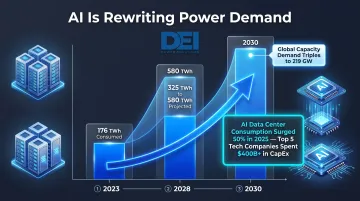
- U.S. data center electricity consumption reached 176 TWh in 2023 and is projected to increase to 325–580 TWh by 2028
- AI-focused data center electricity consumption surged 50% in 2025, with capital expenditure from the five largest technology companies exceeding $400 billion
- Global data center capacity demand is expected to nearly triple to 219 GW by 2030
Every new facility requires extensive low-voltage power distribution infrastructure, and standard catalog switchgear cannot address custom configuration requirements without modification.
Mission-Critical Use Cases Beyond Data Centers
Healthcare facilities, industrial plants, utility substations, and commercial campuses are all scaling up their electrical infrastructure. Each has unique voltage, layout, and code requirements:
- Hospital and clinic construction starts reached a record $33.9 billion in 2024, with $38.8 billion projected by 2030
- Global grid investment projected to top $470 billion in 2025, with the U.S. leading at $115 billion
These sectors share a common constraint: off-the-shelf equipment rarely fits without costly field modifications — which is why sourcing and compliance pressure have become just as important as the equipment itself.
Buy America Build America (BABA) Compliance Pressure
Federal and state infrastructure projects increasingly require domestic manufacturing documentation. The Build America, Buy America Act requires that manufactured products used on federally funded infrastructure projects contain more than 55% domestic content by cost of components and must be manufactured in the United States.
For teams that have relied on overseas or non-compliant equipment, this creates a real sourcing gap. NEMA launched the Make It American Program in spring 2025 to help electrical manufacturers verify and certify BABA-compliant products.
Increasing Regulatory Complexity
NEC code updates and UL certification requirements have raised the technical bar for what qualifies as acceptable power distribution equipment in mission-critical environments:
- UL 891 is the standard for dead-front switchboards rated 1,000V or less, covering testing for short-circuit withstand, temperature rise, and dielectric voltage withstand
- NEC Article 408 requires switchboards to be listed; Authorities Having Jurisdiction typically reject non-listed equipment outright
- NFPA 70B (2023 edition) was elevated from a "Recommended Practice" to a mandatory "Standard" for Electrical Equipment Maintenance
Non-certified equipment doesn't just create inspection headaches — it can trigger AHJ rejection, halt a project mid-construction, and expose contractors to liability that certified equipment would have avoided entirely.
What a New Approach to Mission-Critical Power Looks Like
The new approach is built around specificity from the start: custom-configured switchgear engineered to the actual voltage, amperage, physical layout, and integration requirements of the specific project—not retrofitted from generic equipment once problems surface.
In-House Manufacturing Reduces Schedule Risk
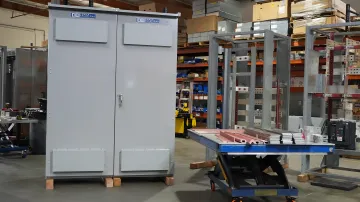
When a supplier controls the full build process under one roof, they can respond to custom specifications faster, reduce dependency on external component suppliers, and shorten delivery timelines compared to traditional distribution channels.
DEI Power's vertically integrated manufacturing process maintains strict control over design, fabrication, wiring, testing, and logistics. The result:
- 4–6 week lead times for custom-configured switchgear
- 3–5 business day delivery nationwide for in-stock units
- Elimination of supply chain variability that creates project delays
Code Compliance as a Built-In Foundation
UL 891 certification, NEC-aligned configurations, and clear documentation should be standard outputs of the manufacturing process. Treating them as optional add-ons pushes compliance work into the field, where it slows inspections and creates rework risk.
Each switchboard manufactured by DEI Power includes:
- UL 891 certification confirming independent testing for safety and performance
- Single-line diagrams for clear system layout representation
- Configuration specifications detailing electrical ratings and design features
- Documentation to support submittal approvals and installation
This reduces field verification requirements and ensures code compliance from delivery through final inspection.
Engineering Support Built Into Procurement
That compliance foundation is only useful if the equipment is configured correctly from the start. In-house engineering support during specification and ordering is what prevents configuration errors before they become change orders.
DEI Power provides direct engineering access across all project phases:
- Specification reviews to confirm voltage, amperage, and layout requirements
- Application guidance to align equipment selection with project conditions
- Compliance verification through design, build, and delivery
Contractors and engineers can engage this support at any stage — from initial concept through final approval — keeping system configurations accurate and submittals clean.
DEI Power: A New Model in Practice
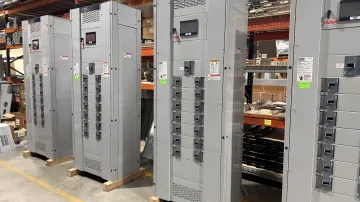
DEI Power manufactures UL 891-certified, USA-built low-voltage switchboards from a 50,000 sq. ft. facility in Ontario, California. As an approved Siemens OEM with BABA-compliant manufacturing, DEI Power addresses the procurement gaps that the traditional model leaves open:
- Custom configurations built to project-specific voltage, amperage, and layout requirements
- Amperage range from 400A to 4000A with voltage options including 480Y/277V, 120/208Y V, 120/240V, and 415/240V
- In-house engineering support for specification reviews and compliance verification
- Lead times designed to keep mission-critical projects on schedule
- Free shipping on all orders
Industries That Can No Longer Afford the Old Way
Data Centers and Colocation Facilities
Hyperscale and enterprise data center builds are the clearest case for this new approach. Power density requirements, rapid construction schedules, and the operational cost of any distribution failure make slow, generic procurement a real liability.
Data center facilities require:
- High fault withstand ratings to maintain stability under peak load conditions
- Scalable bus configurations that support phased capacity expansion
- Coordinated overcurrent protection to isolate faults without cascading downtime
DEI Power's 400–4000 amp switchgear and Remote Power Panels (225A–1200A) provide the reliability and customization these environments demand.
Healthcare and Life-Safety Environments
Hospitals and healthcare campuses face the strictest uptime requirements of any sector. Switchgear failure directly affects patient safety, making UL-certified, properly documented, custom-configured equipment a non-negotiable requirement.
NFPA 99 classifies healthcare facilities into risk categories, with Category 1 (Critical Care) requiring Type 1 Essential Electrical Systems that must be fully operational within 10 seconds of power loss.
DEI Power's UL 891-certified switchgear is built to meet these requirements — with complete documentation packages for AHJ review, configurations that support automatic transfer sequences, and certifications that satisfy healthcare facility compliance requirements out of the box.
Industrial, Utility, and Infrastructure Projects
The same failure pattern that affects hospitals and data centers shows up in industrial and utility work — just with different consequences. Manufacturing plants, utility substations, and large commercial campuses all need power distribution equipment that can be specified to exact requirements and delivered on a predictable schedule. Catalog-based procurement consistently falls short here.
DEI Power's switchgear supports these applications with:
- 400A–4000A ratings that handle heavy industrial load requirements
- Robust enclosure construction designed for long service life in demanding environments
- Modular configurations that accommodate phased infrastructure buildouts
Frequently Asked Questions
What is mission critical power?
Mission-critical power refers to the systems and infrastructure that deliver uninterrupted electricity where failure carries severe operational, financial, or life-safety consequences. This spans generation, distribution, and protection equipment—any layer where an outage is unacceptable.
What is an example of a mission critical industry?
Data centers, hospitals, utility substations, and industrial manufacturing are prime examples. Each depends on continuous power delivery where even minutes of downtime can cause significant harm or financial loss.
What makes power distribution mission-critical?
Power distribution becomes mission-critical when the downstream systems it feeds cannot tolerate interruption. At that point, the reliability, certification, and proper configuration of switchgear are as important as any other element in the power chain.
Why are switchgear lead times a problem for mission-critical projects?
Extended procurement timelines delay energization and push back commissioning schedules. The risk compounds when custom configurations are required but unavailable through standard distribution channels.
What certifications matter for mission-critical switchgear?
UL 891 certification for low-voltage switchboards is a key standard. Certified equipment has been independently tested to meet safety and performance requirements and is typically required for code compliance on commercial, industrial, and infrastructure projects.