: IP Ratings & Applications](https://file-host.link/website/deipower-e6mdmu/assets/refined-images/1779991459054000_8c815872044a468fb1d38c78eb78d585/360.webp)
Introduction
Contractors, engineers, and facility managers face a critical decision when specifying power distribution equipment: will it live indoors or outdoors? The answer affects safety, service life, and code compliance in ways that can't be corrected after installation. The choice hinges on two key factors: installation environment and environmental protection levels defined by IP and NEMA ratings.
Many projects fail because teams assume partial shelter equals full enclosure, or that a higher IP rating automatically makes equipment better. Neither is true. Under-specifying protection creates compliance violations, premature failures, and higher lifecycle costs that compound over time. This article covers the structural and operational differences between indoor and outdoor switchgear, how IP and NEMA ratings define those differences, and a practical framework for selecting the right configuration.
Key Takeaways
- Indoor switchgear carries IP31–IP41 ratings; outdoor units require IP54–IP66 with corrosion-resistant construction
- IP ratings (IEC 60529) measure dust and water ingress; NEMA ratings add corrosion resistance and are required on UL-listed equipment in North America
- The first IP digit covers dust protection (0–6); the second covers water protection (0–9)
- Sealed outdoor enclosures trap heat — active thermal management is required to protect component lifespan
- Under-specifying protection leads to code violations, safety hazards, and accelerated equipment failure
Indoor vs. Outdoor Switchgear: Quick Comparison
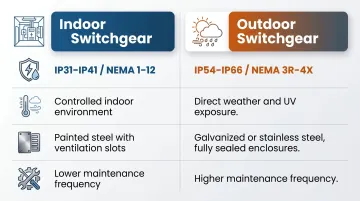
| Aspect | Indoor Switchgear | Outdoor Switchgear |
|---|---|---|
| Installation Location | Electrical room or enclosed facility | Open yard, pad-mounted, or rooftop |
| Typical IP/NEMA Rating | IP31–IP41 / NEMA 1–NEMA 12 | IP54–IP66 / NEMA 3R–NEMA 4X |
| Environmental Exposure | Controlled temperature and humidity | Direct rain, dust, UV, temperature swings |
| Enclosure Construction | Painted steel with ventilation openings | Galvanized or stainless steel, fully sealed |
| Maintenance Demand | Lower frequency | Higher frequency with gasket and seal inspections |
Voltage level also influences placement. Low-voltage (LV) and medium-voltage (MV) switchgear typically installs indoors; high-voltage equipment often goes outdoors unless gas-insulated switchgear (GIS) is used.
That placement logic connects directly to enclosure ratings. A higher IP rating doesn't make one type inherently better — it reflects what the equipment is built to tolerate. Using indoor-rated switchgear in an outdoor location, even partially covered, creates serious compliance and safety risks. Per NEC 110.28, using an enclosure type not rated for the environment violates the code.
What is Indoor Switchgear?
Indoor switchgear consists of circuit breakers, busbars, protective relays, and metering installed inside controlled environments — dedicated electrical rooms, switch rooms, or enclosed buildings. The building envelope acts as the first layer of environmental protection, which is why indoor switchgear can use lower IP ratings without compromising safety.
Construction Types
Two primary construction types dominate indoor switchgear:
Metal-Enclosed Switchgear:
- Components housed within grounded metal shell
- Includes ventilation openings, doors, or removable covers for inspection
- Governed by IEEE C37.20.1 for low-voltage assemblies
Metal-Clad/Metal-Composite Switchgear:
- Components separated into individually grounded compartments
- Features drawout or pull-out breaker design for safer maintenance
- UL 891 governs low-voltage switchboards in the U.S.
Operational Advantages
Indoor installation provides several practical benefits:
- Controlled temperature and humidity slow insulation degradation over time
- Enclosed construction reduces arc flash exposure for maintenance personnel
- Restricted access improves worker safety in high-voltage areas
- Ventilation openings and HVAC integration handle heat dissipation effectively
Thermal Management
Indoor switchgear can include filtered ventilation or forced-air cooling. This allows higher continuous load ratings without the heat buildup risk that sealed outdoor enclosures face. Industry standards recommend maintaining electrical rooms at or below 86°F (30°C), as most LV equipment is rated for 104°F (40°C) maximum ambient.
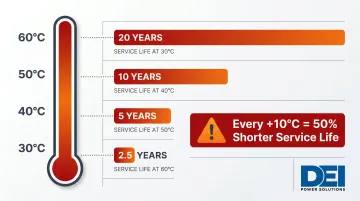
The 10-degree rule applies: a temperature rise of 18°F (10°C) within an enclosure approximately halves the service life of electronics and insulation. That's a direct argument for indoor installation anywhere equipment longevity is a priority.
Use Cases of Indoor Switchgear
Indoor switchgear is the standard choice for:
- Commercial office buildings and campuses with dedicated electrical rooms
- Healthcare facilities where power interruptions affect patient care
- Hyperscale and enterprise data centers requiring tight environmental control
- Industrial plants and manufacturing floors with enclosed MCC rooms
- Utility substations housed in dedicated buildings
Any facility with a dedicated electrical room is a candidate for indoor switchgear.
DEI Power's UL 891-certified low-voltage switchboards (400A–4000A) are built for these environments, supporting 120/240V, 208Y/120V, 480V, and 480Y/277V configurations. Manufactured with Siemens components in Ontario, California, each unit ships with in-house engineering support to reduce field adjustments and keep projects on schedule.
What is Outdoor Switchgear?
Outdoor switchgear is designed for direct exposure to weather — rain, dust, wind-driven debris, UV radiation, and wide temperature swings — without relying on a building for environmental protection. This demands a distinct design approach: sealed enclosures, corrosion-resistant materials, and internal anti-condensation systems.
Structural Differences
Key features that set outdoor switchgear apart:
- Fully gasketed and sealed enclosures: No open ventilation
- Corrosion-resistant construction: Galvanized steel or stainless steel with protective coatings
- Anti-condensation systems: Internal heaters prevent moisture formation on energized components
- Drainage provisions: Ensure water doesn't pool inside enclosures
- Larger air-insulation clearances: Increase overall footprint
Per NEMA 250 requirements, outdoor enclosures must pass a 600-hour salt spray test. Type 4X enclosures require an additional 200 hours (800 hours total) compared to stainless steel specimens.
Thermal Management Challenges
Because ventilation openings cannot be used, outdoor switchgear relies on sealed heat dissipation:
- Natural convection through enclosure walls
- Internal heat sinks
- Thermostatically controlled heaters
The temperature rise in sealed enclosures is calculated using: (Ti - Tu) = Qv / (k × A), where Ti = permitted internal temperature, Tu = ambient temperature, Qv = watts to dissipate, k = heat transfer coefficient, and A = enclosure surface area. For sealed enclosures, heat can only dissipate through the walls, creating thermal derating effects on continuous current ratings.
Increased Maintenance Burden
Outdoor switchgear demands more frequent attention:
- Gasket integrity checks
- Anti-condensation heater verification
- Corrosion inspection on fasteners and hinges
- Drainage hole clearance
ANSI/NETA MTS-2007 sets outdoor bus structure inspections at monthly intervals — twelve times more frequent than the 12-month standard for indoor equipment. That gap reflects how much harder the environment works against component integrity.
Use Cases of Outdoor Switchgear
Primary applications include:
- Utility transmission and distribution substations
- Pad-mounted distribution equipment
- Renewable energy generation sites (solar farms, wind installations)
- Oil and gas processing facilities in open environments
- Remote infrastructure locations without available buildings
These applications share a common thread: open sites where land is available and air-insulated clearances are practical. Where land is scarce — dense urban substations, for instance — engineers typically turn to indoor or GIS (Gas-Insulated Switchgear) installations, where compact footprints justify the added cost.
IP and NEMA Ratings Explained: What the Numbers Mean
IEC 60529 IP Rating System
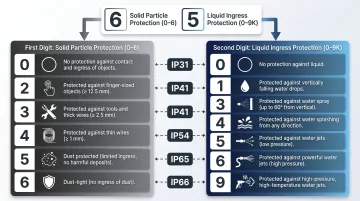
The IP code consists of two digits per IEC 60529:
First digit (0–6): Solid particle protection
- 0 = No protection
- 2 = Fingers (objects >12.5mm)
- 3 = Tools, thick wires (>2.5mm)
- 4 = Most wires (>1mm)
- 5 = Dust protected (limited ingress)
- 6 = Dust-tight (no ingress)
Second digit (0–9): Liquid ingress protection
- 0 = No protection
- 1 = Vertical dripping water
- 3 = Spraying water (60° from vertical)
- 4 = Splashing water (any direction)
- 5 = Water jets (6.3mm nozzle)
- 6 = Powerful water jets (12.5mm nozzle)
- 9 = High-pressure, high-temperature jets
Relevant combined ratings for switchgear:
- IP2X = Finger-safe protection
- IP31 = Tools + dripping water
- IP41 = Fine wires + dripping water
- IP54 = Dust-limited + splash protection
- IP65 = Dust-tight + water jet protection
- IP66 = Dust-tight + powerful water jets
NEMA Enclosure Ratings
NEMA ratings are the North American parallel standard used on UL-listed equipment. They are not direct equivalents of IP ratings — NEMA covers additional factors including corrosion resistance and rust protection.
Indoor types:
- NEMA 1 ≈ IP30: General indoor use, protects against falling dirt
- NEMA 12 ≈ IP54: Indoor industrial, dust and drip-proof, no knockouts
Outdoor types:
- NEMA 3R ≈ IP54: Rainproof, most commonly installed outdoor type
- NEMA 4 ≈ IP65: Watertight, protects against hose-directed water
- NEMA 4X ≈ IP65 + corrosion resistance: Stainless steel or fiberglass construction for coastal/chemical environments
Key distinction: Per the NEMA FAQ document, "It is not possible to state that an IP degree rating is equivalent to a NEMA Type designation." NEC Section 110.28 confirms "IP ratings are not a substitute for Enclosure Type ratings" in U.S. installations.
Thermal Management Tradeoffs
Fully sealed IP66/NEMA 4X enclosures prevent all ingress but trap heat from energized components. A 10°C rise above maximum rated operating temperature halves service life and doubles failure rate.
Enclosures above IP54 typically require active thermal management — heat sinks, forced ventilation, or cooling units — to hold internal temperatures within rated limits. Under-ventilated indoor switchgear in hot equipment rooms can fail just as readily as poorly sealed outdoor units.
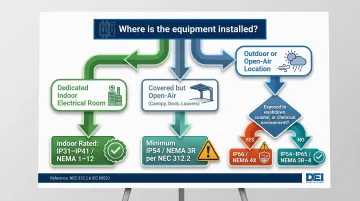
One persistent field error is specifying indoor IP ratings (IP31/NEMA 1) for locations that see partial weather exposure. These include:
- Covered loading docks and equipment pads under canopies
- Rooftop mechanical rooms with open louvers or vents
- Industrial areas subject to pressure-wash cleaning
Any of these conditions qualifies as a damp or wet location under NEC 312.2, requiring a minimum IP54/NEMA 3R enclosure. A partial shelter is not a fully enclosed room.
Choosing the Right Switchgear for Your Application
Decision Framework
Choose indoor switchgear when:
- Equipment will be installed in a dedicated electrical room with HVAC
- Environment is controlled (stable humidity, temperature, dust levels)
- Installation is low to medium voltage for commercial or industrial use
Choose outdoor switchgear when:
- Installation is in an open yard, rooftop, or unenclosed pad
- Direct weather exposure is unavoidable
- Project is a utility substation or renewable energy site with no available building
The Gray Zone: Semi-Outdoor and Harsh Indoor Environments
Covered but open-air installations require special consideration:
Upgrade to outdoor ratings when:
- Parking structures or covered equipment pads exposed to wind-driven rain
- Industrial washdown areas (food processing, pharmaceutical)
- Dusty indoor environments (cement plants, aggregate facilities, grain handling)
Quick checklist:
- Will the equipment ever be exposed to rain or wind-driven moisture?
- Is there a dust or contamination source nearby?
- Will equipment be pressure-washed or hosed down?
A "yes" to any of these means upgrading your IP/NEMA rating. Washdown environments require NEMA 4X (IP66 minimum); high-pressure steam cleaning may require IP69K.
Once you've confirmed the right rating for your environment, the next step is sourcing switchgear built to match your project's exact voltage, layout, and load requirements.
Selecting the Right Configuration
For contractors, engineers, and facility teams specifying low-voltage switchgear, DEI Power manufactures UL 891 switchboards to project-specific voltage, layout, and configuration requirements. Amperage options run from 400A to 4000A, with voltage configurations including 480Y/277V and 208Y/120V — covering hyperscale data centers, industrial plants, and commercial facilities alike.
The in-house engineering team provides:
- Specification review and code compliance verification
- Detailed submittals including single-line diagrams and CAD layouts
- Application-specific design adjustments
- Post-installation support
Lead times run 4–6 weeks from their Ontario, California facility — compared to the 16+ week industry standard — helping keep projects on schedule and avoiding costly field adjustments. For custom configurations or specification guidance, contact DEI Power at (866) 773-8050 or sales@deipower.com.
Frequently Asked Questions
What is the difference between indoor switchgear and outdoor switchgear?
Indoor switchgear is installed in protected, controlled environments like electrical rooms and relies on the building for weather protection. Outdoor switchgear is designed to withstand direct exposure to rain, dust, UV, and temperature extremes through sealed, weatherproof enclosures with higher IP/NEMA ratings (IP54+ or NEMA 3R+).
What is an outdoor switchgear?
Outdoor switchgear is a self-contained assembly of circuit breakers, disconnects, metering, and protection devices built for permanent installation in open yards, utility substations, or renewable energy sites where the equipment is directly exposed to the elements.
Can switchgear be outside?
Yes, switchgear can be installed outdoors, but only if it is specifically rated for outdoor use with appropriate IP and NEMA ratings, corrosion-resistant construction, and anti-condensation provisions. Using indoor-rated switchgear outdoors violates NEC code compliance (Sections 110.28 and 312.2) and creates serious safety and reliability risks.
What IP rating is required for outdoor switchgear?
IP54 is the minimum for outdoor installations, covering dust limitation and water splash protection. Harsher environments — coastal areas, dusty industrial sites, or high-pressure wash-down zones — require IP65 or IP66. In North American projects, the corresponding NEMA ratings (3R, 4, or 4X) are specified on UL-listed equipment.
What is the NEMA equivalent of an outdoor IP rating?
NEMA 3R is approximately equivalent to IP54 (rainproof, general outdoor use), while NEMA 4 and 4X both correspond to IP65 — 4X adding corrosion resistance. Keep in mind that NEMA ratings cover additional criteria like icing resistance and are not a direct numerical translation of IP ratings.
Can you install indoor switchgear in a covered outdoor area?
No. A covered but open-air area does not qualify as an indoor environment for switchgear specification purposes. If equipment is exposed to wind-driven rain, temperature swings, or airborne dust without full enclosure by a building, outdoor-rated equipment is required per NEC 312.2 to maintain code compliance and safe operation.