Introduction: What Is Low Voltage Switchgear?
Low voltage switchgear is electrical distribution equipment rated for systems up to 1,000V AC (or 1,500V DC), used to protect, control, and isolate electrical circuits in commercial, industrial, and utility power systems. This voltage classification comes from IEC 60038, the international standard that defines low voltage as 50–1,000V AC and 120–1,500V DC. "Low voltage" is a standards-based designation, not a reference to residential power levels.
The Electrical Safety Foundation International (ESFI) reports 2,070 electrical fatalities in U.S. workplaces from 2011–2024, with arc flash incidents accounting for 2% of those deaths. OSHA confirms arc flash temperatures can exceed 35,000°F.
Undersized or misspecified switchgear creates direct NEC 408.6 code violations — and exposes workers to potentially fatal conditions.
Those safety risks compound quickly into project consequences. Specification errors drive field rework, change orders, and schedule overruns — and with LV drawout switchgear lead times reaching 70–80 weeks in early 2024, procurement decisions must be locked in during schematic design, not construction documents.
This guide covers what engineers and contractors need to specify correctly the first time:
- Equipment classifications and construction types
- Electrical ratings (ampacity, interrupting capacity, fault current)
- Applicable standards: UL 891, UL 1558, ANSI/IEEE
- Key components and assembly requirements
- A practical selection framework for common applications
Key Takeaways
- Low voltage switchgear covers systems up to 1,000V AC (IEC 60038), governed by UL 891/UL 1558 and ANSI C37.20.1
- Distinct from switchboards and panelboards in fault handling, construction, and applicable standards
- Four specs drive every selection: voltage rating, continuous current (bus ampacity), interrupting rating (kAIC), and bus withstand (bracing)
- NEC 408.6 mandates SCCR not less than available fault current—short-circuit studies are code-required, not optional
- Proper selection aligns all ratings to short-circuit study results, site conditions, and applicable code before procurement
Low Voltage Switchgear vs. Switchboards vs. Panelboards: Key Differences
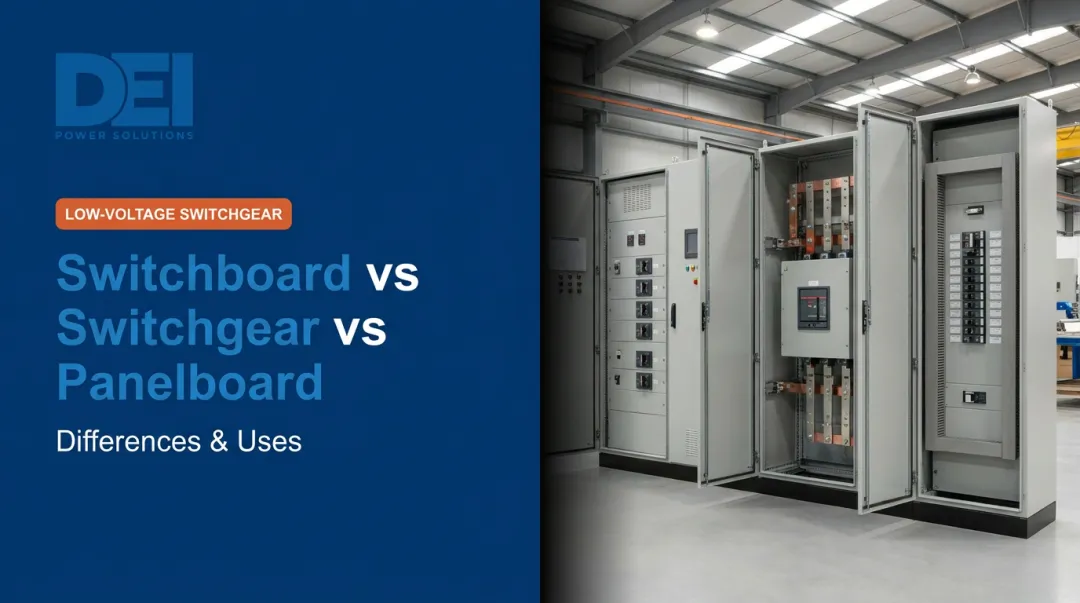
The terms "switchgear," "switchboard," and "panelboard" are frequently misused interchangeably in the field, creating specification errors with real consequences. Each term references a distinct equipment class governed by different UL standards and construction requirements.
Equipment Class Definitions:
| Equipment Type | UL Standard | Construction | Typical Application |
|---|---|---|---|
| LV Power Switchgear | UL 1558 / ANSI C37.20.1 | Metal-enclosed, compartmentalized, drawout breakers | Substations, critical infrastructure |
| Switchboards | UL 891 | Dead-front, non-compartmentalized, fixed breakers | Main service entrance, large distribution |
| Panelboards | UL 67 | Compact wall/flush-mount, branch circuit devices | Downstream branch distribution |
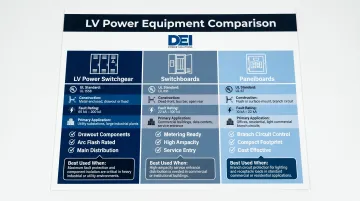
Structural and Functional Differences:
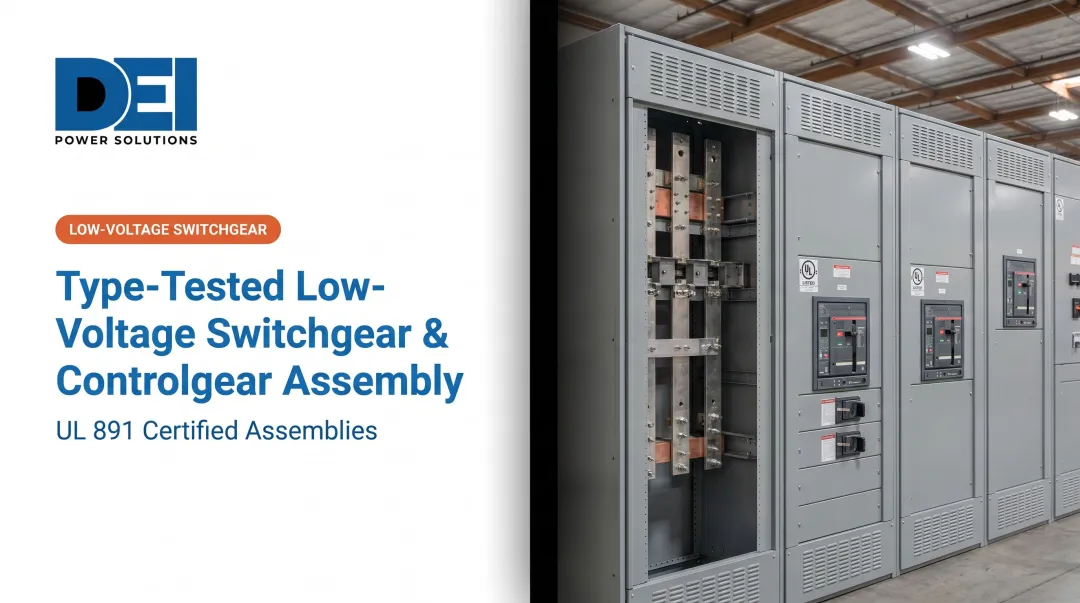
UL 1558 switchgear uses metal barriers to isolate each breaker cell from adjacent cells and from the bus compartment. This enables drawout maintenance without de-energizing the entire assembly—critical for hospitals, data centers, and process plants where any unplanned outage carries direct operational cost. ANSI C37.20.1-2015 specifies preferred AC main bus ratings from 1,600A to 10,000A with 30-cycle (0.5 second) withstand ratings up to 200 kA.
UL 891 switchboards provide dead-front construction (no live parts accessible from the front) but do not require compartmentalization between devices. They use bolt-in or plug-in circuit breakers and are designed for high-ampacity service entrance and distribution applications up to 4,000A at 480V with 100 kA short-circuit ratings under the General Coverage Program.
Panelboards (UL 67) are compact, wall-mounted assemblies for branch circuit distribution up to 1,200A. Their lower fault ratings make them unsuitable for main distribution or high-fault environments.
Selection Thresholds:
The distinction matters for code compliance and insurance purposes. Choose equipment class based on:
- Fault currents above 65 kA typically require switchgear or heavy-duty switchboards
- Main ampacity above 2,000A generally drives switchboard or switchgear selection
- Facilities requiring hot maintenance need drawout switchgear (UL 1558)
- Mission-critical loads benefit from switchgear's compartmentalized cell isolation
A common industry error: specifying "switchgear" on drawings but procuring UL 891 switchboards. Both are code-compliant when properly applied, but the distinction affects warranty, insurance underwriting, and AHJ approval. DEI Power manufactures UL 891-certified switchboards rated 400A to 4,000A, covering most commercial and industrial main distribution applications where fixed-mount construction meets project and code requirements.
Key Electrical Specifications for Low Voltage Switchgear
Voltage Rating
Standard voltage classes for North American LV switchgear include 240V, 480V, and 600V. 480Y/277V three-phase is the dominant industrial distribution voltage in the U.S., providing efficient power delivery for motors while supporting 277V single-phase lighting circuits. The 480V level reduces current to half that of 240V for the same load, allowing smaller conductors and lower installation costs.
NEC Article 408.6 requires that equipment voltage rating match the system voltage. Equipment rated for lower voltage cannot be substituted. DEI Power's switchboard line includes voltage options of 120/240V, 208Y/120V, 240/120V, 480V, 480Y/277V, and 415/240V across all amperage configurations.
Continuous Current (Ampacity)
Per ANSI C37.20.1-2015, preferred continuous current ratings for AC main bus in LV switchgear are: 1,600A, 2,000A, 3,000A, 3,200A, 4,000A, 5,000A, 6,000A, 8,000A, and 10,000A. For UL 891 switchboards, standard ratings include 400A, 600A, 800A, 1,000A, 1,200A, 1,600A, 2,000A, 2,500A, 3,000A, and 4,000A.
NEC Article 220 requires a 25% safety margin for continuous loads: overcurrent devices and conductors must be rated at 125% of the continuous load. Main bus sizing must account for:
- Calculated demand load per NEC 220
- 125% continuous load factor
- Ambient temperature derating
- Harmonic loading (especially in data centers and VFD environments)
- Future load growth projections
Of these factors, harmonic loading warrants particular attention. Harmonic currents from non-linear loads increase I²R losses in bus bars, potentially requiring ampacity derating. IEEE C57.110 addresses this for transformers, but the same harmonic currents flow through switchgear buses — high-harmonic environments may require bus oversizing beyond standard NEC calculations.
Short-Circuit Interrupting & Withstand Ratings
Short-Circuit Current Rating (SCCR) is the maximum fault current an assembly can safely withstand without creating shock or fire hazard. Per UL guidance, the lowest-rated component in the power circuit path determines SCCR.
kAIC (Kiloamperes Interrupting Capacity) is the maximum fault current a circuit breaker can safely interrupt at rated voltage. Common ratings range from 22 kAIC to 200 kAIC depending on system size and source impedance.
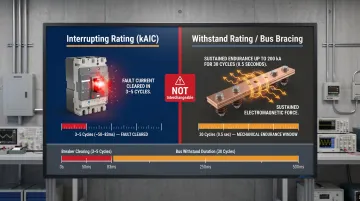
Two ratings govern fault performance — and they are not interchangeable:
- Interrupting rating: The breaker's ability to clear a fault
- Withstand rating (bus bracing): The mechanical ability of bus bars and structure to survive electromagnetic forces during a fault
ANSI C37.20.1 specifies withstand time rating of 30 cycles (0.5 seconds) for LV switchgear, with assemblies available up to 200 kA withstand. Bus bars must withstand fault forces even when a breaker clears the fault in 3-5 cycles.
NEC 408.6 requires that equipment SCCR meet or exceed the available fault current at the point of installation — making a short-circuit study a code requirement. OSHA documentation includes cases where employees suffered third-degree burns from arc flash at 480V electrical boxes due to inadequate fault protection.
Enclosure (NEMA) Rating
NEMA 250 defines enclosure types based on installation environment:
| NEMA Type | Environment | Protection Provided |
|---|---|---|
| Type 1 | Indoor general-purpose | Falling dirt, incidental contact |
| Type 3R | Outdoor, rain-resistant | Rain, sleet, snow, ice formation |
| Type 12 | Indoor industrial | Dust, lint, dripping water, oil seepage |
| Type 4 | Indoor/outdoor watertight | Windblown dust, rain, hose-directed water |
| Type 4X | Corrosion-resistant watertight | All Type 4 plus corrosion resistance |
DEI Power offers NEMA 1 and NEMA 3R as standard configurations across their switchboard line. NEMA 1 is suitable only for controlled indoor environments; outdoor applications require NEMA 3R minimum.
Standards, Certifications & Compliance Requirements
UL Standards
UL 891 certifies switchboards through dielectric (high-potential) testing, temperature rise testing, short-circuit current testing, and construction verification including dead-front design. The UL 891 General Coverage Program allows approved manufacturers to apply the UL Mark at their factories for designs within specific parameters without submitting complete product samples for each configuration.
UL 1558 covers metal-enclosed low-voltage power circuit breaker switchgear assemblies containing drawout or stationary LV power circuit breakers, fused power circuit breakers, and associated control/metering equipment.
UL 508A governs Industrial Control Panels—assemblies of control components (PLCs, motor starters, contactors) for general industrial use at 1,000V or less. It is distinct from power distribution equipment standards because it addresses machine/process control, not service entrance or branch distribution.
UL listing simplifies AHJ inspection and approval. DEI Power's UL 891-certified switchboards ship with listing marks and full compliance documentation included with each unit.
ANSI/IEEE Standards
ANSI C37.20.1-2015 defines performance requirements for metal-enclosed LV switchgear, including:
- Individual metal compartments isolating each circuit breaker
- Personnel protection and fault propagation limits
- Rated maximum AC voltages: 254V, 508V, 635V, 730V, or 1,058V
- Rated maximum DC voltages: 300/325V, 600V, 800V, 1,000V, 1,200V, 1,500V, 1,600V, or 3,200V
IEEE 1015-2006, "IEEE Recommended Practice for Applying Low-Voltage Circuit Breakers Used in Industrial and Commercial Power Systems," provides guidance for selecting breaker types, ratings, trip functions, accessories, acceptance tests, and maintenance requirements.
NEC & Local Code Compliance
NEC Article 408 governs switchboards, switchgear, and panelboards:
- 408.6: SCCR not less than available fault current (mandatory)
- 408.4: Circuit directories must be legible, clear, and specific
- 408.3: Three-phase bus arrangement A-B-C from front-to-back, top-to-bottom, or left-to-right
- 408.18: Non-enclosed equipment requires 3 feet minimum clearance to combustible ceilings
NEC Article 110.26 specifies working clearances:
- 151-600V systems require 3 feet (Condition 1), 3.5 feet (Condition 2), or 4 feet (Condition 3) depth
- Width: 30 inches minimum or equipment width, whichever is greater
- Headroom: 6.5 feet minimum
- Equipment rated 1,200A or more and over 6 feet wide requires two entrance/exit paths
Buy America Build America (BABA) Compliance
The Build America, Buy America Act was signed November 15, 2021 as part of the Infrastructure Investment and Jobs Act (IIJA). Per 2 CFR Part 184:
- Manufactured products (including switchgear) must be manufactured in the U.S. with domestic components exceeding 55% of total component cost
- Iron and steel products: All manufacturing processes from initial melting through coating must occur in the U.S.
- Waiver conditions: Public interest, nonavailability, or unreasonable cost (project cost increase exceeding 25%)
DEI Power manufactures switchboards in Ontario, California, with BABA-compliant construction, making them eligible for federally funded utility, infrastructure, and public works projects. Compliance documentation is provided with each unit.
Arc Flash Compliance
NFPA 70E (current edition: 2027) provides requirements for safe work practices to protect personnel from electrical hazards. Originally developed at OSHA's request, it helps companies comply with OSHA 1910 Subpart S and 1926 Subpart K.
IEEE 1584-2018, "IEEE Guide for Performing Arc-Flash Hazard Calculations," provides mathematical models for determining incident energy and arc-flash boundary distance for three-phase AC systems from 208V to 15 kV.
Switchgear specifications directly affect incident energy calculations. Key factors that reduce arc flash exposure levels include:
- Lower bus impedance — reduces available fault current at the arc point
- Faster protective device clearing times — shorter clearing times limit incident energy release
- Proper arc flash labeling — ensures workers select correct PPE before energized work
A protective device's clearing time at expected arcing current is critical. Longer clearing times can produce significantly higher incident energy than full arcing current scenarios, making breaker coordination a safety issue, not just a reliability one.
Main Components of a Low Voltage Switchgear Assembly
Main Bus and Distribution Bus
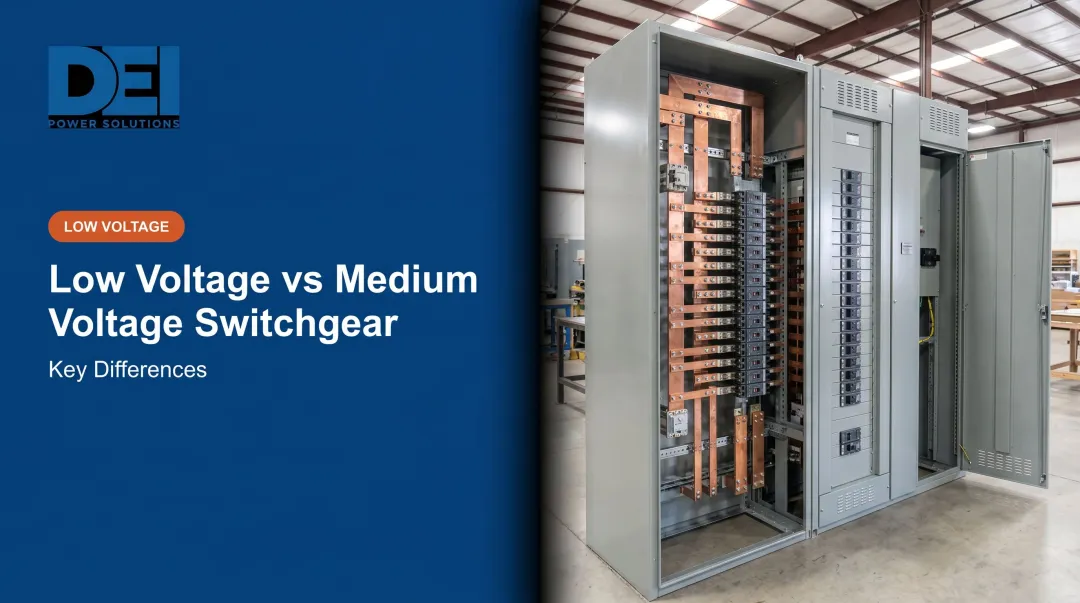
The main bus and distribution bus form the backbone of any LV switchgear assembly—copper or aluminum bars carrying current from the main breaker to branch devices. Bus material, plating, and cross-sectional area all affect ampacity and thermal performance.
| Property | Bare Copper | Tin-Plated Copper | Silver-Plated Copper |
|---|---|---|---|
| Conductivity (IACS) | 100% | ~95% effective | 102% |
| Temperature Rise (IEC 60947-2) | 60K permitted | Equivalent to silver | 70K permitted |
| Salt Spray Survival (ASTM B117) | ~120 hours | 720+ hours | 1,000+ hours |
| Lifespan | 3-5 years | 10-15 years | 15-20+ years |
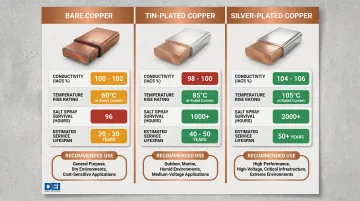
Tin plating is the industry standard for LV switchgear bus bars. It prevents copper oxidation, provides galvanic compatibility with aluminum lugs, and offers a strong cost-to-longevity balance. Silver plating is reserved for premium applications requiring highest conductivity and longest service life (high-current joints above 500A, sliding contacts, military/aerospace). Bare copper oxidizes readily, forming semi-insulating copper oxide that increases contact resistance and creates thermal runaway risk.
Protective Devices
Bus sizing and plating establish the current path — protective devices define where and how that current gets interrupted.
| Device Type | UL Standard | Application | Mounting |
|---|---|---|---|
| Molded Case Circuit Breaker (MCCB) | UL 489 | Branch/feeder overcurrent protection | Fixed-mounted |
| Low-Voltage Power Circuit Breaker (LVPCB) | UL 1066 | Main/tie breakers in switchgear | Drawout or fixed |
| Fusible Disconnect Switch | UL 98 | Isolation and overcurrent protection | Fixed-mounted |
UL 489 breakers are standard for branch circuit protection per NEC. UL 1066 power circuit breakers are rated up to 1,000V AC and 1,500V DC, designed for higher endurance, maintainability, and integration with IEEE C37 switchgear frameworks.
DEI Power's UL 891 switchboards use genuine Siemens MCCBs for branch protection, with main breakers sized to project requirements.
Enclosure Structure and Device Mounting
How those protective devices are mounted — and whether they can be serviced live — shapes the entire enclosure design.
ANSI C37.20.1 covers both stationary (fixed-mounted) and drawout configurations. Drawout construction allows breaker removal for maintenance or replacement without de-energizing the bus—essential for mission-critical facilities. UL 1558 switchgear predominantly uses drawout LVPCBs, while UL 891 switchboards typically use fixed-mounted MCCBs.
Fixed-mounted construction reduces cost and simplifies installation — the right choice when scheduled downtime for maintenance is acceptable. UL 891 switchboards use fixed/bolt-in construction with service-friendly layouts that support straightforward access during planned outages.
Enclosure considerations include:
- Interior and exterior finish requirements
- Grounding bus configuration
- Cable entry provisions (top or bottom)
- Seismic bracing for applicable zones
- NEMA rating per installation environment
How to Select the Right Low Voltage Switchgear for Your Project
Core Selection Sequence
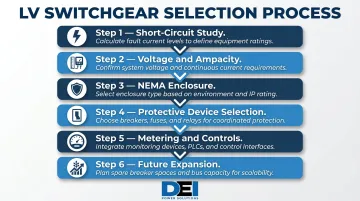
Follow this sequence to avoid specification errors:
Perform a short-circuit study to determine available fault current at the point of interconnection. NEC 408.6 makes this mandatory, not optional. The study establishes minimum SCCR and guides breaker selection.
Establish voltage and ampacity requirements. Match system voltage per NEC 110.9. Size bus per NEC 220 demand calculations with 125% continuous load factor, and account for ambient temperature, harmonic loading, and future expansion.
Confirm NEMA enclosure requirements based on installation environment per NEMA 250. Indoor controlled environments: NEMA 1. Outdoor applications: NEMA 3R minimum. Industrial environments with dust/drip: NEMA 12.
Select protective devices. Match breaker interrupting ratings to available fault current from the short-circuit study. Choose UL 489 MCCBs for branch protection, UL 1066 LVPCBs for main breakers in higher-fault applications.
Specify metering, monitoring, and controls. Define required instrumentation, communication protocols, and integration with facility management systems.
Plan for future expansion. Include spare breaker spaces, spare bus capacity, and provisions for load growth.
Secondary Specification Checklist
- Number and types of branch devices required
- Metering and monitoring needs (revenue-grade meters, protective relays, CTs/PTs)
- Future expansion provisions (spare spaces, spare bus capacity)
- Seismic requirements (IBC/CBC for applicable regions—Seismic Design Categories D, E, F require certification per ASCE 7 Chapter 13)
- Utility interconnect requirements (utility-specific standards, metering, protection coordination)
Seismic Requirements
ASCE 7 Chapter 13 requires seismic design for electrical equipment in Seismic Design Categories D, E, and F. ICC-ES AC156 specifies shake-table testing procedures. Equipment must be certified by the manufacturer with evidence reviewed by a registered design professional. DEI Power's switchboards comply with UBC, CBC, and IBC requirements for all seismic zones.
Manufacturer Evaluation Criteria
Evaluate switchgear suppliers on:
- Confirm UL 891 or UL 1558 certification applies to the specific configuration, not just a generic listing
- Verify actual lead times — custom drawout switchgear commonly runs 70–80 weeks in 2024, while standard switchboards typically land at 6–10 weeks
- Confirm in-house engineering support for specification reviews, application guidance, and system integration
- Assess customization capability to match project-specific voltage, ampacity, layout, and metering requirements
DEI Power applies these criteria directly. Their Ontario, California facility manufactures custom UL 891-certified switchboards (400A–4,000A) with lead times well below the market norm: in-stock units ship within 1 business day with 3–5 day delivery, and custom builds complete in 4–6 weeks. Engineering services cover specification reviews, one-line diagram development, submittal documentation, and code compliance verification.
Frequently Asked Questions
What voltage range is considered "low voltage" for switchgear?
Low voltage switchgear covers systems up to 1,000V AC or 1,500V DC per IEC 60038 definitions. North American applications most commonly operate at 240V, 480V, or 600V, with 480Y/277V three-phase as the dominant industrial distribution voltage.
What is the difference between low voltage switchgear and a switchboard?
Switchboards (UL 891) are dead-front assemblies with fixed-mounted breakers, suited for high-ampacity service entrance and distribution applications where scheduled downtime is acceptable. Switchgear (UL 1558/ANSI C37.20.1) uses metal-enclosed, compartmentalized construction with drawout breakers and higher fault ratings, designed for configurations requiring hot maintenance access. Most commercial, industrial, and utility distribution projects are well served by UL 891-certified switchboard assemblies.
What standard governs low voltage switchgear in the United States?
UL 891 governs switchboards with fixed-mounted devices — the standard applicable to most commercial, industrial, and utility distribution assemblies. UL 1558 and ANSI C37.20.1 apply to metal-enclosed drawout configurations. Both are accepted under the NEC, with UL 891 applying to fixed-mounted switchboard assemblies and UL 1558 to drawout-configured metal-enclosed gear.
What short-circuit rating do I need for low voltage switchgear?
The required interrupting rating (kAIC) must equal or exceed the maximum available fault current at the equipment's point of installation, confirmed via a short-circuit study (NEC 408.6). Common ratings range from 22 kAIC to 200 kAIC depending on system size, transformer kVA rating, and source impedance.
Is NEMA 1 enclosure sufficient for outdoor low voltage switchgear installations?
No. NEMA 1 is rated for indoor use only in controlled environments. Outdoor applications require NEMA 3R minimum (rain-resistant), with NEMA 4 or 4X required where washdown or corrosive environments are present.
What is bus bracing and why does it matter in switchgear specifications?
Bus bracing is the withstand rating for bus bar mechanical strength — specifically, the ability to survive electromagnetic forces during a short-circuit event without deforming. It must be rated at or above the available fault current even when a breaker clears the fault in 3-5 cycles, ensuring structural integrity under worst-case fault conditions.