Introduction
Ground wire sizing for a 1200 amp service is not a detail you estimate or approximate. At this scale, fault currents are large enough to destroy undersized conductors in seconds, turning a protective system into an arc flash risk. A single ground fault in a 1200A installation can generate fault currents exceeding 20,000 amperes—roughly 18 times the rated service amperage—placing immense thermal and magnetic stress on every grounding conductor in the path.
The term "ground wire" in a 1200A service does not refer to a single number. It depends on whether the conductor is an Equipment Grounding Conductor (EGC) or a Grounding Electrode Conductor (GEC), the conductor material (copper or aluminum), and the electrode type to which it connects.
These are distinct conductors with different roles, different sizing tables, and different code requirements under NEC Article 250. Both are covered below, with specific table references and field considerations.
Key Takeaways
- EGC minimum for a 1200A service: 3/0 AWG copper or 250 kcmil aluminum (NEC Table 250.122)
- The GEC is sized separately per NEC Table 250.66, based on service entrance conductor size—not breaker rating
- Electrode type affects GEC size: runs to ground rods or pipe electrodes are capped at 6 AWG copper regardless of service amperage
- Copper and aluminum are both code-permitted, but each carries installation restrictions that affect which is practical at this amperage
- Undersizing the ground wire at 1200A carries serious consequences—conductor failure, arc flash, and failed inspections
What the Ground Wire Does in a 1200 Amp Service
Two distinct grounding conductors are relevant to a 1200A service: the Equipment Grounding Conductor (EGC) and the Grounding Electrode Conductor (GEC). These are not interchangeable terms, and each is sized by different NEC rules.
| Conductor | Primary Function | Sizing Standard |
|---|---|---|
| Equipment Grounding Conductor (EGC) | Carries fault current back to the overcurrent device to trip the breaker | NEC Table 250.122 (based on OCPD rating) |
| Grounding Electrode Conductor (GEC) | Connects the neutral to the grounding electrode for voltage stabilization and surge dissipation | NEC Table 250.66 (based on service conductor size) |
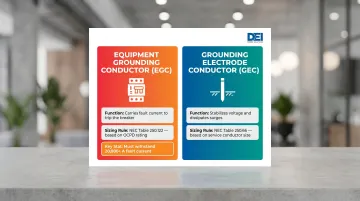
The EGC must handle fault current at sufficient magnitude to operate the breaker quickly. At 1200A, available fault currents can exceed 21,000 amperes — the EGC must carry this without melting, arcing, or losing continuity.
The GEC, by contrast, connects the grounded neutral at the main panel to a grounding electrode — a ground rod, concrete-encased rebar, building steel, or water pipe. Its job is voltage stabilization and lightning/surge dissipation, not fault-current interruption. That functional difference is why NEC sizes each conductor by a separate table.
Ground wire sizing for a 1200A service is a code minimum governed by NEC Article 250. Deviating below that minimum is a code violation — field conditions and cost constraints don't change that.
NEC-Specified Ground Wire Sizes for 1200 Amp Service
The NEC uses two separate tables to size grounding conductors for a 1200A service — one for the equipment grounding conductor (EGC) and one for the grounding electrode conductor (GEC). Which table applies depends on what you're sizing and why.
EGC Size for 1200 Amps: NEC Table 250.122
The EGC is sized based on the rating of the overcurrent protective device (OCPD) ahead of the equipment. For a 1200A breaker, NEC Table 250.122 specifies:
| OCPD Rating | Minimum Copper EGC | Minimum Aluminum EGC |
|---|---|---|
| 800A | 1/0 AWG | 3/0 AWG |
| 1,000A | 2/0 AWG | 4/0 AWG |
| 1,200A | 3/0 AWG | 250 kcmil |
| 1,600A | 4/0 AWG | 350 kcmil |
| 2,000A | 250 kcmil | 400 kcmil |
Proportional upsizing rule: If phase conductors are increased above the minimum to compensate for voltage drop, the EGC must be proportionally upsized using the same ratio per NEC 250.122(B). The EGC scales with the phase conductors; it cannot stay at the table minimum when the phase conductors do not.
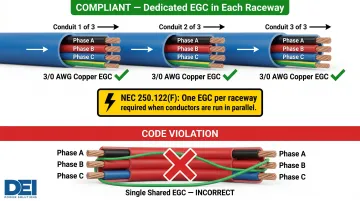
Parallel conductor requirement: When conductors are run in parallel (common at 1200A), an EGC must be included in each raceway or conduit per NEC 250.122(F). Each individual EGC is sized based on the OCPD rating, not split proportionally across raceways. For a 1200A installation with three parallel raceways, each raceway requires its own 3/0 AWG copper EGC.
GEC Size for 1200 Amps: NEC Table 250.66
Unlike the EGC, the GEC has nothing to do with breaker rating. It is sized based on the largest ungrounded service entrance conductor — or the equivalent area when parallel conductors are used.
| Largest Service Conductor (Cu) | Largest Service Conductor (Al) | Minimum GEC (Cu) | Minimum GEC (Al) |
|---|---|---|---|
| Over 3/0 thru 350 kcmil | Over 250 thru 500 kcmil | 2 AWG | 1/0 AWG |
| Over 350 thru 600 kcmil | Over 500 thru 900 kcmil | 1/0 AWG | 3/0 AWG |
| Over 600 thru 1100 kcmil | Over 900 thru 1750 kcmil | 2/0 AWG | 4/0 AWG |
| Over 1100 kcmil | Over 1750 kcmil | 3/0 AWG | 250 kcmil |
A typical 1200A service using 600 kcmil copper phase conductors per parallel set requires a GEC of 1/0 AWG copper or 3/0 AWG aluminum.
Electrode-specific cap: Per NEC 250.66(A), when the GEC terminates only at rod, pipe, or plate electrodes, the GEC need not exceed 6 AWG copper or 4 AWG aluminum — regardless of service size. For concrete-encased electrodes (Ufer), the cap is 4 AWG copper. Only runs to building steel or a ground ring must follow the full table without a cap.
Key Factors That Determine Final Ground Wire Size
While NEC tables set minimums, the final installed ground wire size in a 1200A service depends on several real-world variables. Material choice, conductor configuration, electrode type, and physical routing all factor into the final specification.
Conductor Material: Copper vs. Aluminum
Copper is preferred at large services because of its higher conductivity (smaller physical size for equivalent fault-current capacity), corrosion resistance, and termination compatibility. Aluminum EGCs at 250 kcmil are physically large and require:
- Aluminum-rated lugs
- Antioxidant compound at terminations
- Prohibited in damp or corrosive locations per NEC 250.64(A)
- No direct contact with concrete (bare aluminum restriction)
- Minimum 18-inch clearance from earth when external to a building
At 1200A, aluminum is code-permissible but copper is the standard choice for EGC applications.
Parallel Conductor Configurations
1200A services almost always use parallel conductors because no single conductor is large enough to economically or physically carry 1200A. Common configurations include:
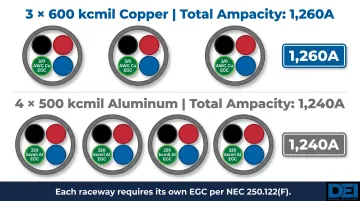
- Three parallel sets of 600 kcmil copper (3 × 420A = 1,260A)
- Four parallel sets of 500 kcmil aluminum (4 × 310A = 1,240A)
NEC requirement: Each raceway must contain its own EGC sized per Table 250.122 (i.e., 3/0 copper or 250 kcmil aluminum per raceway). A common field mistake is running a single shared EGC for all parallel sets, which is a code violation.
Grounding Electrode Type and System Configuration
The grounding electrode system selected for the 1200A service directly affects what GEC size is required:
- Ground rods cap the GEC requirement at 6 AWG copper
- Building steel and ground rings require following the full Table 250.66
- Most large commercial/industrial 1200A installations should use a composite electrode system (rod + Ufer or rod + building steel) for redundancy
Per NEC 250.50, every electrode present must be bonded into a single grounding electrode system — and each conductor to a different electrode type must meet that electrode's individual sizing requirement.
Run Length and Physical Protection Requirements
Run length does not change the code-required minimum size for a GEC or EGC. However, physical protection requirements under NEC 250.64(B) must be followed:
- 8 AWG GECs must be in conduit
- 6 AWG GECs must closely follow structural surfaces if unprotected
- For a 1200A service where GECs are larger than 6 AWG, conduit protection and proper support spacing (per NEC 250.64) are mandatory — verify spacing intervals before rough-in
How Ground Wire Size Is Specified, Documented, and Verified
For a 1200A commercial or industrial service, ground wire sizing must appear in construction documents—not just be selected in the field. The engineer of record typically specifies both EGC and GEC sizes on the electrical drawings, referencing NEC Table 250.122 and 250.66, along with the conductor material, electrode type, and raceway/protection method. Specification errors at this stage are one of the most common triggers for failed inspections and costly rework on large service installations.
DEI Power's engineering support team works with contractors and engineers during the specification phase to confirm that 1200A switchboard configurations include properly rated grounding termination points and bus sizing — catching mismatches before they reach the field.
Inspection Verification
Inspectors check grounding conductors at 1200A by verifying:
- Conductor size against the overcurrent device rating (EGC)
- Conductor size against service entrance conductor size (GEC)
- Each parallel raceway contains its own EGC
- Electrode type and connection method are code-compliant
- Conductor terminations use lugs rated for the conductor material and size
Any of these points can trigger a failed inspection — and on large service installations, that typically means schedule delays and change orders.
Rated Values vs. Tested Values
Passing the inspection checklist above confirms code compliance, but it's worth understanding what the NEC actually measures. The NEC specifies minimum conductor sizes based on calculated fault-current capacity, not field-tested ground resistance. That said, some AHJs (Authorities Having Jurisdiction) also require ground resistance testing, with a target below 25 ohms per NEC 250.53 for rod electrodes. Ground resistance testing does not replace proper conductor sizing. Both are independently required.
Consequences of Using an Undersized Ground Wire at 1200 Amps
Fault-Current Failure Mode
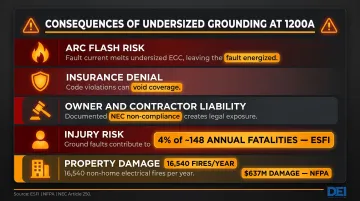
If the EGC is undersized in a 1200A service, it may not survive the thermal and magnetic stress of a ground fault long enough for the overcurrent device to operate. The conductor melts through, loses continuity, and converts from a safe fault path into an open circuit — leaving the fault energized. At 1200A service levels, the resulting arc flash energy release poses severe injury and equipment destruction risk.
At 480V with fault currents in the 20kA-60kA range, incident energy can reach 2.0 to 6.0 cal/cm² at 100ms clearing time—well above the 1.2 cal/cm² second-degree burn threshold per IEEE 1584-2018.
GEC Failure During Transient Events
Unlike the EGC, the GEC carries no load current during normal operation, so an undersized GEC shows no warning signs. It fails at the exact moment it is most needed: during a lightning strike or utility surge. Without sufficient cross-sectional area to dissipate transient energy, the conductor breaks down — taking insulation, connected equipment, and potentially the structure with it.
Common Field Mistakes That Lead to Undersizing
- Confusing EGC and GEC sizing rules and applying the wrong table
- Failing to include an EGC in each parallel raceway at 1200A installations
- Assuming the 6 AWG ground rod cap applies to the full grounding system rather than just the rod-to-GEC segment
- Not upsizing the EGC proportionally when service conductors are increased for voltage drop
Compliance and Liability Consequences
An undersized ground wire in a 1200A installation is a code violation under NEC Article 250 and fails inspection. When a fault or fire occurs afterward, a documented deviation from NEC minimums carries real downstream consequences:
- Insurance coverage: Carriers may deny claims when code violations contributed to the loss
- Owner liability: Facility owners bear exposure if the violation was known or inspectable
- Contractor standing: License complaints and civil liability follow documented NEC non-compliance
- Injury risk: ESFI data shows ground-faults account for 4% of approximately 148 annual workplace electrical fatalities
- Property damage: NFPA reports 16,540 non-home electrical fires per year, causing $637 million in property damage
Conclusion
Ground wire sizing for a 1200A service is a two-conductor specification: the EGC (minimum 3/0 copper or 250 kcmil aluminum per NEC Table 250.122) and the GEC (sized per NEC Table 250.66 from the service entrance conductor, with electrode-specific caps). Applying the wrong table or conflating these roles is the most common and consequential mistake in high-amperage service installations.
Getting the grounding specification right before equipment ships avoids failed inspections, change orders, and rework on high-amperage installs. DEI Power's UL 891-certified 1200A switchboards include correctly sized grounding bus bars and termination points, and the team provides configuration guidance to ensure the full system—grounding conductors included—is specified accurately from the start.
For technical specifications or configuration support, contact DEI Power at (866) 773-8050 or sales@deipower.com.
Frequently Asked Questions
What size grounding conductor for a 1200 amp service?
The EGC minimum is 3/0 AWG copper or 250 kcmil aluminum per NEC Table 250.122. The GEC is sized separately from the service entrance conductor per NEC Table 250.66—typically 1/0 copper or 3/0 aluminum for a 1200A service with 600 kcmil phase conductors.
What size neutral for 1200 amp service?
The neutral must carry at least the maximum unbalanced load and meet the minimum GEC size per NEC 310.12(D). Size it from the same service conductor tables as the ungrounded conductors, applying demand factors per NEC 220.61 based on your load calculation.
What size ground do I need with 3/0 wire?
When 3/0 copper is the service entrance conductor, NEC Table 250.66 requires a 2 AWG copper GEC for most electrode types (rod/pipe electrodes cap at 6 AWG copper). When 3/0 serves as a phase conductor on a 1200A circuit, the EGC is 3/0 copper per Table 250.122.
What size ground for 2000 amps?
For a 2000A service, the EGC minimum per NEC Table 250.122 is 250 kcmil copper or 400 kcmil aluminum. The GEC is sized per Table 250.66 from the service entrance conductor—typically 3/0 copper or 250 kcmil aluminum at minimum for conductors over 1100 kcmil.
Should I use 1/2 or 5/8 ground rod?
NEC 250.52(A)(5) requires ground rods to be at least 5/8 inch diameter (stainless steel or listed copper-clad) unless listed for a smaller diameter. For 1200A commercial installations, 5/8 inch is the standard minimum and larger electrode systems are typically recommended.
How many amps is a #8 ground good for?
An 8 AWG copper EGC is rated for circuits protected by up to 100A overcurrent devices per NEC Table 250.122. As a GEC, 8 AWG copper is the minimum for services with entrance conductors up to 2 AWG copper or 1/0 aluminum—it does not meet 1200A service requirements.