Introduction
You're reviewing submittals for a data center switchboard installation. The supplier's quote says "UL Certified" in bold letters, but your AHJ's checklist specifically asks for UL 891 compliance documentation. Are they the same thing? Will the inspector sign off?
For contractors and engineers specifying power distribution equipment, the distinction between "UL Listed" and "UL Certified" carries real consequences for inspection outcomes, insurance coverage, and project timelines. In regulated environments like data centers, healthcare facilities, and utility infrastructure, specifying the wrong certification type can trigger inspection rejections, costly change orders, or post-installation compliance failures.
The stakes aren't abstract. According to NFPA data, electrical distribution equipment was involved in an estimated 16,930 non-home fires annually between 2012 and 2016, causing 22 civilian deaths and $718 million in property damage. Getting the certification right is a matter of both safety and liability.
This guide clarifies what each term means, how to verify certification status, and which mark your project actually requires — so you can specify with confidence before the inspector shows up.
Key Takeaways
- UL Listed means a complete, standalone product tested to UL safety standards for its specific end-use — the mark inspectors typically require
- UL Certified is UL's umbrella term for Listed, Recognized, and Classified marks — "Certified" alone doesn't confirm testing depth
- UL Recognized components carry the backward "RU" mark and are approved for integration into larger assemblies only — not standalone installation
- UL is the most widely accepted NRTL path for code compliance — OSHA and the NEC don't mandate UL by name, but inspectors consistently expect it
- Specify switchgear by UL standard number (e.g., UL 891 for switchboards) rather than relying on generic "UL Certified" claims
UL Listed vs. UL Certified: Quick Comparison
Scope and Applicability
UL Listed applies to complete, standalone products tested in their intended end-use environment—think finished switchboards, panelboards, or circuit breakers ready for installation. UL Certified is the broader umbrella term UL now uses across multiple certification types:
- Listed — complete products tested for end-use
- Recognized — components intended for integration into larger assemblies
- Classified — products tested against specific hazards only, not comprehensive end-use performance
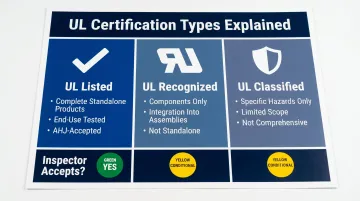
When you see "UL Certified" on a spec sheet, it doesn't automatically mean the product underwent the same comprehensive testing as a UL Listed assembly. You need to determine which specific certification type applies.
Visual Marks and Identification
The physical mark tells you which certification applies:
- UL Listed — circular "UL" mark with the word "LISTED," a control number, and product identity
- UL Recognized — backward "RU" symbol; not approved for standalone use
- UL Certified — UL's newer Enhanced or Smart Marks with "CERTIFIED" and optional attribute modules
To verify any UL mark:
- Locate the UL file number on the product label (begins with "E" followed by digits)
- Visit the UL Product iQ database
- Search by file number to confirm certification type, applicable standard, and current status
Don't skip this step—counterfeit labels exist, and not all "UL Certified" claims hold up to scrutiny.
Testing Scope and Inspector Acceptance
UL Listed products undergo end-use testing that covers electrical safety, mechanical function, grounding, insulation integrity, and environmental performance. That testing depth is what AHJs and inspectors are looking for—specifically, a mark tied to a recognized standard like UL 891 for switchboards.
"UL Certified" as a general claim doesn't specify testing depth. When an AHJ reviews your installation, they want to see the specific UL mark and the standard it references:
- Acceptable: UL Listed to UL 891, or UL Recognized per the component's intended use
- Insufficient: A spec sheet that simply states "UL Certified" without identifying the certification type or applicable standard
What is UL Listed?
UL Listed is a certification mark applied to complete, standalone products that Underwriters Laboratories has tested and confirmed meet nationally recognized safety standards for their specific function and end-use environment. Verification covers electrical hazards, fire risks, and mechanical safety — the full picture for a finished product entering the field.
Testing Rigor and Requirements
Earning UL Listed status requires extensive evaluation:
- Electrical safety testing: Insulation resistance, grounding continuity, overcurrent protection
- Mechanical integrity: Securing of live parts, enclosure strength, fastener reliability
- Environmental simulation: Testing under conditions matching deployment environments (indoor vs. outdoor, temperature extremes, humidity, water exposure)
- Ongoing compliance: Periodic follow-up inspections at manufacturing facilities to maintain certification
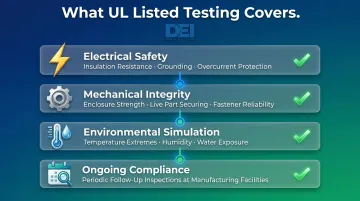
That ongoing inspection requirement is what separates UL Listed from UL Recognized — UL Recognized applies only to components destined for a larger assembly, not to finished, deployable equipment.
Products That Carry UL Listed Status
In power distribution, UL Listed applies to finished electrical equipment ready for direct deployment:
- Switchboards (UL 891)
- Panelboards (UL 67)
- Molded-case circuit breakers (UL 489)
- Load centers and distribution panels
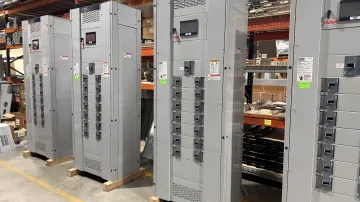
For example, DEI Power's switchboards (400A–4000A) are UL 891 Listed, meaning the entire assembly — not just individual components — has been tested as a complete, deployable system. That distinction matters when the authority having jurisdiction (AHJ) inspects the installation — and it shapes how engineers should write specs and how contractors should verify equipment on delivery.
Use Cases of UL Listed
UL Listed status becomes relevant at multiple project stages:
- Procurement — Specifications should call out UL Listed status and the applicable standard number so bidders provide compliant equipment, not just similar-looking alternatives.
- Delivery — Contractors should verify the UL mark on the equipment nameplate matches the specification before installation begins.
- Inspection — AHJs reference NEC 110.3(B), which requires equipment to be "listed and labeled." Inspectors will check the UL Listed mark and may cross-reference the file number in the Product iQ database.
Industries where UL Listed is expected:
- Commercial and industrial construction projects
- Data centers (hyperscale, enterprise, colocation)
- Healthcare facilities with imaging equipment and life-safety systems
- Utility substations and critical infrastructure
- Manufacturing plants with heavy-duty distribution needs
In these environments, non-listed equipment means failed inspections, voided insurance coverage, and direct liability exposure for the contractor or facility owner.
What is UL Certified?
"UL Certified" is not a single, specific mark—it's an umbrella term UL adopted under its Certification Marks program to indicate a product or manufacturer has met UL safety and quality standards. Seeing "UL Certified" in marketing materials doesn't automatically confirm the same testing rigor as UL Listed.
The Three Main Subtypes
- UL Listed: Complete products tested for end-use deployment (covered above).
- UL Recognized: Components or subassemblies — terminal blocks, busbars, relays, individual circuit breakers — marked with the backward "RU" symbol. They cannot be installed standalone; they must be incorporated into a UL Listed assembly. Using non-Recognized components in a Listed panel can void compliance.
- UL Classified: Products tested for specific hazards or limited conditions only. The mark includes a scope statement (e.g., "Classified as to fire resistance only") — not a comprehensive safety evaluation.
Product-Specific UL Standards
The most verifiable form of "UL Certified" is certification to a named, product-specific standard:
| Standard | Equipment Type | What It Covers |
|---|---|---|
| UL 891 | Low-voltage switchboards | Dead-front switchboards for power distribution |
| UL 67 | Panelboards | Panel construction, circuit protection, enclosures |
| UL 489 | Molded-case circuit breakers | Overcurrent protection devices |
| UL 508A | Industrial control panels | Control panel construction and wiring |
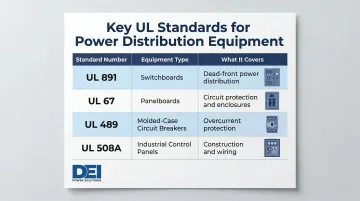
When a product is certified to a named UL standard — like DEI Power's UL 891-certified switchgear — testing was conducted against exact requirements for that product category, not a general safety review. This is verifiable through the UL file number and Product iQ database.
UL Certified Manufacturer vs. UL Certified Product
There's a meaningful distinction between a UL Certified manufacturer and a UL Certified product. A shop enrolled in UL's Industrial Control Panel Shop Program (UL 508A) is authorized to build panels to that standard, but individual panels still require their own evaluation and label to carry a UL mark.
The Panel Shop Program requires UL 508A training, a qualified Manufacturer Technical Representative (MTR) on staff, and ongoing quality controls. Compliance responsibility rests with the manufacturer. Engineers and contractors should verify that individual panels bear valid UL marks — not just confirm a shop's program enrollment.
Use Cases of UL Certified
The term "UL Certified" typically appears in:
- Manufacturer marketing materials
- Online product listings
- Distributor catalogs
- General promotional content
Buyers must dig deeper to identify the specific certification type and applicable UL standard before specifying equipment. If a switchboard is marketed as "UL Certified," confirm whether it's UL Listed under UL 891, or whether only certain components are UL Recognized.
UL Recognized Components in Assemblies
For engineers designing power distribution assemblies, UL Recognized components are essential — and must be used correctly. Circuit breakers, relays, terminal blocks, and wiring materials may carry only the UL Recognized mark (backward "RU"), meaning they're approved within a larger UL-evaluated system, not for standalone installation.
Including non-UL Recognized components in a UL Listed panel can void the panel's compliance status. The result: inspection failures and direct liability exposure.
UL Listed vs. UL Certified: Which Mark Matters for Your Project?
The Key Decision Framework
The right question isn't about which mark sounds more authoritative. It's about which mark the application, AHJ, or applicable code actually requires.
If the product must stand alone and be independently verified (e.g., a switchboard installed in a data center), inspectors will look for UL Listed or certification to a named UL standard like UL 891. Generic "UL Certified" claims won't satisfy most AHJs.
If you're sourcing components for integration into a larger assembly, UL Recognized status is appropriate—but the final assembly must be UL Listed.
Situational Guidance by Role
Contractors specifying power distribution for commercial builds, industrial plants, or data centers:
- Require products certified to the applicable named UL standard (UL 891 for switchboards, UL 508A for control panels)
- Request the UL file number and verify it in the Product iQ database before installation
- Confirm all internal components are UL Recognized for the specific application
Engineers writing specifications:
- Reference the UL standard by number in contract documents (e.g., "Switchboard shall be UL 891 Listed")
- Don't accept generic "UL Certified" language without clarification
- Verify manufacturer credentials and product listings before bid evaluation
Facility teams evaluating existing equipment:
- Locate the UL file number on equipment nameplates
- Cross-reference in the Product iQ database to confirm current status
- Flag any equipment without a visible, verifiable UL mark for further review
Inspector Walkthrough Example: During a final inspection, an AHJ examines a newly installed switchboard. The inspector locates the UL mark on the nameplate, notes the file number (e.g., E123456), and uses a mobile device to verify it in the Product iQ database. The database confirms UL 891 certification, applicable voltage and amperage ratings, and the manufacturer's name. The inspector cross-checks this against the approved submittal. If the mark is absent, unverifiable, or doesn't match the approved equipment, the installation fails inspection.
Insurance and Liability Implications
When an incident occurs involving equipment with a "UL Certified" label that turns out to be only a component-level Recognized mark (or a mark applied to just part of the assembly, such as the enclosure but not the internal wiring), the full assembly may not be covered.
According to the NFPA, electrical distribution equipment was involved in an estimated 16,930 non-home fires annually between 2012 and 2016, causing $718 million in property damage. Insurance investigations following electrical fires scrutinize certification status closely. Non-compliant equipment increases liability exposure and can complicate or void claims.
Practical Procurement Guidance
When issuing an RFQ or purchase order for power distribution equipment:
Specify by standard number — write "Switchboard shall be UL 891 Listed," not just "UL Certified."
Request these documents before acceptance:
- UL file number
- Copy of UL certification letter
- Verification that all internal components are UL Recognized for the application
Before accepting delivery, check the Product iQ database using the file number and confirm the mark on the equipment matches the approved submittal.
DEI Power's UL 891-certified switchboards ship with full submittal documentation — compliance certifications, detailed specifications (dimensions, NEMA ratings, amperage), and traceable UL file numbers — so this verification process is straightforward from day one.
Conclusion
UL Listed—or certification to a specific UL standard like UL 891—is the mark that matters when electrical equipment must pass inspection, satisfy insurance requirements, and perform reliably in mission-critical environments. "UL Certified" as a general term signals a manufacturer's involvement with UL, but without a named standard attached, it doesn't confirm that any specific product has been tested and listed.
Before specifying any switchgear, switchboard, or power distribution assembly, verify the exact UL mark, the applicable standard, and the UL file number. Choosing equipment that carries a named, product-specific UL certification reduces risk, accelerates inspections, and protects against costly change orders or post-installation failures.
For contractors, engineers, and facility teams working on commercial, industrial, or utility projects, clarity on this distinction isn't optional—it's essential for keeping projects on schedule and operations running without interruption. DEI Power manufactures UL 891-certified switchboards and power distribution assemblies built to meet that standard by name—giving project teams the documentation and confidence they need before equipment ever reaches the job site.
Frequently Asked Questions
What's the difference between UL certified and UL listed?
UL Listed is a specific mark for complete, standalone products tested in their intended end-use environment. UL Certified is a broader umbrella term that includes Listed, Recognized (components only), and Classified (limited scope)—so "UL Certified" alone doesn't confirm the same testing depth as Listed.
What does UL Listed mean?
UL Listed means a complete product has been independently tested by Underwriters Laboratories to meet nationally recognized safety standards for its intended function. The designation requires initial testing plus periodic follow-up inspections to maintain compliance.
Does UL Listed mean safe?
It means the product met UL safety standards at certification, with ongoing field inspections to maintain that status. It doesn't guarantee safety under all conditions—if the product is modified or used outside its rated parameters, those assurances no longer apply.
Is a UL listing required in the USA?
No federal law mandates UL listing for all products. In practice, however, state and local codes, AHJ requirements, and industry standards often require it. Most insurers, retailers, and project owners won't accept unlisted equipment for regulated commercial or industrial applications.
How to check if a product is UL Listed?
Buyers can verify a product's UL status using the UL Product iQ database by searching the product's UL file number (beginning with "E"), which confirms the certification type, applicable standard, and current status. The file number appears on the product label near the UL mark.
What is the difference between UL listed and non-UL listed?
UL Listed products have been independently tested and verified to meet recognized safety standards with ongoing compliance monitoring. Non-UL listed products have no third-party verification of safety performance—which can create inspection failures, insurance voids, and liability exposure in commercial and industrial applications.