What Is Air Insulated Switchgear (AIS)?
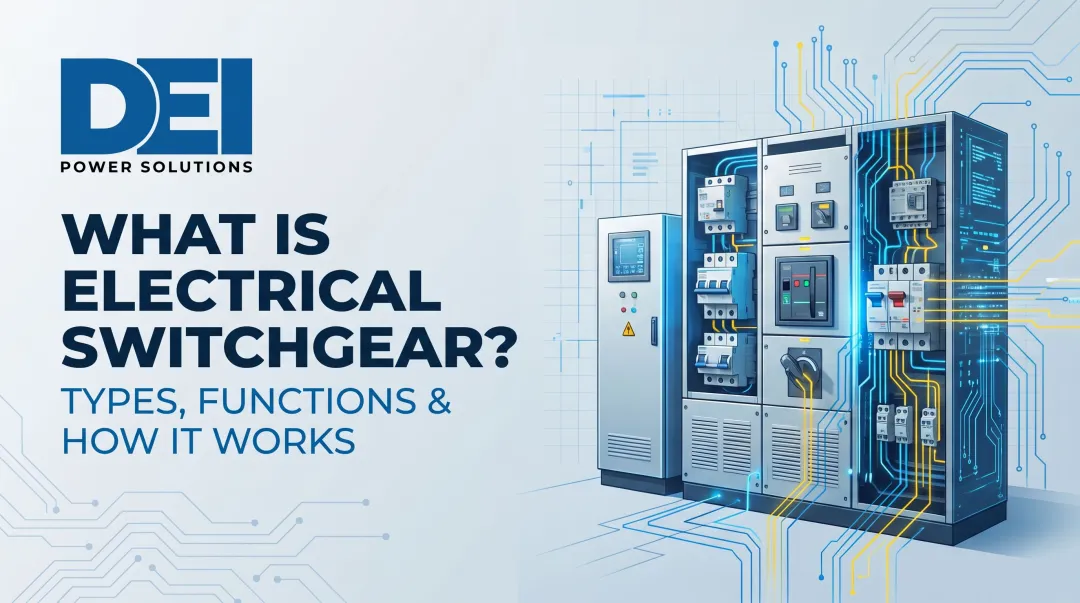
Air insulated switchgear (AIS) controls, protects, and isolates circuits in power distribution systems using ambient air as the insulating medium. The air gap between live components prevents faults and electrical arcing — a proven approach deployed across substations, commercial buildings, industrial plants, and data centers worldwide.
According to IEEE C37.20.2, metal-clad switchgear assemblies are defined as equipment "where air at ambient pressure is the primary insulating medium." The global AIS market was valued at approximately $30.87 billion in 2026 and is projected to reach $48.53 billion by 2034, according to Fortune Business Insights.
Who Relies on AIS?
Contractors, engineers, and facility teams managing electrical infrastructure encounter AIS daily:
- Utility substations and grid interconnection points
- Manufacturing plants and industrial processing operations
- Commercial buildings requiring code-compliant distribution
- Data centers with mission-critical uptime requirements
This guide explains how AIS works, its major types, standout features, benefits and limitations, and how it compares to gas-insulated switchgear (GIS)—so you can make confident equipment decisions.
TLDR:
- Uses ambient air as insulation — no SF6 gas (23,500x CO2 warming potential)
- Costs 2–2.5x less than GIS at 5kV and 15kV voltage classes
- Available in metal-clad and metal-enclosed configurations from 480V to 36kV
- Vacuum circuit breakers provide fast fault interruption without gas handling
- Rated up to 4,000A continuous current and 63kA interrupting capacity per IEEE standards
How Air Insulated Switchgear Works
AIS relies on dielectric strength—air's ability to resist electric fields without breaking down and becoming conductive—to maintain safe clearances between energized conductors and grounded enclosures. At standard atmospheric pressure, air achieves approximately 3 kV/mm, which is effective for low- and medium-voltage applications.
Fault Interruption Process:
When a fault or overload occurs, AIS responds through a precise sequence:
- Detection: Protection relays continuously monitor voltage and current through current transformers (CTs) and potential transformers (PTs)
- Trip signal: When abnormal conditions are detected, relays send a trip signal to the circuit breaker's trip coil
- Contact separation: The circuit breaker opens its contacts, physically separating the current path
- Arc extinction: The arc is extinguished—in modern AIS, this happens in vacuum interrupters at the natural current zero
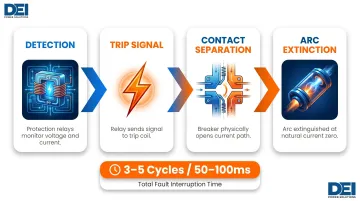
For medium-voltage systems, typical fault clearing times are 3-5 cycles (50-100 milliseconds at 60 Hz). This rapid response protects downstream equipment and personnel from damage.
That speed depends on the components working together. Here's how each one contributes.
Key Components of AIS
Circuit Breakers:
Circuit breakers are the primary fault-interrupting devices in AIS. According to a 2017 Doble Engineering technical paper, vacuum circuit breakers (VCBs) now dominate medium-voltage (1kV–38kV) applications. VCBs deliver fast, reliable arc interruption without SF6 gas, with opening times of 80–120 milliseconds for systems up to 12kV.
Busbars and Disconnect Switches:
- Busbars are the main current-carrying conductors within the switchgear lineup, distributing power to multiple circuits
- Disconnect switches provide visible isolation points for safe maintenance or emergency operations, allowing sections to be de-energized without affecting the entire system
Protection and Control Devices:
Microprocessor-based protection relays continuously monitor electrical parameters and detect abnormal conditions such as overcurrent, undervoltage, or ground faults. These relays trigger appropriate responses—from load shedding to full circuit isolation—protecting both equipment and personnel.
Types of Air Insulated Switchgear
Metal-Clad vs. Metal-Enclosed AIS
The distinction between metal-clad and metal-enclosed switchgear matters for safety, maintenance, and code compliance.
Metal-Clad Switchgear (IEEE C37.20.2):
Metal-clad is the highest construction class of medium-voltage switchgear. To qualify, equipment must meet all of these requirements:
- Draw-out circuit breakers that can be moved between Connected, Test, and Disconnected positions
- Grounded metal barriers between all major compartments (breaker, bus, cable)
- Insulation-covered primary busbars throughout the assembly
- Automatic shutters that cover primary stabs when breakers are withdrawn
- Mechanical interlocks preventing unsafe operating sequences
Metal-clad switchgear is typically rated 5 kV to 38 kV and favored for utility substations, industrial plants, and mission-critical facilities where safety, reliability, and maintenance flexibility are paramount.
Metal-Enclosed Switchgear (IEEE C37.20.1):
Metal-enclosed is a broader category with less rigid compartmentalization requirements. It may use fixed or draw-out breakers, and internal barriers aren't required to be metal or grounded. This construction is simpler and less expensive, making it suitable for commercial facilities, light industrial sites, and secondary distribution where maintenance access is not a primary concern.
Indoor vs. Outdoor AIS
Indoor AIS is designed for climate-controlled environments like switchrooms and substations. These units typically carry NEMA 1 enclosure ratings, providing protection against incidental contact but not environmental exposure.
Outdoor AIS is built with weatherproof enclosures rated NEMA 3R or higher. According to ANSI/NEMA 250-2020, NEMA 3R enclosures protect against rain, sleet, and ice, making them suitable for utility applications and industrial sites where space constraints require outdoor installation. Outdoor units often require more frequent maintenance due to exposure to dust, moisture, and temperature extremes.
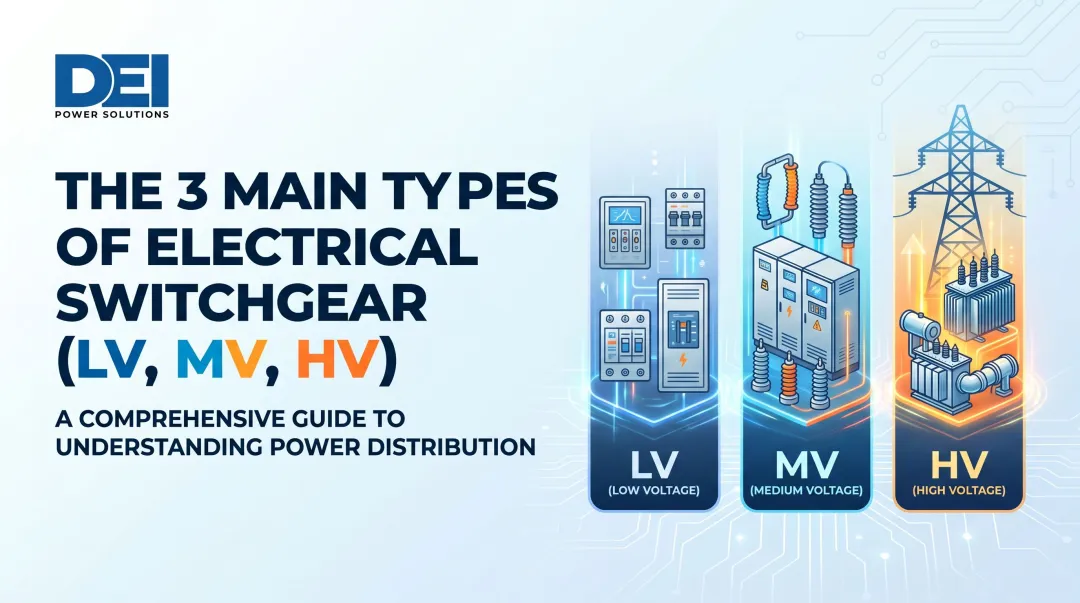
Low-Voltage AIS (up to 1,000V)
Low-voltage AIS covers commercial buildings, data centers, and light industrial facilities. These units operate at voltages such as 480V, 208V, or 600V and are governed by standards like UL 891 for switchboards.
UL 891 specifies maximum ratings of 4,000A at 480V for U.S. constructions and 100kA short-circuit current rating at up to 600V. DEI Power manufactures UL 891-certified switchboards to these ratings, with NEMA 1 and NEMA 3R enclosure options for both indoor and outdoor installations.
Where low-voltage distribution handles building-level loads, medium-voltage AIS steps up to handle utility-scale and campus-wide power demands.
Medium-Voltage AIS (1kV–36kV)
Medium-voltage AIS serves utility substations, industrial plants, and large commercial campuses.
Metal-clad switchgear is the most common form at 5kV and 15kV voltage classes.
Per IEEE C37.20.2, standard ratings include:
- Voltage classes: 4.76 kV, 8.25 kV, 15.0 kV, 27.0 kV, 38.0 kV
- Continuous current: 1,200A, 2,000A, 3,000A, 4,000A
- Interrupting capacity: 25 kA, 31.5 kA, 40 kA, 50 kA, up to 63 kA
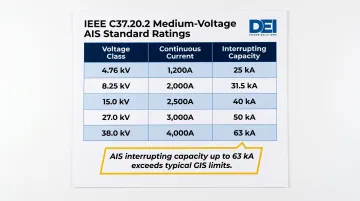
These ratings exceed typical GIS limits of 3,000A continuous and 40kA interrupting, making AIS the higher-capacity option for demanding applications.
Fixed vs. Draw-Out (Withdrawable) Configurations
Fixed-mounted equipment is bolted in place, offering simpler construction and lower cost. However, maintenance requires de-energizing the entire switchgear section, increasing downtime.
Draw-out (withdrawable) designs allow circuit breakers to be removed for maintenance without de-energizing adjacent sections. The breaker moves between three positions:
- Connected: Primary and secondary circuits fully engaged for normal operation
- Test: Primary circuits isolated while secondary circuits remain live — used to test breaker control functions without switching loads
- Disconnected: Breaker fully racked out for safe inspection, maintenance, or replacement
This flexibility reduces maintenance downtime and supports live-section work, which is why draw-out configurations are standard in metal-clad switchgear and mission-critical applications.
Key Features of Air Insulated Switchgear
Open, Accessible Design
AIS components are visible and physically accessible without specialized gas handling equipment. This simplifies:
- Visual inspections of busbar connections and insulation
- Thermographic scanning to detect hot spots before failures occur
- Component replacement without draining and refilling gas tanks
For facility teams performing routine inspections, this accessibility reduces inspection time and equipment costs when compared to sealed GIS systems.
Modular and Expandable Architecture
AIS lineups are designed to accept additional panels or sections as load requirements grow. Vertical sections can be added to existing installations, with new busbars bolted to existing bus structures and new breaker compartments integrated into the lineup.
This modularity matters for organizations anticipating future expansion:
- Add switchgear sections as server capacity grows — without replacing entire lineups
- Expand electrical distribution incrementally as production scales
- Extend existing switchgear to new buildings rather than starting from scratch
Interlocking and Safety Mechanisms
Properly engineered AIS includes mechanical and electrical interlocks preventing unsafe operation sequences:
- Prevents disconnect switch operation while the circuit breaker is closed
- Blocks access to live compartments during operation
- Requires specific sequences for breaker racking (moving between positions)
- Ensures grounding switches are closed before accessing cable compartments
These interlocks protect maintenance personnel from arc flash and shock hazards.
Standards Compliance and Ratings
AIS is designed and tested to applicable standards:
- ANSI/IEEE/NEMA standards for North American applications
- UL 891 for low-voltage commercial switchboards
- IEEE C37.20.2 for metal-clad medium-voltage switchgear
- IEC 62271 for international markets
Buyers should verify that switchgear carries the correct certification for their jurisdiction and application. For commercial low-voltage switchboards in the U.S., UL 891 certification is the recognized standard.
Arc Flash Management
Standards compliance and arc flash protection are closely linked — arc-resistant design requirements are themselves defined by IEEE testing criteria. Well-engineered AIS incorporates pressure-relief channels and reinforced compartments to direct arc energy safely away from personnel.
IEEE C37.20.7-2024 defines five pass/fail criteria for arc-resistant testing:
- Doors and covers must not open
- No parts may be ejected (fragmentation)
- No burn-through of external walls in protected areas
- Cotton indicators simulating clothing must not ignite
- Grounding connections must remain effective
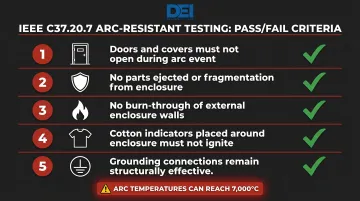
Arc-resistant designs use pressure-relief vents that open during arc faults. These vents channel hazardous flames and gases — which can reach 7,000°C — out the top through plenums or chimney systems, keeping personnel protected during live-panel inspections.
Benefits of AIS — and Limitations to Know
Benefits of AIS — and Limitations to Know
Benefits
Lower Upfront Cost and Simpler Installation
Because AIS uses air rather than sealed gas systems, initial equipment costs are lower. At 5 kV and 15 kV, GIS costs approximately 2 to 2.5 times as much as metal-clad AIS, according to Eaton's comparative white paper.
Installation doesn't require specialized gas handling or sealed enclosure management, reducing both labor time and contractor expertise requirements.
Environmental Advantage
AIS avoids SF6 gas — a potent greenhouse gas with a 100-year global warming potential of 23,500 relative to CO2, according to the IPCC Fifth Assessment Report.
Regulations are shifting against SF6 across multiple jurisdictions:
- EU F-Gas Regulation (February 2024) restricts SF6 in medium-voltage switchgear starting 2030–2032
- California (CARB) has enacted SF6 phase-down requirements for electrical equipment
- New York (NYSDEC Part 495) established parallel restrictions on SF6 use
Ease of Maintenance and Repair
AIS components are directly accessible, parts are widely available, and standard electrical technicians can handle most maintenance without specialized training. Eaton's white paper notes that while AIS requires "more frequent and elaborate maintenance" than GIS, the tasks are straightforward and don't require extended shutdowns.
The NFPA 70B (2023 edition) — now a mandatory standard — supports condition-based maintenance frameworks. Inspection frequency varies by environment and loading conditions, but the work itself stays accessible to in-house staff.
Limitations to Consider
Space Requirements
AIS requires larger physical clearances between components than GIS. At lower voltage classes (5 kV and 15 kV), footprints are similar. But at 27 kV and 38 kV, GIS offers a footprint reduction of up to 60% compared to equivalent AIS lineups.
In dense urban substations or confined switchrooms, space becomes a decisive factor. For greenfield sites or facilities with adequate space, the cost savings and flexibility of AIS outweigh the footprint difference.
Greater Sensitivity to Environmental Conditions
Dust, moisture, humidity, and airborne contaminants can degrade AIS insulation and increase maintenance frequency. Outdoor or harsh industrial environments may require:
- More rigorous inspection schedules
- Enhanced enclosure protection ratings (NEMA 3R or higher)
- Periodic cleaning of insulators and bus compartments
Indoor installations in climate-controlled environments minimize these concerns, while outdoor AIS requires proactive maintenance planning.
AIS vs. GIS: How to Choose
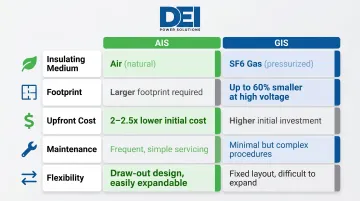
Choosing between AIS and GIS comes down to five factors: voltage class, available space, upfront budget, maintenance tolerance, and long-term flexibility.
| Decision Factor | AIS Advantage | GIS Advantage |
|---|---|---|
| Insulating medium | Atmospheric air (no SF6 environmental liability) | SF6 gas (sealed, unaffected by external contaminants) |
| Footprint/space | Similar to GIS at 5-15kV; larger at 27-38kV | Up to 60% smaller footprint at 27-38kV |
| Upfront cost | 2-2.5x less expensive at 5kV and 15kV | Higher initial cost, potentially offset by building savings at 27-38kV |
| Maintenance burden | More frequent inspections; simpler tasks | Minimal maintenance for long periods; complex repairs if failure occurs |
| Operational flexibility | Draw-out breakers; easy circuit modifications and expansions | Fixed-mount; difficult or impossible to expand once installed |
Where AIS Wins
At 5kV and 15kV voltage classes, AIS (metal-clad) is significantly less expensive than GIS while offering comparable current and interrupting ratings. AIS also provides greater flexibility for future circuit modifications and expansions—GIS cannot easily accommodate changes once installed.
For facilities with adequate space and environmental control, AIS delivers better long-term value. Eliminating SF6 also removes regulatory exposure and reduces environmental liability over the equipment's lifespan.
Where GIS Wins
At 27kV and 38kV, GIS offers a meaningfully smaller footprint, making it preferable for space-constrained urban substations. GIS is also sealed against environmental contaminants, so dust, humidity, and temperature extremes pose no insulation risk.
GIS carries a higher initial cost and locks in your layout permanently. A failure inside the gas tank requires an extensive shutdown to repair — unlike AIS, where individual components can be isolated and serviced without taking the full assembly offline.
Where AIS Is Used: Common Applications
Substations and Utility Infrastructure
AIS is the dominant technology in medium-voltage electrical substations globally. Eaton confirms that "today, the bulk of installed equipment is air-insulated switchgear."
In distribution substations, AIS manages:
- Power flow between transmission and distribution circuits
- Fault isolation to prevent cascading outages
- Load switching to balance demand across feeders
- Grid interconnection at voltage classes from 5kV to 38kV
Industrial Plants and Commercial Facilities
AIS serves manufacturing plants, processing facilities, healthcare campuses, and large commercial buildings. In these environments, reliability, ease of servicing, and code compliance are paramount.
Typical applications include:
- Manufacturing plants requiring stable power for production equipment
- Processing facilities with continuous operations that cannot tolerate extended outages
- Healthcare campuses where patient safety depends on reliable power distribution
- Large commercial buildings and office complexes with complex electrical systems
DEI Power's custom-configured, UL 891-certified AIS solutions are engineered specifically for these commercial and industrial environments where uptime and code compliance are non-negotiable — offering amperage ratings from 400A to 4,000A with rapid delivery and in-house engineering support from spec to delivery.
Data Centers and Energy Infrastructure
Hyperscale and enterprise data centers rely on low-voltage AIS for reliable, fast-response power distribution to IT loads. According to Data Center Dynamics, AIS has been "historically favored by some operators specifically to avoid the environmental risks and regulations associated with SF6 gas."
Data center applications include:
- Main switchboards distributing power to UPS systems and PDUs
- Redundant power paths ensuring N+1 or 2N availability
- Scalable architectures supporting phased capacity additions
AIS also plays a growing role in renewable energy integration. Wind farm collector substations at 34.5kV use AIS switchgear lineups with collector feeder breakers and bus arrangements. Microgrids and solar installations benefit from AIS's modular, expandable design, which supports evolving load profiles as generation and storage assets are added.
Frequently Asked Questions
What is commercial switchgear?
Commercial switchgear refers to electrical switching and protection equipment used in commercial buildings, campuses, and facilities to control, distribute, and protect power circuits. It encompasses circuit breakers, disconnect switches, busbars, and protection devices housed in metal enclosures rated for the facility's voltage and current requirements.
What maintenance and accessibility features and components should I look for in air-insulated switchgear for commercial use?
Look for draw-out circuit breakers for safe maintenance without full de-energization, front-accessible compartments, arc-resistant enclosure design, mechanical interlocks, and clear labeling with documented maintenance intervals. UL 891 certification signals compliance with domestic commercial safety standards.
What is the main difference between AIS and GIS?
AIS uses atmospheric air as its insulating medium while GIS uses pressurized SF6 gas. AIS is larger and more sensitive to environmental conditions, but costs less and adapts more easily to modifications — while GIS is more compact and lower-maintenance but significantly more expensive and difficult to expand.
What voltage range is air insulated switchgear typically used for?
AIS covers a wide range — from low-voltage applications below 1,000V (commercial switchboards at 480V or 208V) up to medium-voltage applications at 5kV, 15kV, and in some cases 36kV. For commercial and industrial facilities, low-voltage AIS below 1,000V is the most common application. Above 36kV, GIS is generally preferred.
Can AIS be installed outdoors?
Yes, outdoor AIS is widely used, but requires weatherproof enclosures with appropriate NEMA ratings (typically NEMA 3R) to protect against rain, dust, and temperature extremes. Expect more frequent maintenance intervals outdoors compared to climate-controlled indoor installations.
How long does air insulated switchgear typically last?
Well-maintained AIS is designed to operate reliably for 25 years or longer, according to industry standards. Actual service life depends on installation environment, maintenance adherence, loading conditions, and whether components like circuit breakers are periodically tested and refurbished.