Introduction
Step into any large commercial office building, warehouse, or data center in the U.S. and you'll find the same designation on panel labels and equipment nameplates: 277/480V. For electricians, engineers, and facility teams, this is the standard three-phase service that keeps commercial operations running.
It's also the foundation of nearly every large-scale power distribution system in the country—from hospitals and manufacturing plants to hyperscale data centers.
Yet despite how frequently professionals encounter 277/480V, the relationship between these two voltages is regularly misunderstood. Many can identify the numbers but struggle to explain how both voltages come from a single service—leading to mismatched equipment specs, incorrect wiring assumptions, or transformer installations that weren't necessary.
That gap in understanding has real consequences on the job. This guide covers where both voltages come from, the electrical logic that connects them, why this system dominates commercial distribution, and what to know when specifying equipment for a 480Y/277V installation.
Key Takeaways
- 277V and 480V come from the same three-phase, four-wire Wye system—not two separate services
- 480V is line-to-line voltage (between phase conductors); 277V is line-to-neutral voltage (phase to neutral)
- The math is straightforward: 480V ÷ 1.732 = 277V, the same ratio that produces 120V from a 208V system
- 277V serves lighting and branch circuits
- 480V powers motors, HVAC, and high-demand industrial loads
- Properly rated switchgear safely separates and distributes both voltage levels within one facility
What Is the 277/480V System?
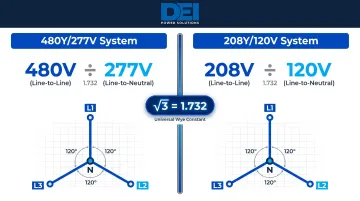
Written in NEC notation as 480Y/277V, this designation identifies a three-phase, four-wire electrical service where 480V exists between any two phase conductors (line-to-line) and 277V exists between any single phase conductor and the neutral wire (line-to-neutral). The "Y" indicates a Wye-connected transformer, distinguishing it from a Delta configuration.
Per NEC Article 100, "Voltage, Nominal," 480Y/277V is an explicit example of standard voltage designation. ANSI C84.1 establishes it as the authoritative standard for nominal system voltages in North America.
That standard exists for a practical reason: commercial and industrial facilities need two voltage levels simultaneously—a higher voltage for power-intensive equipment and a lower voltage for lighting and low-power loads. The 480Y/277V Wye configuration delivers both from a single service, without requiring dedicated transformers for every branch circuit.
Common misconceptions to avoid:
- It is NOT two independent services running in parallel
- 277V alone is NOT a standalone voltage—it only exists as the line-to-neutral component of the larger 480Y/277V service
- It is NOT interchangeable with 240V (split-phase) or 208V (from a 208Y/120V system), which originate from entirely different transformer configurations
How the 277/480V System Works
The 480Y/277V system operates through a specific transformer winding configuration—the four-wire Wye (star) connection—which makes both voltage levels simultaneously accessible from a single service.
The Four-Wire Wye Configuration
In a 480Y/277V system, one end of each of the three transformer phase windings connects to a shared common point—the neutral—while the other end becomes a hot phase conductor (L1, L2, L3). This creates a line-to-neutral voltage available on every phase.
Key distinction: A three-wire Delta system delivers 480V line-to-line only and cannot serve 277V single-phase loads without adding a transformer. The "Y" in 480Y/277V tells engineers and electricians the system is Wye-configured and natively provides both voltages.
The Math Behind 277V
In any Wye system, line-to-neutral voltage equals line-to-line voltage divided by the square root of 3 (√3 ≈ 1.732):
480V ÷ 1.732 = 277.13V (rounded to 277V)
This isn't arbitrary—it's a fixed geometric consequence of how three-phase power is produced. The three phases are separated by exactly 120 electrical degrees, and the vector derivation uses the law of cosines to establish the √3 relationship.
The 208Y/120V parallel: The same mathematical relationship governs residential and light-commercial systems:
| System | Line-to-Line | ÷ √3 | Line-to-Neutral |
|---|---|---|---|
| 480Y/277V | 480V | 1.732 | 277V |
| 208Y/120V | 208V | 1.732 | 120V |
Both systems follow identical geometry — only the transformer's winding ratio changes.
Accessing Both Voltages from One Panel
277V is obtained by connecting a load between one phase conductor and neutral (line-to-neutral). 480V is obtained by connecting a load between any two phase conductors (line-to-line), or across all three phases for three-phase equipment.
This means a single 480Y/277V distribution panel can simultaneously serve:
- 277V lighting circuits (single-phase, line-to-neutral)
- 480V three-phase motor loads (line-to-line or three-phase)
Through separate breakers and branch circuits within the same assembly.
Infrastructure requirements: Safely separating and routing both voltage levels requires switchboards and panelboards rated and configured for 480Y/277V service. The distribution equipment must maintain code-compliant isolation between 277V and 480V branch circuits within the same assembly — a design requirement that directly shapes switchgear selection for commercial and industrial projects. DEI Power manufactures UL 891-certified switchboards in ratings from 400A to 4000A, built specifically for 480Y/277V distribution in commercial and industrial installations.
Why Commercial Buildings Use 277/480V Instead of Lower Voltages
Higher Voltage Reduces Current and Conductor Costs
Ohm's Law (P = V × I) reveals the fundamental advantage: for the same power output, higher voltage means proportionally lower current. Lower current means conductors run cooler, smaller wire gauges suffice, and energy losses from resistive heating drop significantly.
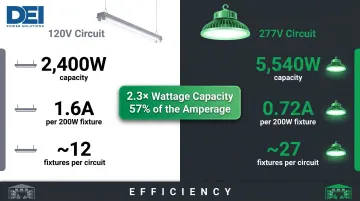
Circuit capacity comparison for a standard 20A branch circuit:
| Voltage | Maximum Wattage | Current for 200W Fixture | Fixtures per Circuit |
|---|---|---|---|
| 120V | 2,400W | 1.6A | ~12 |
| 277V | 5,540W | 0.72A | ~27 |
Result: 277V delivers 2.3x the wattage capacity on identical wire and breaker sizes, drawing only 57% of the amperage for equal power output.
In a 100,000 sq ft warehouse requiring 100 kW of LED lighting, a 120V system draws approximately 833A total across ~42 circuits. The same load at 277V draws only 361A across ~18 circuits—cutting circuit count by more than half and reducing panel space, conduit, and conductor costs.
Large Commercial and Industrial Loads Require 480V
Motors driving HVAC chillers, cooling towers, compressors, elevators, and pumps require 480V three-phase. Per NEMA MG1 Part 10.30, the standard utilization voltage for polyphase motors on 480V distribution systems is 460V (with a ±10% tolerance window).
Example: A 500-ton cooling tower specifies 480V three-phase at 64A full load. Attempting to power equivalent loads at 120/208V would demand prohibitively oversized conductors and breaker ratings.
That load profile is exactly why 277V lighting and 480V power loads are engineered onto the same service—each voltage serves its intended load class without compromise.
277V Lighting Efficiency at Commercial Scale
Fluorescent and LED drivers rated for 277V draw less current than 120V equivalents for the same lumen output. In facilities with hundreds of fixtures—warehouses, office campuses, retail spaces—this current reduction directly cuts:
- Conductor sizing requirements
- Panel breaker count
- Long-run heat losses (I²R losses)
Modern LED drivers often feature universal input ranges (120V-277V), automatically adjusting to the input voltage. Using 277V directly from the 480Y/277V service avoids the energy loss and equipment cost of step-down transformers required for 120V loads.
Eliminating Step-Down Transformers Across the Building
The 480Y/277V service natively produces 277V for lighting from the same panel delivering 480V for power loads. This lets engineers design most of the electrical system without adding dedicated lighting transformer banks.
Transformers are still used where 120V receptacles or controls are needed—typically a 480V → 120/208V step-down—but this becomes a targeted, localized addition rather than the primary distribution architecture.
Why Not 208Y/120V for Large Facilities?
Understanding why 480Y/277V dominates large facilities means understanding what 208Y/120V cannot do. This lower-tier three-phase service tops out at 208V line-to-line. This is insufficient for large motor loads and HVAC systems without significantly oversized conductors.
Facilities with heavy power loads almost always specify 480Y/277V from the utility at the design stage—a decision engineers cannot easily reverse after construction.
Where 277/480V Systems Are Deployed
Commercial and Institutional Buildings
Large office buildings, retail centers, schools, hospitals, and university campuses are the primary users of 480Y/277V systems. The combination of extensive overhead lighting (served at 277V) and large HVAC and mechanical equipment (served at 480V three-phase) makes this service the standard for commercial projects above a certain demand threshold.
Utility standard: Commercial buildings above a certain size are served at 480Y/277V, three-phase, four-wire service. Nearly all spot networks in North America function at 480Y/277V secondary voltage, serving concentrated, high-reliability loads such as high-rise buildings and shopping malls.
Data Centers and Critical Facilities
480V three-phase is the standard input voltage for large UPS systems, power distribution units (PDUs), and precision cooling equipment in enterprise and hyperscale data centers. 277V serves raised-floor and overhead lighting.
Industry standard: All three major UPS manufacturers—Eaton (93PM, 9395XC), Schneider Electric (Galaxy VS), and Vertiv (Liebert EXL S1, 250-1200kW)—offer 480V three-phase as their standard U.S. data center input voltage. These environments operate at near-continuous full load, so the efficiency advantages of 480Y/277V distribution show up directly in operating costs.
For facilities that need structured branch circuit distribution at this voltage, DEI Power's Remote Power Panels—available in 225A, 400A, 600A, and 1200A ratings with 480Y/277V capability—are built for hyperscale data center main distribution, AI compute halls, and colocation facilities.
Industrial Plants and Processing Facilities
Manufacturing environments use 480V three-phase to drive motors on production lines, compressors, conveyor systems, and processing equipment while the same service powers facility lighting at 277V.
Voltage hierarchy: In industrial facilities, primary distribution occurs at medium voltage (5 kV to 35 kV), carried by feeders from substations to network transformers, which step down to 480Y/277V for secondary distribution. The 480Y/277V bus then serves:
- Motor control centers and variable frequency drives
- Lighting panels at 277V
- Step-down transformers to 208Y/120V for receptacle and office loads
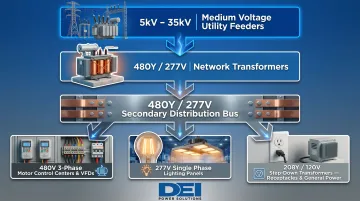
Facilities with lower primary voltage infrastructure (2.4kV, 4.16kV, or 13.8kV) follow the same secondary distribution pattern, stepping down to 480Y/277V for branch circuit distribution.
Wiring and NEC Compliance for 277/480V Circuits
Conductor Requirements
277V branch circuit (single-phase, line-to-neutral):
- One ungrounded hot phase conductor
- One grounded neutral conductor
- One equipment grounding conductor
480V three-phase circuit (line-to-line):
- Three hot conductors
- One equipment grounding conductor
- Typically no neutral for balanced three-phase loads
Critical distinction: Connecting two hot phase conductors together does not create a 277V circuit—277V is always line-to-neutral.
NEC Conductor Color Conventions for 480Y/277V Systems
NEC Article 210.5 governs branch-circuit conductor identification. The widely adopted industry convention for 480Y/277V systems is:
| Conductor | Color | NEC Requirement |
|---|---|---|
| L1 (Phase A) | Brown | Convention (not mandated) |
| L2 (Phase B) | Orange | Convention (not mandated) |
| L3 (Phase C) | Yellow | Convention (not mandated) |
| Neutral (Grounded) | Gray | Required per NEC 200.6 |
| Equipment Ground | Green or bare | Required per NEC 250.119 |
Important: The NEC does not mandate specific colors for ungrounded conductors above 120V. It requires only that they be identified and that the identification scheme be posted at each panelboard. Brown/Orange/Yellow is an industry convention that has achieved near-universal acceptance but carries no force of code.
Hazard: Misidentifying conductors between voltage classes is a serious safety risk. The gray neutral in a 277/480V system is not interchangeable with a white neutral from a 120V circuit.
NEC Compliance and Equipment Rating Requirements
480Y/277V systems fall under NEC provisions for over-150V-to-ground systems, which impose stricter requirements:
Working clearances (NEC Table 110.26(A)(1)):
| Condition | 0-150V | 151-600V (480Y/277V) |
|---|---|---|
| Condition 1 | 3 ft | 3 ft |
| Condition 2 (grounded parts opposite) | 3 ft | 3.5 ft |
| Condition 3 (live parts opposite) | 3 ft | 4 ft |
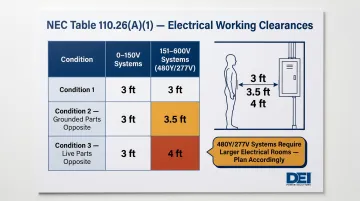
480Y/277V installations require larger electrical rooms than equivalent 208Y/120V designs.
Arc flash and shock hazards (NFPA 70E): For the 301-750V range, which encompasses all 480V equipment, two boundaries apply: the limited approach boundary for fixed circuit parts is 3 ft 6 in., and the restricted approach boundary is 1 ft 0 in.
All switchgear, panelboards, and distribution equipment must be listed and rated for the specific voltage. Equipment that is not rated for the actual system voltage is a code violation and a safety liability.
DEI Power manufactures UL 891-certified switchboards rated for 480Y/277V low-voltage distribution — built and tested to meet NEC requirements for commercial and industrial installations.
Frequently Asked Questions
What does 480V 277V mean?
480Y/277V designates a three-phase, four-wire Wye system where 480V is the line-to-line voltage between any two phase conductors and 277V is the line-to-neutral voltage between one phase and neutral—both delivered from a single service.
Why do you get 277 volts from 480?
In a Wye-configured three-phase system, line-to-neutral voltage equals line-to-line voltage divided by √3 (1.732). 480 ÷ 1.732 = 277V. This is a geometric property of three-phase AC power.
When a 3ø 4-w supply system delivers 277/480 volts, is the system connected as wye or delta?
It is always a Wye (Y) connection. Only the Wye configuration has a neutral wire, which makes line-to-neutral (277V) access possible. A Delta configuration has no neutral and cannot deliver 277V line-to-neutral voltage.
Is 277V always 3-phase?
277V itself is a single-phase voltage (one hot conductor to neutral), but it only exists as part of a three-phase 480Y/277V Wye system. You cannot generate 277V from a single-phase service—the underlying service must be three-phase.
Can you convert 277V to 120V?
Yes. A step-down transformer converts 277V to 120V for receptacles, low-voltage controls, or other 120V loads. This is a standard, code-compliant practice in commercial buildings served by a 480Y/277V panel.
Is 240V the same as 277V?
No. 240V comes from a single-phase 120/240V split-phase or 240V Delta system; 277V comes exclusively from a 480Y/277V Wye system. Equipment rated for one is not compatible with the other. NEMA connector standards use physically non-interchangeable pin configurations—NEMA 6 series for 240V, NEMA 7 series for 277V—to prevent dangerous voltage mismatches.