
Introduction
A 1200 amp service installation is a major capital investment, and it's nothing like swapping out a panel. This is a multi-phase engineering project that requires licensed master electricians, coordinated utility work, professional load calculations, and dedicated electrical rooms built to NEC clearance standards.
This guide addresses the contractors, facility engineers, and project managers overseeing new construction or major service upgrades in commercial buildings, industrial plants, data centers, and healthcare facilities. According to NFPA research, electrical distribution equipment causes an estimated 16,930 non-home fires annually, resulting in $718 million in property damage—making proper installation critical.
This guide covers what you need to know to get a 1200A service done right: NEC code requirements, parallel conductor sizing, switchgear selection, installation procedures, cost breakdowns, and the field problems most likely to trigger inspection failures and rework.
Key Takeaways
- 1200A service powers large facilities with sustained demand beyond what residential or light commercial systems can handle—typical for hospitals, data centers, manufacturing plants, and large commercial buildings
- Licensed electricians must perform load calculations per NEC Article 220 and coordinate with the utility months before construction
- Electrical rooms must meet NEC 110.26 clearance requirements; this is a code-mandated design constraint, not optional
- Parallel conductor sets of 600–750 kcmil copper (or aluminum equivalent) are required to carry 1200A loads
- NEC 220.87's 125% continuous load rule means maximum demand should not regularly exceed ~996A at 1200A service
- Total installed cost ranges from $70,000 to $120,000, with major infrastructure projects exceeding $150,000 depending on switchgear, utility work, and site complexity
What Is 1200 Amp Service and Who Needs It?
A 1200 amp electrical service delivers up to 1,200 amperes of current—typically at 480V or 208/120V three-phase—forming the backbone of large-scale power distribution systems. According to CTL Systems' utility reference guide, the two predominant voltage configurations are:
- 277/480V three-phase, 4-wire wye — standard for larger commercial and industrial facilities
- 120/208V three-phase, 4-wire wye — common in smaller commercial applications
The deciding factor isn't building size—it's total connected and demand load.
Facilities That Typically Require 1200A Service
Load density — not square footage — determines service size. Per IEEE and ASHRAE benchmarks compiled by DesignDrafter, these facility types commonly require 1200A or greater service:
| Facility Type | Total Load Benchmark | Typical Service Size |
|---|---|---|
| Hospital | 20-30 VA/sq ft | 1200A-4000A |
| Data Center | 50-200+ W/sq ft | 2000A-4000A+ |
| Manufacturing | 25-70+ VA/sq ft | 1200A-4000A |
| Large Office Building | 12-20 VA/sq ft | 800A-2000A |
| Retail | 15-25 VA/sq ft | 400A-1200A |
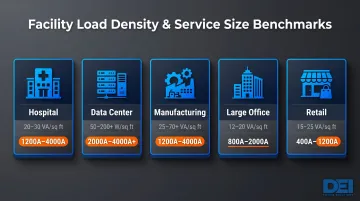
For context, residential and light commercial services typically range from 200A to 400A. A 1200A service represents a 3-6x step increase in capacity, equipment size, and code requirements. The engineering scope, gear specifications, and installation practices at this level are in a different category entirely.
Installation Guide for 1200 Amp Service
Installing a 1200A service is a multi-phase project spanning planning, utility coordination, electrical room construction, equipment procurement, conductor installation, and inspection. Each phase depends on the one before it — a missed step early on compounds into expensive rework or failed inspections downstream.
Prerequisites, Electrical Room Requirements, and Code Compliance
Before physical installation begins:
A licensed engineer must perform a full load calculation per NEC Article 220 to confirm 1200A is the correct service size. NEC 220.87 governs the existing-load calculation method: multiply measured maximum demand by 125%, then add new loads. The total must not exceed the service rating.
The 125% multiplier is a safety factor (1/1.25 = 80%). For a 1200A service, maximum demand should not regularly exceed approximately 996A under continuous load operation.
NEC 110.26 electrical room clearance requirements:
According to NFPA 70 and NEC 2023 standards, electrical rooms must provide:
- Working clearance in front of equipment (151-600V):
- Condition 1: 3 ft minimum
- Condition 2: 3.5 ft minimum
- Condition 3: 4 ft minimum
- Minimum headroom: 6.5 ft
- Dedicated space above equipment: 6 ft above equipment or to structural ceiling (whichever is lower)—no piping, ductwork, or foreign systems permitted
- Equipment width: Minimum 30 inches or equipment width, whichever is greater
- Egress: Equipment rated 1200A or more and over 6 ft wide requires two entrances/exits unless working space depth is doubled
NEC Article 230 service requirements:
NEC 230.71 permits a maximum of six sets of disconnects per service grouped in one location. The 2020 NEC revision requires each service to have only one disconnecting means per enclosure unless specific configurations are met.
Non-negotiables before installation proceeds:
- Active utility coordination confirming service availability and metering requirements
- Building permits pulled and approved
- Engineering drawings stamped by a licensed professional
- UL-listed equipment specified with correct fault current rating
- Electrical room constructed to NEC 110.26 dimensions
Wire Sizing and Key Equipment for 1200 Amp Service
1200A service conductors require parallel conductor sets. A single cable cannot carry 1200A loads—you must install multiple sets of equally sized conductors per NEC 310.10(H).
Common 1200A parallel conductor configurations:
Based on NEC Table 310.16 ampacity values:
| Configuration | Material | Size | Ampacity (75°C) | Sets | Total Ampacity |
|---|---|---|---|---|---|
| Standard Copper | Copper | 600 kcmil | 420A | 3 | 1,260A |
| Economy Copper | Copper | 350 kcmil | 310A | 4 | 1,240A |
| Standard Aluminum | Aluminum | 500 kcmil | 310A | 4 | 1,240A |
| High-Capacity Aluminum | Aluminum | 900 kcmil | 425A | 3 | 1,275A |
Per NEC 240.4(B), the "next size up" overcurrent protection rule applies only to circuits 800A or less. For a 1200A service, conductor ampacity must equal or exceed the overcurrent device rating — no exceptions.
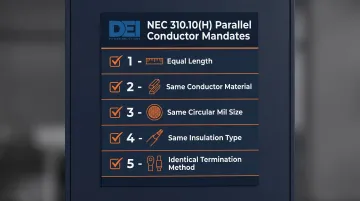
NEC 310.10(H) parallel conductor requirements mandate:
- Same length for all conductors in each set
- Same conductor material (all copper or all aluminum)
- Same size in circular mil area
- Same insulation type
- Terminated in the same manner
Conduit sizing: For three sets of 600 kcmil copper THHN, each conduit carries 4 conductors (A, B, C, N). NEC Table C requirements show a 4-conductor set of 600 kcmil THHN requires minimum 3-inch EMT or 3.5-inch RMC conduit per set.
Core equipment required:
- Main service switchboard or switchgear rated for 1200A (UL 891 or UL 1558)
- Current transformers and metering compartments (CT metering is standard at this amperage)
- Grounding electrode system per NEC Article 250
- Surge protection devices (if specified)
All equipment must be rated for available fault current. According to Process Solutions, commercial 480V systems typically require protective devices rated at 35 kAIC, 65 kAIC, or 100 kAIC depending on available fault current. The lowest-rated component limits the entire assembly's short-circuit current rating (SCCR).
For projects requiring a specified switchboard, DEI Power manufactures UL 891-certified 1200A switchboards built to project specifications — voltage, layout, and fault current rating — using Siemens components at their Ontario, California facility. BABA-compliant construction is available for federally funded projects.
How to Install 1200 Amp Service: Step-by-Step Overview
Step 1 — Site and electrical room preparation:
Verify the electrical room meets all requirements before equipment delivery:
- NEC 110.26 clearances (3-4 ft working space, 6.5 ft headroom, 6 ft dedicated space above)
- Structural load capacity for heavy switchgear (600-1,500 lbs typical)
- Conduit stub-up or entry point locations matching approved drawings
- Utility service entrance point correctly positioned
Any deficiencies must be corrected before equipment delivery.
Step 2 — Utility coordination and service entrance:
Work with the utility to:
- Schedule service entrance installation
- Confirm metering configuration (CT metering required at 1200A)
- Establish point of demarcation
Start utility coordination early. NOVEC Commercial/Industrial Service Guidelines require minimum 8 weeks advance notification for service entrance work, and Boston Solar reports primary metering cabinet lead times can run 6 to 10 months. Late utility applications cause cascading schedule delays that no amount of field hustle can fix.
Step 3 — Switchboard/switchgear placement and securing:
Positioning the switchboard correctly at this stage prevents costly conduit rerouting later. Conduit entry locations are fixed once conductors are pulled — verify alignment before anchoring.
- Set the 1200A switchboard per approved drawings
- Anchor to structural floor per manufacturer and NEC requirements
- Verify equipment is plumb and level
- Ensure conduit entries align with planned conductor routing
Step 4 — Conductor installation:
Pull parallel conductor sets through conduit:
- Install conductors in coordinated sets, ensuring equal length and identical routing per NEC 310.10(H)
- Maintain phase identity throughout installation
- Terminate all conductors at rated torque values using a calibrated torque wrench
Fluke Corporation's technical reference identifies that "overheating is caused by high resistance within conductors or at overtightened or loose connections." Improper termination torque is among the leading causes of connection failures at high amperage — at 1200A, even a single undertorqued lug can generate enough heat to cause equipment failure or fire.
Step 5 — Grounding, bonding, and pre-energization checks:
Grounding and bonding errors are among the top three inspection failure categories — complete this step methodically before requesting energization.
- Install grounding electrode system per NEC Article 250
- Install service bonding jumper and equipment grounding conductors
- Conduct full pre-energization checklist:
- Megger all conductors (insulation resistance testing)
- Verify all bus torque values
- Confirm protective relay settings
- Secure all covers
Post-Installation Checks and Validation
Before requesting utility energization:
- Visual inspection: all conductors landed correctly, no exposed conductors, all hardware torqued and documented
- Insulation resistance testing on all conductors and bus
- Verify switchboard's main breaker or fuse configuration matches approved design
After energization:
- Verify phase rotation
- Measure voltage at main bus (all phases balanced within acceptable tolerance)
- Confirm metering records correctly
- Document all readings
These checks directly determine whether the installation passes inspection on the first attempt. Shaffer Construction reports a first-time pass rate exceeding 95% across commercial electrical inspections — but that still means a measurable share of experienced contractors face rework. Grounding and bonding deficiencies, working clearance violations, and parallel conductor installation errors are the top three failure categories.
Cost of 1200 Amp Service Installation
Total project cost range: According to Delta Wye Electric's industrial cost guide, a complete 1200A industrial electrical service installation typically costs $70,000 to $120,000, with major infrastructure changes including utility transformer upgrades reaching $150,000+.
Cost breakdown by major component:
| Cost Category | Typical Range |
|---|---|
| Complete 1200A Service | $70,000 - $120,000 |
| Major Infrastructure (with utility work) | $100,000 - $200,000+ |
| Main Switchboard | $2,000 - $15,000 |
| Copper Wire | $5 - $25 per foot |
| Conduit and Fittings (installed) | $10 - $50 per foot |
| Trenching (Underground) | $50 - $150 per linear foot |
| Industrial Permits | $2,000 - $8,000 |
| Temporary Power (occupied facilities) | $5,000 - $20,000 |
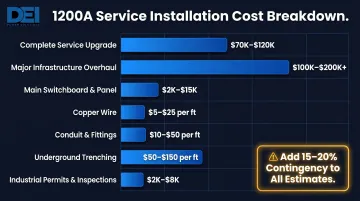
Recommended contingency: Add 15-20% above base estimate.
Factors That Cause Cost Variation
Geographic Labor Rates
BLS reports the national median annual wage for electricians at $62,350 (May 2024), but rates vary significantly by state:
- Washington: $93,840 mean annual
- Illinois: $89,190 mean annual
- California: $85,780 mean annual
Projects in high-wage states can see labor costs 30-50% higher than low-cost regions.
New Construction vs. Existing Facility Upgrade
Upgrades to occupied facilities require:
- Temporary power ($5,000-$20,000)
- Weekend/overtime premiums (1.5x-2x standard rates)
- Complex sequencing to maintain operations
- Potential downtime coordination
Fault current rating requirements: Higher SCCR-rated switchgear costs more. Equipment must match available fault current from the utility, and mismatches require costly change orders.
Utility transformer upgrades: If the serving utility transformer lacks capacity for the new 1200A service, transformer upgrade costs can add $20,000-$50,000+ to the project.
These cost factors compound quickly when design decisions are made late. Specification errors — undersized switchgear, incorrect fault current ratings, or non-compliant configurations — typically surface during equipment procurement or inspection, triggering change orders, schedule delays, and expedited re-procurement.
Common Installation Problems and How to Fix Them
Three problems account for the majority of 1200A service installation failures: conductor imbalance, clearance violations, and utility coordination delays. Each is preventable with the right sequencing.
Improper Parallel Conductor Installation
Problem: Parallel conductor sets installed with unequal lengths or different routing, causing unequal impedance and unbalanced current sharing.
Likely cause: Field crews deviating from engineered drawings to save time or work around field conditions.
Fix: Confirm equal lengths for all conductors within a parallel set before pulling. If already installed, use a clamp meter to measure current on each conductor under load. Unequal readings confirm improper installation and require correction before energizing.
Insufficient Electrical Room Clearance
Switchboards fail inspection when working clearances don't meet NEC 110.26 minimums: 3-4 ft in front, 6.5 ft headroom, and 6 ft of dedicated space above. The root cause is almost always an electrical room sized during early design without accounting for final equipment dimensions.
Fix: Review final equipment submittals against room dimensions during the design phase—before the room is built. If already constructed, determine whether the switchboard footprint can be reconfigured or whether the room partition must be moved. Moving partitions post-construction typically adds $5,000-$15,000+ to project cost.
Utility Coordination Delays Causing Schedule Impact
Problem: Installation is complete, but the project can't energize because the utility hasn't finished service entrance work, CT metering, or the transformer upgrade.
Fix: Submit the utility service application during design development—not after construction begins. Build utility lead time into the master schedule as a critical path item. Lead times vary widely:
- Standard service connections: 8 weeks minimum
- CT metering cabinet installations: often 6-10 months
- Transformer upgrades: timeline varies by utility
Keep in regular contact with your utility account representative throughout the process. Late applications create cascading costs—temporary power, overtime labor premiums, and extended general conditions can add $10,000-$30,000+ to the project budget.
Pro Tips for Installing 1200 Amp Service Effectively
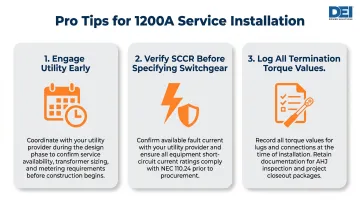
Three practices consistently separate smooth 1200A installations from costly mid-project corrections:
Engage the utility and pull permits during the design phase. Utility service availability, metering configuration, and transformer capacity all affect design decisions. Discovering these constraints after construction documents are finalized creates expensive redesigns and schedule delays.
Confirm short-circuit current rating (SCCR) before specifying switchgear. Available fault current at the service entrance must be verified with the utility, and all equipment must be rated at or above that value. Per NEC 110.24, available fault current must be documented and marked on equipment — a mismatch is both a code violation and a safety hazard.
Log every conductor termination torque value and retain those records. Inspection authorities and commissioning engineers frequently require torque logs at project closeout. This documentation also protects the installation team during any future fault investigation.
Frequently Asked Questions
What size wire is needed for a 1200 amp service?
1200A service requires multiple parallel sets of large conductors—typically parallel runs of 600-750 kcmil copper THWN-2 or equivalent aluminum—sized per NEC 310.10(H) and ampacity tables in NEC 310.16. A licensed engineer must verify the final configuration based on voltage, conduit type, ambient temperature, and terminal ratings.
What are the requirements for a 1200A electrical room?
NEC 110.26 requires 36-48 inches of working clearance in front of the switchboard, minimum 6.5 ft headroom, and a dedicated 6 ft zone above the switchboard free of piping and ductwork. Room dimensions must accommodate the switchboard footprint plus all required clearances—undersized rooms are one of the most common causes of inspection failures.
What is the 125% rule for electrical services?
NEC 220.87 requires multiplying measured maximum demand by 125%, then adding new loads—the combined total must not exceed the service rating. For a 1200A service, continuous demand should not regularly exceed ~996A. The safety factor accounts for inrush currents and prevents sustained overloading.
How much is a new 1200A switchboard?
UL 891-listed 1200A switchboards typically range from $8,000 to $15,000, with custom units featuring higher SCCR ratings, specialized metering, or complex branch arrangements reaching $20,000+. DEI Power's pre-engineered, UL 891-certified 1200A switchboards are built with Siemens components and ship ready to install, reducing field adjustments and change orders.
What is the average cost of replacing a commercial 1200A electrical service?
Total installed cost typically ranges from $70,000 to $120,000, factoring in switchgear, licensed labor, and utility coordination. Occupied facility upgrades requiring temporary power and overtime can reach $100,000-$150,000+, and projects needing utility transformer upgrades can exceed $200,000.
How much do electricians charge to install a 1200A service?
At the 1200A commercial/industrial scale, installation labor is priced by the project rather than hourly, involving multiple licensed electricians over days or weeks. Typical rates range from $75-$125/hour for journeyman electricians and $100-$150/hour for master electricians, with total labor representing 40-50% of project cost. In high-wage states like California and Washington, labor costs can run 30-50% higher than national averages.