Introduction
In commercial buildings, industrial plants, and data centers, power distribution is rarely a simple point-to-point connection. The equipment that bridges the gap between the source and the load determines whether your facility experiences reliable uptime or costly failures. Remote Power Panels (RPPs) and Power Distribution Units (PDUs) both play critical roles in that chain, yet they serve fundamentally different functions. Specifying the wrong one creates real problems on real projects.
Choosing the wrong device creates tangible consequences:
- Oversized cable runs that inflate material costs
- NEC compliance violations that trigger change orders
- Inadequate circuit protection that jeopardizes equipment
- Project delays that cascade into missed deadlines
For contractors and engineers specifying power distribution equipment, getting this right is essential to delivering on time, on budget, and to code.
What follows covers clear definitions, a side-by-side comparison, and a practical framework — including when the two devices work together in large-scale facilities and what NEC and UL standards require for compliant installation.
Key Takeaways
- RPPs distribute power from upstream switchgear to localized branch circuits, cutting feeder runs and voltage drop
- PDUs range from basic rack strips to intelligent units with remote monitoring and outlet-level control
- For commercial, industrial, and campus facilities with dispersed loads, RPPs are the right fit
- In data center racks and IT environments, PDUs win on outlet-level control, remote management, and energy monitoring
- Large data centers often use both: upstream PDUs for monitoring and control, downstream RPPs for localized branch-circuit protection
RPP vs PDU: Quick Comparison
| Attribute | Remote Power Panel (RPP) | Power Distribution Unit (PDU) |
|---|---|---|
| Primary Function | Branch circuit protection and distribution near loads | Last-mile power distribution to IT equipment with optional monitoring |
| Typical Placement | Data center row/zone, electrical closet, near distributed loads | Inside or alongside server rack |
| Power Input/Output | Hardwired input from switchgear or main PDU; hardwired branch circuits to loads | Cord-connected or hardwired input; multiple IEC or NEMA outlets |
| Circuit Protection | Molded-case or thermal-magnetic breakers (NEC Article 408) | Internal supplementary protectors (optional above 16A) |
| Monitoring Capabilities | Optional branch circuit monitoring systems (BCMS) with Modbus/SNMP | Built-in for metered, monitored, and switched PDU tiers |
| Ideal Use Environment | Commercial buildings, industrial plants, healthcare facilities, data center zones | Data center racks, colocation facilities, edge computing sites |
Basic PDUs carry a lower entry cost, but RPPs scale more efficiently for high-amperage, multi-circuit loads. Final pricing depends on several variables:
- Monitoring tier (basic metering vs. full BCMS with SNMP/Modbus)
- Phase configuration (single-phase vs. three-phase)
- Customization level (breaker count, amperage, enclosure type)
- Whether PDUs are cascaded to reduce per-rack network port costs
The sections below break down each option in detail to help you match the right solution to your load profile and facility requirements.
What is a Remote Power Panel (RPP)?
A Remote Power Panel is a locally mounted electrical distribution panel that receives power from an upstream source — such as a switchboard, switchgear, or main PDU — and distributes it to individual branch circuits near the load. The term "remote" refers to its physical distance from the main electrical room, not wireless functionality. By placing the RPP close to the equipment it serves, engineers eliminate long branch-circuit cable runs, reduce voltage drop, and simplify NEC compliance.
Core Components:
- Main lugs or main breaker for upstream input
- Bus bars rated for the panel's amperage
- Individual branch circuit breakers (typically 20A–30A)
- Optional current metering or branch circuit monitoring systems (BCMS)
- NEMA-rated enclosure (Type 1 for indoor, Type 3R for outdoor/weather-resistant)
Operational Benefits:
Placing RPPs near the load produces concrete cost and compliance benefits:
- Supports NEC Article 215 voltage drop limits (3% feeder maximum, 5% combined maximum)
- Allows smaller-gauge wire on shorter conductor runs, cutting copper and conduit costs
- Simplifies future load additions — new circuits tap the RPP instead of running home-runs back to the main electrical room
Custom Configurations:
RPPs are built to project-specific requirements. Amperage ratings range from 225A to 1,200A, with breaker counts from 42 to 168 poles depending on configuration. Voltage options include 120/208V and 277/480V for single- and three-phase applications. Enclosures are sized to fit the installation environment, and optional BCMS integrations provide real-time power monitoring via Modbus/TCP or SNMP.
DEI Power designs and manufactures custom RPPs to project-specific requirements, including UL 891-certified configurations that reduce field adjustments. Contractors can submit load schedules for review and receive panels built to their drawings, voltage requirements, and jobsite conditions.
Use Cases of RPP
RPPs appear across a range of industries wherever loads are spread over large areas or require localized circuit protection:
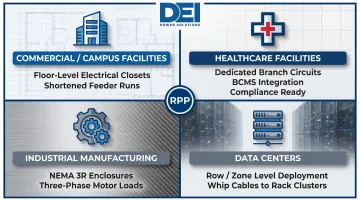
- Large commercial and campus facilities — RPPs placed at floor-level electrical closets shorten feeder runs from the main switchboard, cut material costs, and make zone-based load management practical without running everything back to a central room.
- Healthcare facilities — Hospitals rely on RPPs for dedicated branch circuits serving critical equipment, with optional BCMS integration providing real-time power visibility and supporting compliance with healthcare electrical codes.
- Industrial manufacturing floors — Plants deploy RPPs with NEMA 3R enclosures for harsh-environment installations; three-phase configurations handle high-amperage motor loads and HVAC systems.
- Data centers (row/zone level) — RPPs sit between floor-standing PDUs and rack PDUs, distributing power to individual rack clusters via short whip cables. According to Eaton's data center power chain documentation, this architecture extends distribution while maintaining localized control and monitoring.
What is a PDU (Power Distribution Unit)?
A Power Distribution Unit (PDU) receives high-capacity power input and distributes it to multiple downstream outlets or loads. The term covers a wide spectrum: from simple passive rack-mounted power strips to sophisticated managed units with per-outlet switching, real-time metering, and network-based remote control.
Four Main Types of PDUs:
| PDU Type | Capabilities | Ideal For |
|---|---|---|
| Basic | Reliable power distribution; no monitoring or network access | Small server rooms near IT staff |
| Metered | Local display showing current, voltage, power factor | Air-gapped environments; planning for future remote monitoring |
| Monitored | Remote monitoring via secure web interface, down to outlet level | High-density data centers; colocation (billing); cloud providers |
| Switched | Remote on/off/reboot of individual outlets plus all monitored features | Large-scale data centers; remote/edge sites; locations where technician dispatch is costly |
According to Vertiv's PDU classification framework, these four tiers represent the standard industry taxonomy, though some manufacturers subdivide further based on feature granularity.
Hardware Profile:
- Form factors: 0U vertical (mounted on rack posts, consuming no rack space), 1U/2U horizontal (inside the rack)
- Outlet types: IEC C13/C19 (international standard, up to 250V); NEMA 5-15R, 5-20R, L5-20R, L6-20R, L6-30R
- Input cordsets: NEMA L5-30P, L21-30P, or hardwired connections
- Amperage range: 10A to 120A per unit
- Voltage options: 100V single-phase to 415V three-phase
Advanced Features:
Managed PDUs now handle far more than basic power delivery. Switched PDUs with Auto-Probe can automatically power-cycle unresponsive devices when they stop responding to network pings, avoiding costly truck rolls for simple reboots.
Environmental sensors (temperature, humidity) integrate with monitoring systems to support proactive maintenance and SLA compliance.
Use Cases of PDU
Data Center Server Rows and Racks
Rack PDUs are the standard for distributing power to servers, network switches, and storage arrays. Key deployment considerations include:
- Vertical 0U PDUs maximize outlet density without consuming rack space
- Horizontal 1U/2U units fit standard rack layouts
- Intelligent PDUs provide outlet-level metering for capacity planning and energy reporting
Colocation Facilities (Tenant-Level Metering)
Colocation providers require billing-grade accuracy (±1%) to account for each client's electricity use. Monitored and switched PDUs deliver per-outlet power data and remote control, letting operators allocate costs accurately and offer remote reboot as a value-added service.
Edge Computing Sites
Edge deployments at branch offices, retail stores, and cell towers benefit most from switched PDUs. Remote outlet control lets IT teams power-cycle equipment from a central NOC — eliminating technician site visits and cutting both downtime and operational expense.
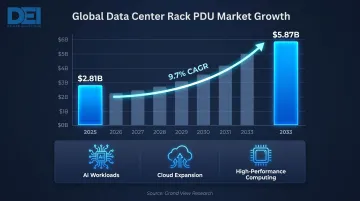
That demand is backed by strong market momentum. The data center rack PDU market was valued at $2.81 billion in 2025 and is projected to reach $5.87 billion by 2033 at a CAGR of 9.7%, according to Grand View Research. AI workloads, cloud expansion, and high-performance computing are pushing intelligent PDU adoption fastest.
RPP vs PDU: Which One Should You Choose?
The right choice depends on facility size, load type, monitoring requirements, and NEC compliance constraints.
Choose an RPP when:
- Your project involves a large or spread-out facility (commercial building, industrial plant, campus, or healthcare complex) where loads are fixed and require dedicated hardwired branch-circuit protection
- NEC compliance requires local overcurrent protection near the load to meet voltage drop limits
- High-amperage, three-phase distribution to non-IT equipment (HVAC, motors, lighting panels) is involved
- You need custom breaker configurations, voltage ratings, or enclosure types (NEMA 3R for outdoor installations)
Choose a PDU when:
- Your environment is a data center, server room, or edge computing site where IT equipment is rack-mounted
- You need outlet-level power control, remote reboot capability, or per-outlet energy metering
- The flexibility of a managed unit (monitored or switched) adds operational value that a static panel cannot provide
- Colocation billing or tenant-level metering is required
Choose both when:
- Operating a large data center or colocation facility — use a managed PDU at the row or zone level for power monitoring and control, then use RPPs downstream to provide local branch-circuit protection to individual rack clusters
- Eaton's documented power chain confirms this architecture: Utility → Switchgear → UPS → STS → Floor PDU → RPP → Rack PDU → IT Load
Code and Safety Considerations:
Whichever direction fits your project, the standards governing each product type are non-negotiable. RPPs in commercial and industrial settings are classified as panelboards under NEC Article 408, which governs switchboards, switchgear, and panelboards. Key requirements include:
- Section 408.36: Panelboards must have overcurrent protection not exceeding the panel's nameplate rating
- Section 408.4(A): Every circuit must be legibly identified by its purpose
- Section 408.6: Equipment must be marked with a short-circuit current rating at least equal to available fault current
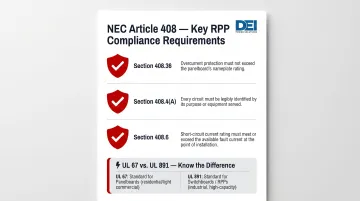
RPPs also fall under UL 67 (panelboards, up to 1,200A, wall-mounted), not UL 891 (switchboards, up to 6,000A, floor-mounted). UL 67 panelboards have lower maximum ampacity and are designed for front-access-only installation — a critical spec difference when sizing equipment for your application. For more details, see NEC Article 408 requirements and UL 67 vs. UL 891 standards.
DEI Power's RPPs are UL 891-certified and manufactured to meet these standards out of the box, reducing the risk of code conflicts or field rework on your project.
Conclusion
The right choice between an RPP and a PDU comes down to where in the distribution chain each device belongs — not which one is inherently better. The environment, load types, and whether outlet-level control or remote monitoring adds operational value all factor into that placement decision. For contractors and engineers on large projects, getting that placement right is the actual specification challenge.
When that decision is made correctly, the downstream benefits are tangible: lower cable costs, NEC compliance, reduced downtime, and fewer surprises on the project schedule. If you're specifying power distribution equipment for commercial, industrial, or data center projects, contact DEI Power at (866) 773-8050 or sales@deipower.com for engineering support and custom-configured, UL 891-certified distribution solutions built to your exact specs.
Frequently Asked Questions
What is the purpose of a remote power panel?
An RPP serves as a localized branch-circuit distribution point installed close to the load. It receives power from an upstream switchboard or PDU and distributes it to individual circuits, reducing feeder cable lengths, minimizing voltage drop, and providing dedicated overcurrent protection near the equipment being served.
What is the difference between a PDC and a PDU?
A PDC (Power Distribution Center) is a facility-level assembly — comparable to a switchboard — that receives utility or generator power and feeds downstream panels or PDUs. A PDU operates at the rack or equipment level, supplying outlets directly to servers, network gear, or other IT loads.
What are the three types of PDUs?
The three most commonly referenced types are: Basic PDUs (passive power distribution, no monitoring), Metered/Monitored PDUs (real-time power data via network interface), and Switched/Managed PDUs (monitoring plus remote outlet control). Vendor classification schemes sometimes add subcategories, but these three cover the core distinctions.
Can an RPP and a PDU be used together in the same system?
Yes — this is a common architecture in large data centers. A managed PDU handles power monitoring and control at the row or zone level, while RPPs provide hardwired branch-circuit protection downstream. This combines the intelligence of a managed PDU with the physical circuit protection and load distribution benefits of a dedicated panel.
What is the difference between an RPP and a panelboard?
Both terms refer to enclosures housing circuit breakers that distribute power to branch circuits, and they're often used interchangeably. The practical difference is placement: panelboards (defined under NEC Article 408) can serve as main or sub-distribution points anywhere in a facility, while "RPP" specifically describes a panel positioned remotely from the main electrical room, close to the served loads.
How do I determine the right amperage and breaker count for an RPP?
Key sizing factors include total connected load amperage, the number of individual circuits required, voltage configuration (single-phase vs. three-phase), and NEC branch-circuit sizing requirements. Reviewing a load schedule with an engineer before specifying the panel helps avoid under- or over-sizing — DEI Power's in-house engineering team can assist with this during the quoting process.