The confusion is understandable: both serve critical roles in protecting electrical systems, and circuit breakers often live inside switchgear assemblies. But they are fundamentally different devices with distinct functions, applications, and system roles.
Key Takeaways
- A circuit breaker is a single protective device; switchgear is a complete assembly of switching, protection, and control equipment—circuit breakers included
- Circuit breakers react to faults automatically; switchgear actively controls, protects, and isolates power across multiple circuits
- Switchgear operates across low, medium, and high voltage systems in substations, industrial plants, and data centers; circuit breakers appear in panels, switchgear assemblies, and standalone applications
- Your choice depends on voltage, system complexity, and whether you need localized protection or centralized power management
What is a Circuit Breaker?
A circuit breaker is an automatic electrical switch that monitors current flow and interrupts the circuit when it detects an overload, short circuit, or fault condition. According to IEC 62271-100 and ANSI C37.100-1992, it is defined as "a mechanical switching device capable of making, carrying, and breaking currents under normal circuit conditions and also making, carrying for a specified time, and breaking currents under specified abnormal conditions such as short circuit."
Circuit breakers protect individual circuits or equipment rather than entire distribution networks. Where fuses must be replaced after a fault, circuit breakers can be reset and returned to service immediately — a meaningful advantage in production and commercial environments where downtime has a cost.
How Circuit Breakers Work
Circuit breakers rely on three primary trip mechanisms to detect and respond to abnormal current levels:
- Thermal trip: A bimetal element provides inverse-time overload protection (trips faster as overload severity increases), bending as it heats and eventually triggering the breaker to open
- Magnetic (instantaneous) trip: A solenoid actuates rapidly when high fault current flows through the coil, providing immediate protection against short circuits
- Electronic (solid-state) trip: Current sensors and microprocessors implement adjustable trip functions, true-RMS measurement, and coordination with other protective devices
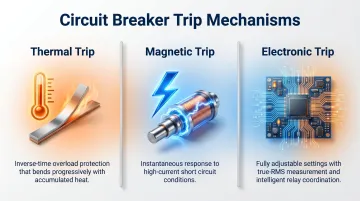
Most industrial and commercial breakers combine thermal and magnetic elements; electronic trip units are common in larger molded-case and power circuit breakers where adjustable settings are required.
Three Main Functional Types
Engineers and facility teams encounter three primary circuit breaker types:
| Type | Primary Function | Key Code Requirement |
|---|---|---|
| Standard | Overcurrent and overload protection for branch circuits; molded-case and power versions serve industrial and commercial loads | General NEC compliance |
| GFCI | Personnel protection against electric shock from ground faults | NEC 210.8(B) — required in bathrooms, kitchens, rooftops, outdoors, and wet areas |
| AFCI | Detects arc faults to prevent electrical fires from damaged or degraded wiring | NEC 210.12(D) — required in hotel guest rooms, nursing home patient sleeping areas, and emergency service sleeping quarters |
Use Cases of Circuit Breakers
Circuit breakers are deployed wherever localized protection is needed:
- Residential and commercial electrical panels protecting branch circuits
- Within switchgear assemblies as the interrupting device
- Motor control circuits protecting individual machines
- Industrial equipment protection for specific loads
Circuit breakers monitor constantly but are designed to trip infrequently. Frequent tripping isn't a sign that the breaker is doing its job well — it signals an underlying problem: undersized conductors, an overloaded circuit, or equipment failure that needs addressing.
What is Switchgear?
Switchgear is not a single device but a broad category of electrical equipment that controls, protects, and isolates electrical systems. A switchgear assembly can include circuit breakers, fuses, disconnect switches, protective relays, current transformers, busbars, and control panels—all housed together in a metal-enclosed or metal-clad enclosure.
How Switchgear Works
When a protective relay detects an abnormal electrical condition—overcurrent, short circuit, ground fault, or voltage anomaly—it sends a trip signal to the circuit breaker or other switching device within the switchgear. The breaker opens its contacts, interrupting current flow and isolating the fault while allowing the rest of the system to continue operating.
This coordinated, system-level response is what distinguishes switchgear from standalone circuit breakers. Beyond fault response, operators can also:
- Manually control and switch individual circuits
- Isolate sections of a system for safe maintenance
- Execute switching sequences without disrupting the broader network
- Monitor electrical conditions in real time
Voltage Classes and Applications
Switchgear is classified into three primary voltage categories:
Low-Voltage Switchgear (up to 1 kV) serves commercial buildings, industrial facilities, and end-of-transformer distribution. UL 891-certified low-voltage switchboards are built to meet code requirements for commercial and industrial distribution. DEI Power manufactures UL 891-certified assemblies rated from 400A to 4000A, supporting voltage configurations including 208Y/120V, 480V, and 480Y/277V.
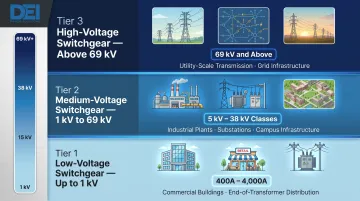
Medium-Voltage Switchgear (1 kV to 69 kV) is used in industrial power distribution, substations, and campus infrastructure. According to ANSI C84.1-2020 standards, common MV equipment classes include 5 kV, 15 kV, 27 kV, and 38 kV systems. IEEE C37.20.2-2022 defines metal-clad medium-voltage switchgear with drawout circuit breakers, while IEEE C37.20.3-2023 covers metal-enclosed interrupter switchgear rated above 1 kV up to 48.3 kV.
High-Voltage Switchgear (above 69 kV) supports utility-scale transmission systems with advanced safety requirements and rigorous insulation coordination.
Specialized Switchgear Classifications
Two additional classifications address specific safety and environmental needs:
Arc-resistant switchgear mitigates the effects of internal arcing faults by directing or containing arc energy away from personnel. Testing procedures are defined by IEEE C37.20.7-2024. This equipment is essential in facilities with high fault current risk—data centers, industrial plants, and utility substations—where incident energy can exceed the 1.2 cal/cm² second-degree burn threshold required by OSHA 1910.269 and NFPA 70E.
Metal-enclosed designs provide robust protection for harsh environments and outdoor installations, with NEMA 3R weather-resistant enclosures available for applications requiring outdoor deployment.
Use Cases of Switchgear
Switchgear is essential in complex power distribution environments:
- Power substations managing multiple incoming and outgoing feeders
- Industrial facilities running high-power machinery across many circuits
- Hyperscale data centers requiring redundant and isolatable power paths; Power Magazine reports that large step-down transformers feed medium-voltage switchgear, which then feeds UPS systems and downstream distribution
- Healthcare facilities with critical uptime requirements governed by NEC 517 and NFPA 99, which mandate Essential Electrical Systems with separate Life Safety, Critical, and Equipment branches
- Large commercial campuses distributing power across multiple buildings
Circuit Breaker vs Switchgear: Key Differences at a Glance
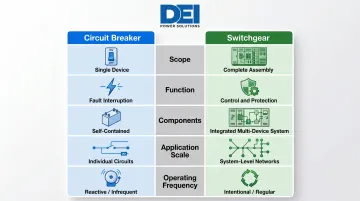
| Dimension | Circuit Breaker | Switchgear |
|---|---|---|
| Scope/Definition | Single protective device | Complete assembly of multiple devices |
| Primary Function | Automatic fault interruption on one circuit | Control, protection, isolation, monitoring across multiple circuits |
| Components | Self-contained: contacts, arc extinguisher, trip unit | Integrated system: breakers, relays, busbars, CTs, disconnect switches, control panels |
| Application Scale | Individual circuits, equipment, or panels | System-level networks, substations, multi-circuit distribution |
| Operating Frequency | Infrequent, reactive (trips only on faults) | Regular, intentional (manual switching, isolation, control) |
Each of these differences has practical implications for how you specify, install, and operate your power distribution equipment. Here's what they mean in practice.
Function
A circuit breaker's sole function is fault interruption on a specific circuit. Switchgear handles a broader mandate: fault protection, load control, circuit isolation, equipment monitoring, and safe de-energization across an entire distribution network.
Components
A circuit breaker is a self-contained device with contacts, an arc extinguishing mechanism, and a trip unit. Switchgear is an integrated system of multiple protective and switching devices working together. Circuit breakers are often components inside a switchgear assembly, not alternatives to it.
Installation and Complexity
Circuit breakers are relatively straightforward to install, replace, or retrofit. Switchgear requires engineered design, dedicated physical space, proper grounding, and in many cases third-party certification—such as UL 891 for low-voltage switchboards—to be code-compliant. Getting the specification right upfront prevents costly field adjustments and schedule delays.
Operating Frequency
Switchgear is designed for regular, intentional operation. Operators manually control circuits, perform switching sequences, and isolate sections for maintenance. Circuit breakers remain closed under normal conditions and only operate automatically during faults.
Circuit Breaker vs Switchgear: Which One Does Your Project Need?
The right choice depends on your system's complexity, voltage level, and control requirements. Use this as a quick reference:
Choose a standalone circuit breaker when:
- Protecting a single circuit or piece of equipment
- Working in a simple, lower-voltage application (residential panel, light commercial installation)
- Providing localized machine protection
Choose switchgear when:
- Managing a complex distribution network across multiple circuits, voltage levels, or loads
- Requiring coordinated protection, isolation capability, and centralized control
- Operating in environments where uptime, safety, and system-level control are critical
Situational Recommendations
Here's how the decision plays out across common project types:
- Data centers and colocation facilities — Switchgear handles redundant power path management and fast fault isolation. Per Uptime Institute Tier standards, Tier III requires concurrent maintainability with redundant distribution paths, and Tier IV requires full fault tolerance — both demand switchgear-level control.
- Industrial plants — Switchgear protects high-power motor loads across many circuits, with medium-voltage assemblies commonly deployed at 5 kV to 38 kV.
- Utility substations — Medium- or high-voltage switchgear handles system-level control, while individual circuit breakers within those assemblies manage fault clearing.
For low-voltage applications in the 400A–4000A range — including data centers, commercial buildings, and industrial facilities — DEI Power manufactures UL 891-certified switchboards built to your voltage, layout, and jobsite specifications. Contact the team at sales@deipower.com or (866) 773-8050 to discuss your project requirements.
Conclusion
Circuit breakers and switchgear are complementary, not interchangeable. They serve different roles and routinely work together within the same distribution system. Which one you need — or whether you need both — comes down to the scale, complexity, and control requirements of your specific application.
Specifying correctly from the start has real consequences for project execution. Key factors to nail down before procurement:
- Load scale: Individual branch protection points to a breaker; full distribution infrastructure points to switchgear
- Control requirements: Remote monitoring, metering, and multi-feeder switching require a switchgear assembly
- Code compliance: UL 891-certified switchgear is required in many commercial and industrial applications
- Schedule risk: Misspecification leads to change orders, field rework, and delayed commissioning
In environments like data centers, hospitals, and industrial facilities — where downtime is expensive — getting this right at the design stage is far cheaper than correcting it in the field. DEI Power's team works with contractors and engineers to configure UL 891-certified switchgear that fits the project specs from day one, with lead times built for schedules that can't slip.
Frequently Asked Questions
Is a switchgear the same as a circuit breaker?
No. A circuit breaker is a single protective device that interrupts current during a fault. Switchgear is a complete system that includes circuit breakers along with relays, fuses, disconnect switches, busbars, and control equipment working together to control and protect a power distribution network.
What does a main switchgear do?
Main switchgear serves as the central control and protection hub for a power distribution system. It controls electricity flow, protects downstream equipment from faults, isolates network sections for safe maintenance, and monitors electrical conditions in real time.
What is the purpose of a main breaker?
A main breaker is the primary circuit breaker at the top of an electrical panel or switchgear assembly that controls power to all downstream circuits. It protects the entire panel from overload and serves as the main shutoff point to safely de-energize the system.
What are the three types of switchgear?
The three primary classifications are based on voltage rating:
- Low-Voltage (up to 1 kV) — used in buildings and end-of-transformer applications
- Medium-Voltage (1 kV to 69 kV) — used in industrial plants and substations
- High-Voltage (above 69 kV) — used in utility-scale transmission infrastructure
What are the three main types of breakers?
Standard circuit breakers provide overcurrent and overload protection for general circuits. GFCI breakers offer ground fault protection primarily for personnel safety in wet or outdoor locations. AFCI breakers provide arc fault detection to prevent electrical fires from damaged wiring.
How does a switchgear breaker work?
A circuit breaker inside switchgear works in coordination with protective relays. When a relay detects an abnormal condition (overcurrent, short circuit, or ground fault), it sends a trip signal to the breaker. The breaker opens its contacts to interrupt current flow and isolate the fault, while the rest of the system continues operating normally.