Introduction
Picture a contractor on site when the utility inspector rejects a newly installed switchboard: the equipment lacks required arc flash labeling, the UL listing doesn't match the locally adopted code edition, or the domestic content documentation isn't sufficient for the federally funded project. The result? Costly rework, project delays measured in weeks, and potential penalties reaching $165,514 per OSHA violation. For contractors, engineers, and facility teams, these scenarios aren't hypothetical—they're avoidable risks created by manufacturers cutting compliance corners.
Switchboard compliance spans multiple overlapping obligations: safety certifications, electrical codes, supply chain integrity, and documentation. A manufacturer can meet UL 891 standards but still fail an Authority Having Jurisdiction (AHJ) inspection if the equipment doesn't align with the locally adopted NEC edition.
Equipment can carry proper markings yet be ineligible for federal projects without Build America Buy America (BABA) documentation. Each layer represents a distinct failure point—and the consequences land on the buyer's project schedule.
This guide covers what standards govern switchboard manufacturers, what compliance challenges they commonly face, and what buyers can do to protect their projects by choosing the right manufacturing partner.
TLDR:
- Manufacturers must satisfy UL 891, three-year NEC cycles, NFPA 70E arc flash rules, OSHA 1910.333, and BABA domestic content thresholds
- Compliance failures trace to evolving standards, component-level quality gaps, engineering-to-production miscommunication, and jurisdiction-specific utility requirements
- Circuit breaker lead times reaching 151 weeks push manufacturers toward component substitutions that can void certifications
- Verify active UL listing, factory acceptance testing records, BABA documentation, and EUSERC approvals before placing any order
The Regulatory Landscape: Standards Switchboard Manufacturers Must Navigate
UL 891: The Foundation Standard
UL 891 is the primary standard for low-voltage switchboards in the U.S., governing design, construction, and performance testing for dead-front switchboards up to 1000V. The standard covers critical safety tests including short-circuit withstand, dielectric voltage, temperature rise, heat dissipation, and enclosure integrity.
A UL 891 listing requires:
- Laboratory certification testing by UL Solutions
- Passing the Manufacturers Technical Representative (MTR) exam
- Initial Production Inspection at the manufacturing site
- Ongoing Follow-Up Service inspections at factories where products are manufactured, assembled, or labeled with UL Marks
A UL listing differs fundamentally from self-attested compliance. Listed products have been tested by third-party laboratories and verified to meet full safety standards. Self-declarations lack independent verification. While UL listing isn't federally mandated, it's typically required by local electrical codes and AHJs for code compliance and insurance acceptance.
DEI Power's switchboards carry UL 891 certification, manufactured at their Ontario, California facility with documented Follow-Up Services compliance — giving buyers third-party verified documentation rather than manufacturer claims alone.
National Electrical Code (NEC): A Moving Target
The NEC (NFPA 70) updates every three years—the current edition is 2026, with the next expected in late 2028. Article 408 specifically covers switchboards, switchgear, and panelboards rated at 1000V or less.
Key NEC 2026 changes affecting switchboard manufacturers:
- Section 110.16: Expands arc flash labeling requirements and clarifies where labels must be applied
- Section 110.26: Updates working space measurement requirements, including a defined 24-inch egress path measured at a 90-degree door opening
Because AHJs adopt different NEC editions at different times, manufacturers serving multiple jurisdictions face overlapping compliance requirements. A switchboard built to NEC 2023 may arrive at a job site governed by NEC 2026, creating inspection failures and rework costs.
NFPA 70E: Voluntary Standard with Legal Teeth
NFPA 70E, the Standard for Electrical Safety in the Workplace, was originally developed at OSHA's request and helps companies comply with OSHA 1910 Subpart S. It isn't a regulation, but OSHA references it as the consensus standard for electrical safety work practices. That makes it a practical compliance obligation — and the legal benchmark used in electrical accident liability determinations.
Arc flash labeling requirements under NFPA 70E Article 130.5:
Equipment requiring labels includes switchboards, panelboards, industrial control panels, and disconnect switches. Labels must include seven elements:
- Danger/warning header
- Incident energy at working distance
- Minimum arc rating of PPE
- Arc flash boundary
- Required PPE category
- Limited and restricted approach boundaries
- Shock risk when cover is removed
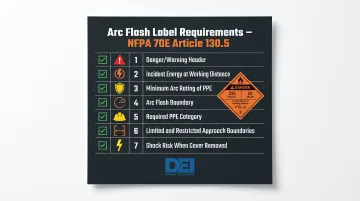
Label data must be reviewed for accuracy at intervals not exceeding 5 years.
NFPA 70E also updates on a three-year cycle (current edition: 2024; next: 2027), requiring continuous manufacturer attention to stay current.
OSHA 1910.333: Safety Practices Near Energized Equipment
OSHA 29 CFR 1910.333 mandates that live parts be de-energized before work, with narrow exceptions for infeasibility (such as circuit testing that can only be performed energized). This directly affects manufacturers' internal assembly and testing processes—switchboard factories must establish documented energized-work procedures for factory testing.
Penalties for violations (effective January 15, 2025):
- Serious violations: up to $16,550 per violation
- Willful or repeated violations: up to $165,514 per violation
These requirements also affect how equipment must support safe field maintenance, including Lockout/Tagout (LOTO) provisions and clear labeling.
Buy America / Build America (BABA): Federal Procurement Mandate
Safety standards govern how switchboards are built — procurement standards govern where. The Build America, Buy America Act requires manufactured products used in federally funded infrastructure to have greater than 55% domestic component cost, with all manufacturing processes occurring in the United States. For iron or steel products, all manufacturing processes from initial melting through coating application must occur domestically.
Manufacturers without documented BABA compliance can disqualify contractors from federal or state-funded projects. Equipment failing to meet BABA requirements may require removal and replacement, triggering project delays and contract penalties.
Major Compliance Challenges Facing Switchboard Manufacturers
Keeping Up With Evolving Standards
Regulatory bodies release updated requirements on regular cycles, creating continuous compliance obligations:
- NEC (NFPA 70): Every 3 years (current: 2026; next: 2029)
- NFPA 70E: Every 3 years (current: 2024; next: 2027)
- NFPA 70B: Every 3 years (current: 2023; next: 2026)
- UL 891: Periodic revisions as needed through UL's Standards Technical Panel
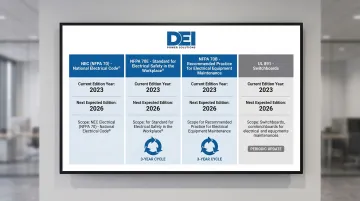
Manufacturers must continuously review regulatory changes, communicate new requirements across engineering and production departments, and update quality management systems—all without halting production schedules.
The organizational burden is real. Compliance teams must interpret regulatory changes, train production staff, update documentation templates, and verify that existing inventory still meets current standards.
That last point catches many manufacturers off guard: a board that was compliant at production time may arrive at a job site governed by a newer code edition.
Quality Control Across Complex Manufacturing
Switchboard manufacturing involves hundreds of individual components: circuit breakers, busbars, protective relays, metering devices, and enclosures. Each must meet specified performance standards. A single non-compliant or counterfeit component can void the certification of the entire assembly.
Factory acceptance testing (FAT) is the primary mechanism for catching compliance failures before they reach the field. Comprehensive FAT includes:
- Verifying every connection against drawings and specifications
- Checking torque settings on all terminations
- Testing circuit functionality and protective device settings
- Validating component ratings and certifications
- Documenting all results with signed test reports
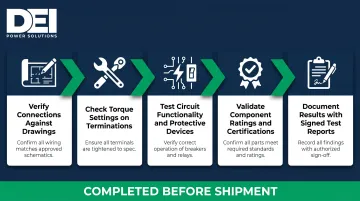
Manufacturers without documented FAT processes create significant downstream risk. Without systematic verification, assembly errors, incorrect component substitutions, or missing protective devices may not be discovered until AHJ inspection—triggering costly field rework.
Communication Gaps Between Engineering and Production
Compliance failures often originate not in deliberate shortcuts but in miscommunication. Design specifications may include specific protection schemes, utility metering requirements, or custom configurations that are not accurately conveyed to the production floor. The result: a board that is built, but not built correctly.
Manufacturers who separate sales, engineering, and production into siloed teams are far more prone to these gaps. When sales quotes one configuration, engineering designs another, and production builds a third, the risk of non-compliance multiplies.
Vertically integrated processes close that gap. When the same engineering team touches design, manufacturing, and quality review, there are fewer handoff points where specs can be lost or misread.
Jurisdiction-Specific and Utility-Specific Requirements
Beyond national standards, individual utilities and jurisdictions often impose additional requirements. The Electric Utility Service Equipment Requirements Committee (EUSERC)—formed in 1983 and representing approximately 80 utilities from 12 states—publishes specifications for service entrance equipment and metering configurations.
Critical EUSERC consideration: Not all EUSERC member utilities accept all metering devices that meet EUSERC specifications. A device may meet EUSERC specs but still be rejected by a specific utility. Manufacturers must check with each utility for approval before deploying equipment.
State-level electrical codes, utility interconnection standards, and local amendments to the NEC create compliance complexity that extends far beyond federal requirements. Manufacturers who skip that local verification step expose buyers to a specific, costly outcome: equipment that passes factory testing but fails utility acceptance at the job site—requiring redesign, resubmittal, and schedule delays.
Supply Chain Disruptions and Their Compliance Ripple Effect
Switchboard manufacturing depends on a complex web of suppliers for raw materials (copper, aluminum) and precision components (circuit breakers, relays, surge protective devices). High-voltage circuit breaker lead times reached approximately 151 weeks—nearly three years—by late 2023, roughly double pre-pandemic norms. Transformer costs rose 4-6x versus pre-2022 levels.
Any disruption at the supplier level creates pressure to substitute components. The compliance risk: substitutions can inadvertently void certifications if not re-verified against UL 891 listing requirements. UL's Follow-Up Services program specifically checks that materials and components used in UL-certified products match their approved descriptions.
Third-party supplier relationships add another layer of exposure. Manufacturers must confirm that suppliers themselves meet applicable standards across three areas:
- Quality and technical compliance — components must conform to the specs tied to the UL 891 listing
- ESG obligations — increasingly embedded in procurement regulations at both federal and international levels
- Regulatory due diligence — requirements such as the EU's Corporate Sustainability Due Diligence Directive (CSDDD) are now filtering into global supply chain contracts
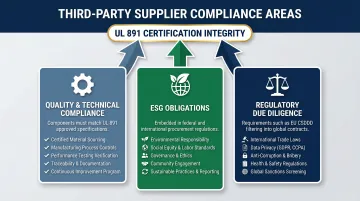
Supply chain bottlenecks create schedule pressure, and schedule pressure is where compliance shortcuts happen. Skipping or accelerating verification steps to meet a deadline is one of the most common paths to a voided certification or a failed inspection.
Manufacturers with vertically integrated supply chains and in-house component inventory are better positioned to maintain both schedule and compliance standards simultaneously because they are not subject to the same third-party delays and substitution pressures.
Documentation and Certification Pitfalls
What Documentation Should Accompany Every Switchboard
A compliant switchboard shipment should include:
- UL listing marks and certification documentation
- Factory test reports with signed checklists
- Compliance declarations (UL 891, NEC, NFPA 70E)
- Wiring diagrams and single-line drawings
- Arc flash incident energy analysis and labeling data
- Utility-specific verification checklists (EUSERC or other)
- BABA domestic content certification (for federally funded projects)
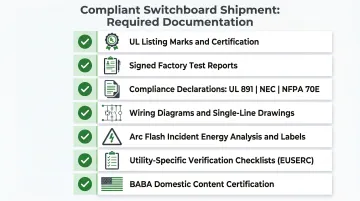
Buyers who do not explicitly require this documentation at the time of order risk receiving equipment they cannot verify as compliant.
Consequences of Expired or Improperly Maintained Certifications
Equipment without valid certification may fail AHJ inspection. Most inspectors won't pass unlisted equipment that hasn't been field labeled. These failures compound quickly:
- Failed AHJ inspections can force full equipment removal and replacement, stalling projects indefinitely
- Insurers can deny coverage when incidents involve unlisted equipment, leaving owners exposed
- NEC non-compliance triggers OSHA fines, penalties, and potential project shutdown
- If unlisted equipment malfunctions and causes injury or property damage, installers, contractors, and owners all face liability
Ongoing maintenance of certifications requires manufacturers to invest continuously in audits, employee training, and quality management systems.
Record-Keeping Obligations
NFPA 70B shifted from a "Recommended Practice" to a mandatory "Standard" in 2023, requiring formal Electrical Maintenance Programs (EMPs) with documentation and records-retention policies. OSHA can utilize NFPA 70B to issue citations.
Required EMP components include:
- A records-retention policy covering maintenance, equipment, and personnel documentation
- Written maintenance procedures for all covered electrical equipment
- A scheduled inspection, servicing, and testing plan
- A defined process for identifying, implementing, and documenting corrective actions
- A formal program review and revision cycle
System studies—including short-circuit studies, coordination studies, and incident energy analyses—must be updated every 5 years or sooner, along with current single-line diagrams. Inadequate records are among the most common reasons organizations fail compliance audits.
How to Identify a Truly Compliant Switchboard Manufacturer
Ask these four questions before placing an order:
1. Can you provide the UL listing documentation for this switchboard?
- Strong answer: The manufacturer provides active UL listing certificates, Follow-Up Services documentation, and verification that the specific configuration you're ordering falls within their listed scope
- Weak answer: Vague assurances about compliance without documentation, or claims that the equipment "meets UL standards" without a formal listing
2. What does your factory acceptance testing process look like, and what documentation do you provide?
- Strong answer: Detailed FAT checklist including torque verification, circuit testing, protective device calibration, and signed test reports provided with every shipment
- Weak answer: No documented FAT process, generic assurances about quality, or inability to provide test reports
3. Do your products meet BABA domestic content requirements for federally funded projects?
- Strong answer: Documented BABA certification with specific domestic content percentages, material sourcing documentation, and certification letters ready for federal project submittals
- Weak answer: Uncertainty about BABA requirements, inability to provide domestic content documentation, or reliance on imported components without verification
4. How do you handle utility-specific compliance requirements such as EUSERC?
- Strong answer: Proactive verification process that confirms utility acceptance before manufacturing, documented EUSERC approval, and experience working with specific utilities in your service area
- Weak answer: Assumption that EUSERC approval is universal, no process for verifying utility-specific requirements, or requirement that buyer handles all utility coordination
Red Flags That Indicate Compliance Shortcuts
- Vague answers about certification or inability to provide documentation
- No documented FAT process or refusal to provide test reports
- Inability to provide wiring diagrams or compliance declarations
- Long lead times caused by uncontrolled supply chains
- Tendency to promise compliance without supporting documentation
- Reluctance to discuss component sourcing or substitution policies
- No established process for handling jurisdiction-specific requirements
A manufacturer that answers these questions confidently — with paperwork to back it up — is one built around compliance rather than around promises. DEI Power, for example, manufactures UL 891-certified switchboards at their Ontario, California facility, provides BABA documentation for federal projects, and includes signed test reports with every shipment. That's the standard worth holding any manufacturer to.
Frequently Asked Questions
What are the compliance challenges for switchboard manufacturers?
Switchboard manufacturers navigate several overlapping compliance pressures:
- Evolving standards (UL 891, NEC, NFPA 70E revise on a three-year cycle)
- Component-level quality control — one non-compliant part can void the entire assembly's listing
- Supply chain disruptions that push teams toward unvetted component substitutions
- Jurisdiction-specific utility requirements that go beyond national codes
- Documentation requirements to prove compliance at every production stage
What strategies can switchboard manufacturers use to ensure compliance with electrical safety standards?
A few practices that consistently reduce compliance risk:
- Keep UL listings active and review them with each major standard update
- Run documented factory acceptance testing on every assembly before shipment
- Build cross-functional compliance teams that include both engineering and production
- Engage local utilities early to catch jurisdiction-specific requirements
- Invest in supply chain resilience so disruptions don't force non-compliant substitutions
What are the biggest supply chain challenges for switchboard manufacturers?
The most disruptive supply chain issues include:
- Raw material price volatility and shortages in copper and aluminum
- Extended lead times on high-demand components — circuit breakers have reached 151 weeks in some cases
- Third-party supplier compliance risks, including ESG obligations
- Compounding delays: when supply slips, production schedules and quality verification timelines both suffer
What is the importance of a switchboard in an organization?
A switchboard is the central point for distributing electrical power, protecting circuits from overloads and faults, and enabling safe isolation and maintenance of electrical systems. A non-compliant or poorly built switchboard creates serious downstream risks — arc flash hazards, equipment failure, unplanned downtime, and regulatory penalties.
What happens if a switchboard fails to meet UL 891 standards?
A non-UL 891-listed switchboard may fail utility acceptance inspections, trigger costly field rework or full replacement, void insurance coverage, and expose the contractor and facility owner to liability. The cost of replacement and project delays far exceeds the cost of sourcing a certified unit from the start.
How does Buy America (BABA) compliance affect switchboard procurement?
BABA requirements mandate a greater than 55% domestic content threshold for equipment used in federally funded infrastructure projects. Contractors who can't document compliance risk losing project eligibility, contract penalties, or being required to replace installed equipment at their own cost.
Ready to protect your project with documented, verifiable compliance? Contact DEI Power at (866) 773-8050 to discuss UL 891-certified, BABA-compliant switchboards manufactured with in-house quality control and comprehensive factory acceptance testing.