That gap creates real risk: over-specifying UL 1558 when UL 891 would satisfy code compliance (unnecessary cost and lead time), or under-specifying it when fault current levels and operational demands genuinely require the heavier equipment.
This guide covers what UL 1558 requires, how listed equipment is built to comply, and where it fits versus UL 891—so engineers and specifiers can make the right call before the purchase order goes out.
Key Takeaways
- UL 1558 is the UL certification standard for metal-enclosed low-voltage power circuit breaker switchgear, aligned with IEEE C37.20.1 for systems rated up to 1000V AC
- Preferred voltage ratings are 254V, 508V, and 635V; continuous main bus ratings run from 1,600A to 10,000A
- Key differentiators from UL 891: draw-out power circuit breakers, compartmentalized construction, 30-cycle short-time withstand, and available arc-resistant classification
- Verify UL listing through UL Product iQ by manufacturer name, model, or category
- Where UL 891 meets code requirements, it delivers the same UL listing at significantly lower cost and faster delivery
What Is UL 1558 Switchgear?
UL 1558 (currently Edition 6-2025, published April 2, 2025) is the Underwriters Laboratories standard titled Metal-Enclosed Low-Voltage Power Circuit Breaker Switchgear. It governs design, construction, performance, and testing requirements for low-voltage switchgear assemblies where power circuit breakers serve as the primary overcurrent protective device.
The UL 1558 and IEEE C37.20.1 Relationship
UL 1558 doesn't operate in isolation. Its requirements supplement and are used alongside ANSI/IEEE C37.20.1, which defines the metal-enclosed low-voltage power circuit breaker switchgear construction and rating framework. The current edition, C37.20.1-2026, extends the scope to 1000V AC and below.
UL 1558 is the certification pathway; IEEE C37.20.1 defines the engineering framework. Projects requiring both UL listing and ANSI/IEEE performance compliance should specify both standards explicitly in project documents.
Scope and Rating Ranges
Preferred AC maximum voltage ratings:
- 254V, 508V, 635V, 730V, 1058V
Preferred main horizontal bus current ratings:
- 1,600A through 10,000A
The 254V/508V/635V tiers are the ratings most commonly referenced in North American industrial specifications. When selecting equipment, cross-reference your project's voltage and current requirements against IEEE C37.20.1 directly — the standard includes application guidance that secondary documentation often omits.
What "Metal-Enclosed" Actually Means
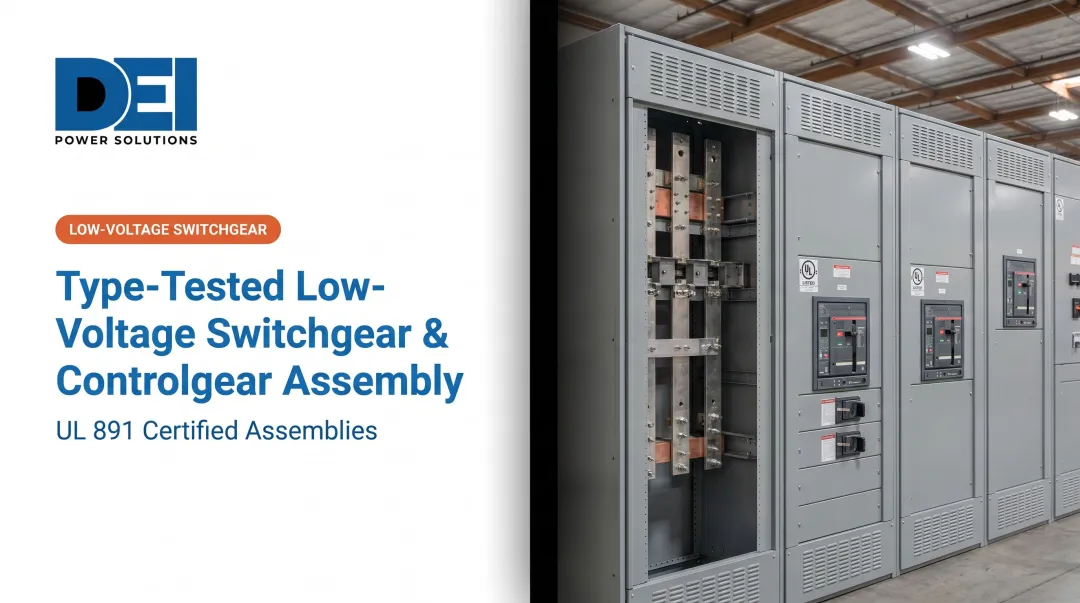
The switchgear sits inside a grounded metal enclosure with defined internal compartments, physically separating bus bars, circuit breakers, control wiring, and cable termination areas. This compartmentalization limits fault propagation: an arc event in one section cannot freely travel into adjacent sections.
The Power Circuit Breaker Distinction
The breaker type inside the enclosure is what defines the switchgear's performance class. UL 1558 assemblies use low-voltage power circuit breakers tested to UL 1066 — draw-out devices that are 100%-rated and built to withstand or interrupt faults for sustained durations.
That capability sets UL 1558 apart from UL 891 switchboards, which rely on molded-case or insulated-case breakers (typically UL 489). The distinction matters when fault current levels, serviceability requirements, or application criticality drive equipment selection.
Key Technical Requirements Under UL 1558
Short-Circuit Withstand Rating
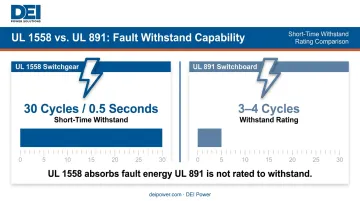
The most operationally significant requirement is the 30-cycle (0.5-second) short-time withstand rating for the bus and structural assembly. During a fault event, UL 1558 switchgear must sustain the fault current long enough for downstream protective devices to operate and clear—without catastrophic structural failure.
UL 891 switchboards, by contrast, handle full fault current for only three to four cycles. That gap reflects a different structural and engineering standard altogether—UL 1558 equipment is built to absorb and contain fault energy that UL 891 designs are not rated to withstand.
Conformance testing for UL 1558 assemblies follows IEEE C37.51, which covers the test procedures for metal-enclosed low-voltage AC power circuit breaker switchgear assemblies.
Voltage and Insulation Levels
Eaton's published switchgear documentation indicates a typical insulation level of 2.2 kV for low-voltage switchgear rated up to 635V. Full dielectric withstand test values—covering power frequency and DC withstand—are defined in both the UL 1558 and IEEE C37.20.1 standard text. Specifiers should reference the purchased standard for the specific kV values tied to each voltage rating tier.
Temperature and Continuous Current
ABB's MNS-SG product documentation specifies a maximum bus temperature rise of 65°C over a 40°C ambient, yielding a 105°C total operating temperature for that design. Temperature class limits for insulating materials and bus connections vary by design and insulation system—verify these values from the standard text for the specific equipment being specified.
Busbar Construction
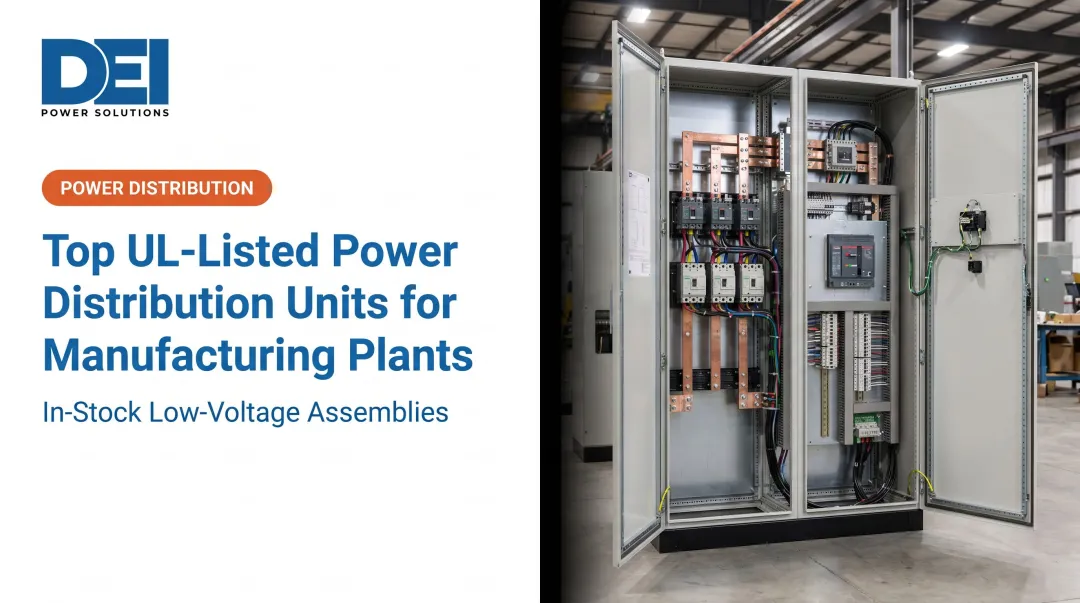
Busbars must be constructed of high-conductivity copper or aluminum, sized for the rated continuous current, and mechanically braced to withstand short-circuit electromagnetic forces. UL 1558 switchgear includes physical isolation between bus sections and adjacent compartments—a structural requirement absent from UL 891 switchboard designs.
Testing Requirements
UL 1558-listed assemblies must pass:
- Type tests (performed on representative designs to qualify the equipment family): short-circuit withstand, temperature rise, mechanical endurance, conducted per IEEE C37.51
- Production tests (performed on every unit before shipment): dielectric withstand, control wiring verification, and mechanical operation checks
Both test categories must be satisfied before a manufacturer can apply the UL Mark.
Construction and Design Standards
Compartmentalization
UL 1558 requires physical barriers separating three primary areas:
- Bus compartment — contains the main horizontal bus
- Breaker compartment — individual space for each power circuit breaker
- Cable/lug compartment — dedicated cable termination area
Grounded steel barriers prevent fault energy from propagating between compartments. This separation also enables arc-resistant construction per IEEE C37.20.7-2024, which defines test procedures for internal arcing fault containment. UL 891 switchboards do not require internal barriers and use group-mounted breakers—a significant structural difference.
Draw-Out Breaker Configuration
Each power circuit breaker is individually mounted and removable from its compartment without disturbing adjacent breakers or the energized bus. For facilities with strict uptime requirements—industrial plants, hospitals, data centers—this matters considerably. The draw-out design allows:
- Testing, maintaining, or replacing a single breaker without shutting down adjacent sections
- Eliminating full-lineup outages for isolated breaker changes
- Racking operations controlled by mechanical interlocks that prevent movement while main contacts are closed
That last point—the interlock requirement—is not found in UL 891 switchboards.
Enclosure Dimensions
Typical UL 1558 switchgear enclosures (per Eaton and ABB documentation):
| Dimension | Typical Value |
|---|---|
| Height | 96 inches |
| Standard depth | 72 inches |
| Minimum depth | 54 inches |
| Sheet metal (exterior) | 14-gauge steel |
DEI Power's UL 891 switchboards, by comparison, measure 14″ deep × 30″ wide × 90″ tall—a dramatically smaller footprint. The larger UL 1558 enclosure is a deliberate trade-off for fault withstand capacity and compartmentalized access.
Arc-Resistant Construction
For facilities where personnel regularly work on or near energized equipment, UL 1558 switchgear can be specified with arc-resistant construction. ABB's Type 2B arc-resistant design, for example, contains internal arcs initiated in any of the three compartments for 500ms, channeling energy through roof chimneys or plenums rather than toward personnel. This option is tested under IEEE C37.20.7 and is not available for UL 891 switchboards.
UL 1558 vs. UL 891: Choosing the Right Standard
Side-by-Side Comparison
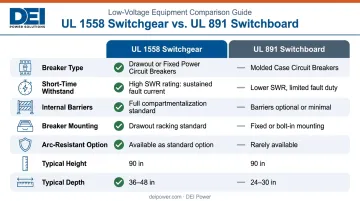
| Attribute | UL 1558 Switchgear | UL 891 Switchboard |
|---|---|---|
| Breaker type | Power circuit breaker (UL 1066) | Molded/insulated-case (UL 489) |
| Short-time withstand | 30 cycles / 0.5 seconds | 3–4 cycles |
| Internal barriers | Required | Not required |
| Breaker mounting | Draw-out, individually compartmentalized | Group-mounted |
| Arc-resistant option | Available (IEEE C37.20.7) | Not available |
| Typical height | 96 inches | 90 inches |
| Typical depth | 54–72 inches | 14–18 inches |
The Practical Selection Rule
Specify UL 1558 when the application involves:
- High available fault current at the point of installation
- Transformer capacity above roughly 500 kVA–1 MVA
- Complex protection coordination requirements
- Draw-out maintainability without de-energizing the full lineup
- Project specifications or AHJ explicitly requiring listed low-voltage power circuit breaker switchgear
UL 891 is the right fit for commercial buildings, healthcare facilities, data centers with moderate fault current, and light industrial distribution. If fault current levels and operational demands don't require 30-cycle withstand or draw-out architecture, UL 891 covers the application.
When UL 891 Makes More Sense
The heavier construction, draw-out mechanisms, and extended testing behind UL 1558 translate directly into higher cost and longer lead times — costs that aren't justified when the fault current environment or project spec doesn't require them.
For projects where UL 891 satisfies code requirements, DEI Power manufactures UL 891-certified switchboards built with Siemens components, available from 400A to 4000A across seven voltage configurations (including 480V and 480Y/277V). Standard in-stock configurations ship in 3–5 business days; custom-built units typically complete in 4–6 weeks — a meaningful difference when project schedules are tight.
How to Verify and Specify UL 1558 Listed Equipment
Verifying the UL Listing
UL-listed UL 1558 switchgear carries a UL Mark on the nameplate. To verify a listing:
- Go to UL Product iQ
- Search by manufacturer name, model number, or category description
- Confirm the listing is active and covers the specific voltage, continuous current, and short-circuit rating required for the project
- Cross-reference the nameplate fields against the Product iQ record
The product category code for metal-enclosed low-voltage switchgear is commonly referenced as GZNY—verify this directly inside Product iQ before finalizing specifications, since the guide information isn't consistently visible on public-facing pages.
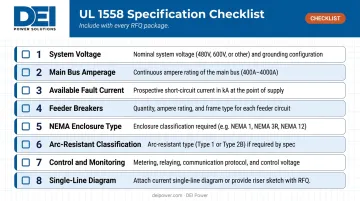
Once the listing is confirmed, accurate specifications at the quoting stage prevent most downstream errors and change orders. Use this checklist when submitting an RFQ:
Specification Checklist for UL 1558 Switchgear
- System voltage and configuration — 480V or 600V, 3-phase
- Main bus amperage rating — from the short-circuit study
- Available fault current (kAIC) — at the point of installation
- Number and rating of feeder breakers — with coordination study results
- NEMA enclosure type — NEMA 1 (indoor) or NEMA 3R (outdoor)
- Arc-resistant classification — if required by facility safety plan
- Control and monitoring — metering, protective relays, SCADA interfaces
- Single-line diagram — include with the RFQ package
Even well-prepared specs can introduce cost or field problems. Watch for these three common mistakes:
Common Specification Mistakes
- Specifying UL 1558 when UL 891 satisfies the code requirement and fault current environment — this adds procurement cost and lead time with no operational benefit
- Ordering without verifying the listed kAIC matches available fault current at the installation point — a mismatch creates compliance exposure after installation
- Skipping confirmation that the draw-out mechanism and breaker manufacturer align with the facility's existing maintenance program — incompatibilities surface during commissioning, not at delivery
Frequently Asked Questions
What is the difference between UL 1558 and UL 891?
UL 1558 covers metal-enclosed switchgear with draw-out power circuit breakers for industrial and high fault-current applications; UL 891 covers dead-front switchboards with molded-case breakers for commercial and light industrial use. The primary distinctions are compartmentalization, busbar isolation, fault withstand duration (30 cycles vs. 3–4 cycles), and arc-resistant construction availability.
What voltage and current ratings does UL 1558 cover?
Preferred AC maximum voltages are 254V, 508V, 635V, 730V, and 1058V, per IEEE C37.20.1-2026. Main horizontal bus continuous current ratings range from 1,600A to 10,000A.
What does it mean for switchgear to be "UL 1558 listed"?
It means Underwriters Laboratories has independently tested the equipment, confirmed it meets UL 1558's design, construction, and performance requirements, and authorized the manufacturer to apply the UL Mark. Listings can be verified through UL Product iQ at iq.ul.com.
What short-circuit withstand rating is required by UL 1558?
UL 1558 switchgear must sustain a 30-cycle (0.5-second) short-time withstand on the bus and structural assembly, giving downstream protective devices enough time to operate and clear the fault. This is the core technical distinction from UL 891 switchboards, which withstand full fault current for only 3–4 cycles.
When should I specify UL 1558 instead of a switchboard?
Specify UL 1558 when the project involves high available fault current, large transformer capacity, complex protection coordination, draw-out maintainability requirements, or an explicit AHJ or specification mandate. If none of those conditions apply, UL 891 switchboards meet code requirements at lower cost and with shorter lead times.
How do I verify UL 1558 switchgear is properly listed for my project?
Check the nameplate for the UL Mark, then search UL Product iQ by manufacturer name or model number. Confirm the listing is active and that the listed voltage, continuous current rating, and short-circuit rating match your project's requirements before finalizing the purchase order.