Introduction
A hyperscale data center in Virginia loses primary utility feed at 2 AM. Without warning, 30 megawatts of critical compute load suddenly shifts to backup systems. But because the facility's medium-voltage switchgear was properly specified and maintained, protective relays detect the fault in milliseconds, circuit breakers isolate the problem section, and downstream equipment continues running without interruption. Total customer-facing downtime: zero.
This scenario plays out daily in industrial facilities worldwide. Industrial switchgear is the engineered assembly of circuit protection and control devices that stands between normal operations and catastrophic equipment failure. When properly selected and deployed, it prevents single-point failures from cascading into full facility shutdowns.
This guide covers what industrial switchgear is, how it works, what it's made of, where it's used, and how to choose the right system. Whether you're an engineer specifying new equipment, a contractor managing a retrofit, or a facility team responsible for uptime-critical infrastructure, you'll find both conceptual clarity and practical guidance here.
Distributed generation, variable loads, and tighter uptime requirements are reshaping how power systems are designed—and how switchgear must perform within them.
TLDR:
- Industrial switchgear protects and controls power flow in commercial and industrial facilities using circuit breakers, relays, and disconnect switches
- Voltage classification (LV, MV, HV) and construction type (metal-clad, metal-enclosed) determine application suitability
- The global switchgear market reached $139.43 billion in 2026, driven by expanding industrial and data center infrastructure
- Correct specification requires matching voltage class, current rating, and short-circuit withstand capacity to UL/ANSI standards
What Is Industrial Switchgear?
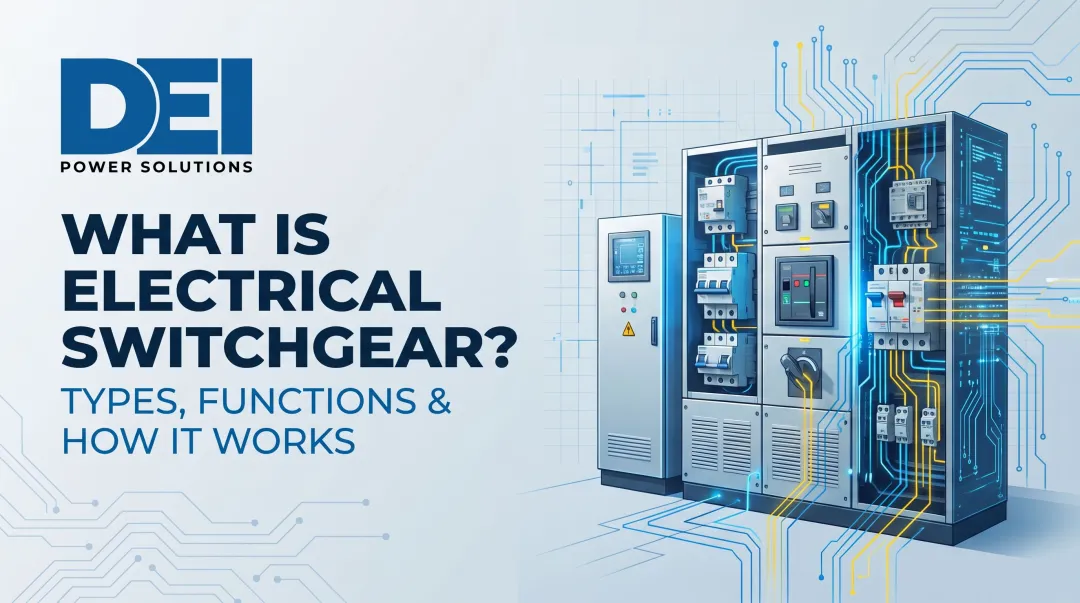
Industrial switchgear is a centralized assembly of circuit protection and control devices housed in a metal enclosure. It includes circuit breakers, fuses, disconnect switches, protective relays, and busbars—all working together to control, protect, and isolate electrical equipment within a power distribution system.
Three Core Functions
- Power control: Distributes electricity from the utility or generator to branch circuits, ensuring each load receives the correct voltage and current
- Fault protection: Interrupts current flow in milliseconds when protective relays detect short circuits, ground faults, or overloads—isolating problems before equipment is damaged
- Isolation: De-energizes specific circuits for safe maintenance without shutting down the entire system; disconnect switches confirm power is physically removed upstream
How Switchgear Differs From Breaker Panels
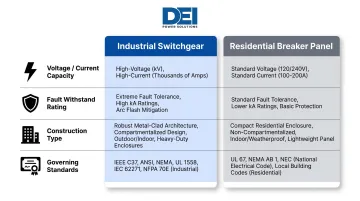
While residential breaker panels and industrial switchgear both contain overcurrent protection, they're engineered for very different applications:
- Capacity: Switchgear handles higher voltage (up to 38 kV) and current (up to 6,000A) than standard panelboards (typically 600V, 1,200A maximum)
- Withstand rating: Switchgear is built to withstand fault conditions for 30 cycles; panelboards are rated for just 3 cycles
- Construction: Switchgear features draw-out circuit breakers in fully enclosed metal compartments; panelboards use plug-in or bolt-on breakers in open frames
- Standards: In North America, switchgear complies with ANSI/IEEE C37.20.2 (metal-clad), C37.20.3 (metal-enclosed), and UL 891; international installations follow IEC 62271
For most commercial and industrial facilities, low-voltage switchgear (up to 600V) handles the bulk of power distribution requirements—from manufacturing floors and data centers to healthcare campuses and utility substations.
The global switchgear market is forecast to grow from $139.43 billion to $187.95 billion between 2026 and 2031—a 6.15% annual growth rate driven largely by data center expansion, renewable energy integration, and aging grid infrastructure requiring upgrades.
Types of Industrial Switchgear
Switchgear is classified two ways: by voltage class and by construction type. Understanding both is essential for specifying the right equipment for any application.
Voltage-Based Classification
Low-Voltage (LV) Switchgear Rated up to 1,000V per ANSI/NEC definitions, LV switchgear serves commercial buildings, industrial facilities, data centers, and smaller power distribution systems. Components typically include molded case circuit breakers, fuses, and copper or aluminum busbars. DEI Power's UL 891-certified switchboards are a common example — available from 400A to 4000A, supporting 480V, 480Y/277V, 208Y/120V, and other standard North American configurations.
Medium-Voltage (MV) Switchgear Covering the range from 1 kV to 38 kV, MV switchgear appears in utility substations, industrial campuses, large manufacturing plants, and power generation systems. Vacuum circuit breakers and current transformers are key components, with typical interrupt ratings from 25 kAIC to 63 kAIC.
High-Voltage (HV) Switchgear Operates above 38-69 kV depending on the standard applied. HV switchgear appears in transmission grids and large-scale power generation facilities. It's engineered to withstand extreme electrical stresses and is typically installed outdoors or in specialized substations with additional safety clearances.
Construction-Based Classification
Voltage class defines the operating range. Construction type determines how components are physically arranged, isolated, and protected — and directly affects maintenance safety and arc flash risk.
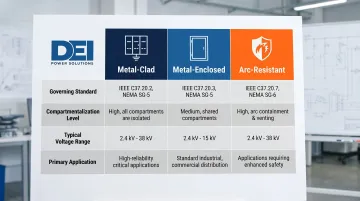
Metal-Clad Switchgear Defined by IEEE C37.20.2, metal-clad switchgear houses all major components in separate grounded metal compartments. The main circuit breaker, bus sections, and instrumentation each occupy individual metal-enclosed spaces. Draw-out circuit breakers allow maintenance without disrupting adjacent equipment. Metal-clad construction is standard in industrial facilities and power generation plants, typically at 5–38 kV.
Metal-Enclosed Switchgear Defined by IEEE C37.20.3, metal-enclosed switchgear does not require the full compartmentalization mandated for metal-clad designs. Components share common enclosures without individual grounded metal barriers between each section. This construction is common in commercial buildings and industrial facilities where incoming service exceeds 480/600V but full metal-clad separation isn't required.
Arc-Resistant Switchgear A safety-enhanced subtype tested to ANSI/IEEE C37.20.7, arc-resistant switchgear redirects arc flash energy away from personnel during internal arcing faults. A dedicated plenum channels explosive gases and plasma safely out of the enclosure, protecting operators standing in front of or near the equipment. Given that 68% of low-voltage arc flash incidents occur at 480–700V and 74% of injuries happen during maintenance activities, arc-resistant designs add critical protection in high-risk environments.
The table below summarizes the key differences across construction types:
| Construction Type | Governing Standard | Compartmentalization | Typical Voltage Range | Primary Application |
|---|---|---|---|---|
| Metal-Clad | IEEE C37.20.2 | Full — each component in separate grounded metal enclosure | 5–38 kV | Industrial plants, power generation |
| Metal-Enclosed | IEEE C37.20.3 | Partial — shared enclosures, no individual barriers required | 480V–38 kV | Commercial buildings, light industrial |
| Arc-Resistant | ANSI/IEEE C37.20.7 | Metal-clad or metal-enclosed base + arc venting plenum | 5–38 kV | High-risk environments, frequent maintenance areas |
Key Components Inside Industrial Switchgear
Switchgear isn't a single device—it's an engineered assembly of interdependent components. Each plays a specific role in controlling power flow, detecting faults, or enabling safe isolation.
Circuit Breakers
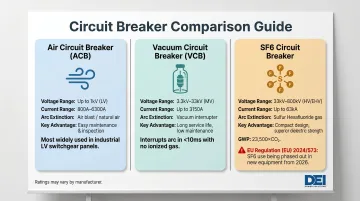
Circuit breakers are the primary protective device, automatically interrupting current when they detect overloads or short circuits. Three main types serve industrial switchgear:
- Air Circuit Breakers (ACB) handle LV applications up to 690V with current ratings reaching 6,300A. Arc extinction occurs in atmospheric air using arc chutes that divide and cool the arc.
- Vacuum Circuit Breakers (VCB) dominate modern MV systems (11–33 kV), extinguishing arcs in sealed vacuum bottles at extremely low pressure (10^-2 to 10^-6 torr). VCBs held 40% revenue share in 2025 due to compact size, minimal maintenance, and long service life.
- SF6 Circuit Breakers use sulfur hexafluoride gas for arc extinction in HV applications. EU Regulation 2024/573 bans SF6 in medium-voltage equipment below 24 kV starting January 2026, accelerating adoption of vacuum and clean-air alternatives.
Disconnect Switches (Isolators)
Disconnect switches safely de-energize circuit sections for maintenance or repair. Unlike circuit breakers, isolators do not interrupt fault current—they must only be operated after a circuit breaker has opened and the circuit is de-energized. Their primary role is worker safety during planned maintenance, providing a visible disconnect point that can be locked and tagged out.
Protective Relays
Protective relays continuously monitor electrical parameters—current, voltage, frequency, phase angle—and signal circuit breakers to trip when abnormal conditions are detected. Modern microprocessor-based relays (Intelligent Electronic Devices or IEDs) respond faster than older electromechanical designs, typically isolating faults within 4–20 milliseconds.
Beyond protection, IEDs also provide data logging, event recording, and oscillography for root-cause analysis. Remote monitoring is handled via communication protocols like IEC 61850-8-1, DNP3, and IEC 60870-5-104.
Busbars and Fuses
Busbars are rigid copper or aluminum conductors that distribute electricity from the incoming supply to outgoing feeders within the switchgear assembly. Their ampacity (current-carrying capacity) determines the continuous current rating of the entire system. Typical current density for copper bars is 1.0–1.6 A/mm², with temperature rise limits set by IEC 61439-1 at maximum 70K above 35°C ambient.
Fuses provide one-time overcurrent protection in lower-complexity or cost-sensitive applications where circuit breakers aren't required. Once a fuse operates, it must be replaced—unlike circuit breakers, which can be reset and reused.
How Industrial Switchgear Works in Power Distribution
Under normal conditions, switchgear distributes power from the supply source (utility transformer or generator) through busbars to downstream circuits. Protective relays monitor all circuits continuously, measuring current, voltage, and frequency in real time.
When a relay detects an abnormality—overcurrent from a short circuit, ground fault, or equipment overload—it sends a trip signal to the appropriate circuit breaker. Modern vacuum circuit breakers can separate contacts in as little as 16-20 milliseconds (approximately 1 cycle at 60 Hz), interrupting fault current before it damages equipment or creates safety hazards. The affected section is isolated while the rest of the distribution system continues operating normally.
Intelligent Switchgear and Predictive Maintenance
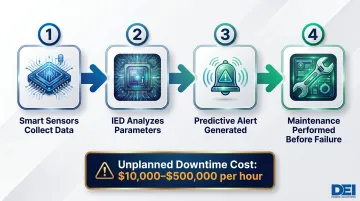
Modern switchgear incorporates smart sensors, IEDs, and network connectivity to enable real-time monitoring, predictive maintenance alerts, and remote control. These systems continuously collect and act on data across every critical point in the distribution system:
- Logs operational data and tracks cumulative breaker operations
- Monitors contact wear to flag components approaching end of life
- Measures temperature at key connection points to catch thermal issues early
By shifting from reactive to condition-based maintenance, facilities reduce unplanned downtime at a meaningful scale. That matters when 83% of industrial decision-makers report unplanned downtime costs at least $10,000 per hour, with 76% estimating costs up to $500,000 per hour.
Industrial Switchgear Applications by Sector
Manufacturing and Industrial Plants
Switchgear manages power distribution to motors, variable frequency drives, HVAC systems, and production equipment. Its fault-isolation capability prevents single equipment failures from cascading into full production shutdowns. In automotive manufacturing, downtime can cost up to $2.3 million per hour; across industrial sectors generally, the median cost is approximately $125,000 per hour.
DEI Power supplies switchgear for manufacturing applications in amperage ranges from 400A to 4000A, with configurations in NEMA 1 (indoor) and NEMA 3R (outdoor) enclosures. Common applications include:
- Motor control and variable frequency drive (VFD) feed circuits
- HVAC and mechanical system distribution
- Production line power with coordinated fault protection
- Outdoor equipment pads requiring weatherproof enclosures
Data Centers and Critical Facilities
Hyperscale data centers and healthcare facilities require switchgear with precise fault protection and high reliability. 54% of data center operators reported their most recent significant outage cost over $100,000, with 16% exceeding $1 million. UL-listed, code-compliant switchgear is typically required for these applications.
That exposure drives demand for fully documented, code-compliant systems. DEI Power's UL 891-certified switchboards serve data centers and colocation facilities with configurations supporting 480V, 480Y/277V, and 208Y/120V systems. Built with Siemens components and manufactured in the USA, these systems come with the compliance documentation and configuration accuracy that mission-critical installations require.
Utility and Energy Infrastructure
Utility substations and renewable energy installations rely on MV and HV switchgear to manage power transfer between generation sources and distribution networks. Grid congestion management costs tripled in Germany, the UK, and the US between 2019 and 2022, driving modernization projects that include switchgear upgrades. For low-voltage distribution within these facilities — service entrances, auxiliary power panels, and equipment feeds — DEI Power supplies switchboards from 400A to 4000A, with seismic compliance per UBC, CBC, and IBC requirements for installations in high-risk zones.
How to Select the Right Industrial Switchgear
Determine Core Technical Parameters
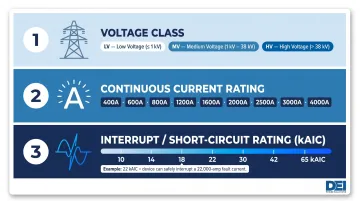
Three primary specifications must be established first:
Voltage Class
Match switchgear voltage rating to your system design: LV (up to 1,000V), MV (1 kV to 38 kV), or HV (above 38 kV). The voltage class determines component selection, insulation requirements, and applicable standards.
Continuous Current Rating
The maximum load current the switchgear must carry continuously without tripping. Available ratings typically include 400A, 600A, 800A, 1000A, 1200A, 1600A, 2000A, 2500A, 3000A, and 4000A for low-voltage systems.
Interrupt/Short-Circuit Withstand Rating (kAIC)
The maximum fault current the system must safely interrupt and withstand, measured in kiloamperes interrupting capacity. For example, 10 kAIC means the device can safely interrupt up to 10,000 amperes of fault current. Typical low-voltage switchgear interrupt ratings range from 10 kAIC to 65 kAIC depending on the system's available fault current.
Ensure Compliance and Certification
In North America, switchgear should comply with ANSI/IEEE standards and carry UL listing. For low-voltage switchboards, UL 891 certification serves as the recognized standard, covering design, construction, and testing requirements. For contractors and engineers navigating submittal approvals, working with a manufacturer that carries UL 891 listing and OEM engineering support — such as DEI Power — reduces the documentation burden and helps projects meet insurance and code requirements without delays.
Address Environmental and Application-Specific Factors
Installation Environment
Indoor installations typically use NEMA 1 enclosures; outdoor or weather-exposed locations require NEMA 3R (rainproof) or NEMA 4 (watertight) ratings.
Available Space
Front-access designs work in space-constrained electrical rooms; rear-access or front-and-rear-access configurations provide more service flexibility in larger facilities.
Arc Flash Hazard
High-risk environments benefit from arc-resistant switchgear tested to ANSI/IEEE C37.20.7 standards, which redirect arc flash energy away from personnel.
Lead Time Requirements
Standard switchgear lead times historically ranged from 4-6 weeks but stretched to 12-16 weeks during supply chain disruptions (2020-2021). Working with a manufacturer offering in-house manufacturing and in-stock inventory reduces schedule exposure and procurement delays. DEI Power's 50,000 sq. ft. facility in Ontario, California maintains in-stock inventory with 3-5 business day delivery for standard configurations and 4-6 week lead times for custom-built units.
Frequently Asked Questions
What is industrial switchgear?
Industrial switchgear is an assembly of protective and control devices—including circuit breakers, disconnect switches, fuses, and relays—housed in a metal enclosure. It controls, protects, and isolates electrical equipment in industrial and commercial power distribution systems.
What is the purpose of a switchgear?
Switchgear serves three core purposes: controlling power flow to various loads, protecting circuits and equipment from faults like short circuits and overloads, and enabling safe isolation of specific circuits for maintenance without shutting down the entire system.
What is a main switchgear?
The primary switchgear assembly in a facility—also called the main distribution switchgear or main switchboard—receives incoming power from a utility feed or generator. From there, it distributes power downstream to sub-panels, motor control centers, and other loads.
What is a switchgear enclosure?
A switchgear enclosure is the metal housing that contains and protects all switchgear components. Enclosures are rated for indoor or outdoor use, classified by construction type (metal-clad, metal-enclosed), and must meet NEMA or IP standards for the intended environment.
What is a low voltage distribution system?
A low voltage distribution system operates at voltages below 1,000V and delivers power from a transformer or main panel to downstream equipment—lighting, motors, plug loads, and similar loads. It's typically protected and controlled by LV switchgear or switchboards.
What is an example of a switchgear?
A UL 891-certified low-voltage switchboard installed in the main electrical room of a commercial building or data center is a common example. It receives utility power and distributes it to downstream circuits through metered and protected feeder breakers.