Introduction
Specifying the wrong NEMA rating for an outdoor electrical installation can lead to equipment failure, NEC code violations, and expensive rework. Engineers and contractors face this risk on every project—choosing between NEMA 3, 3R, 4, or 4X often determines whether a job stays on schedule or falls victim to compliance issues and water damage.
This guide breaks down exactly what NEMA 3R means, what environmental hazards it protects against (and critically, what it doesn't), where it's required by code, and how it compares to other ratings. Use it as a reference when specifying enclosures for your next outdoor installation.
TLDR:
- NEMA 3R is rainproof but not watertight—it protects against falling rain and snow but omits windblown dust protection
- Drainage holes are required by design, distinguishing NEMA 3R from fully sealed ratings
- Suitable for semi-sheltered outdoor locations; step up to 3RX or 4X for hose-directed water or coastal environments
- Available in carbon steel, aluminum, stainless steel, and fiberglass across panelboards, switchgear, and junction boxes
- UL listing and NEMA rating are separate requirements—verify which your project mandates
What Is a NEMA 3R Enclosure?
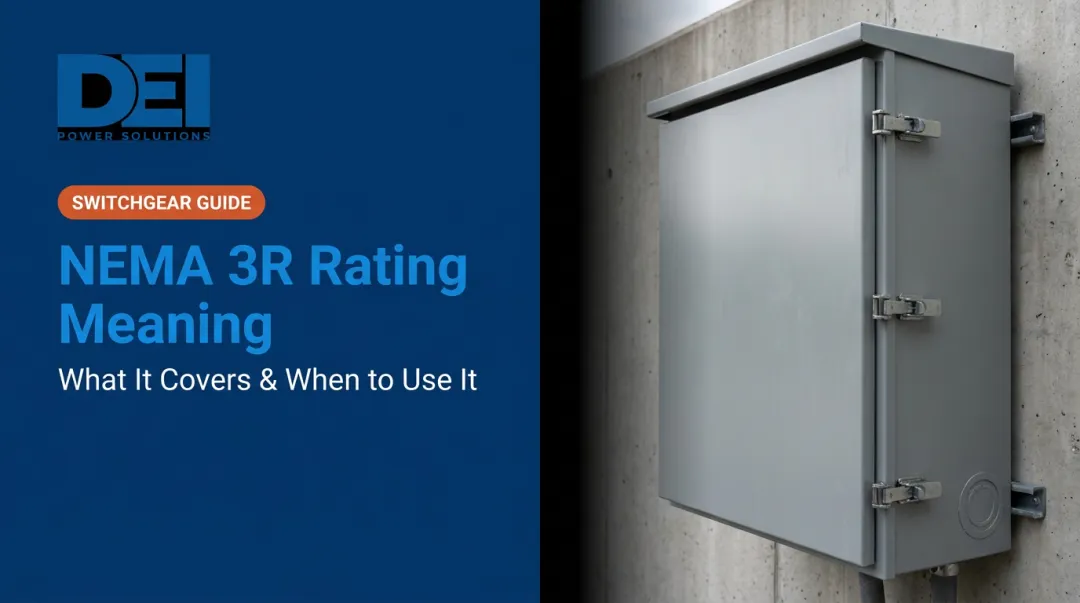
NEMA 3R is a classification established by the National Electrical Manufacturers Association (NEMA) under the ANSI/NEMA 250 standard. The "3R" designation identifies enclosures built for outdoor use with specific, limited weather protection—distinct from the broader NEMA 3 family in key ways.
Purpose of NEMA Ratings
NEMA ratings provide a standardized language for communicating how well an enclosure shields electrical equipment from environmental hazards. These hazards include moisture ingress, airborne debris, and accidental human contact. When specifiers, contractors, and engineers select equipment based on NEMA ratings, they ensure installations meet code requirements and perform reliably in the field.
NEMA Rating vs. UL Listing
NEMA 3R is a protection category, not a safety certification. NEMA is a standards development organization (SDO) that does not test or certify products—manufacturers may self-certify to NEMA 250 or use a third-party certification body.
UL listing is separate. Standards like UL 508A (for Industrial Control Panels) and UL 891 (for Switchboards) govern electrical safety and construction quality. For most outdoor power distribution applications, both are typically required — the specific combination depends on the application and local Authority Having Jurisdiction (AHJ).
In practice, this means specifying an enclosure's NEMA rating addresses environmental protection, while UL certification addresses electrical safety and construction quality. Both criteria show up on project specifications and AHJ submittals, particularly for switchboards in outdoor or exposed locations.
What Does the "R" Mean?
With the NEMA vs. UL distinction established, it's worth clarifying exactly what the "3R" classification covers at the enclosure level.
The "R" stands for rainproof. NEMA 3R enclosures are designed with drainable interiors and baffled openings to prevent rain from interfering with internal components under normal rainfall conditions. Unlike fully sealed enclosures, NEMA 3R units do not require continuous gasketed sealing surfaces. This is intentional — and it distinguishes them from higher-rated types like NEMA 4 or 4X.
NEMA 3R Protection Scope: What It Covers and What It Doesn't
What NEMA 3R Protects Against
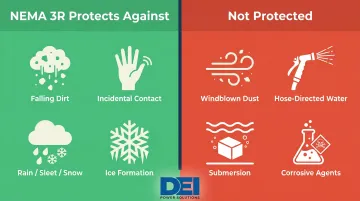
NEMA 250 (2020 edition) defines NEMA 3R enclosures as protecting against:
- Falling dirt
- Incidental contact with enclosed equipment
- Water ingress from rain, sleet, and snow
- External ice formation on the enclosure body (undamaged by ice)
- Suitable for indoor or outdoor use
What NEMA 3R Does NOT Protect Against
NEMA 3R specifically omits:
- Windblown dust and debris (covered by NEMA 3, not 3R)
- Hose-directed water streams (requires NEMA 4)
- Submersion (requires NEMA 6P)
- Corrosive agents without the "X" suffix (requires NEMA 3RX or 4X)
Unlike NEMA Type 3, which includes windblown dust protection, NEMA 3R deliberately excludes windblown dust protection. If your installation faces airborne particulates or desert/industrial dust, NEMA 3R is insufficient.
Rainproof vs. Rain-Tight
NEMA 3R is rainproof but not rain-tight — and that distinction matters for installation planning:
- NEMA 3R: No continuous gasketed seal; beating rain or wind-driven water under extreme conditions can still penetrate
- NEMA 4: Watertight construction; rated to withstand hose-directed water streams
Drainage Holes: A Defining Characteristic
NEMA 3R enclosures must include drainage holes or weep provisions that allow accumulated moisture or condensation inside the enclosure to drain out. This feature prevents long-term damage to sensitive electrical components and distinguishes NEMA 3R from sealed enclosure types.
NEMA 3RX: Corrosion-Resistant Variant
The "X" suffix indicates the same 3R protection level with added corrosion resistance. NEMA 250 defines NEMA 3RX as offering increased corrosion resistance suitable for coastal environments, marine proximity, or chemically harsh outdoor settings. Outdoor enclosures are subjected to 600 hours of salt spray testing; corrosion-resistant types receive an additional 200 hours.
If your site is within range of salt air or industrial chemical exposure, that additional 200-hour salt spray threshold is the standard that separates adequate protection from insufficient.
Key Structural Features of NEMA 3R Enclosures
Knockout Placement
NEMA 3R enclosures typically feature knockouts on the sides and bottom, not the top, to prevent water ingress from above. Manufacturers like Milbank offer units with or without concentric knockouts on the bottom, and installers use raintight hubs for top conduit entries to maintain rain protection.
Water flows downward, so top penetrations are natural entry points for rain. Keeping knockouts on the sides and bottom — and using raintight fittings for any top entries — maintains the enclosure's rainproof integrity without compromising access.
Drip Shields and Overlapping Covers
NEMA 3R designs incorporate structural features to shed rain:
- Drip shield tops that extend beyond the enclosure body
- Overlapping covers that fit under the drip shield
- Baffled openings to prevent direct water entry
nVent HOFFMAN's Drip-Shield Screw-Cover Type 3R and HingeCover Type 3R series demonstrate these approaches.
Door Gaskets: Often Absent
Most NEMA 3R enclosures lack the continuous dust-tight door gasket required in higher NEMA ratings. Because NEMA 3R does not require windblown dust protection, manufacturers may omit gaskets entirely. However, some voluntarily add gaskets to provide additional protection beyond the minimum rating. If your enclosure will be installed in a dusty environment or must meet IP54 dust ingress requirements, confirm with the manufacturer whether a door gasket is included before specifying the unit.
Available Form Factors
NEMA 3R enclosures are manufactured in:
- Wall-mount panels
- Floor-standing cabinets
- Junction boxes
- Metering enclosures
- Load center and switchgear housings
Enclosure sizes span from compact junction boxes under 6 inches to large switchgear cabinets exceeding 72 inches tall, so most equipment footprints and installation layouts can be matched to an off-the-shelf or custom unit.
Where NEMA 3R Enclosures Are Used and Required
NEC Context
The National Electrical Code (NEC) Section 110.28 requires enclosures rated not over 1,000V and intended for specific environmental conditions to be marked with an enclosure-type number from Table 110.28. NEMA 3R is among the accepted ratings for outdoor electrical installations in non-severe environments.
Local Authorities Having Jurisdiction (AHJs) may set minimum enclosure ratings for a given installation. Verify local code requirements before specifying.
Common Applications
NEMA 3R enclosures are specified for:
- Outdoor panelboards and load centers
- Service entrance equipment
- Utility metering enclosures
- Transfer switches
- Outdoor lighting controls
- Irrigation controllers
- HVAC disconnect switches
- Outdoor communications equipment
Power Distribution and Switchgear
NEMA 3R-rated enclosures frequently house outdoor switchboards, distribution panels, and low-voltage switchgear in commercial, industrial, and utility applications. Equipment is commonly mounted on building exteriors, in covered equipment yards, or on utility poles and pads in semi-sheltered locations.
For mission-critical power distribution, the enclosure rating must align with a properly certified switchboard (such as UL 891) to ensure both environmental protection and electrical safety compliance. DEI Power's UL 891-certified switchboards are available in NEMA 3R outdoor weather-resistant enclosures across the full 400A–4000A range for commercial, industrial, and utility installations.
When NEMA 3R Is Appropriate vs. Insufficient
Not every outdoor location calls for the same enclosure rating. NEMA 3R works well in:
- Covered or semi-sheltered outdoor locations
- Dry climates with light precipitation
- Indoor industrial environments without significant airborne particulates
NEMA 3R is NOT suitable for:
- Direct exposure to windblown dust (upgrade to NEMA 3 or NEMA 12)
- Coastal or salt-spray environments without the "X" suffix (upgrade to NEMA 3RX or 4X)
- Locations subject to washdown or hose-directed water (upgrade to NEMA 4/4X)
- Flooding or submersion risk (upgrade to NEMA 6P)
NEMA 3R vs. Other NEMA Ratings
Comparison Table
| NEMA Rating | Windblown Dust | Rain/Snow | Ice | Hose-Directed Water | Corrosion Resistance | Indoor/Outdoor |
|---|---|---|---|---|---|---|
| 3 | Yes | Yes | Yes | No | No | Indoor/Outdoor |
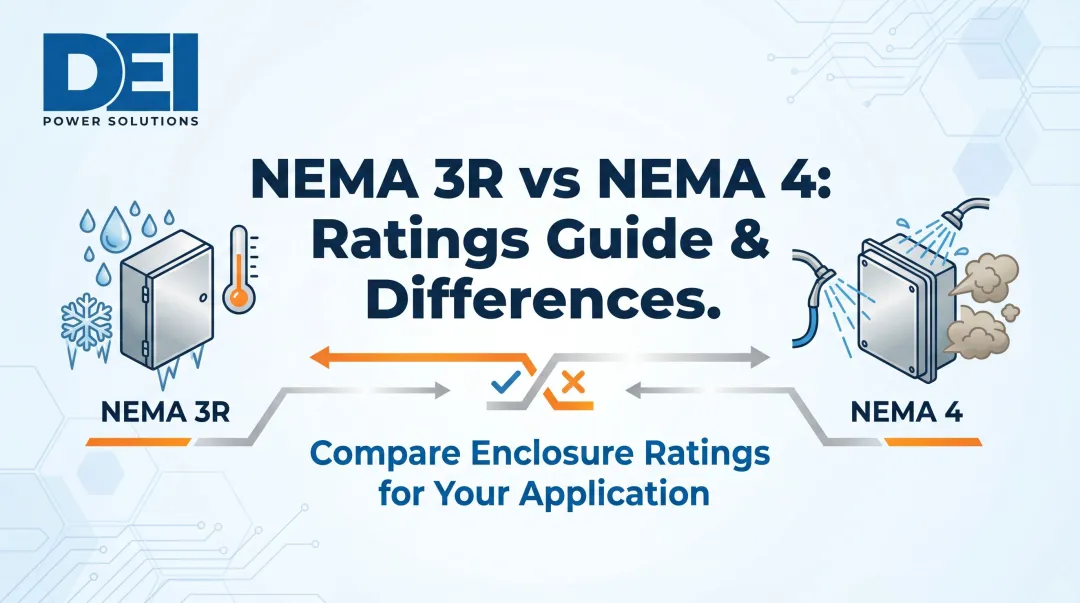
| 3R | No | Yes | Yes | No | No | Indoor/Outdoor |
| 3RX | No | Yes | Yes | No | Yes | Indoor/Outdoor |
| 4 | Yes | Yes | Yes | Yes | No | Indoor/Outdoor |
| 4X | Yes | Yes | Yes | Yes | Yes | Indoor/Outdoor |
Source: NEMA 250 Enclosure Types (2020)
Key Practical Differences
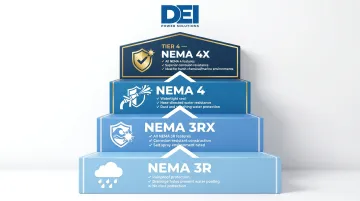
Each rating targets a specific set of environmental conditions rather than building linearly on the last:
- NEMA 3 adds windblown dust protection that 3R lacks
- NEMA 4 adds watertight construction and hose-directed water resistance
- NEMA 4X adds corrosion resistance on top of NEMA 4 protection
- NEMA 3RX adds corrosion resistance to NEMA 3R (but still no windblown dust or hose-directed water protection)
When to Upgrade from NEMA 3R
Move to a higher rating when:
- Dust exposure → NEMA 3 or NEMA 12 (indoor industrial)
- High-pressure water or washdown → NEMA 4
- Corrosive or salt-laden environments → NEMA 4X or NEMA 3RX
- Submersion risk → NEMA 6P
Choosing the Right Material for Your NEMA 3R Enclosure
Common Material Options
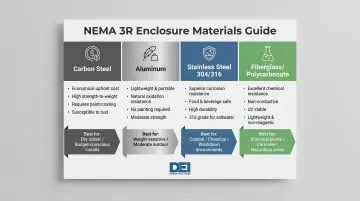
Carbon Steel (Galvanized or Powder-Coated):
- Most common for general outdoor use
- Cost-effective
- Good for standard outdoor switchgear applications
- Powder coating provides additional corrosion protection in wet climates
Aluminum:
- Lighter weight than steel
- Naturally corrosion-resistant
- Suitable for moderate outdoor environments
- Often specified for portable or wall-mount applications
Stainless Steel (304 or 316 Grade):
- Superior corrosion resistance
- 316 stainless steel offers extreme resistance to chlorides, making it ideal for seawater and industrial chemical exposure
- Often paired with NEMA 3RX rating
- Preferred for coastal or chemically aggressive environments
Fiberglass/Polycarbonate:
- Non-conductive
- Lightweight
- Excellent for corrosive or humid environments
- Does not require additional coatings
Selection Criteria
Choose material based on:
- Installation environment (humidity, salt exposure, chemical presence)
- Required service life
- Budget constraints
- Corrosion-resistance standards (the "X" suffix denotes extra corrosion resistance under NEMA ratings, such as NEMA 3RX)
For steel enclosures in wet or coastal climates, review coating options such as powder coat or zinc plating alongside the base material — these can meaningfully extend service life without moving to a more expensive alloy.
High-Voltage and Power Distribution Applications
Once you've matched material to environment, the application's electrical demands narrow the choice further. In high-voltage and power distribution installations, carbon steel and stainless steel dominate because of:
- Structural strength requirements
- Compatibility with grounding and bonding needs
- Industry standards for switchgear and switchboard housings
Frequently Asked Questions
What does NEMA Type 3R mean?
NEMA 3R is a standard enclosure rating from the National Electrical Manufacturers Association designating protection against falling rain, snow, ice formation, and incidental contact—but not windblown dust or high-pressure water. Drainage holes are required as a defining feature.
Is a NEMA 3R enclosure for indoor or outdoor use?
NEMA 3R enclosures are rated for both indoor and outdoor use, though most commonly specified for outdoor applications. Indoors, they may be used where light moisture or condensation is a concern but dust levels are controlled.
Is a NEMA 3R enclosure weatherproof or rainproof?
NEMA 3R is rainproof—designed to prevent rain from interfering with equipment under normal conditions—but not weatherproof or rain-tight. It lacks a continuous gasket seal, so beating rain or wind-driven water under extreme conditions can still enter.
What is the difference between NEMA 3 and NEMA 3R?
The key difference is windblown dust protection. NEMA 3 protects against windblown dust and rain, while NEMA 3R omits the windblown dust requirement but adds the requirement for interior drainage holes to manage accumulated moisture.
What is the difference between NEMA 3R and NEMA 4?
NEMA 4 provides a significantly higher level of protection—it is watertight and must withstand hose-directed water, whereas NEMA 3R is only rainproof. NEMA 4 also does not require drainage holes since water entry is prevented entirely.
What material is best for a NEMA 3R enclosure?
The best material depends on the environment: carbon steel with powder coating suits most standard outdoor installations, aluminum offers lighter weight with natural corrosion resistance, and stainless steel (304/316) or fiberglass is recommended for coastal, chemical, or highly corrosive environments.